
Game review
Grand Soul Story
6.5 / 10
- Developer
- Jeremy Reineck
- Publisher
- Moon Soul Games
- Released
- 28 February 2024
- Platforms
- Windows, Mac
- Genre
- Narrative-driven turn-based JRPG
- Monetisation
- One-time purchase, no in-game store or additional currency purchases
- Players
- Single-player only
The short version
Grand Soul Story drops a refugee into DuPont, a crumbling city-state run by technocrats, drug cartels, and a mysterious cybernetic power, on a journey west to reunite with family — all built and composed single-handedly by developer Jeremy Reineck. Reviewers consistently praise the game's "sense of place" as genuinely exceptional for the genre, backed by an original soundtrack multiple reviewers compare directly to Final Fantasy composer Nobuo Uematsu, and a nonlinear, choice-driven quest structure with no random battles. Set against that acclaim is a specific, credible problem: at least two reviewers, months apart, report the same game-breaking softlock in the game's Red Temple area, with one stating directly that the developer had previously acknowledged and claimed to fix the bug, only for it to still be present when they encountered it. Several reviewers separately describe the game's second half and ending as a real step down from a genuinely strong opening.
Biggest strengths
- Reviewers repeatedly single out the game's "sense of place" as exceptional, with one calling it the best of any JRPG they've played and naming it their game of the year, praising how lived-in and realistic DuPont and its surrounding regions feel
- The original soundtrack, composed by the solo developer, draws sustained, specific praise across the review sample, with multiple reviewers independently comparing it to Final Fantasy composer Nobuo Uematsu's work
- Turn-based combat is deliberately hard and encounter-based rather than random, rewarding careful strategy and giving players the option to avoid many fights entirely, a design choice several reviewers specifically credit for keeping the pacing tight
Biggest weaknesses
- A specific, credible, and repeated bug report describes a softlock in the game's Red Temple area roughly eight to ten hours in, where leaving the area after entering becomes impossible; one reviewer states the developer had previously acknowledged and claimed to have fixed this exact bug, only for it to still be present when they encountered it later
- Multiple reviewers describe the game's second half as a noticeable step down from its opening, with one stating the ending is bad enough to "retroactively" worsen their opinion of the entire story, and separately criticising the main character as not living up to the supporting cast around them
- Combat is reported to become repetitive later in the game, with at least one reviewer noting they found themselves "constantly fighting the same enemy squad composition" as the story progressed
Who it's for: JRPG fans nostalgic for SNES-era turn-based combat and worldbuilding, who want a mature, atmospheric story with real player choice, and who can tolerate the real risk of hitting a game-breaking bug partway through in exchange for an otherwise distinctive, well-composed experience.
Our recommendation: Worth playing for the atmosphere, music, and first half alone, but back up your save regularly and research the Red Temple area before entering it, given credible, dated reports of a game-breaking softlock there that a developer statement claiming a fix doesn't appear to have fully resolved.
6.5 / 10
DuPont, the crumbling city-state at the center of Grand Soul Story, is the kind of setting reviewers keep describing in terms usually reserved for much bigger productions. "This game has the best 'sense of place' of any JRPG I've ever played," one writes, naming it their game of the year outright. Another calls it a "hidden gem," praising how the "gritty cyberpunk atmosphere kept my interest all the way through." That's an unusually strong reaction to a solo-developed indie JRPG, and it's backed by specifics rather than vague enthusiasm — reviewers describe a world that feels lived-in, populated by characters dealing with their own problems independent of the player's quest, technocrats and drug cartels and a mysterious cybernetic power called the Eye of God all rendered with enough texture to feel like a real place rather than a backdrop.
A score that keeps earning its own praise
If one element of the game draws unanimous, specific admiration, it's the music. Developer Jeremy Reineck composed the entire original score himself, and reviewers repeatedly single it out by name rather than folding it into general presentation praise. "The soundtrack perfectly complemented the gameplay," one writes; another draws the comparison directly: "Very much inspired by Nobuo Uematsu," naming the Final Fantasy series' longtime composer as the clear touchstone. For a one-person project, having the score specifically and repeatedly compared to one of the genre's most celebrated composers is a genuine, hard-won compliment rather than routine flattery.
Combat that respects your time, mostly
The turn-based battle system draws real, if slightly more qualified, praise. There are no random encounters — every fight is a deliberate, visible engagement the player can often choose to avoid — and reviewers consistently describe the difficulty as genuinely challenging rather than padded with grinding. "No need to grind," one reviewer notes approvingly, "can avoid most enemy encounters." Several reviewers frame this as forcing real strategic engagement rather than allowing players to overlevel their way past difficult fights, a design philosophy that draws consistent respect even from reviewers with other complaints. That said, the same design shows wear over a long campaign: one reviewer who otherwise praises the first half directly notes that combat "feels repetitive as the game goes on when you're constantly fighting the same enemy squad composition" — a specific complaint about encounter variety rather than difficulty itself.
A story that some reviewers say doesn't finish as strongly as it starts
The clearest split in the sample concerns pacing across the full runtime. Several reviewers who praise the opening hours in detail separately flag a real drop-off later on. "Great game, especially the first half, the second half is good but it falls off a bit," one writes plainly. A more pointed critique goes further: "the ending is so bad it retroactively makes the entire story worse," the reviewer argues, adding that the main character doesn't feel worthy of the supporting cast surrounding them. This isn't a universal reaction — plenty of reviewers who finished the game report full satisfaction with where the story lands — but it's specific and repeated enough, from reviewers who clearly engaged deeply with the narrative, to be a real rather than idiosyncratic concern.
A specific bug worth knowing about before you play
The most serious issue in the sample is a credible, dated, and repeated bug report rather than a vague complaint about jank. One reviewer describes becoming permanently stuck in the game's Red Temple area roughly eight hours in: the area auto-saves on entry, and leaving becomes impossible, with the game repeatedly displaying the same blocking dialogue regardless of what the player tries. A second reviewer, writing separately and evidently later, reports the identical problem — being stuck in the Red Temple around the ten-hour mark — and adds a specific, serious detail: "this bug... was flagged months ago, and the developers indicated they addressed it. However, it is still present, and it completely breaks the game." Two independent reports of the same specific softlock, months apart, with one explicitly noting a prior claimed fix didn't hold, is a strong enough signal that this review treats it as a real, currently-unresolved risk rather than an isolated, already-patched issue — buyers should back up saves before entering that area and check recent community discussion for the bug's current status.
A developer who clearly kept working, even if not always visibly
Whatever the state of that specific bug, this review can confirm Jeremy Reineck did not abandon the game after its Early Access exit on 19 March 2024. The events feed shows an extraordinarily dense patch cadence through the following months — often multiple updates per week — followed by a difficulty-levels addition in October 2024, a combined "Bug Fix + Story Mode" update that November, and achievements finally added that December, over nine months after release. One reviewer's specific complaint that updates arrived "almost daily... some without patch notes" reads less like neglect and more like a solo developer iterating quickly without always documenting each change thoroughly — a real communication gap, but a different problem than the abandonment several other small studios covered in this lane have shown.
Final verdict
Grand Soul Story is a genuinely ambitious solo achievement: a JRPG with a setting reviewers describe in unusually glowing terms, an original score that earns direct comparisons to genre-defining composers, and a combat and quest structure built around real player choice rather than padding. What keeps it from a stronger recommendation is specific and serious rather than vague — a credibly reported, previously-acknowledged game-breaking bug that appears to remain live for at least some players, and a back half several engaged reviewers say doesn't sustain the quality of the opening hours. For JRPG fans willing to save often and take the Red Temple carefully, this is a distinctive, well-composed throwback worth the risk; for anyone who can't tolerate the possibility of a stuck save file, it's worth waiting to see whether that specific bug gets a confirmed, lasting fix.
Pros and cons
Pros
- Reviewers repeatedly single out the game's "sense of place" as exceptional, with one calling it the best of any JRPG they've played and naming it their game of the year, praising how lived-in and realistic DuPont and its surrounding regions feel
- The original soundtrack, composed by the solo developer, draws sustained, specific praise across the review sample, with multiple reviewers independently comparing it to Final Fantasy composer Nobuo Uematsu's work
- Turn-based combat is deliberately hard and encounter-based rather than random, rewarding careful strategy and giving players the option to avoid many fights entirely, a design choice several reviewers specifically credit for keeping the pacing tight
- Nonlinear quest design lets players approach objectives in different orders and make choices that lead to different outcomes, with multiple endings confirmed by several reviewers who replayed to see more than one
- As a scope achievement for a solo developer who also composed the music, the game draws consistent respect from reviewers who frame their criticisms specifically in that context, several expressing enthusiasm for whatever the developer builds next
Cons
- A specific, credible, and repeated bug report describes a softlock in the game's Red Temple area roughly eight to ten hours in, where leaving the area after entering becomes impossible; one reviewer states the developer had previously acknowledged and claimed to have fixed this exact bug, only for it to still be present when they encountered it later
- Multiple reviewers describe the game's second half as a noticeable step down from its opening, with one stating the ending is bad enough to "retroactively" worsen their opinion of the entire story, and separately criticising the main character as not living up to the supporting cast around them
- Combat is reported to become repetitive later in the game, with at least one reviewer noting they found themselves "constantly fighting the same enemy squad composition" as the story progressed
- Early difficulty is described by at least one reviewer as punishing enough to cause a one-shot death shortly after leaving the starting area, though the same reviewer later revised their opinion upward after revisiting the game following developer updates
- One reviewer specifically questions an unusually abrupt exit from Early Access followed by a period of frequent updates lacking detailed patch notes, though they acknowledge this may simply reflect the realities of solo development
Screenshots
-

Grand Soul StoryImage: Moon Soul Games via Steam -

Grand Soul StoryImage: Moon Soul Games via Steam -

Grand Soul StoryImage: Moon Soul Games via Steam -
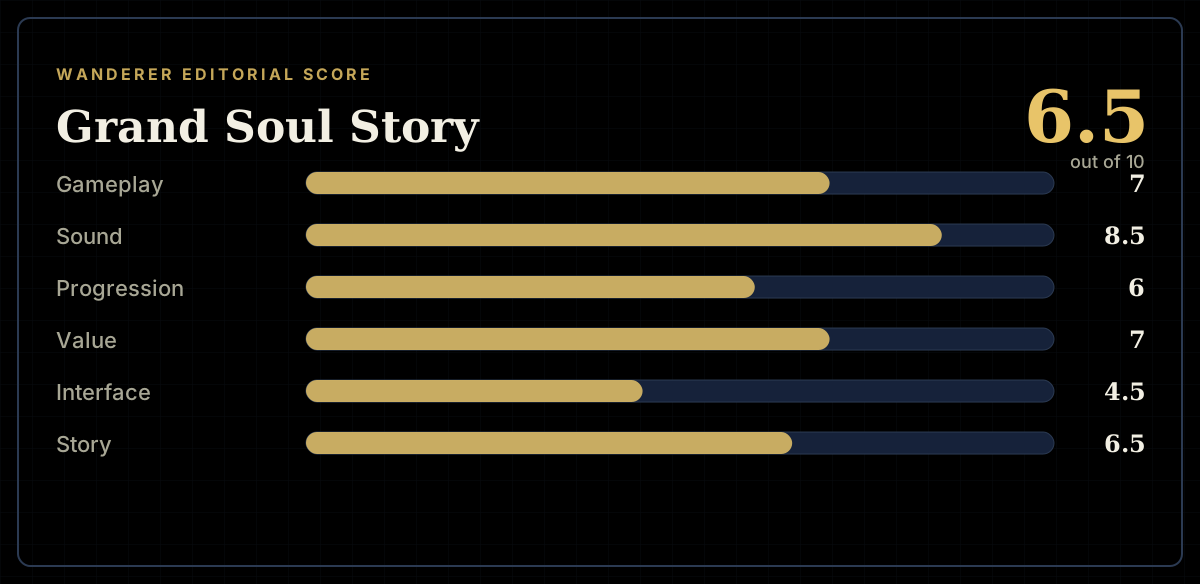
How the review scores each part of the gameWanderer Editorial -
The short versionWanderer Editorial