
Game review
Get To Work
6.5 / 10
- Developer
- Isto Inc.
- Publisher
- Isto Inc.
- Released
- 2 December 2024
- Platforms
- Windows
- Genre
- Foddian rage-platformer
- Monetisation
- One-time purchase, with one paid cosmetic-adjacent DLC pack available
- Players
- Single-player only
The short version
Get To Work asks you to climb a satirical corporate ladder using nothing but rollerblades strapped to your character's arms and feet, narrated by streamer CDawgVA with cameo voice work from a roster of other well-known internet personalities. It's a Foddian "rage game" in the Getting Over It lineage, and reviewers who've played many entries in that specific subgenre consistently rank it among the best, praising a genuinely rewarding momentum-based movement system and sharp, funny writing that elevates it well above a generic difficulty gimmick. Set against that praise is a real, specific, and widely reported set of technical problems: physics glitches that fling the player unpredictably, moving platforms players report phasing through, and — most seriously — an autosave system that a significant number of reviewers say has failed outright, costing them substantial progress in a genre where progress is already hard-won. The developer has patched steadily since launch, including specific performance and stability fixes, but several of the exact bugs quoted here were still being reported well into the game's first year.
Biggest strengths
- The core "Shmoovement" system is repeatedly singled out by genre veterans as genuinely satisfying and well-tuned, with multiple reviewers who've played numerous Foddian games specifically ranking this among the best they've tried
- The narrated, satirical corporate-ladder story draws consistent praise for its writing, humour, and voice cast, elevating the experience well beyond a pure difficulty gimmick for reviewers on both sides of the recommendation line
- A built-in speedrun timer and dedicated developer-run speedrun competitions with announced winners give the game a real, actively supported competitive layer beyond the base campaign
Biggest weaknesses
- A significant number of reviewers report a failed or unreliable autosave system, with at least one describing losing a full hour of hard-won progress and others describing saves that silently overwrite progress with an earlier, worse state
- Physics and collision bugs are widely and specifically reported, including unpredictable ragdolling on landing, random speed-boost variance on certain platform types, and moving platforms that players say they intermittently phase through
- Performance issues including stuttering and frame drops are reported by multiple independent reviewers, several noting the problem is severe enough to disrupt precise jumps mid-attempt regardless of hardware capability
Who it's for: Fans of Getting Over It-style rage/precision platformers who want genuinely rewarding movement mechanics wrapped in sharp comedic writing, and who can tolerate real technical rough edges along the way. Less suited to players who want a technically polished experience free of the risk of losing progress to a bug.
Our recommendation: A genuinely strong pick for fans of the rage-platformer genre specifically, offering more narrative and comedic personality than most of its peers. Save manually and often given the reported autosave issues, and go in aware that physics glitches are a real, documented risk rather than rare bad luck.
6.5 / 10
Get To Work's premise is a joke that could easily have been the whole pitch and nothing else: climb a satirical corporate tower using rollerblades bolted to both your arms and your feet, narrated the whole way by streamer CDawgVA cheering you on through your inevitable, repeated failures. It's squarely a Foddian rage-platformer in the Getting Over It lineage, a genre built almost entirely around the psychological experience of losing hard-fought progress in an instant. What separates this review's sample from a typical entry in that genre is how specific and consistent the praise is for the movement itself, and how equally specific and consistent the complaints are about the technical foundation that movement sits on.
A movement system genre veterans single out
The clearest, most repeated praise in this sample comes from reviewers with real standing to make the comparison. "As a foddian game expert, Get To Work separates itself from the pack with its narrative driven story and VO," one writes, and another goes further: "this is the only 'rage game'/Foddian game that I've ever played that actually feels satisfying to play... Monkeyball meets Getting Over It meets Stanley Parable for the vibes." That's an unusually specific and considered endorsement from someone clearly well-versed in the genre's crowded field of imitators, and it's echoed by others describing the "Shmoovement" system's momentum and risk-reward balance as genuinely well-tuned rather than punishing for its own sake.
Where the technical foundation gives out
Set against that praise, an unusually large and specific cluster of negative reviews describes real, reproducible technical problems rather than simple frustration with difficulty. "The orange moving platforms are super janky and I frequently phased through them... causing literal hours of setbacks," one reviewer writes, and several others separately describe unpredictable ragdolling on landing and random speed-boost variance that can throw a player forward to the finish or backward to the start with no clear pattern. Most seriously, a specific and repeated complaint concerns the save system itself: "game be like 'hey we have auto-saves and checkpoints' and then the game be like 'haha we know we just saved your progress, but go back to this previous section,'" one reviewer writes, describing what reads as a genuine bug in a genre where lost progress is already the entire emotional stakes of play. Losing progress to the genre's intended difficulty is one thing; losing it to a broken save system is a meaningfully different and more legitimate complaint.
A DLC that draws sharp, specific criticism
Beyond the base game, at least one detailed reviewer singles out the paid "Doinkler Portfolio" DLC pack for pointed criticism, stating bluntly that they were "baffled a real human said 'yeah this is good, let's add this to our video game.'" This review can't independently verify the DLC's specific content quality beyond the base game's own store listing, but the specificity of the complaint, paired with achievement data showing DLC-specific challenges sitting at just 0.2% and 1.9% completion, suggests genuinely low engagement with that add-on relative to the base campaign.
A developer that has kept patching, without fully closing the gap
To its credit, this isn't a studio that shipped and walked away. The partner-events feed documents a dense day-one and week-one hotfix cluster, dedicated developer-run speedrun competitions with publicly announced winners through the game's first month, a specific performance-improvement update in January 2025, and continued localisation and stability patches running into 2026. That's a genuinely active, responsive support record. What it hasn't fully resolved, based on the timing of reviews quoted in this sample, is the specific cluster of physics and save-related bugs — several of the most detailed bug reports here were posted well after the initial patch wave, suggesting these are persistent issues rather than simple launch-week teething problems.
What the achievement data confirms about the difficulty
Steam's own completion figures back up just how demanding this game genuinely is, even for a genre defined by demanding play. The core story-completion achievement sits at just 14%, a steep number even accounting for the Foddian genre's inherent selection bias toward players who enjoy repeated failure. That's consistent with the review sample's account of a game whose difficulty is real and uncompromising by design — worth knowing going in, separate entirely from the technical bugs layered on top of it.
A cameo-driven cast that doubles as genuine value
It's worth naming directly what a chunk of this game's charm comes from: a roster of well-known internet personalities lending voices to collectible "Podcast Pickups" scattered throughout the levels, alongside the main CDawgVA narration. Reviewers specifically enjoy discovering these as a secondary collection goal layered on top of the core climb, and at least one jokes about "a photorealistic scan of Atrioc" appearing as an in-game character model. This kind of internet-culture cross-promotion could easily read as a cheap gimmick in a weaker game, but reviewers consistently treat it as a genuine source of delight rather than a distraction, which speaks well of how the writing integrates the cameo cast into the game's actual tone rather than simply name-dropping streamers for attention.
Final verdict
Get To Work earns real, specific praise from genre veterans for a movement system and comedic narrative that genuinely elevate it above the pack of Getting Over It imitators — praise this review found credible and well-supported by detailed, comparative reviewer accounts. But a real, documented cluster of physics glitches and save-system failures sits alongside that praise, and for a genre whose entire appeal rests on the fairness of losing progress through your own mistakes rather than a bug, that's a meaningfully more serious concern than ordinary jank. Recommended for rage-platformer fans specifically, with a clear-eyed expectation that you should save manually and often.
Pros and cons
Pros
- The core "Shmoovement" system is repeatedly singled out by genre veterans as genuinely satisfying and well-tuned, with multiple reviewers who've played numerous Foddian games specifically ranking this among the best they've tried
- The narrated, satirical corporate-ladder story draws consistent praise for its writing, humour, and voice cast, elevating the experience well beyond a pure difficulty gimmick for reviewers on both sides of the recommendation line
- A built-in speedrun timer and dedicated developer-run speedrun competitions with announced winners give the game a real, actively supported competitive layer beyond the base campaign
- A "Give Up" button, letting players voluntarily concede a section at any time, is a specific, thoughtful design choice several reviewers appreciate as a pressure release valve the genre doesn't always offer
- The developer has maintained a steady patch cadence extending well over a year past launch, including specific performance improvement updates, security hotfixes, and continued content in the form of a paid DLC pack and localisation additions
Cons
- A significant number of reviewers report a failed or unreliable autosave system, with at least one describing losing a full hour of hard-won progress and others describing saves that silently overwrite progress with an earlier, worse state
- Physics and collision bugs are widely and specifically reported, including unpredictable ragdolling on landing, random speed-boost variance on certain platform types, and moving platforms that players say they intermittently phase through
- Performance issues including stuttering and frame drops are reported by multiple independent reviewers, several noting the problem is severe enough to disrupt precise jumps mid-attempt regardless of hardware capability
- The paid DLC pack draws sharply negative, specific criticism from at least one reviewer, who describes it as poorly conceived relative to the quality of the base game
- Steam's own achievement data shows a very steep completion curve even by this lane's standards, with the core story-completion achievement sitting at just 14%, indicating a large share of buyers do not finish the base campaign regardless of the genre's inherently high difficulty expectations
Screenshots
-

Get To WorkImage: Isto Inc. via Steam -

Get To WorkImage: Isto Inc. via Steam -

Get To WorkImage: Isto Inc. via Steam -
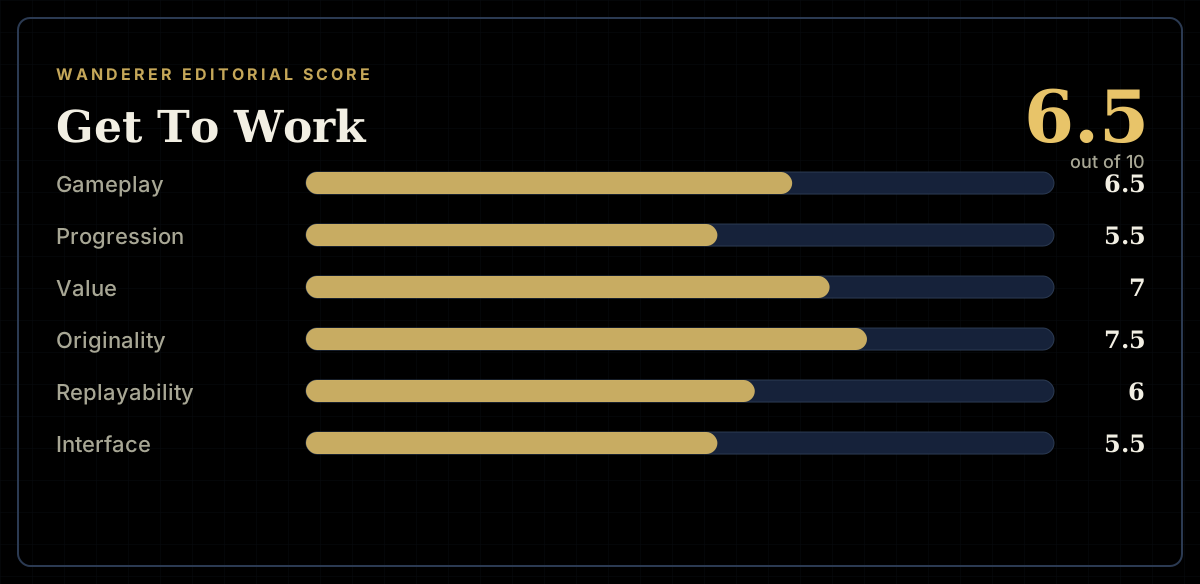
How the review scores each part of the gameWanderer Editorial -
The short versionWanderer Editorial