
Game review
Baby Steps
7 / 10
- Developer
- Gabe Cuzzillo, Maxi Boch, Bennett Foddy
- Publisher
- Devolver Digital
- Released
- 23 September 2025
- Platforms
- Windows
- Genre
- Physics, Walking Simulator, Comedy
- Monetisation
- One-time purchase, no DLC or in-game currency
- Players
- Single-player
The short version
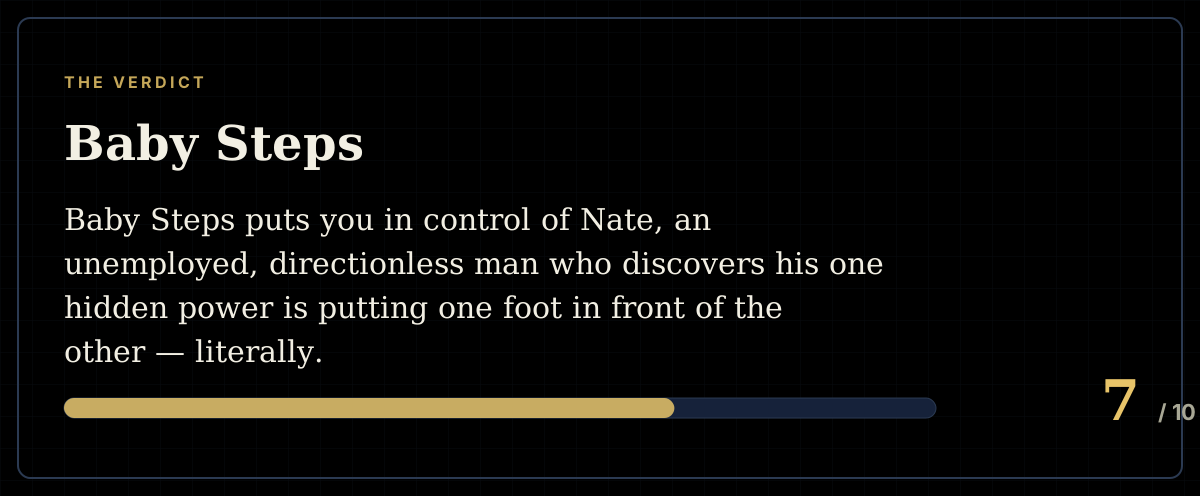
Baby Steps puts you in control of Nate, an unemployed, directionless man who discovers his one hidden power is putting one foot in front of the other — literally. Every step up a mist-shrouded, mountain-sized mountain is manually placed by the player, with fully-simulated physics governing balance, momentum and the many, many ways a climb can go wrong at the worst possible moment. It's from Bennett Foddy, the mind behind Getting Over It with Bennett Foddy, working alongside Gabe Cuzzillo and Maxi Boch, and the reception follows a strikingly similar pattern to that earlier cult classic: reviewers who describe genuine hatred for the experience — for the developers, for themselves for playing it — recommend it anyway, treating the frustration as the entire point rather than a flaw to forgive. A smaller, more conventional set of complaints concerns the soundtrack and reported stuttering that undermines the precision the core mechanic demands.
Biggest strengths
- The core walking mechanic is widely praised as clever and meticulously designed, with fully-simulated physics governing every footstep in a way reviewers say genuinely earns comparisons to Foddy's earlier work rather than repeating it
- The game's comedic tone and absurdist premise land well for a large share of reviewers, with the dynamic between Nate's aimless characterisation and the punishing mechanics drawing specific praise for tonal consistency
- Multiple reviewers describe the experience as more genuinely entertaining to watch and discuss afterward than almost any other "rage game," crediting the specific, replayable failure states with real comedic and social value
Biggest weaknesses
- Multiple reviewers report the game feels deliberately designed to maximise frustration, describing physically raised blood pressure and hand strain, and specifically call out failure states engineered to occur right after a long, successful stretch of progress
- The soundtrack draws unusually pointed criticism from reviewers who otherwise enjoyed the game, with one describing it as sounding like a five-year-old was allowed to compose and edit it, severe enough on its own to tip at least one enthusiastic player toward a negative recommendation
- Reported stuttering and performance inconsistency are a real, repeated complaint given how much the core mechanic depends on precise, predictable footing — several reviewers say technical hitches directly caused otherwise avoidable falls
Who it's for: Fans of Bennett Foddy's earlier deliberately-frustrating physics games, or anyone specifically drawn to comedic "rage game" design where failure and backtracking are the entire experience rather than an obstacle to a smoother one. Explicitly not for players who want conventional challenge-and-reward progression, or anyone likely to find intentionally obtuse controls more infuriating than funny.
Our recommendation: A genre-defining experience worth playing specifically because of, not despite, how deliberately frustrating it is — but know exactly what you're buying going in, since this is designed to test patience as its core feature, and the small but real technical and audio complaints below are worth weighing if precision and immersion matter to you.
7 / 10
Learning to walk, on purpose, badly
Baby Steps' premise is almost aggressively simple: you play Nate, a directionless, unemployed man who discovers his singular hidden talent is putting one foot in front of the other, and you spend the entire game manually placing each of those footsteps up a mist-shrouded, mountain-sized mountain. Fully-simulated physics govern balance and momentum at every step, meaning a small misjudgement can send you sliding, tumbling or falling back down ground you'd spent real time earning. That's the whole game, by design, from Bennett Foddy — the developer behind the notorious Getting Over It with Bennett Foddy — working alongside Gabe Cuzzillo and Maxi Boch.
A very familiar kind of love-hate
The reception follows a pattern anyone familiar with Foddy's earlier work will recognise instantly. Reviewers describe genuine, visceral frustration — one reports the game "raising my blood pressure, hurting my hands," accusing the developers of designing failure states specifically engineered to strike right after a long stretch of hard-won progress. Another states plainly: "I hate this game. I hate the developers for making it. If you like this game, I hate you too. I hate myself for wasting time trying to play it," before still marking the review as a recommendation, with the deadpan coda "game is working as intended." That's not an isolated joke — it's the dominant emotional register of the entire positive side of the corpus, treating the frustration itself as the actual product rather than an unfortunate side effect of otherwise-good design. One reviewer sums up the appeal about as concisely as possible: "story is stupid gameplay is stupid controls are stupid protagonist is stupid cutscenes are massively stupid the game is perfect."
The complaints that aren't part of the joke
Set apart from that intentional frustration are a smaller number of complaints reviewers treat as genuine flaws rather than features. The soundtrack draws unusually pointed criticism — one reviewer who otherwise found the game funny and enjoyable specifically blames the music for tipping their overall verdict negative, comparing it unfavourably to a small child let loose with editing software. Reported stuttering and performance inconsistency matter more here than in most games, given how entirely the core mechanic depends on precise, predictable footing; several reviewers specifically describe technical hitches causing falls that had nothing to do with genuine misjudgement on their part. A related structural complaint concerns recovery pacing: more than one reviewer describes long, uneventful walks back to a previous position after a fall, with nothing new to see or do along the way, turning what should be tense backtracking into simple tedium.
A more skeptical reading, raised by several reviewers, questions who the game is really built for. More than one argues Baby Steps is "made for streamers to get mad over" rather than for personal, private enjoyment, framing its appeal as spectator content first and a satisfying solo experience second. That's a fair critique of the broader "rage game" subgenre Foddy helped define, and it's worth weighing honestly rather than assuming everyone drawn in by clips of someone else's frustration will enjoy generating their own.
More than a climb
Beneath the punishing traversal, the game's own feature list leans hard into its self-aware, absurdist tone: a "fully dynamic onesie soilage system" tracks the state of Nate's jumpsuit as he stumbles through mud and worse, a dynamic soundtrack built from hundreds of separate musical stings reacts to the terrain and your progress, and non-collectible hats sit somewhere between a joke and a genuine reward for exploring off the beaten path. Reviewers who engage with the wider world beyond the central climb describe genuine affection for the local fauna and environmental storytelling scattered through the mist, treating the mountain less as a single obstacle course and more as a place worth actually looking at between falls — a tonal balance that helps explain why so many reviewers can describe active hatred for the mechanics while still recommending the overall experience.
Optional difficulty, by design
One detail worth drawing out from the corpus is that Baby Steps doesn't force every player through its hardest sections. At least one detailed reviewer specifically credits the level design for offering genuinely safer, easier paths up the mountain alongside harder, more direct routes that reward the attempt with better views, hats or shortcuts rather than punishing failure to attempt them at all. Bennett Foddy has described this design intent directly: a set of achievable, relatively safe paths that the game constantly tempts players away from toward something harder and more optional. That's a meaningfully different structure from a game that simply gates progress behind mandatory difficulty spikes, and it gives Baby Steps more in common with an open, exploratory mountain than a linear gauntlet, even though the reputation the game has earned focuses almost entirely on the latter.
The verdict
Baby Steps succeeds at being exactly what it sets out to be: a meticulously designed, deliberately maddening physics game that turns walking itself into the entire challenge, wrapped in a self-aware, absurdist comedy that a large share of reviewers say earns its place alongside Foddy's earlier cult classic. The soundtrack and performance complaints are real and worth knowing about, and the "built for content, not players" critique deserves genuine consideration rather than dismissal. But for players who already know they enjoy this specific, uncomfortable genre — or are curious enough to find out — this is a confident, singular experience unlike almost anything else currently on Steam.
Pros and cons
Pros
- The core walking mechanic is widely praised as clever and meticulously designed, with fully-simulated physics governing every footstep in a way reviewers say genuinely earns comparisons to Foddy's earlier work rather than repeating it
- The game's comedic tone and absurdist premise land well for a large share of reviewers, with the dynamic between Nate's aimless characterisation and the punishing mechanics drawing specific praise for tonal consistency
- Multiple reviewers describe the experience as more genuinely entertaining to watch and discuss afterward than almost any other "rage game," crediting the specific, replayable failure states with real comedic and social value
- At least one detailed reviewer specifically credits the exploration design for offering meaningful optional risk — safer, easier paths exist alongside harder, more rewarding ones — giving the climb real decision-making depth beneath the frustration
- The love-hate reception itself is treated by many reviewers as a feature rather than a flaw, following the same pattern that made Getting Over It a cultural touchstone rather than simply another difficult game
Cons
- Multiple reviewers report the game feels deliberately designed to maximise frustration, describing physically raised blood pressure and hand strain, and specifically call out failure states engineered to occur right after a long, successful stretch of progress
- The soundtrack draws unusually pointed criticism from reviewers who otherwise enjoyed the game, with one describing it as sounding like a five-year-old was allowed to compose and edit it, severe enough on its own to tip at least one enthusiastic player toward a negative recommendation
- Reported stuttering and performance inconsistency are a real, repeated complaint given how much the core mechanic depends on precise, predictable footing — several reviewers say technical hitches directly caused otherwise avoidable falls
- A recurring structural complaint describes the recovery process after a fall as tedious rather than challenging, with some reviewers reporting ten or more minutes of uneventful walking just to return to a previous position with nothing new to see or do along the way
- Several reviewers explicitly frame the game as content built for streamers and YouTubers to react to rather than a satisfying experience to actually play, arguing its appeal is more about spectacle than personal engagement for viewers watching rather than playing themselves
Screenshots
-

Baby StepsImage: Devolver Digital via Steam -

Baby StepsImage: Devolver Digital via Steam -

Baby StepsImage: Devolver Digital via Steam -
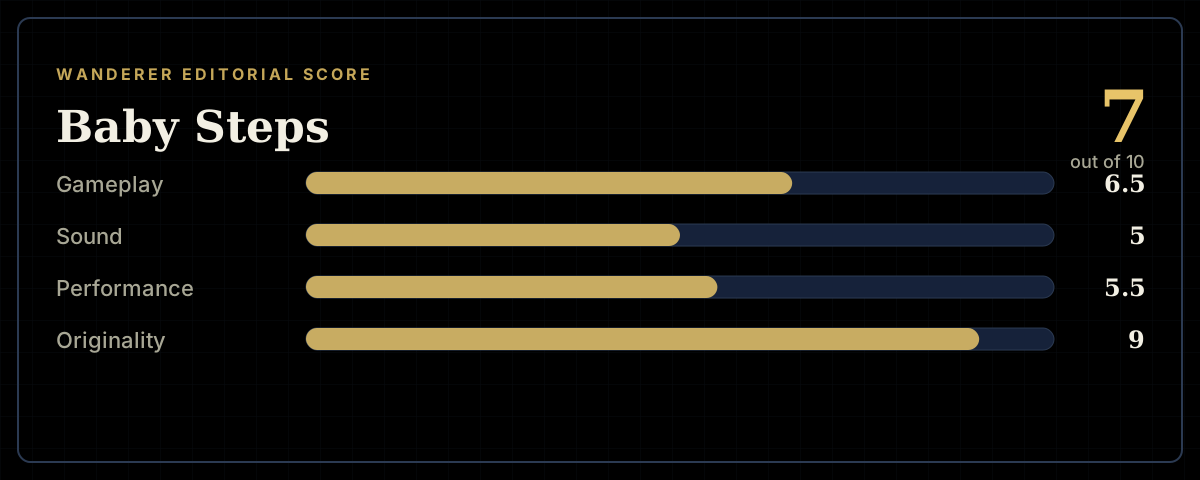
How the review scores each part of the gameWanderer Editorial -
The short versionWanderer Editorial