
Game review
Date Everything!
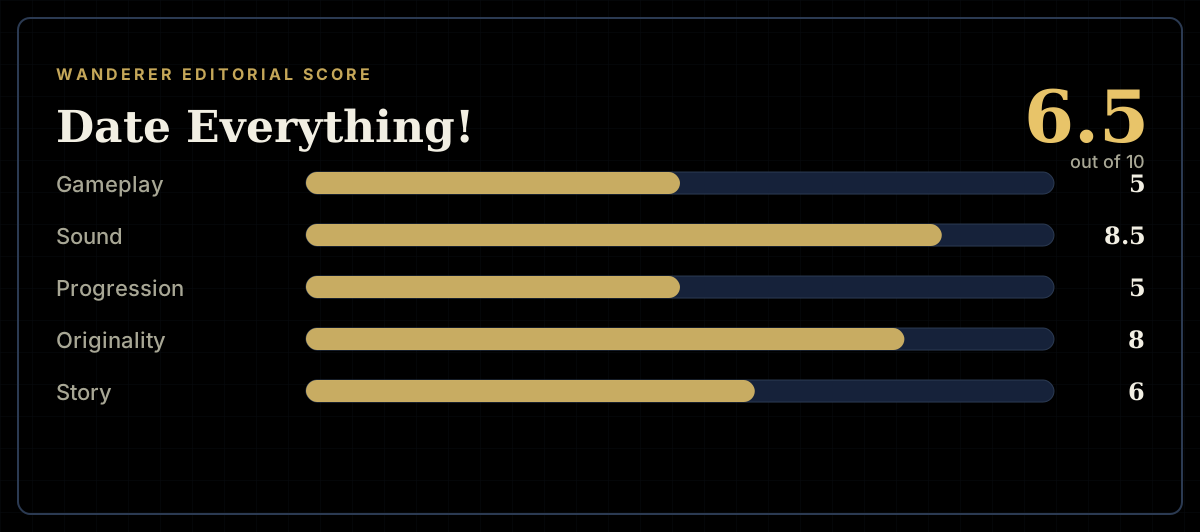
6.5 / 10
- Developer
- Sassy Chap Games
- Publisher
- Team17
- Released
- 17 June 2025
- Platforms
- Windows
- Genre
- Dating Sim, Comedy, Visual Novel
- Monetisation
- One-time purchase, optional DLC
- Players
- Single-player
The short version
Date Everything! commits fully to a premise that could easily have been a one-joke gimmick: magical glasses called Dateviators bring your entire house to life, turning your bed, your smoke alarm and 99 other household objects into fully voice-acted potential lovers, friends or enemies. Reviewers are genuinely won over by the scale of the voice-acting achievement — describing it as a love letter to the craft — and the game's willingness to swing between silly and surprisingly serious writing draws real praise. Set against that is a large, detailed share of the same review corpus arguing the actual "dating sim" mechanics don't hold up to the premise's ambition: many relationships feel more like speed dating than genuine courtship, correct dialogue choices are often unintuitive enough that reviewers report needing outside guides, and an advertised "make enemies" option is reported not to function as described. A further, more serious complaint from at least one long-term player concerns bugs and softlocks still present roughly a year after launch with no recent fix.
Biggest strengths
- The scale and quality of voice acting across 100 distinct characters draws exceptional, specific praise, with reviewers describing the game as a genuine celebration of voice performers rather than a gimmick that wears thin after the first few characters
- The writing's willingness to swing between genuinely silly comedy and surprisingly serious character moments earns real credit, with several reviewers noting individual character arcs land with more emotional weight than the absurdist premise would suggest
- Built-in content warnings are specifically praised by at least one reviewer as a thoughtful, player-respecting touch given how widely the tone and subject matter can swing between different characters
Biggest weaknesses
- A large, detailed share of reviewers argue the actual dating mechanics feel more like speed dating than a genuine dating sim, with limited meaningful character development within any individual relationship before it resolves
- Multiple reviewers independently report needing to consult outside guides to navigate dialogue choices correctly, since "wrong" answers can cause characters to dislike you in ways the game doesn't clearly telegraph in advance
- The advertised ability to deliberately befriend or antagonise characters you dislike is reported by multiple reviewers not to function as described, with attempts to build an "enemies" relationship failing to work the way the marketing implies
Who it's for: Players drawn specifically to the absurdist premise and genuinely impressive voice-acting scale, who want a low-stakes, casual dating sim experience without deep relationship-building systems. Less of a fit for dating-sim genre veterans who specifically want the save-scumming, relationship-optimising depth the genre is traditionally built around.
Our recommendation: Worth it at a discount for the novelty and voice performances alone, but go in with modest expectations for the actual dating mechanics, and check recent patch notes for outstanding bugs before committing serious time, given at least one long-term player reports persistent unaddressed issues well after launch.
6.5 / 10
Falling in love with your smoke alarm
Date Everything!'s premise sounds like a punchline until you see how thoroughly it's executed: a pair of magical glasses called Dateviators bring your entire house to life, and every single object in it — your bed, your toilet, your smoke alarm, all the way up to a full roster of 100 — becomes a fully voice-acted character with their own personality, story, and potential to become a lover, friend or enemy. Reviewers who go in expecting a shallow, one-joke gimmick consistently report being won over by just how much genuine writing and performance went into pulling it off. One reviewer frames the achievement precisely: "A love letter to voice actors, that's all the reason I needed," crediting the game with reminding players how much a strong vocal performance can carry a character regardless of how absurd the premise wrapping them is.
When speed dating isn't quite dating
Set against that genuine achievement is a large, detailed thread of criticism about the actual dating-sim mechanics underneath the premise. Multiple reviewers describe individual relationships as feeling more like speed dating than a genuine courtship — brief, surface-level interactions that resolve before any real character development has a chance to land. One reviewer states the distinction directly: "This isn't a dating sim. This feels like speed dating." Compounding that, several reviewers independently report needing to consult outside guides to navigate dialogue choices correctly, since incorrect answers can cause a character to turn hostile in ways the game doesn't clearly signal in advance — a frustrating experience for a genre that usually rewards intuitive, personality-driven choices rather than trial-and-error memorisation.
A specific, advertised feature draws particular pushback: the game's marketing promises you can deliberately befriend or antagonise characters you don't want to romance, but multiple reviewers report this "make enemies" option simply doesn't function as described, undercutting one of the premise's more interesting promised freedoms.
Not every character gets equal love
A more subtle but specific criticism concerns how evenly that writing investment is distributed across the full 100-character roster. At least one detailed reviewer argues certain characters receive noticeably more narrative weight and polish than others, and connects that imbalance directly to which voice actors are more prominent or popular — a pattern that, if accurate, suggests some character arcs may have been prioritised for reasons outside the story's own internal logic. That's a specific, checkable claim about content distribution rather than a vague quality complaint, and it's worth knowing before assuming every one of the 100 advertised characters received equal care.
Bugs a year later
The most serious complaint in the corpus comes from a long-term player who reports bugs and softlocks present since launch remaining unaddressed roughly a year afterward, with the game's last substantial patch fixing major issues arriving well before the time of their review. That reviewer specifically states they enjoyed the game but can no longer recommend it in its current, seemingly under-supported state — a meaningfully different concern from ordinary launch-week rough edges, since it suggests active development may have slowed or stopped while known issues remain live for new buyers.
A viral hook, and the weight it carries
Part of what makes Date Everything!'s reception worth examining closely is how much hype preceded it. Multiple reviewers specifically describe going in with high expectations built from pre-release buzz around the concept, and several frame their disappointment explicitly in those terms — not that the game is bad in isolation, but that it doesn't match the bar their own anticipation set. One reviewer captures this directly: "I was incredibly hyped for the game, and I want to be the biggest fan!" before laying out a detailed list of caveats alongside their recommendation. That's a useful frame for a prospective buyer coming to the game today, well after its initial viral moment: judging it on its actual mechanical substance, rather than the premise's internet-native appeal, is likely to produce a more measured impression than the game's initial buzz cycle did.
Sandbox freedom, genre expectations
Some of the disagreement in the corpus traces back to a genuine mismatch between what "dating sim" implies to genre veterans and what Date Everything! actually delivers. Traditional dating sims typically reward extended relationship-building, meaningful stat management and replay-driven optimisation; Date Everything!'s sandbox structure instead offers a wide buffet of short, largely self-contained character stories to sample. Reviewers who came in wanting the former report disappointment with the latter, while reviewers who embraced the anthology-style structure — treating each object's storyline as its own bite-sized vignette rather than a slow-burn romance — report considerably more satisfaction. Neither reading is wrong exactly; they reflect two different expectations for what a 100-character dating game should actually be.
The verdict
Date Everything! succeeds spectacularly at the specific thing it set out to prove — that even a smoke alarm can be a compelling romantic lead with the right writing and voice performance behind it — and that achievement earns real, warranted praise. Where it falls short for a large, detailed share of its own audience is in the mechanical substance underneath that premise: shallow relationship progression, guide-dependent dialogue, a non-functional advertised feature, and, more seriously, a report of unresolved bugs well into the game's second year. At a discount, the novelty and voice acting alone justify the purchase; at full price, weigh those persistent complaints carefully before committing, and go in expecting a wide buffet of short, self-contained vignettes rather than a slow-burn genre romance if you want your expectations to match what's actually on offer.
Pros and cons
Pros
- The scale and quality of voice acting across 100 distinct characters draws exceptional, specific praise, with reviewers describing the game as a genuine celebration of voice performers rather than a gimmick that wears thin after the first few characters
- The writing's willingness to swing between genuinely silly comedy and surprisingly serious character moments earns real credit, with several reviewers noting individual character arcs land with more emotional weight than the absurdist premise would suggest
- Built-in content warnings are specifically praised by at least one reviewer as a thoughtful, player-respecting touch given how widely the tone and subject matter can swing between different characters
- At least one reviewer frames the low-stakes, no-save-scumming structure as a genuine refreshing change from more traditional dating sims that demand repeated optimisation to "correctly" romance a character, appreciating the ability to just enjoy a single story per character
- The sandbox structure and sheer character variety mean there's genuinely something for a wide range of tastes and senses of humour within the same purchase, letting different players gravitate toward entirely different favourite storylines
Cons
- A large, detailed share of reviewers argue the actual dating mechanics feel more like speed dating than a genuine dating sim, with limited meaningful character development within any individual relationship before it resolves
- Multiple reviewers independently report needing to consult outside guides to navigate dialogue choices correctly, since "wrong" answers can cause characters to dislike you in ways the game doesn't clearly telegraph in advance
- The advertised ability to deliberately befriend or antagonise characters you dislike is reported by multiple reviewers not to function as described, with attempts to build an "enemies" relationship failing to work the way the marketing implies
- At least one reviewer identifies a specific quality-of-content imbalance, arguing certain characters receive noticeably more writing investment and narrative weight than others, correlating with which voice actors are more prominent or popular rather than any in-universe logic
- A long-term reviewer reports bugs and softlocks present since launch remaining unaddressed roughly a year later, with the last substantial patch fixing major issues arriving well before the time of their review — a serious concern for a full-price release still being actively recommended to new buyers
Screenshots
-

Date Everything!Image: Team17 via Steam -

Date Everything!Image: Team17 via Steam -

Date Everything!Image: Team17 via Steam -
How the review scores each part of the gameWanderer Editorial -
The short versionWanderer Editorial