
Game review
Bionic Bay
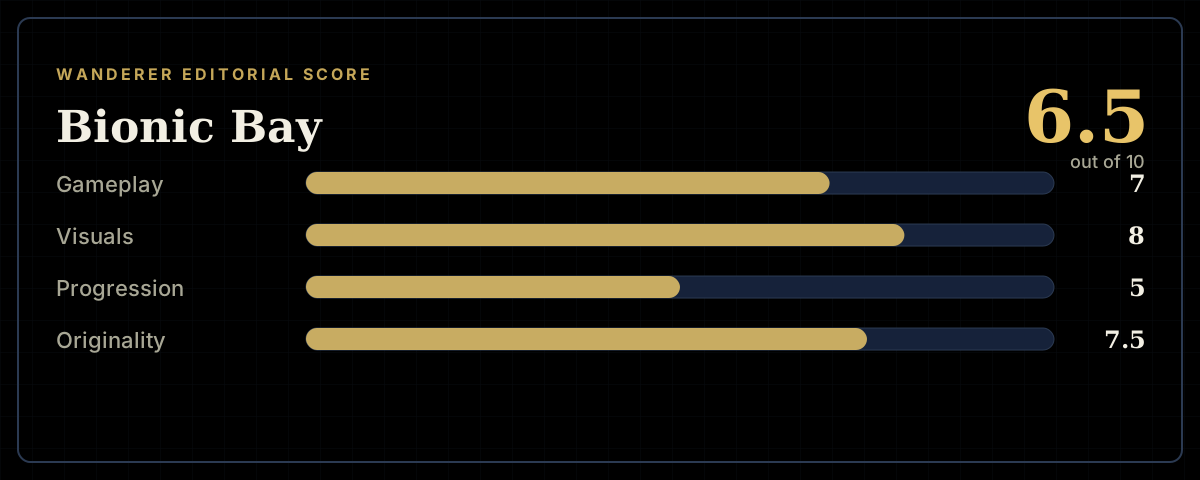
6.5 / 10
- Developer
- Psychoflow Studio, Mureena Oy
- Publisher
- Kepler Interactive
- Released
- 16 April 2025
- Platforms
- Windows
- Genre
- Puzzle Platformer, Physics
- Monetisation
- One-time purchase, no DLC or in-game currency
- Players
- Single-player with optional online speedrunning leaderboards
The short version
Bionic Bay drops a stranded scientist into a decaying biomechanical world armed with a teleportation instrument that swaps their position with nearby objects, gravity and all — freezing, burning, exploding or vaporising along the way through a gritty, high-density pixel-art landscape with sound design several reviewers compare to their first time playing Half-Life. The swap mechanic and its physics interactions are genuinely inventive, and the opening hours draw constant, earned comparisons to Limbo and Inside for atmosphere and momentum. What a large and independently-corroborated share of the game's own admirers say happens next is the real story: the same core skills get tested repeatedly across a six-to-ten-hour runtime without enough new ideas introduced to justify the length, turning what several reviewers separately describe as a perfect two-hour concept into an exhausting slog by the end.
Biggest strengths
- The core swap mechanic — exchanging positions with objects, enemies and even gravity itself — is repeatedly praised as genuinely inventive, giving physics-based platforming and combat encounters a distinctive identity beyond typical genre templates
- Sound design and atmosphere draw exceptional, specific praise, with one reviewer directly comparing the feeling of first entering the world to playing Half-Life for the first time
- The high-density pixel art and biome variety are consistently singled out as some of the strongest visual work in the genre, with reviewers describing individual scenes that "look like a painting"
Biggest weaknesses
- An unusually large and independently corroborated share of reviewers describe the game's central problem identically: a brilliant two-hour opening concept stretched across six to ten hours without introducing enough new mechanical ideas to sustain that length, testing the same core skills repeatedly rather than building meaningfully on them
- Multiple reviewers specifically contrast this unfavourably with genre touchstones Limbo and Inside, arguing those games introduced new ideas at a much steadier pace across a similar or shorter runtime rather than repeating established mechanics
- At least one reviewer reports the game inexplicably removing access to previously-unlocked mechanical elements at points, seemingly at random, undercutting the sense of steadily accumulating tools that the swap system's introduction promises
Who it's for: Physics-puzzle-platformer fans who specifically want Limbo/Inside-style atmosphere paired with a genuinely novel swap mechanic, and who are comfortable with a game that front-loads its best ideas rather than escalating them steadily. Less of a fit for anyone who needs constant new mechanical wrinkles to stay engaged across a longer campaign, or players sensitive to precise, occasionally trial-and-error platforming sections.
Our recommendation: Worth it at a discount for the opening hours and the swap mechanic's genuine inventiveness alone — just calibrate expectations for the back half, which an unusually large and consistent share of the game's own fans say overstays its welcome well before the credits roll.
6.5 / 10
A swap mechanic worth building a game around
Bionic Bay's central idea is the kind of clean, elegant concept genre fans immediately recognise as special: a teleportation instrument lets your stranded scientist swap positions with nearby objects, enemies, and even gravity itself, transforming physics-based platforming into a puzzle about what to trade places with and when. Combined with a genuinely reactive physics system — fire spreads, objects shatter, gravity redirects — the swap mechanic gives combat encounters and traversal puzzles alike a distinctive identity that reviewers consistently praise as inventive rather than derivative. The atmosphere carries real weight too: high-density pixel art renders a decaying biomechanical world with enough visual density that one reviewer describes individual scenes looking "like a painting," and the sound design draws an unusually strong compliment — a reviewer comparing their first encounter with the world's atmosphere to playing Half-Life for the first time.
When two hours becomes ten
The dominant story running through Bionic Bay's review corpus, though, isn't about what the game does well — it's about how much of the game there is relative to how many ideas it actually has. An unusually large number of reviewers, writing independently and reaching for near-identical language, describe a brilliant opening concept — several specifically estimate around two hours — stretched across a much longer six-to-ten-hour campaign without introducing enough new mechanical wrinkles to justify the added length. One reviewer's framing captures the pattern memorably: "a great two-hour concept bloated into an exhausting eight-hour slog." Multiple reviewers make the comparison to genre touchstones explicit, arguing Limbo and Inside — the games Bionic Bay most obviously draws from — introduced new ideas at a steadier pace across similar or shorter total runtimes, while Bionic Bay tests the same core skills repeatedly rather than building meaningfully on them level after level.
That's not a minority complaint from players who bounced off the concept early — it recurs across reviewers who otherwise rate the game highly, including several who specifically say they're glad they played it while still wishing, by the end, that it had wrapped up sooner. One particularly candid review frames the tension precisely: the underlying engine has "the most potential I have ever seen," with buttery-smooth movement and effortless-feeling mechanics, but the game "refuses to go beyond the surface of what it can achieve" across its full length.
What the achievement data confirms
Steam's own global achievement statistics back up the pattern independently of any single review. Early achievements — the kind unlocked within the first hour or two — sit at 85 to 96% of the playerbase, but achievements tied to full game completion fall to just 0.5%. That's an exceptionally steep drop-off even by the standards of a genre where many players never finish a given title, and it lines up precisely with the widespread reviewer account of a game whose middle and late stretches lose a large share of the audience that loved its opening.
A second life for speedrunners
Beyond the single-player campaign, Bionic Bay's online mode gives the game a genuinely separate reason to stick around for a specific audience: timed races against other players' ghost runs, leaderboards, and a character customisation system for staying recognisable while competing. The store page describes this mode receiving regular new events, and the swap mechanic's precision and speed potential make it a natural fit for the kind of frame-perfect optimisation speedrunning communities build around. None of the reviews sampled for this piece dwell on the online mode at length — the overwhelming focus, on both sides of the recommendation, is the single-player campaign's pacing — but its existence is worth noting as a separate value proposition for players specifically drawn to competitive time-attack play rather than narrative-driven exploration.
The game comes from a two-studio partnership: Finnish solo developer Juhana Myllys, credited with art and design and previous indie work, paired with a separate development studio handling engineering. That structure is consistent with the reviewer observation that the underlying engine and physics system feel unusually accomplished for the studio's scale — the foundational technical work is clearly the product of real specialised expertise, even where reviewers feel the content built on top of it runs thinner than the engine's apparent ceiling.
The verdict
Bionic Bay's swap mechanic and opening hours are genuinely special, and the atmosphere, art and sound design earn comparisons to some of the puzzle-platformer genre's most respected touchstones. Where it falls short, according to an unusually large and consistent share of its own fans, is pacing: six to ten hours of content built from ideas that comfortably support about two. At its current discounted price, that's an easy recommendation for the opening stretch alone — just go in prepared to recognise when the game has shown you everything it has to offer, and don't feel obligated to push through to the very end if the repetition starts to wear thin, since the achievement data suggests most players who love this game don't actually finish it either. For speedrunners specifically, the online mode's ghost races and regular events offer a separate, ongoing reason to stay engaged well past the point where the single-player campaign's pacing problems would otherwise send most players toward the exit — a genuine second act that the base campaign's own reviewers rarely mention, but one well worth knowing about if competitive time-attack play is part of what you're specifically looking for here.
Pros and cons
Pros
- The core swap mechanic — exchanging positions with objects, enemies and even gravity itself — is repeatedly praised as genuinely inventive, giving physics-based platforming and combat encounters a distinctive identity beyond typical genre templates
- Sound design and atmosphere draw exceptional, specific praise, with one reviewer directly comparing the feeling of first entering the world to playing Half-Life for the first time
- The high-density pixel art and biome variety are consistently singled out as some of the strongest visual work in the genre, with reviewers describing individual scenes that "look like a painting"
- An online mode with timed ghost races against other players' best runs and regularly updated events gives dedicated speedrunners a genuine long-tail reason to keep returning after the campaign ends
- Death carries minimal punishment in terms of lost progress according to multiple reviewers, keeping the challenging, precision-platforming sections from feeling unfairly punishing outside of specific late-game exceptions
Cons
- An unusually large and independently corroborated share of reviewers describe the game's central problem identically: a brilliant two-hour opening concept stretched across six to ten hours without introducing enough new mechanical ideas to sustain that length, testing the same core skills repeatedly rather than building meaningfully on them
- Multiple reviewers specifically contrast this unfavourably with genre touchstones Limbo and Inside, arguing those games introduced new ideas at a much steadier pace across a similar or shorter runtime rather than repeating established mechanics
- At least one reviewer reports the game inexplicably removing access to previously-unlocked mechanical elements at points, seemingly at random, undercutting the sense of steadily accumulating tools that the swap system's introduction promises
- Precision platforming sections involving exact timing or pixel-perfect jumps draw specific frustration from multiple reviewers, with the difficulty spike in these sections contrasted against an otherwise smoother difficulty curve elsewhere
- Global achievement data shows an extremely steep completion cliff: early achievements clear at 85-96%, while full-game-completion achievements sit at just 0.5%, strongly corroborating widespread reviewer reports that a large share of players who start the game don't finish it
Screenshots
-

Bionic BayImage: Kepler Interactive via Steam -

Bionic BayImage: Kepler Interactive via Steam -

Bionic BayImage: Kepler Interactive via Steam -
How the review scores each part of the gameWanderer Editorial -
The short versionWanderer Editorial