
Game review
.Forty-Five
6 / 10
- Developer
- Microwave Studios
- Publisher
- Microwave Studios
- Released
- 24 March 2024
- Platforms
- Windows
- Genre
- Wild-west card-battler roguelite
- Monetisation
- Free, no in-game purchases or advertising of any kind
- Players
- Single-player only
The short version
.Forty-Five takes the Slay the Spire deckbuilding template and reworks it around a genuinely clever central hook: instead of a normal hand of cards, you load bullets with distinct effects into a six-chamber revolver, managing rotation and limited capacity as its own layer of strategy. Reviewers consistently praise that hook, the hand-drawn art, and the fact that all of it costs nothing and carries no ads or microtransactions at all — a detail a striking number of reviewers single out with genuine disbelief. Set against that goodwill is a real, repeated set of technical and balance complaints: frequent crashes, at least one save-corrupting bug that wipes a player's unlocked bullets, and an early difficulty curve several reviewers call disproportionate for a game still finding its footing. The developer supported the game with weekly updates for its first few months, tapering to occasional community events through 2025, before announcing a full successor, ".Forty-Five: Reloaded," in 2026 — suggesting this specific version has now reached the end of its active development road.
Biggest strengths
- The revolver-loading mechanic is repeatedly singled out as a genuinely fresh twist on the deckbuilding roguelite formula, with reviewers specifically praising how managing chamber rotation and limited capacity adds a layer of strategy beyond a typical card hand
- Hand-drawn art and a strong western atmosphere draw consistent praise, with several reviewers describing the presentation as well above what they expected from a free release
- Being completely free with no microtransactions, no ads, and an open-source license is one of the most repeated points of genuine surprise and goodwill across the review sample, with multiple reviewers stating outright they wished they could pay for it
Biggest weaknesses
- Crashes are the single most repeated technical complaint, with multiple independent reviewers reporting the game crashing every few minutes during otherwise enjoyable sessions
- At least two reviewers report a specific, serious bug where loading a save corrupts or erases previously unlocked bullets, in one case wiping an entire collection built up over a run
- Several reviewers describe the early-game difficulty as disproportionate, citing enemies with around 110 health appearing very early against a starting deck that deals single-digit damage per hit, creating a punishing wall before the game's stated strategic depth has a chance to click
Who it's for: Fans of roguelite deckbuilders who want a free, mechanically inventive card-battler with a fun western hook and don't mind rough technical edges, crashes, and a punishing opening stretch. Less suited to players who want a fully polished, crash-free experience out of the box.
Our recommendation: An easy recommendation at its price of exactly nothing, provided you go in tolerant of crashes and a steep early difficulty spike. If a smoother, more actively developed version of the same idea matters more to you, the announced "Reloaded" successor may be the better place to start once it arrives.
6 / 10
Free, open-source deckbuilding roguelites aren't a common combination, and .Forty-Five leans into that novelty from the moment you load it up: a hand-drawn western world, a revolver instead of a normal card hand, and not a single microtransaction, advertisement, or price tag anywhere in sight. That last detail alone drives a remarkable share of the review sample's enthusiasm — reviewers repeatedly express genuine disbelief that something this well-made costs nothing, several explicitly saying they wish there were a way to pay for it. Underneath that goodwill, though, sits a game still working through real crashes, a punishing early difficulty spike, and a support timeline that suggests its active development window may already be behind it.
A genuinely clever twist on a familiar formula
The Slay the Spire-style card-battler roguelite is a crowded genre by now, and .Forty-Five earns its comparisons to that game honestly while doing something distinct with the format. Instead of drawing a hand of cards each turn, you load bullets — each with a unique effect — into a six-chamber revolver, meaning capacity, rotation order, and reload timing all become tactical considerations in their own right. "The unique revolver mechanics and bullet synergies are a breath of fresh air," one reviewer writes, and a more experienced deckbuilder fan goes further: "this game has layers upon layers of strategy," praising the story and artwork alongside the mechanical hook. That praise is echoed closely enough across the sample that it reads as a genuinely successful piece of design, not just a reskin of an existing genre with a cowboy hat on top.
Real, repeated technical problems
Set against that praise is a consistent, specific run of technical complaints. "It crashes too much dude... I am not gonna be like 'duhhh I want my money back' for a free game but only reason I am unrecommending it is because its making me work to play it," one reviewer writes, and the sentiment repeats across multiple independent accounts of crashes occurring every few minutes. More seriously, at least two reviewers describe a specific save-corruption bug: one reports that "bullets break" on loading a save, rendering runs unplayable, while another states plainly they "lost all saved bullets after run ended due to bug." These aren't vague performance gripes — they're specific, reproducible-sounding failures that strike directly at player progress, and their repetition across independent reviewers suggests real, unresolved issues rather than isolated hardware problems.
A difficulty curve several reviewers call unfair, not just hard
A second cluster of complaints concerns balance, specifically in the game's early stretch. Multiple reviewers cite the same concrete detail: enemies with roughly 110 health appearing very early in a run, against a starting deck dealing single-digit damage per hit. "After killing two 110 health enemies with attacks that do about 8 damage is extremely tiring," one reviewer writes, and another frames the deeper structural issue behind that number: too few cards drawn per turn and almost no card-draw effects to compensate, unlike the genre's established fundamentals. "There is an extremely good reason most roguelike deck builders have FIVE cards drawn at the start of each turn and not two," one detailed review argues, treating this as a design gap rather than simply a difficulty preference — a specific, testable claim that's hard to dismiss given how many separate reviewers land on some version of the same math.
Real support, for a while
To the developer's credit, the partner-events feed confirms .Forty-Five received a genuinely dense support cadence in its early life: weekly updates ran from launch through the middle of 2024, followed by community-driven "Bullet Contest" and "Bulletin" content events running into December 2024. That's a real, sustained effort for a free, open-source solo or small-team project, and it directly addresses one reviewer's worry, visible in the negative sample, that updates had already stopped. What the same feed also shows, though, is that visible activity on this specific game quiets down after that December 2024 event, with the developer's next public move being the May 2026 announcement of a full successor, ".Forty-Five: Reloaded" — a reasonable next step for a small studio wanting to rebuild on stronger foundations, but one that leaves this original, still-crash-prone version without a clear path to further fixes.
What "free and open source" actually buys you
It's worth pausing on what the open-source licensing specifically means for this review's recommendation, beyond the immediate goodwill of a zero price tag. Unlike a free-to-play game backed by a live-service monetisation plan, .Forty-Five has no obvious commercial incentive left to keep it maintained now that the developer's attention has visibly shifted toward "Reloaded" — there's no storefront, no cosmetic shop, no season pass revenue to protect by continuing to patch this version. That cuts both ways: on one hand, it means nothing was ever held back behind a paywall, and everything reviewers praise about the mechanical depth and art is genuinely the whole product, not a curtailed preview of a bigger monetised system. On the other hand, it also means the crash and save-corruption bugs documented above have less of a built-in commercial reason to get fixed than they would in a paid game still generating revenue, which makes the open-source license itself the most realistic path to a community-patched, more stable version, if and when someone takes it up.
Final verdict
.Forty-Five is a clever, generous, genuinely well-designed free roguelite that earns the goodwill its price tag generates, built around a revolver-loading twist that stands on its own mechanical merits rather than riding purely on novelty. But it's also a game with real, repeated crash and save-corruption problems, and a difficulty curve that a meaningfully sized share of its own fans call unfair rather than simply challenging. Worth downloading without hesitation given the cost, but go in expecting some frustration alongside the fun — and keep an eye on "Reloaded" if a more polished version of the same idea is what you're actually after.
Pros and cons
Pros
- The revolver-loading mechanic is repeatedly singled out as a genuinely fresh twist on the deckbuilding roguelite formula, with reviewers specifically praising how managing chamber rotation and limited capacity adds a layer of strategy beyond a typical card hand
- Hand-drawn art and a strong western atmosphere draw consistent praise, with several reviewers describing the presentation as well above what they expected from a free release
- Being completely free with no microtransactions, no ads, and an open-source license is one of the most repeated points of genuine surprise and goodwill across the review sample, with multiple reviewers stating outright they wished they could pay for it
- The developer sustained a dense weekly update cadence for the first several months after launch, followed by community-driven content events through late 2024, showing real early responsiveness to player feedback
- The core gameplay loop is described as having "layers upon layers of strategy" by more than one experienced deckbuilder fan, suggesting real mechanical depth beneath the western dressing
Cons
- Crashes are the single most repeated technical complaint, with multiple independent reviewers reporting the game crashing every few minutes during otherwise enjoyable sessions
- At least two reviewers report a specific, serious bug where loading a save corrupts or erases previously unlocked bullets, in one case wiping an entire collection built up over a run
- Several reviewers describe the early-game difficulty as disproportionate, citing enemies with around 110 health appearing very early against a starting deck that deals single-digit damage per hit, creating a punishing wall before the game's stated strategic depth has a chance to click
- More than one reviewer compares the game directly and unfavourably to Slay the Spire's card-draw fundamentals, specifically criticising a two-card starting hand size and a near-total lack of card-draw effects as a structural design gap rather than a difficulty choice
- Regular content updates appear to have tapered off after a December 2024 community event, with the developer's next visible move being the announcement of a separate, full successor title in 2026 rather than continued support for this specific release
Screenshots
-

.Forty-FiveImage: Microwave Studios via Steam -

.Forty-FiveImage: Microwave Studios via Steam -

.Forty-FiveImage: Microwave Studios via Steam -
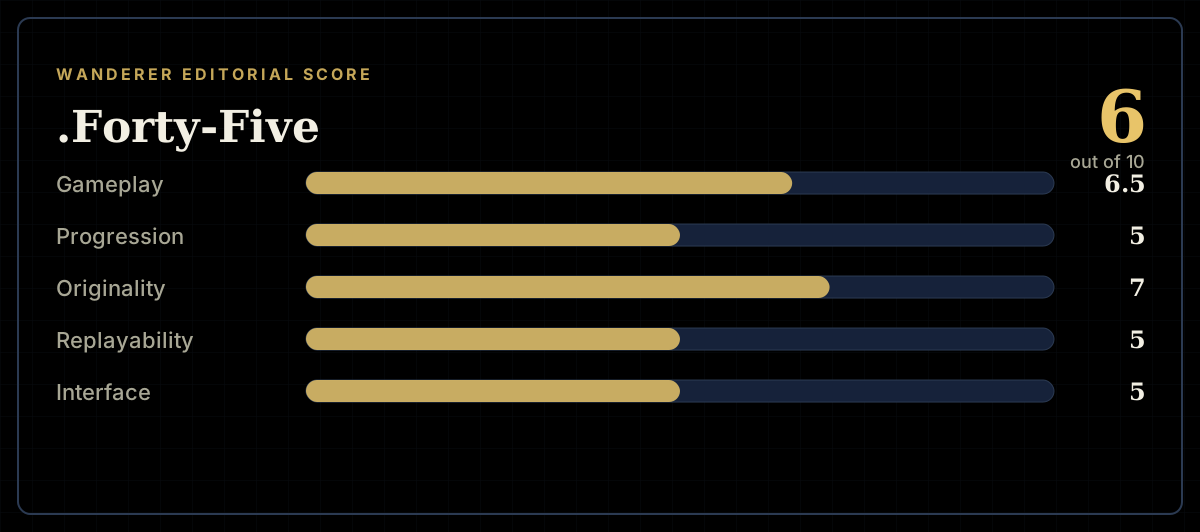
How the review scores each part of the gameWanderer Editorial -
The short versionWanderer Editorial