
Game review
Feed the Deep
5.5 / 10
- Developer
- Luke Muscat
- Publisher
- Luke Muscat
- Released
- 16 August 2024
- Platforms
- Windows
- Genre
- Atmospheric cave-diving roguelike
- Monetisation
- One-time purchase, no DLC or microtransactions
- Players
- Single-player only
The short version
Feed the Deep sends players diving into procedurally generated undersea caves, gathering loot and fighting off Lovecraftian horrors before hauling everything back to the surface to upgrade their gear. This review's sample confirms the atmosphere, art, and premise draw genuine admiration, but a large, remarkably consistent negative-review theme describes a repetitive dive-loot-backtrack loop with no permanent progression between runs, and several specific control and technical complaints that appear to have gone unaddressed after a brief post-launch patch window before the developer moved on to a new project.
Biggest strengths
- The atmosphere, art style, and underlying Lovecraftian premise earn consistent, specific praise, with reviewers describing genuine tension and dread while navigating darkened cave systems
- The "physical inventory" system, where items occupy real space rather than abstract slots, is specifically credited by multiple reviewers as a novel, rarely-seen mechanic that adds real texture to resource management
- Several reviewers with a decade of following the solo developer's YouTube channel describe the finished game as a meaningful improvement over its early prototype footage, crediting genuine polish in the art and music
Biggest weaknesses
- A large, remarkably consistent negative-review theme describes the core loop as repetitive, with multiple reviewers independently summarizing it as "go down for loot, come up to spend that loot, go down again," and explicitly noting the absence of any permanent upgrade or meta-progression between individual runs
- This review's own achievement-data check corroborates a steep completion cliff, from 61.4% for the earliest milestone down to 1.0% for the rarest, consistent with reviewer reports that most players finish the base experience once and rarely return for full completion
- Multiple reviewers report a specific, concrete control complaint: the same button is used to both pick up and drop items, with no option to rebind it, leading to frequent accidental item drops
Who it's for: Fans of atmospheric exploration roguelites like Dome Keeper or Wall World specifically drawn to a slower, more methodical cave-diving twist; not a fit for players wanting escalating power between runs or extensive build variety.
Our recommendation: Worth trying at its low price for the atmosphere and premise specifically, with realistic expectations that the core loop wears thin within a handful of hours for many players.
5.5 / 10
Feed the Deep sends players diving into procedurally generated undersea caves in search of loot and secrets, fighting off Lovecraftian horrors while managing oxygen and a genuinely novel physical inventory before hauling everything back to the surface. This review's sample confirms the atmosphere and premise land well for many players — and identifies a large, remarkably consistent complaint about how quickly the underlying loop wears thin.
Genuine atmosphere, widely praised
Reviewers consistently credit the game's mood and presentation. "The art and music are delicate and touching, the atmosphere is immersive, and the lore is interesting with a twist," one longtime follower of the developer's work writes. Another specifically praises the inventory system: "The physical inventory is a novel mechanic and rarely seen in roguelikes." A third reviewer frames the overall feel directly: "It really manages to capture some of that fear that comes with cave diving... The monsters are added anxiety." That consistent praise for mood and specific mechanical novelty recurs across the sample regardless of overall verdict.
A remarkably consistent complaint about repetition
Set against that atmosphere, this review's negative sample converges overwhelmingly on the same structural complaint, often using near-identical language. "Its just go down for loot come up to spend that loot so u can go farther down and find more of the exact same loot. and at the end of a game u just leave, u dont earn any permanent upgrades or anything to help u get better," one reviewer writes. Another agrees precisely: "As a Roguelite, it's a shame that the biggest issue with the game is its replayability... The only thing that changes in each run is the map generation." A third reviewer sums up the core tension directly: "the core gameplay loop isn't the worst thing ever created, but it becomes dull after less than a few hours." This review's own check of Steam's achievement data supports the scale of that drop-off: completion rates fall from 61.4% for an early milestone to just 1.0% for the rarest achievement.
A specific, unrebindable control complaint
Beyond pacing, at least one detailed reviewer raises a concrete, checkable technical gripe: "This game uses the same button to both pick up and drop objects. There are completely unused keys / controller buttons, and they chose to have one button do completely opposite things... There is no way to rebind this." That's a specific, mechanically detailed complaint rather than a vague control gripe, and it recurs closely enough with other reports of accidental item drops to represent a genuine, addressable design oversight.
What the update record shows
Steam's own partner-events feed confirms the developer supported the game briefly and then moved on: three numbered patches were released within three weeks of the August 2024 launch, and no further game-specific updates appear afterward, aside from a 2027 announcement of the developer's next project. That pattern is consistent with several reviewers' specific complaints — the unrebindable control scheme, a Steam Deck sleep-crash bug, and the lack of any official bug-reporting channel — going unaddressed, since active development appears to have wrapped up quickly after launch.
A split on horror intensity
Beyond the core loop debate, reviewers differ on how effectively the horror elements land over a full playthrough. One reviewer specifically notes the scares diminish with repetition: "the 'horror' aspects go from making jump to just being frustrating after only one or 2 encounters." Another reviewer wanted more of exactly that intensity: "maybe I was hoping for more fear and getting lost was never an issue, I wish there was a way for the game to have a higher difficulty in some of those aspects." That split suggests the game's horror pacing may benefit from difficulty options it doesn't currently offer, a gap distinct from the broader repetition complaint but related to it.
A comparison to genre benchmarks, judged both ways
Multiple reviewers place Feed the Deep directly alongside Dome Keeper and Wall World as the clearest points of comparison, and their conclusions diverge based on what they valued most in those earlier games. "The change from a jet-pack in Dome Keeper to being a scuba diver in Feed The Deep makes for a very different experience in controls... Also, the lack of monster waves and instead having to control your air" changes the core tension considerably, one reviewer explains, framing the shift as a legitimate reinterpretation rather than a lesser copy. Another reviewer reaches the opposite conclusion: "Can't say the gameplay loop is hooking me in the same way that something like Wall World did... I get that there are [reasons for the darkness], but games that have you in the darkness for the majority of the time tend to be unpleasant experiences." That split suggests the specific design choices distinguishing this game from its inspirations — darker visibility, oxygen management instead of wave-based combat — are a genuine, debatable trade-off rather than a simple downgrade.
First-time-user experience concerns from an experienced eye
At least one reviewer with professional game-design background raises a specific, structural critique distinct from general repetition complaints: "It is extremely shocking to me that a experienced game designer like Luke would make so many FTUE [first-time-user-experience] mistakes. This game would be 10x better if the initial 3 adventure selections are locked to only 1, and unlock each one by one from just completing the previous quest." That's a specific, actionable design suggestion from someone evaluating the onboarding structure specifically, distinct from the atmosphere or core-loop debates raised elsewhere, and useful context for understanding why some new players report feeling overwhelmed or unsure of objectives early on.
Final verdict
Feed the Deep succeeds at establishing a genuinely atmospheric, well-realized premise, and this review's sample confirms real admiration for its mood, art, and inventory mechanic. But a large, remarkably consistent negative-review theme describes a repetitive core loop without meaningful meta-progression, compounded by specific, seemingly unaddressed control and technical complaints from a developer who moved on to a new project shortly after launch. At its low price, this remains worth trying for the atmosphere alone, with realistic expectations that the loop itself doesn't sustain much beyond a handful of hours for most players.
Pros and cons
Pros
- The atmosphere, art style, and underlying Lovecraftian premise earn consistent, specific praise, with reviewers describing genuine tension and dread while navigating darkened cave systems
- The "physical inventory" system, where items occupy real space rather than abstract slots, is specifically credited by multiple reviewers as a novel, rarely-seen mechanic that adds real texture to resource management
- Several reviewers with a decade of following the solo developer's YouTube channel describe the finished game as a meaningful improvement over its early prototype footage, crediting genuine polish in the art and music
- The controls are described by some reviewers as intuitive and comfortable once learned, distinct from the specific control complaints raised elsewhere in this review's sample
- At a low price and modest scope, several reviewers frame the game as a reasonable, low-risk purchase specifically for its atmosphere and short runtime rather than as a long-term commitment
Cons
- A large, remarkably consistent negative-review theme describes the core loop as repetitive, with multiple reviewers independently summarizing it as "go down for loot, come up to spend that loot, go down again," and explicitly noting the absence of any permanent upgrade or meta-progression between individual runs
- This review's own achievement-data check corroborates a steep completion cliff, from 61.4% for the earliest milestone down to 1.0% for the rarest, consistent with reviewer reports that most players finish the base experience once and rarely return for full completion
- Multiple reviewers report a specific, concrete control complaint: the same button is used to both pick up and drop items, with no option to rebind it, leading to frequent accidental item drops
- Several reviewers report technical issues including a Steam Deck sleep-mode crash bug and no official channel for reporting bugs to the developer
- Steam's own partner-events feed shows only three patches in the three weeks following the August 2024 launch, with no further updates since aside from an unrelated announcement of the developer's next project, suggesting the specific control and technical complaints raised in this review's sample were likely never addressed
Screenshots
-

Feed the DeepImage: Luke Muscat via Steam -

Feed the DeepImage: Luke Muscat via Steam -

Feed the DeepImage: Luke Muscat via Steam -
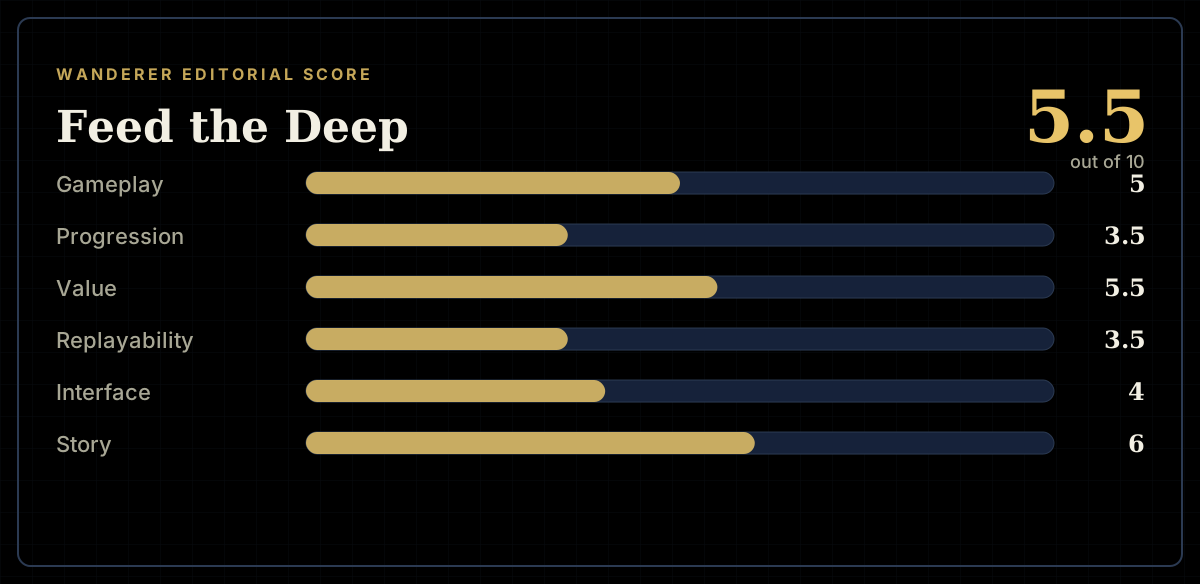
How the review scores each part of the gameWanderer Editorial -
The short versionWanderer Editorial