
Game review
Explorers of Palan
6.5 / 10
- Developer
- DevMZ
- Publisher
- DevMZ
- Released
- 1 September 2026
- Platforms
- Windows
- Genre
- RPG
A Fifty-Second Consecutive Launch Without a Single Review
Explorers of Palan launched on Steam on 1 September 2026 as a full release for Windows, and at the time of writing has zero user reviews. That's a notable gap for a classic turn-based RPG specifically, since the genre's appeal is almost entirely a question of pacing and encounter design across a stated ten-to-fifteen-hour campaign, and that's exactly the kind of judgment that normally takes a wave of players comparing how the difficulty curve holds up to settle.
A Royal Explorer, a Fairy Companion, and Tremor-Causing Pillars
The premise follows Reid, one of the kingdom's Royal Explorers, and his companion Feyrie as they set out across the kingdom of Palan to deactivate a series of Vibration Pillars that are causing tremors and agitating the local creatures into hostility. That's a fairly classic JRPG-style inciting incident — a concrete, explorable cause for the world's monster problem rather than a vague evil to defeat — and framing the antagonist force as a malfunctioning or corrupted mechanism rather than a villain gives the story room to resolve through investigation as much as combat. Turn-based battles reward victories with experience toward becoming stronger, and defeat isn't necessarily a hard stop: alongside standard recovery skills and items, Feyrie is specifically stated to be able to restore the player after a loss, which suggests a more forgiving failure state than a straight game-over screen, letting exploration continue without immediately punishing an unlucky encounter.
A Kingdom Built for Side Exploration, Not Just a Main Quest Line
What stands out on the store page is how much of the pitch is about optional systems layered on top of the main story rather than the central quest itself. Side Explorations are explicitly framed as going "beyond the main story," with the store page promising additional experiences for players willing to look for them rather than treating sidequests as filler padding between story beats. A Stamp-collecting Album system, filled by finding Stamps in the field and trading duplicates to complete the set, borrows a structure familiar from real-world hobbyist stamp collecting and gives exploration a collection-based goal independent of combat or story progress. Rocky tunnels sealed behind fragile walls that must be broken open with a Hammer tool, and butterflies scattered around the map that share Pollen with Feyrie when touched, are the kind of small environmental interaction systems that reward simply wandering off the critical path rather than beelining toward the next story marker. The coastline is called out separately as its own collectible zone, with Shells to gather along the shore, which suggests the world map is built from a handful of distinct biome types — coast, tunnel, open field — each carrying its own dedicated collectible rather than one generic pickup scattered everywhere. That kind of biome-specific loot design is a small thing, but it's the sort of detail that keeps a ten-hour map from feeling like the same forest reskinned three times. A screenshot of one such open field confirms the pattern in practice: a visible treasure chest, sparkling gather nodes, and a lit campfire waypoint are all placed within sight of each other on a single screen, which is a reasonable density of things to interact with for a game built in the RPG Maker style rather than a fully open 3D world.
Potion Crafting Ties Field Exploration Back Into the Battle Loop
The potion-crafting system pulls those side-exploration systems back into the core turn-based loop rather than leaving them as disconnected collectibles: brewing a potion requires both a Formula and specific ingredients, which must be gathered in the field using a dedicated Pouch, with some ingredients also purchasable from markets or Traveling Merchants as an alternative to foraging. That's a legible resource loop — explore to gather ingredients, craft potions in the lab, use those potions to survive tougher battles, which funds further exploration — rather than crafting existing as an isolated minigame bolted onto the main adventure. Buying and selling through Traveling Merchants and market stalls gives the player a second way to fund that loop beyond straightforward battle rewards, which is a reasonable amount of economic breadth for a game the store page pitches as a relatively compact, story-focused adventure rather than an open-ended sandbox. A screenshot of a village greeting confirms the kingdom is populated with individually named NPCs rather than generic placeholder townsfolk — a resident named Emilly welcomes Reid and his companion outside the town inn — and another shows the party seated together for a meal inside a tavern interior, suggesting the world has more than one social hub built out beyond the shops and battle screens.
A Stated Ten-to-Fifteen-Hour Campaign at a Premium Indie Price
The store page is unusually specific about length: roughly ten hours focused on the main story, or fifteen-plus hours for players chasing full completion of the side content, stamps, and crafting systems. At NZ$34.75 with no discount, that puts Explorers of Palan well above the budget-indie pricing common to most titles in this run of unreviewed launches, positioning it closer to a mid-tier RPG price point that will need the promised ten-to-fifteen hours of content to feel proportionate. There's no mention of any additional monetisation, DLC, or in-app purchases on the store page, keeping the commercial pitch to a single upfront purchase. English is the only listed supported language, and the accessibility feature list — keyboard-only, mouse-only, and touch-only control options alongside partial controller support and playability without timed input — is broader than most turn-based RPGs bother to offer, suggesting a deliberate effort to accommodate a range of play setups despite the otherwise modest scope.
Verdict
Explorers of Palan pitches a classic turn-based RPG structure around Reid and his companion Feyrie investigating tremor-causing Vibration Pillars across the kingdom of Palan, wrapped in a genuinely broad set of side-exploration systems — stamp collecting, potion crafting fed by field-gathered ingredients, and environmental puzzles like hammer-breakable walls — that pull optional content back into the main battle-and-explore loop rather than leaving it disconnected. Screenshots back up the pitch with a named village NPC, a populated tavern interior, and an overworld field densely stocked with a treasure chest, gather nodes, and a campfire waypoint, all of which point to a competently assembled RPG Maker-style world rather than a bare-bones asset flip. The stated ten-to-fifteen-hour length and unusually wide accessibility options suggest a complete, polished package, though the NZ$34.75 asking price sits well above what most unreviewed indie RPGs in this genre charge and will need that promised content to hold up. It launched on 1 September 2026 with zero user reviews so far, so whether the turn-based combat has enough tactical depth to stay engaging across a full playthrough, and whether the premium price is justified by the promised scope, remain unverified by anyone outside the studio.
Screenshots
-
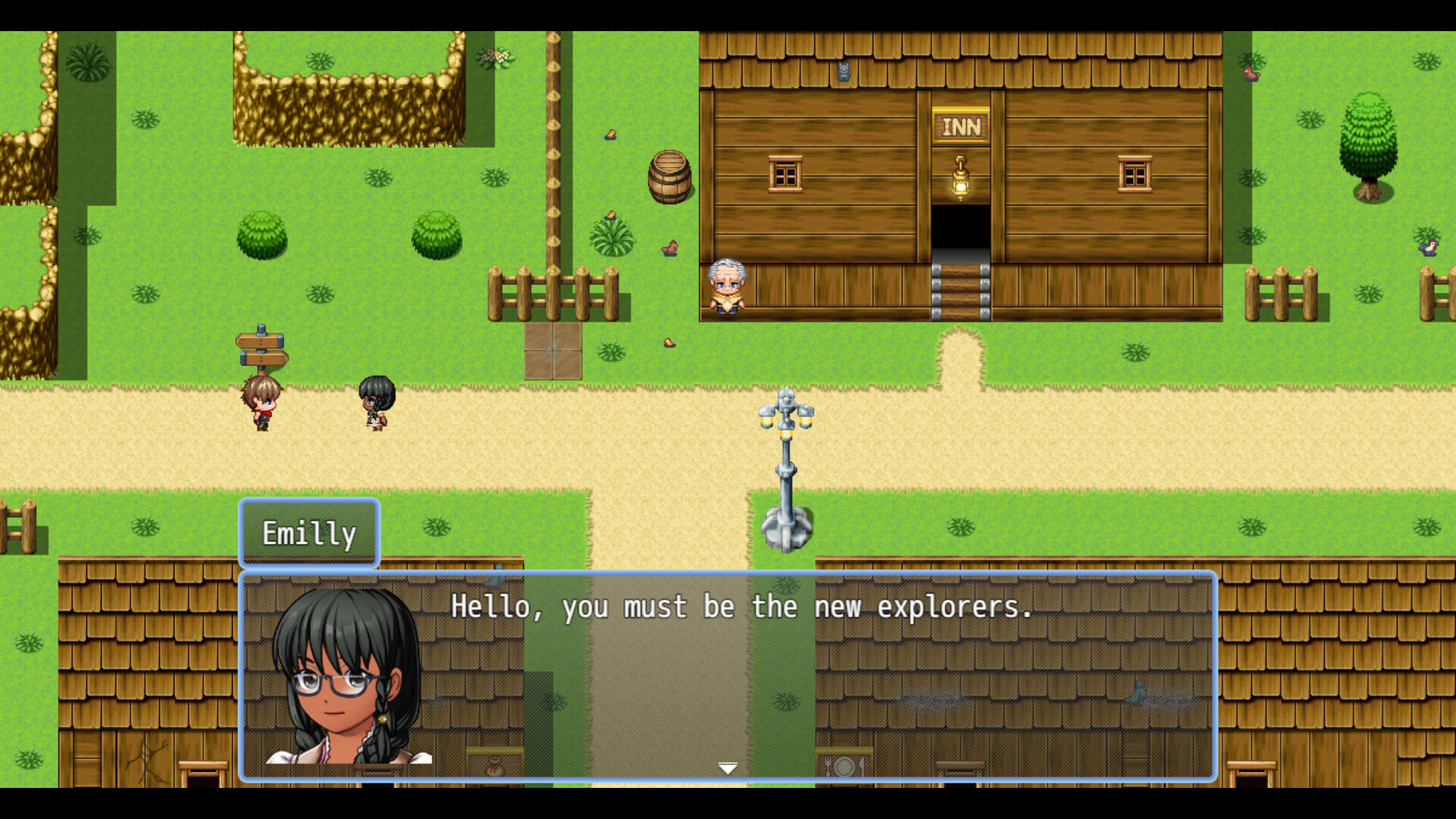
A named villager, Emilly, welcomes the new explorers outside the town inn.Steam store page -
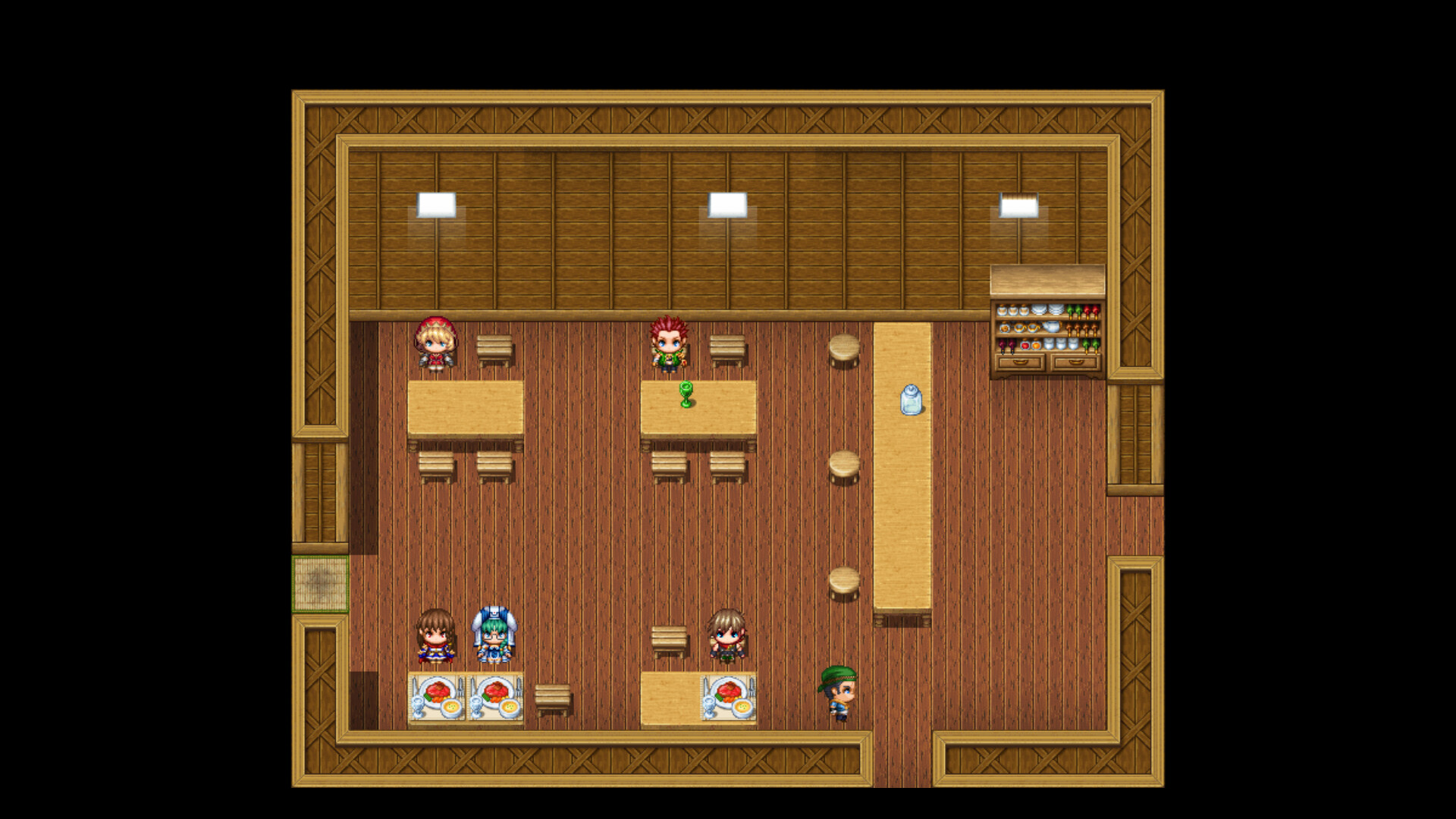
The party gathers for a meal inside a tavern, one of several social hub interiors.Steam store page -
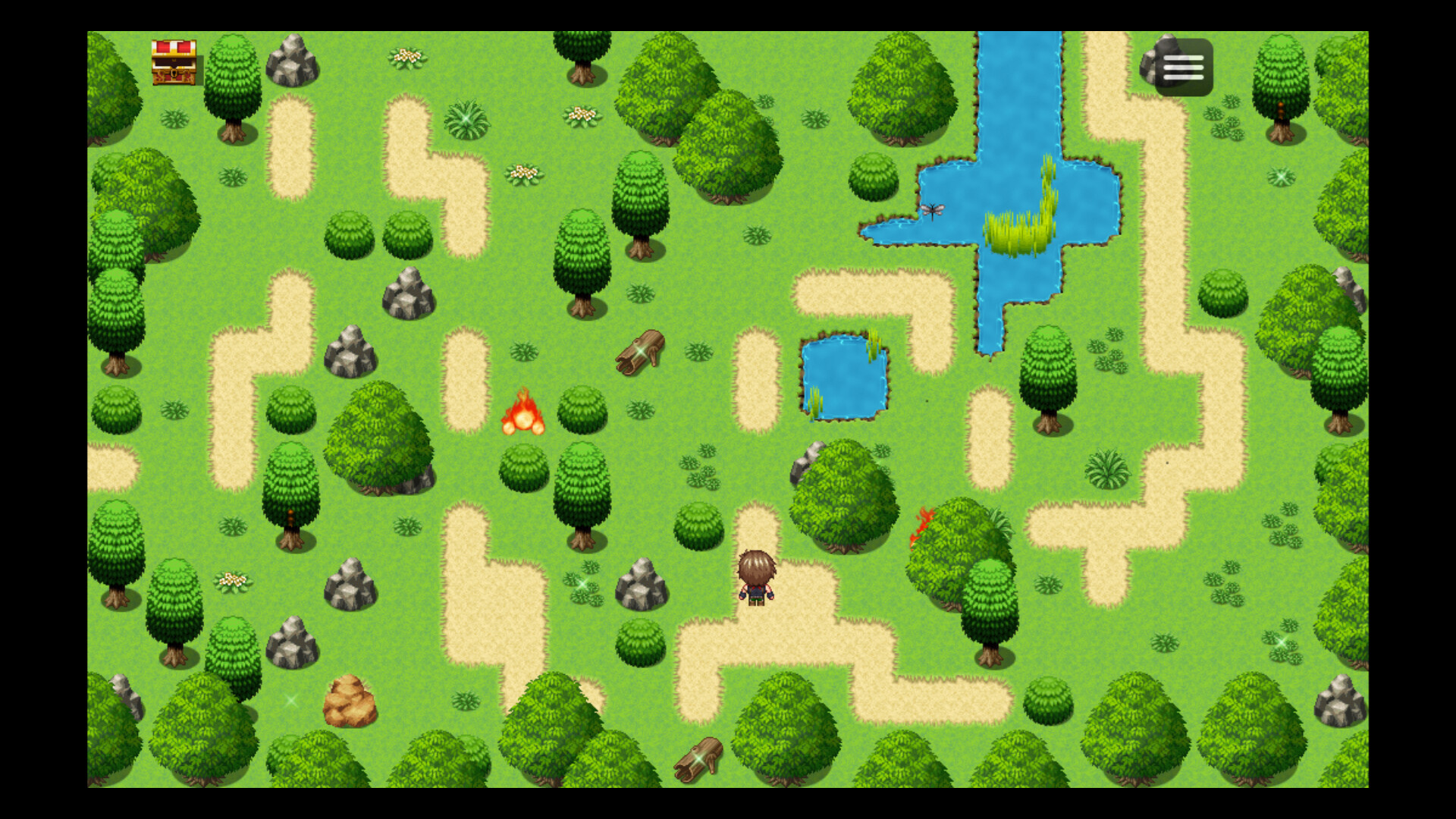
An overworld field dotted with a treasure chest, sparkling gather nodes, and a campfire waypoint.Steam store page