
Game review
Embermarch
7.3 / 10
- Developer
- Ser Podrik Pomboke
- Publisher
- Don't Open The Box!
- Released
- 11 August 2026
- Platforms
- PC
- Genre
- Idle Guild-Management RPG
A guild you send into the dark, not a hero you control
Embermarch takes the idle genre's core promise — progress that happens whether you're watching or not — and builds a genuinely substantial management RPG around it instead of a simple number-farm. You never control a hero directly. Instead you recruit a roster of named adventurers, assemble them into parties of up to four, set standing "doctrines" for how bold or cautious they should be, and send them marching down an endless night road while combat, looting, and decision points resolve automatically. Released 11 August 2026 by solo developer Ser Podrik Pomboke for NZ$12.49, it commits to genre-crossing ambition that's rare at this price point: part Darkest Dungeon-style party management, part idle-incremental resource loop, wrapped in a permadeath system with real consequences.
Community tags back up how much ground this covers: RPG, Idler, Incremental, Party-Based RPG, Dark Fantasy, and Management all apply simultaneously, and having looked at the screenshots directly, none of those tags feel like a stretch.
The roster is the actual game
Where most idle RPGs treat your units as disposable stat-sticks, Embermarch's roster screen shows real character identity: each member has a class (Cutpurse Rogue, Longshot Ranger, Stormcaller Mage, Pyromancer Mage among those visible), a one-line flavour quote ("Finds coin in a beggar's shadow," "Argues with the horizon, and wins"), and accumulated trait tags like Brute, Iron Stomach, Coward, or Marked by the Road. According to the store page, those traits aren't static — wounds leave scars, three scars plus a bad enough disaster can permanently kill a character unless a bonded party-mate intervenes at a cost, and survivors who live through enough catastrophes can shed early traits like Coward entirely. Fallen adventurers go to a memorial "Lantern Wall," with their gear returning home and their kin potentially available to recruit later. That's a meaningfully deeper permadeath-with-memory system than idle RPGs typically bother with, closer to a genre crossover with Darkest Dungeon's stress-and-scarring model than a conventional incremental.
The expedition screen backs this up mechanically: a live road strip shows the party's pixel-art sprites marching toward named threats (a "Gravebound Colossus" boss guarded a 500m milestone in the screenshots), with a scrolling log reporting waystone loot, camp decisions, and combat outcomes in real time, or the whole thing can run in the background while you're away — the store page specifies offline simulation covers up to twelve hours before requiring a check-in.
A real crafting economy, not a currency sink
The Forge screen shows tiered gear recipes gated by specific monster-part drops rather than a single catch-all currency: an "Ashbrand" weapon costs Fen Hide, an "Embersteel Edge" needs Ember Core, and top-tier recipes like the "Wyrmfang Blade" are explicitly locked behind Forge building upgrades rather than just being expensive. Combined with the Hall (guild room construction), Library (offline research), and Cartographer's Table (road-charting and scouting) systems described on the store page, this reads as a genuinely layered management sim sitting on top of the idle shell, with real either/or building choices rather than a single upgrade tree.
The store page also promises a defined endpoint rather than infinite scaling for its own sake: an eight-verse "buried song" storyline leads to a final choice with three distinct answers, each leaving a permanent mark before the game offers a Legacy prestige reset. A rival guild competing for the same road and camps adds a light competitive layer without turning this into a multiplayer game.
Thin review evidence, and a language gap worth flagging
The catch is that almost none of this can currently be checked against independent player experience. Only one Steam review exists at the time of writing, and its actual content is mostly a verbatim repost of the store page's own description in Simplified Chinese, with just one original line of commentary: "has achievements, no Chinese" — a complaint about the lack of localized text. That checks out against the store listing, which lists English as the only supported language with full audio support; there's no independent account here of how the permadeath system, road pacing, or Forge economy actually feel to play across real hours, which keeps this review's confidence in the systems tied to what the developer states and what the screenshots visibly show, not to player-confirmed experience.
The interface itself, at least as shown in the expedition screen, is dense in a way that seems purposeful rather than cluttered: a persistent top bar tracks four separate currencies (gold, essence, renown, legacy) alongside speed controls up to 4x, while the road strip below keeps party health, active buffs, and enemy names all visible without needing a separate menu. That's a reasonable case for a solid interface score even without hands-on confirmation, though a single screenshot obviously can't settle how it holds up once a roster of eight and multiple simultaneous expeditions are all being tracked at once.
Where this lands
Embermarch's ambition is the clearest thing about it: a genuinely story-and-character-driven take on the idle genre, with permadeath, scarring, guild-building, and a defined narrative arc in a space that's usually content to just make numbers bigger. The screenshots support that the underlying systems exist and look coherent. What's missing is real independent confirmation of how well those systems hold together over the hours the genre demands — with a single, low-substance review on file, this is a recommendation based on strong design intent and visible execution rather than a track record, and interested idle-RPG players should treat it as a promising, still largely unproven pick.
Screenshots
-
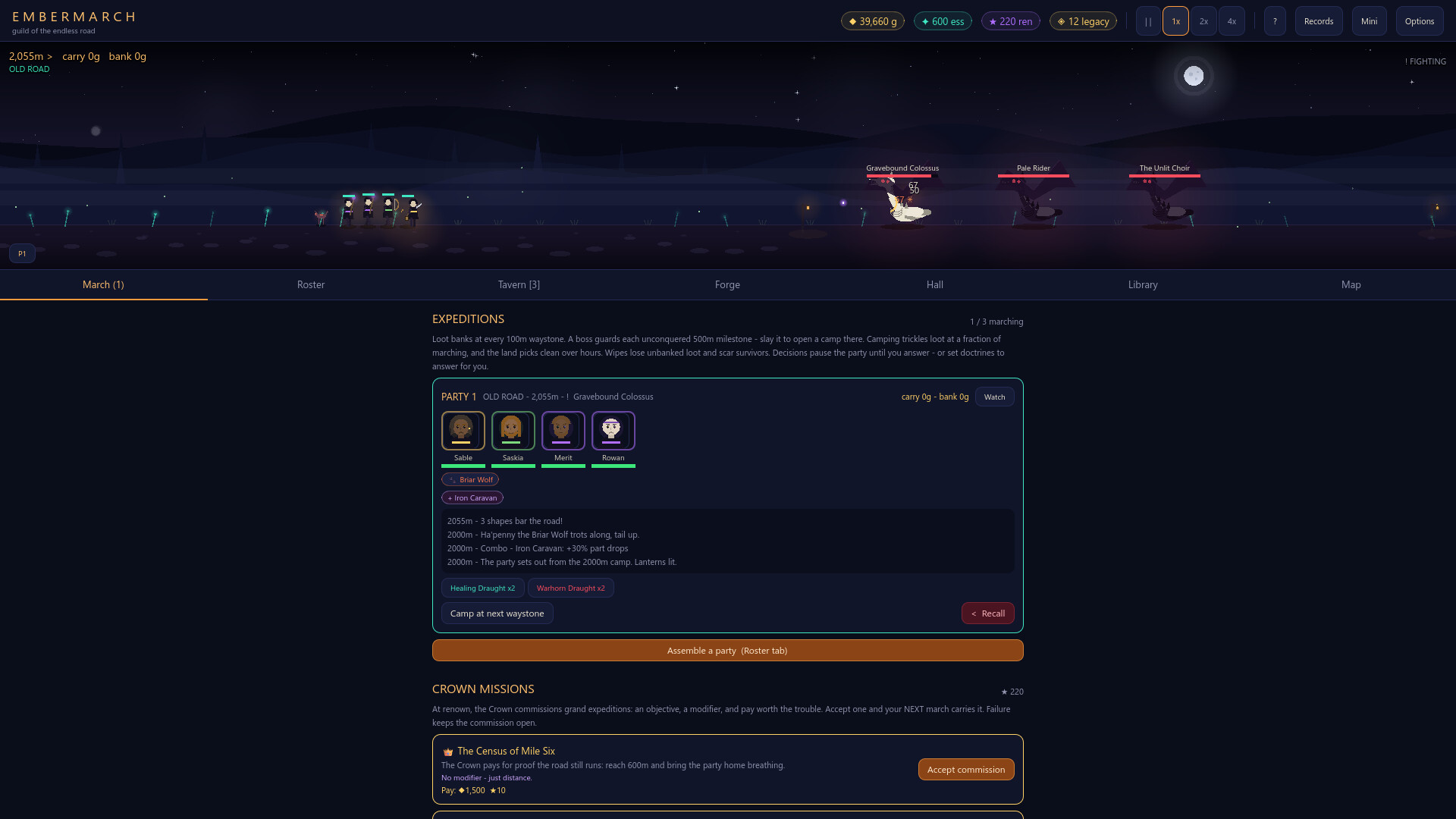
Expeditions run as an animated road strip: the party marches, fights, and loots on its own while a scrolling log reports every waystone and encounter.Steam store page -
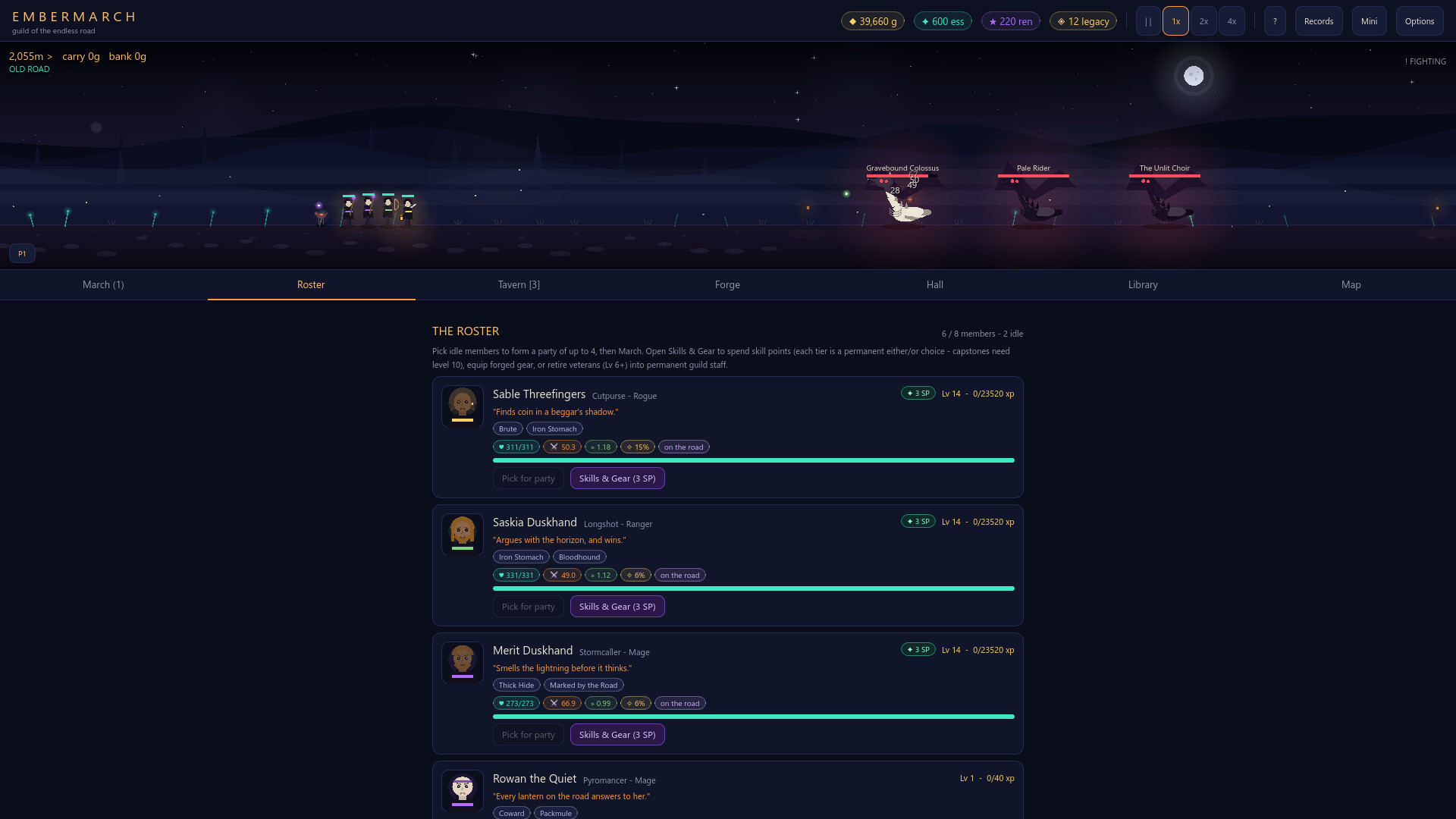
Every roster member has a class, a personal flavour line, and a set of trait tags that accumulate as they survive - or don't - repeated expeditions.Steam store page -

The Forge turns monster-part drops into tiered gear, with the strongest recipes gated behind Forge upgrades rather than just grinding currency.Steam store page