Game review
The Keeper's Path
3.8 / 10
- Developer
- Call Yourself a Lord Studios
- Publisher
- Call Yourself a Lord Studios
- Released
- 23 August 2026
- Platforms
- PC
- Genre
- Idle Incremental RPG
A grim premise that never quite becomes a game
The Keeper's Path sets up one of the more genuinely interesting premises in the current idle RPG crop: you're the custodian of a living, parasitic house that traps gods, tyrants, and monsters in its barrows and feeds on the power leaking out of them, and the entire pitch is built around the moral discomfort of being unsure whether you're protecting the world or farming it. Released 23 August 2026 by Call Yourself a Lord Studios for NZ$7.89, it's explicitly built to be left running — "the yard glows whether you're watching or not," per the store page — a standard idle-genre promise wrapped in unusually dark, literary flavour text about deep time and the cost of power.
Community tags confirm the intended lane: RPG, Idler, Incremental, Dark Fantasy, Atmospheric, and Resource Management. On concept alone, this reads like exactly the kind of thing idle-RPG players who want something moodier than the genre's usual numbers-go-up cheerfulness would be drawn to.
The mechanics are there, but the identity isn't
The screenshots show a genuinely dense system underneath the mood-setting: a "Veins" panel for training passive skills that gate which prey you can bind, a "Grounds" panel for constructing barrows and wards, a scrolling "Ledger" that delivers worldbuilding fragments as combat-log-style text, and a "Prey at Large" sidebar tracking specific named captives with bind percentages and yield rates. A detailed lifetime "Chronicle" page — one of the more substantial prestige-tracking screens seen in this genre — tallies dozens of long-run totals across repeat playthroughs: 251 captives bound across all lives, 16 ascensions crossed, 25 bargains accepted, 961 convergence events faced. That's real structural depth, and it tells a story of a system built for players who reset and climb again and again.
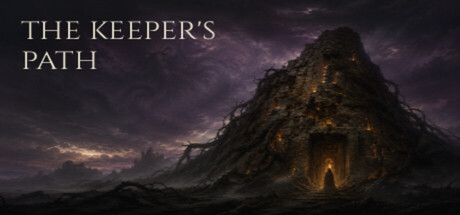
But every one of those screens is presented as plain text on a dark, monospace-styled dashboard with zero character art, creature illustrations, or distinct visual identity anywhere in the actual gameplay — a stark contrast to the moody painted key art on the store page. The one reviewer who logged serious time (575 minutes) put it bluntly: the UI "is the exact same as at least 4 other idle/incrementals I know of," and having looked at the screenshots directly, that's a fair description — the layout, typography, and panel structure here are close to interchangeable with a wide swathe of the genre's other text-dashboard idlers, offering little to distinguish it visually from games with far less ambitious writing behind them.
Reviewers agree the systems don't track with the promises
All three Steam reviews on file are negative, and two of the three — independently, in separate reviews — raise a specific and serious concern: that the game feels like it was designed with heavy AI assistance and minimal human refinement, citing systems that "do not work as they are described," pacing that "is strange," and progression that "does not feel meaningful" despite an interesting premise. That's a claim about the development process that can't be independently confirmed one way or the other from the outside — there's no statement from the developer addressing it, and this review treats it as an unverified allegation raised separately by two reviewers, not an established fact. What can be verified directly is the substance behind it: the 625-minute reviewer describes training passive skills purely to "capture a resource node" that lets you prestige and start over, with unlocked upgrades that "do nothing but increase speed modifiers" — a thin mechanical loop for a game whose store page promises binding gods and grappling with the ethics of power.
A third, brief review in Simplified Chinese simply states confusion about how to play at all, which — combined with the other two accounts of systems not behaving as described — points to a real onboarding and clarity problem on top of the thin moment-to-moment loop.
The lore and the loop don't meet in the middle
The scrolling ledger visible in the second screenshot is where most of the game's actual prose lives — brief lines like "The Path closes — none taken. 4 rivals walk away, perhaps to Ascend without you" and "A Convergence — 4 apex beings stalk your grounds. Bind them before the Path closes" scroll past alongside routine stat-gain notifications, with no separation between narrative beats and mechanical bookkeeping. That's a defensible stylistic choice for a game about deep time and quiet dread, but it also means the atmosphere the store page promises has to be assembled by the player from fragments buried in a log, rather than delivered directly. The 575-minute reviewer specifically called the lore "interesting all the same" despite not making sense in the moment, which lines up with what the screenshots show: individually striking lines of writing that never cohere into a legible throughline while actually playing.
That disconnect is the core tension running through every part of this review. The premise, the prestige depth, and the individual lines of flavour text are all more ambitious than the genre's average — but none of it is backed up by an interface built to showcase it, and the people who've actually spent hours with it describe mechanics that don't deliver on what the writing sets up.
Where this lands
The Keeper's Path has a genuinely striking pitch and, underneath its plain dashboard, a prestige system with real long-run depth — the Chronicle screen alone shows more tracked lifetime statistics than most idle RPGs bother with. But a zero-positive review record, a generic interface that multiple reviewers say is indistinguishable from other idle games, and firsthand accounts of systems that don't function as advertised all point to a gap between the writing on the store page and what's actually been built. At $7.89 this is a cheap experiment worth acknowledging for its atmosphere and ambition, but current buyers should go in expecting the execution described by its only three reviewers: something that looks and reads better than it plays.
Screenshots
-
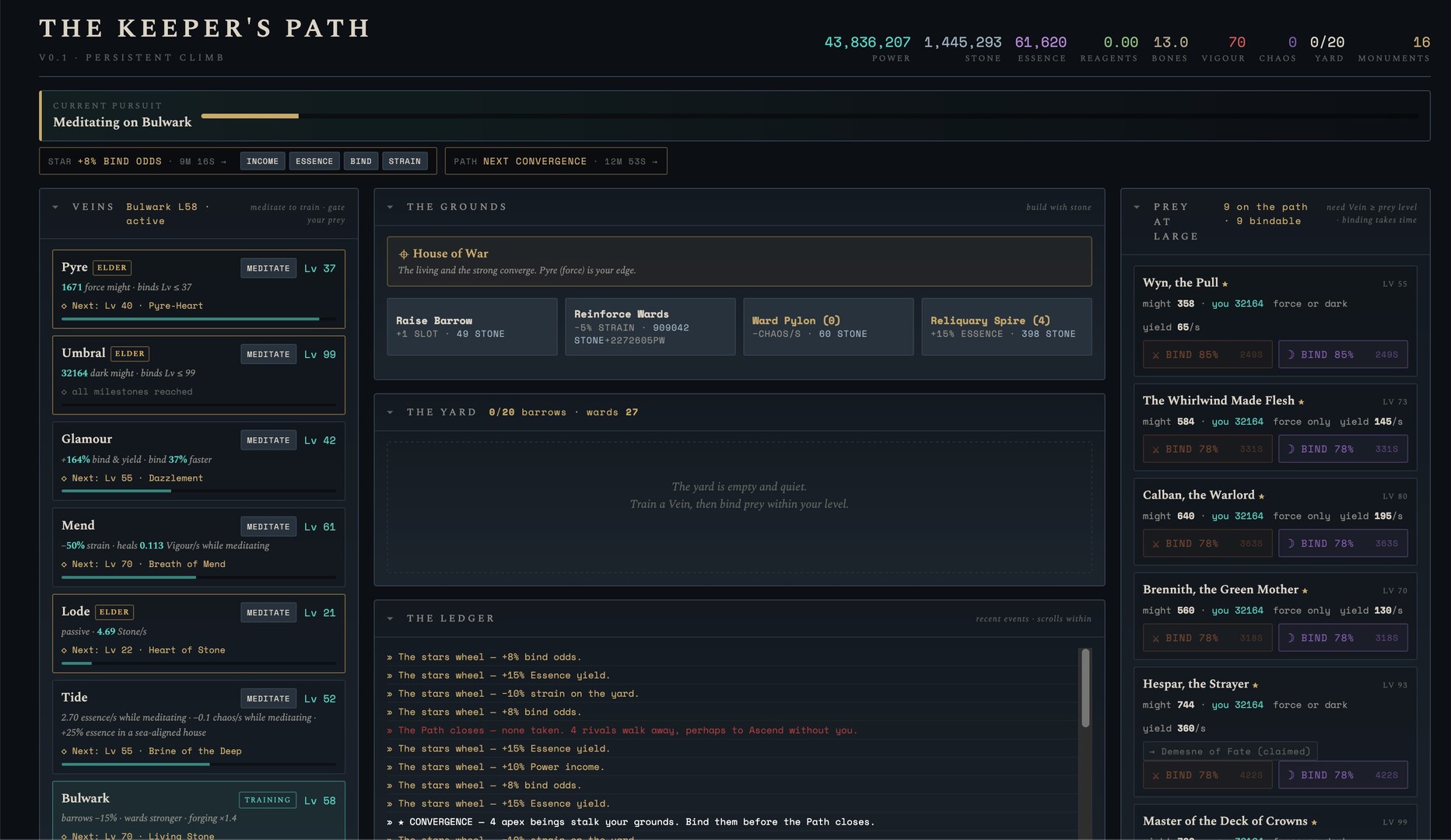
The entire game plays out on a single dark dashboard: resource counters, trainable skill lists, and a sidebar of nameable captives to bind, with no character art anywhere on screen.Steam store page -
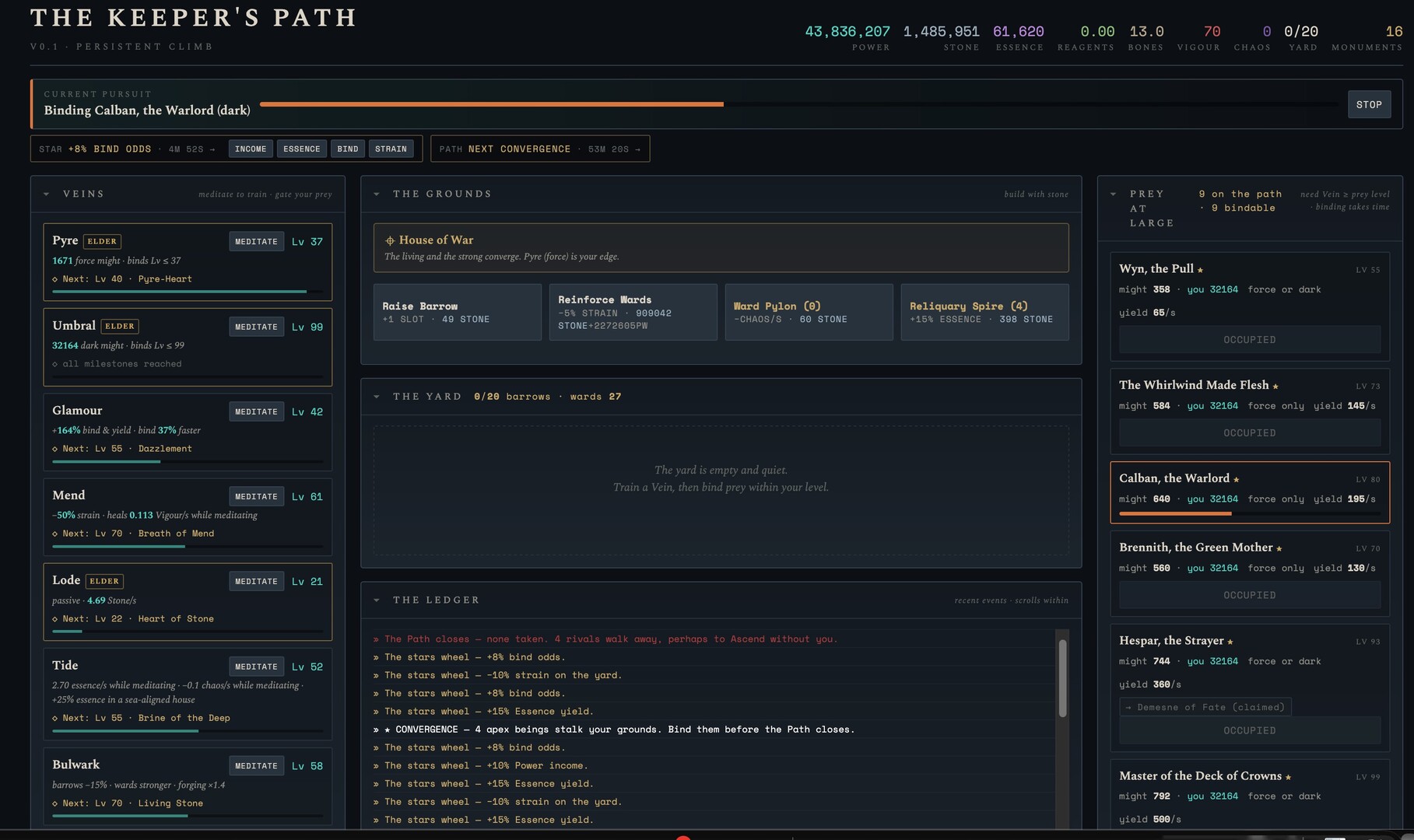
A scrolling text ledger delivers the game's worldbuilding in fragments - Convergence events, rival keepers, and warnings about the Path closing - alongside the mechanical numbers.Steam store page -

A detailed lifetime-statistics chronicle tracks dozens of long-run totals across repeated prestige cycles, evidence of a genuinely deep number-tracking system underneath the plain presentation.Steam store page