
Game review
Idle Trinity Builder
5.3 / 10
- Developer
- Yamate
- Publisher
- Yamate
- Released
- 10 June 2026
- Platforms
- PC
- Genre
- Idle Party-Based RPG
A dual-hero idler that leans hard on synergy
Idle Trinity Builder is a small-scale idle RPG from solo Chinese developer Yamate, released 10 June 2026 for NZ$12.49. The pitch is narrow and specific: pick two heroes from three available classes — Warrior, Mage, and Priest — and build around whatever synergy that pairing creates, whether that's a poison-stacking combo, a thorns-reflect tank build, or a magic-burst pairing. Combat is fully automated once a run starts; the game's actual interactive layer is entirely in the menus, where levelling, gear synthesis, and stat-point allocation happen between fights.
Community tags mark it as Idler, Party-Based RPG, Inventory Management, RPG, Strategy, and Anime, and every one of those tags is earned. This isn't a minimalist number-farm idler — it's closer to a compact, gear-focused RPG that happens to remove manual combat input entirely, with a genuine equipment-crafting layer sitting underneath the auto-battles.
The build system is the actual game
The screenshots make clear where Idle Trinity Builder puts its effort. The character screen is dense with detail: a Warrior hero at level 60 has a full equipped-item grid, a separate multi-row inventory grid packed with named weapons and accessories, a synthesis panel for combining duplicate gear into higher tiers, and a stat panel breaking out attack, defence, dodge percentage, crit rate, crit damage, and life-steal as separate tracked values. One Steam reviewer with over 1,270 minutes logged confirmed this is the actual appeal: gear rarity increases through combining pieces, each combat stage drops low-tier gear, and there's a store selling randomized pieces for gold — a genuine crafting-and-optimization loop layered under the idle shell, not just a stat-increase treadmill.
That same reviewer flagged a specific progression quirk worth knowing going in: character and skill leveling are gated by gold rather than experience, and the gold cost per level climbs steeply. That reframes gold from a simple currency into the actual progression bottleneck, which changes how the early-to-mid game plays out compared to a more conventional idle RPG where experience and gold serve separate purposes.
Combat readability gets worse as the numbers grow
The battle screenshots tell a consistent story about where the interface struggles. In an early-stage fight against three horned "Red Dragon" enemies, floating combat text for lightning damage, poison stacks, and lifesteal already overlaps and competes for space above a two-hero party. By the game's later "Abyss" stage, enemy health pools have scaled into the tens of thousands and the combat log has become a genuine wall of stacked Chinese-language damage numbers, skill names, and status effects, several outright unreadable where text has piled on top of other text mid-animation.
That density is compounded by a real localization gap: Steam lists English as a fully supported language with audio, but every screenshot on the store page — combat, inventory, and stat screens alike — shows interface text exclusively in Chinese. Whether that reflects the promotional screenshots simply predating an English patch or a genuine gap between the store listing and what actually ships, it's the kind of mismatch a prospective buyer should know about before purchasing, and it's reflected in a low interface score here.
A quiet launch that hasn't been followed up
Idle Trinity Builder's own Steam news feed shows four posts, all dated within its first 24 hours on sale — a release announcement followed by three quick clarifications about hero selection, difficulty levels, and inventory management — and nothing since. Three months on from launch, the store page currently carries Valve's "Profile Features Limited" flag, which follows automatically from low account/engagement activity rather than any judgment on the game itself, but it does line up with a genuinely small player base: only three Steam reviews exist at the time of writing.
One of those three, a negative Simplified Chinese review, claims outright that the development team has disbanded and the game has been abandoned — words to the effect of "the team's split up and run off, don't buy this, folks." That's a serious allegation, but it comes from a single reviewer with no corroborating source available; there's no official statement confirming or denying it, and it should be read as one player's account rather than a confirmed fact. What can be independently confirmed is the quiet news feed and the low engagement flag — real signals of a game that isn't getting much attention, whatever the reason turns out to be.
It's worth noting the other two reviews on file don't mention anything resembling abandonment — the long-session reviewer's complaints were purely about the gold-gated leveling curve, and the third, brief review simply asked about adding storage for spare items, the kind of quality-of-life request that implies a player still actively engaged with the game rather than one who considers it dead. That doesn't settle the abandonment question either way, but it means the available review evidence is mixed rather than uniformly alarming.
Where this lands
Idle Trinity Builder has a real, well-built core: the dual-hero synergy hook and gear synthesis loop are more substantial than most idle RPGs bother with, and the one detailed long-session review on file backs up that the build-crafting hook holds up over real playtime. But it's let down by an interface that gets genuinely harder to read as fights scale up, a language-support gap between what's promised and what the screenshots show, and a three-month silence from the developer that's left the game sitting at a bare three reviews with an unverified abandonment claim attached to it. Worth a look for idle-RPG players specifically drawn to gear-optimization builds, but go in aware of both the readability issues and the uncertainty around ongoing support.
Screenshots
-

Combat runs on autopilot: two heroes exchange lightning, poison, and lifesteal effects against a wave of stacked enemies while gold and kill counters tick upward in the corner.Steam store page -
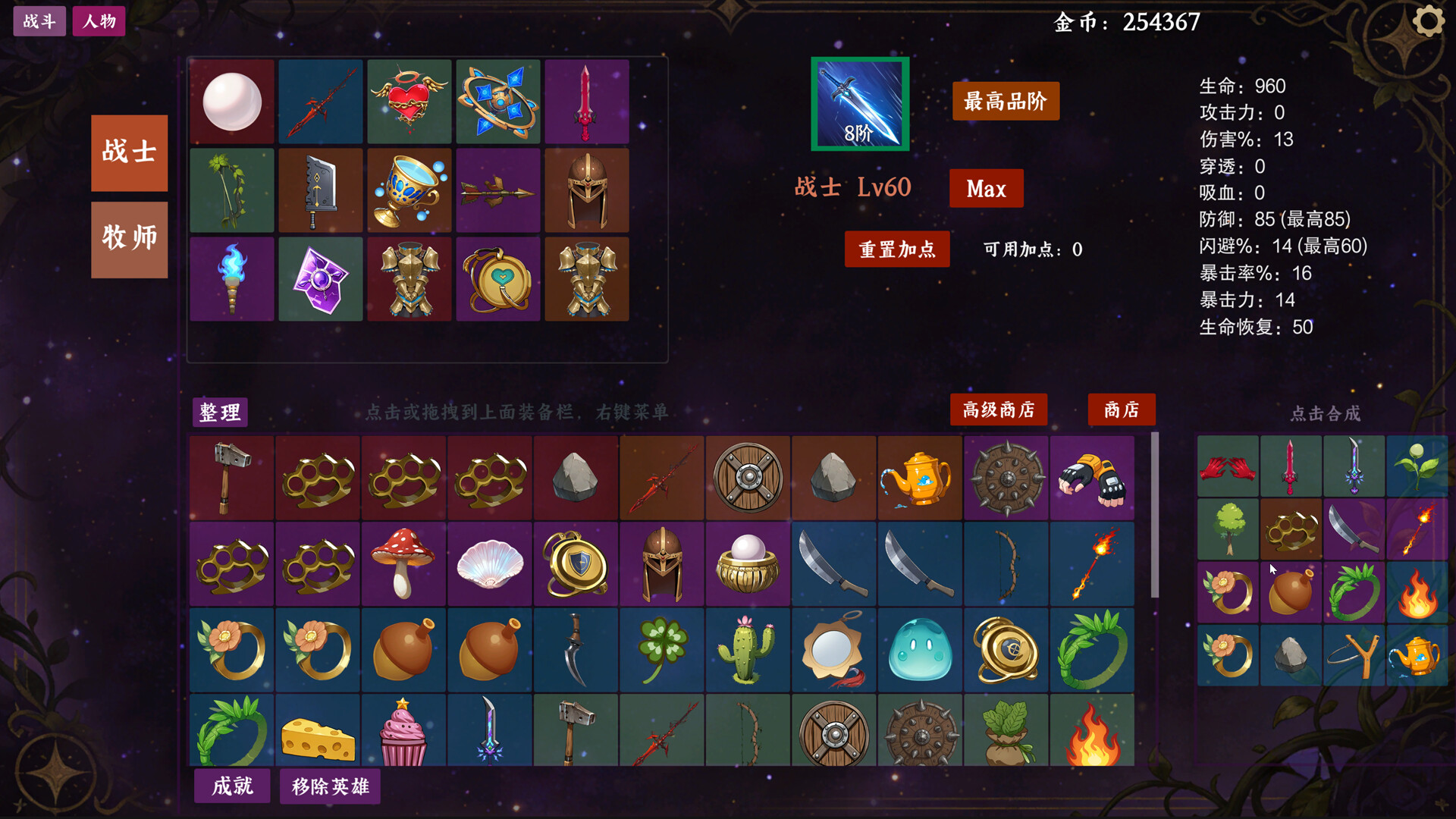
The build screen is dense: equipment slots, a synthesis panel for combining duplicate gear, and stat allocation all live on one crowded page.Steam store page -

Enemy health pools scale into the tens of thousands by the game's later stages, with combat log text stacking up faster than it can be read.Steam store page