Game review
Elden Ring Nightreign
7.5 / 10
- Developer
- FromSoftware
- Publisher
- Bandai Namco Entertainment
- Released
- 30 May 2025
- Platforms
- Windows, PlayStation 5, PlayStation 4, Xbox Series X|S, Xbox One
- Genre
- Action RPG, Roguelite
- Monetisation
- Premium, one-off purchase; The Forsaken Hollows expansion sold separately
- Players
- Online co-op for one, two or three players; no offline or split-screen option
The short version
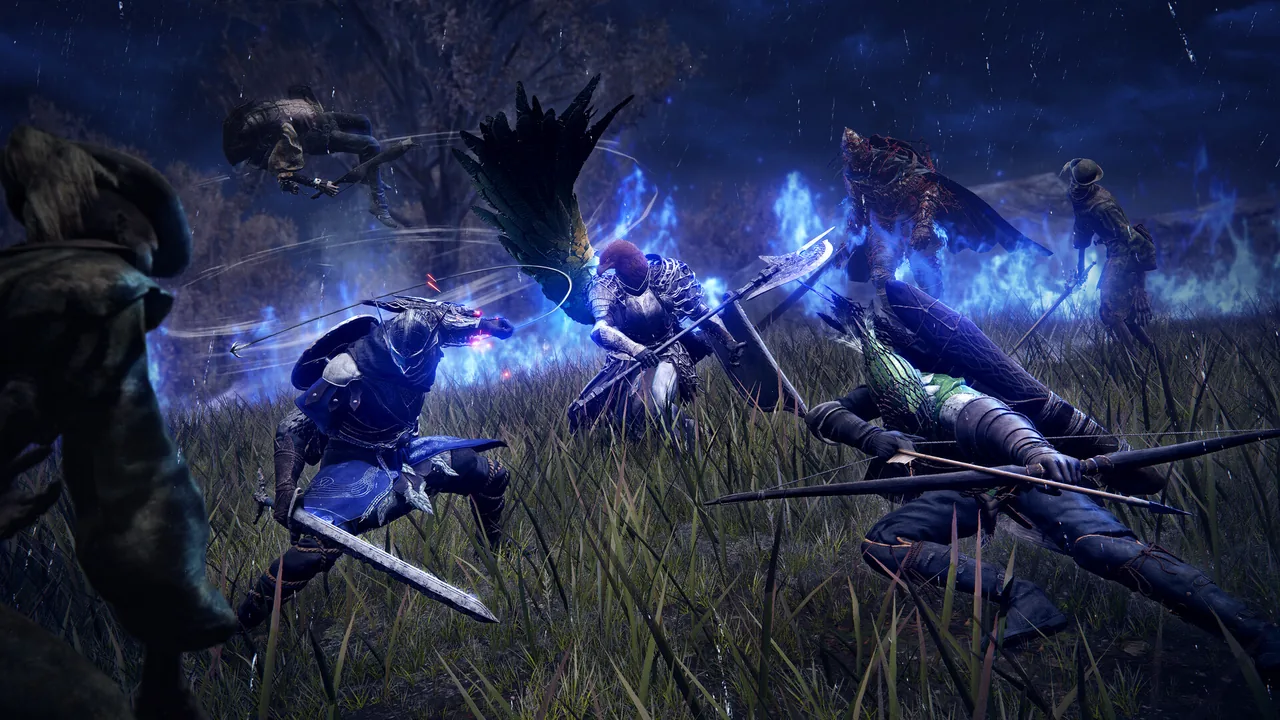
Nightreign takes the thing FromSoftware does better than anyone — big, readable, dangerous boss fights — and puts a stopwatch on it. A run is two days of scavenging across a shrinking map, fighting whatever the map throws at you, then a third day against one of several Nightlords who will kill an uncoordinated team in seconds. When the timing lands and three players are reading a fight together, it is some of the best co-op combat FromSoftware has ever shipped.
It is not Elden Ring 2, and treating it like one is the fastest way to be disappointed by it. You don't build a character here — you pick one of ten fixed heroes and work with what a run gives you. Solo play has been patched into something survivable rather than something the fights were designed around, and the post-launch content pipeline has slowed to a crawl fourteen months after release. Worth owning if you have two other people; worth trying carefully if you don't.
Biggest strengths
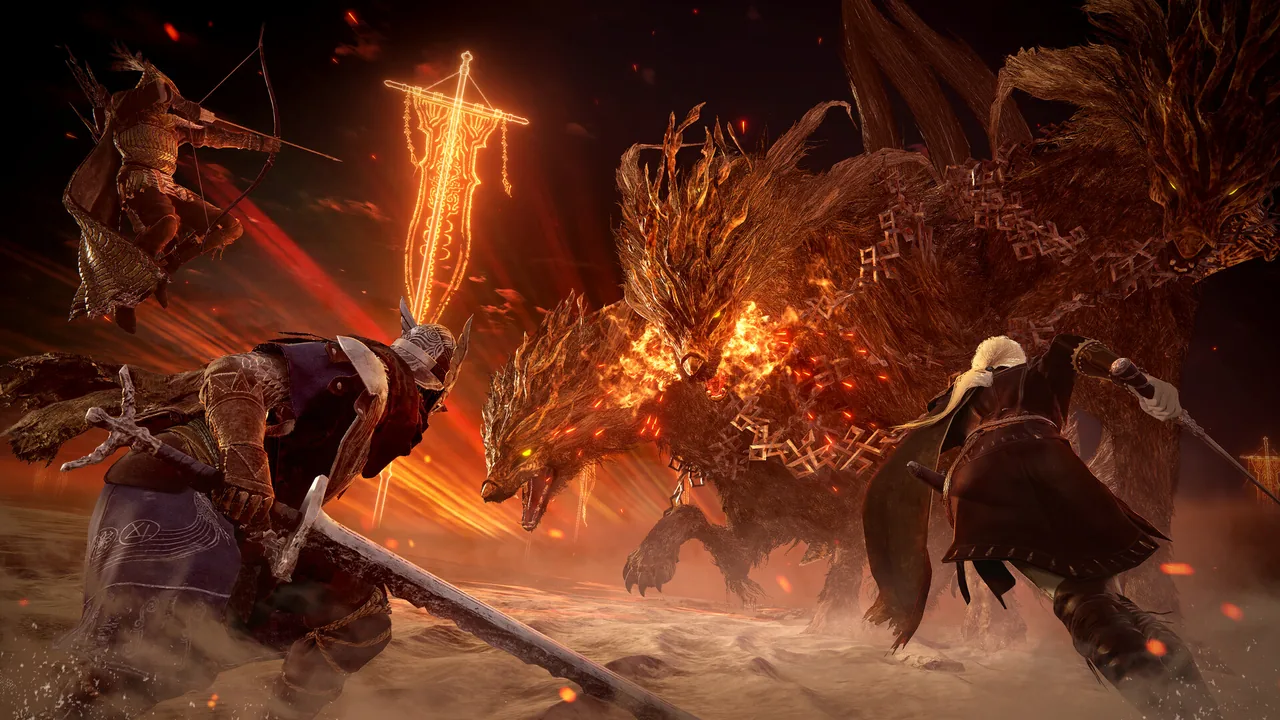
- Boss fights keep FromSoftware's readable, punishing attack-pattern combat even compressed into 40-minute runs
- Ten Nightfarers each play like a genuinely distinct class rather than a reskinned generic hero
- Duo matchmaking, added two months after launch, finally lets two players queue together instead of hunting for a third
Biggest weaknesses
- Solo play still leans on scaled-down boss HP and a free revive rather than encounters redesigned around one player
- Fixed Nightfarer kits trade away the open character-building that defines mainline Elden Ring
- The Forsaken Hollows expansion landed to a noticeably rougher critical reception than the base game
Who it's for: Elden Ring fans with a regular co-op squad who want short, high-intensity sessions rather than another fifty-hour open world; Soulslike players who enjoy boss-rush structure more than exploration.
Our recommendation: Buy it if you have a fixed trio (or duo) to play it with — that's the mode it was built for. Solo players and anyone hoping for open-ended Elden Ring build customisation should try before committing.
7.5 / 10
FromSoftware spent a decade and a half training players to slow down. Learn the swing, respect the opening, punish the recovery, and never be greedy. Nightreign takes that entire vocabulary and forces it to happen inside a shrinking circle with two other people, on a clock that does not care whether you've learned the boss yet. That single decision — Soulslike combat under time pressure — is the whole game, for better and for worse.
Released on 30 May 2025 across PC, PlayStation 4/5 and Xbox One/Series X|S, Nightreign is not an expansion and not a sequel. It's a standalone, session-based spin-off built on Elden Ring's engine and largely its map, reshaped into something closer to a boss-rush roguelite than an open-world RPG. Fourteen months on, with one paid expansion and a slowing patch cadence behind it, it's worth being precise about what kind of game this actually is, because the marketing and the fanbase have spent a year and a half talking past each other about it.
The loop: two days of scavenging, one day of dying
An expedition runs in three in-game days, each only a few dozen minutes long. The first two are spent exploring a version of Limveld — a remixed, denser cousin of Limgrave — while a border storm shrinks the playable area on a battle-royale timer. Each of those two days ends with a boss fight; survive it and you carry whatever runes, weapons and relics you've scavenged into the night. The third day is the payoff: a fight against one of several Nightlords, bosses built to punish a team that hasn't learned to split aggro, cover each other's punishes and manage revives.
It's a clever structural fix to Soulslike design's biggest problem for a general audience — the enormous time cost of a bad run. Die to a boss forty hours into Elden Ring and you've lost a significant chunk of a weekend re-approaching it. Die to a Nightlord here and you've lost forty minutes, and you're straight back into the queue with a different set of Nightfarers, a different map roll and a different set of item drops. "Shifting Earth" events occasionally swap the whole map for a themed variant with its own hazards and boss additions, which does a lot of work keeping the loop from feeling identical run to run.
What it costs is the sense of a world. Limveld's landmarks reset and rotate rather than accumulate meaning, and there's no in-game journal or recap system to remind a team what actually happened two days ago — a gap even the more forgiving reviews at launch flagged, and one that hasn't been addressed since. If you liked Elden Ring for the feeling of a place you'd mapped in your head over dozens of hours, Nightreign deliberately doesn't offer that. It offers repeatable, escalating combat encounters instead, and judges itself entirely on whether those encounters hold up to repetition. Mostly, they do.
Ten heroes instead of one blank slate
The biggest philosophical break from the mainline game is character building. Elden Ring's whole appeal for a lot of players was the freedom to build almost anything — a dex/faith incantation build, a pure strength colossal-weapon tank, a int-scaling sorcerer who never gets hit. Nightreign throws that out. You pick from a roster of Nightfarers — eight at launch (Wylder, Guardian, Ironeye, Raider, Recluse, Executor, Duchess and Revenant), with Undertaker and Scholar added by the December expansion — and each one is a preset hero with a fixed skill, a fixed ultimate and a fixed identity. Guardian tanks and shields the team. Recluse plays a spellcaster. Duchess is a fast, evasive striker who can rewind a fight's clock in her favour. You don't level stats the way you did in Elden Ring; you find runes and level up within a run the classic way, but the ceiling and the shape of that growth are locked to whichever hero you picked at the start.
That's a defensible design decision for a three-player game — it guarantees a party actually has a tank, a striker and support rather than three overlapping strength builds — but it is a genuine loss for players who came to Nightreign specifically because it says "Elden Ring" on the box. Variance instead comes from relics: colour-coded passive bonuses collected across both successful and failed runs, which you slot in before an expedition to bend a Nightfarer's kit in a particular direction. It's a meaningful system, and the relic and weapon pool is deep enough that two players running the same class rarely look identical by hour twenty. It is not, however, character building in the sense Elden Ring trained its audience to expect, and reviewers who scored the game lowest — PCGamesN and The Guardian both landed around 6/10 territory — tended to be the ones weighing it against that expectation rather than judging it as its own thing.
Solo, duo, trio — and the fight over who this is for
The two loudest complaints at launch were about who Nightreign was actually built for, and both are worth revisiting now that the dust has settled.
The first was solo play. Nightreign supports it — enemy and boss health is reduced to roughly a third of the three-player value, and solo runs come with one free revive per Nightlord fight — but the encounters themselves were never redesigned around a single player. Boss movesets assume a team splitting aggro and covering each other's openings, and scaling health down doesn't change that a Nightlord's combo is built to threaten three flanks at once. The result, more than a year later, is still a mode that's survivable rather than genuinely tuned: manageable with an optimised build and a lot of practice, punishing and grindy otherwise, with runbacks after a loss that some coverage has clocked at half an hour before you're even back at the boss. If your plan is to play this entirely alone, go in knowing you're playing the hardest version of the game, not the intended one.
The second was matchmaking, and this one actually got fixed. At launch, official matchmaking supported solo queues or full three-player parties — there was no dedicated way to queue as a pair, which was a real problem for the enormous number of Elden Ring players whose regular co-op partner is exactly one other person. FromSoftware acknowledged it quickly and shipped Duo Expeditions in a patch on 30 July 2025, two months after release, adding proper two-player matchmaking with its own difficulty scaling rather than forcing a pair to either recruit a stranger or eat a three-player tuning with a gap in the party. It was overdue, but it landed, and it's been the default way a lot of two-person groups play the game since.
Put those two things together and the honest read is: Nightreign is a three-player game first, a two-player game reasonably well by now, and a one-player game that technically works. Buy it for the mode you actually intend to play, not the one the marketing leads with.
The post-launch record, and where things stand now
FromSoftware kept a real cadence going through the back half of 2025. Everdark Sovereigns — harder, three-phase reworks of existing Nightlord fights — rolled out between June and August, with the stated intention of eventually covering the whole roster. Deep of Night, an endgame ranked mode that hides which Nightlord you'll face until the run begins and suspends any active Shifting Earth map variant, arrived in mid-September for players who'd already cleared the main content and wanted something to push against.
The Forsaken Hollows expansion followed on 4 December 2025, adding the two new Nightfarers, two new day-three bosses — including a reworked callback to a boss from an earlier FromSoftware game, a nice touch for series veterans — and a new Shifting Earth environment. It's the one significant misstep in an otherwise well-managed release: where the base game earned broad critical approval (76% of critics recommending it on OpenCritic at launch), the expansion's review aggregate came in dramatically lower, hovering around a third of critics recommending it. Reception from the existing playerbase was warmer than that critical split suggests, but it's a real dip in a franchise not used to mixed expansion reviews.
Since a balance patch in January 2026 — which buffed Executor, Raider and Guardian after Scholar and Undertaker had come to dominate the meta — content has gone quiet. There's been no second expansion announced, and as of this review the most visible ask from the community isn't a new system so much as one specific fight: an Everdark version of Heolstor, the Nightlord that serves as the game's true final boss, which every other major boss has now received and Heolstor conspicuously hasn't. Steam's user sentiment reflects that lull — the all-time score sits at a healthy Very Positive, but the most recent review window has slipped to Mostly Positive, the kind of dip you'd expect from a live game whose players have run out of new things to run.
Presentation, performance and value
Visually this is unmistakably Elden Ring — the same lighting, the same silhouette design on enemies, the same weight to a landed hit — repurposed rather than reinvented, which is a compliment to how good that foundation already was and a mild knock against how little Nightreign does visually that the original game hadn't already shown you. Where it earns its own identity is sound design: boss tells remain some of the best audio cueing in the genre, which matters enormously when you're reacting to three overlapping threats instead of one.
Technically, the picture is uneven rather than bad. Metacritic's spread across platforms — 84 on Xbox Series X|S against 79 on PC and 77 on PS5 — suggests console versions have generally run smoother than the PC and PS5 releases, though nothing in the post-launch record points to a persistent, unresolved technical crisis. At US$39.99, the base game undercuts Elden Ring's own launch price by a third while offering a genuinely different, replayable structure rather than a shorter version of the same experience; that's a fair trade even before counting the roughly 5 million copies FromSoftware confirmed sold within its first two months, a genuine commercial hit by any measure. The Forsaken Hollows expansion at roughly US$15-20 is a harder sell given its critical reception, worth picking up for the two extra Nightfarers if you're already committed rather than as a reason to buy in.
Verdict
Nightreign succeeds at the thing it's actually trying to do: it turns FromSoftware's boss design into a tight, repeatable, genuinely social multiplayer loop, and when a coordinated team is reading a Nightlord's patterns together, it produces some of the best cooperative combat this studio has ever shipped. It loses points for treating solo play as an afterthought it eventually patched into tolerable rather than designed for from the start, for asking Elden Ring fans to give up build freedom in exchange for a fixed roster, and for a post-launch pace that's cooled off noticeably since December without a clear signal of what comes next.
Seven and a half is a "very good, with real and specific limits" score, not a "everyone should own this" score. If you've got two friends who also finished Elden Ring, this is close to essential. If you're hoping for a build-your-own-character sequel to the open world you remember, this isn't that game, and no patch is going to make it one — Nightreign was never trying to be Elden Ring 2, and it's a better game once you stop expecting it to be.
Players who like their progression to keep ticking over without needing a full three-person squad logged in at the same time might also find Titan Quest II or Wanderer's own persistent, always-there world closer to what they're after between expeditions.
Pricing and store details checked 30 July 2026.
Pros and cons
Pros
- Boss fights keep FromSoftware's readable, punishing attack-pattern combat even compressed into 40-minute runs
- Ten Nightfarers each play like a genuinely distinct class rather than a reskinned generic hero
- Duo matchmaking, added two months after launch, finally lets two players queue together instead of hunting for a third
- Relic and weapon drops create real run-to-run variance without demanding a fresh build every session
- A lost run costs 40 minutes, not an evening, which keeps failure from feeling like a punishment
Cons
- Solo play still leans on scaled-down boss HP and a free revive rather than encounters redesigned around one player
- Fixed Nightfarer kits trade away the open character-building that defines mainline Elden Ring
- The Forsaken Hollows expansion landed to a noticeably rougher critical reception than the base game
- Nothing in the interface records what happened in a run, so reviewing or explaining a loss relies on memory
- Content has slowed to a single balance patch since December's expansion, and the community's loudest request — a proper final-boss showdown — remains unanswered
Screenshots
-
ELDEN RING NIGHTREIGNImage: FromSoftware, Inc. via Steam -
ELDEN RING NIGHTREIGNImage: FromSoftware, Inc. via Steam -
ELDEN RING NIGHTREIGNImage: FromSoftware, Inc. via Steam -
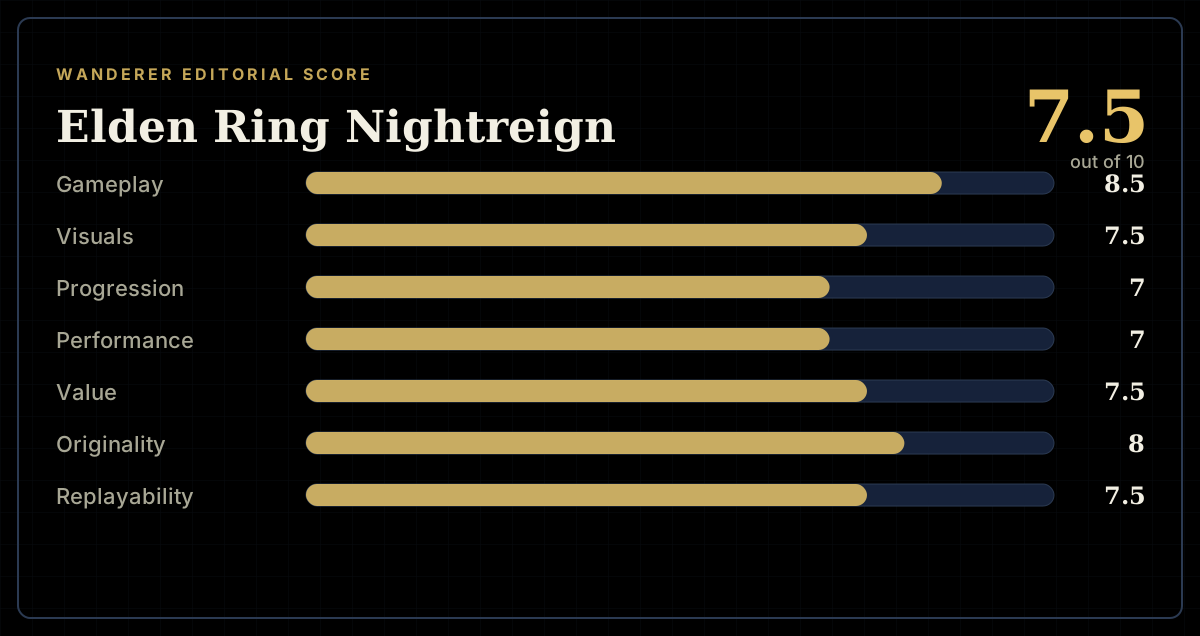
How the review scores each part of the gameWanderer Editorial -
The short versionWanderer Editorial