Game review
Elden Ring
9 / 10
- Developer
- FromSoftware
- Publisher
- Bandai Namco Entertainment
- Released
- 25 February 2022
- Platforms
- Windows, PlayStation 4, PlayStation 5, Xbox One, Xbox Series X|S, Nintendo Switch 2
- Genre
- Action RPG
- Monetisation
- Premium, one-off purchase; Shadow of the Erdtree expansion sold separately
- Players
- Online co-op (up to three, via summon signs) and invasion-based PvP; no offline multiplayer
The short version
Elden Ring is what happens when a studio that built its reputation on tight, hand-authored corridors decides to remove the corridors and keep everything else. The result is the best argument yet that open-world design and Soulslike difficulty aren't in tension — most of the time, the openness is the thing that makes the difficulty bearable, because a wall you can't get past is a wall you can walk around. It costs the series some of its pacing discipline: catacombs repeat, boss fights get reused as regular enemies, and the game explains almost nothing about its own systems. Shadow of the Erdtree adds a whole extra region built to the same standard, at a difficulty spike sharp enough that FromSoftware patched it down within weeks of launch.
Biggest strengths
- Six broad, distinct regions reward genuine exploration with real gear, spells and lore rather than filler collectibles
- Getting stuck on a boss has an actual escape valve — go level up, find better gear, or fight someone else first
- Ashes of War let almost any weapon be reshaped with a new skill and elemental infusion, keeping build variety high late into a run
Biggest weaknesses
- Catacombs, tunnels and hero graves reuse the same handful of floor plans and the same recurring mini-bosses well past the point of novelty
- The game offers almost no in-fiction explanation of stat scaling, ashes of war affinities or how weapon requirements interact with damage
- Several late-game and DLC bosses lean on long, low-recovery combo strings that reward memorisation over the earlier fights' emphasis on reading an opponent
Who it's for: Players who already like Dark Souls or Bloodborne and want the format expanded rather than replaced; anyone who enjoys exploration being rewarded with actual content instead of collectible markers; players comfortable engineering their own difficulty curve by going elsewhere when a fight isn't landing.
Our recommendation: Buy it. At NZ$99.99 for a game this large, this replayable and this rarely discounted, it's one of the better value propositions in the genre — just go in accepting that nobody is going to explain the stat system to you, and that Shadow of the Erdtree is a proper difficulty step up, not a victory lap.
9 / 10
Every FromSoftware game before this one was built like a locked house. You entered through one door, and the level design decided, room by room, exactly when you'd meet the next threat and how prepared you'd be for it. Elden Ring took that house and knocked every wall down. What's left is still recognisably a FromSoftware game — the same stamina-managed combat, the same punishing enemy movesets, the same bonfire-adjacent checkpoints now called Sites of Grace — but the player gets to decide the order everything happens in, and that one change reshapes almost every other design decision in the game. Released 25 February 2022 for PC, PlayStation 4/5 and Xbox One/Series X|S — with a Nintendo Switch 2 release confirmed for 28 August 2026 — Elden Ring is a fantasy world co-designed with novelist George R. R. Martin, directed by Hidetaka Miyazaki, and it remains the clearest evidence that the Souls formula was never actually about corridors. It was about consequence. The corridors were just the delivery mechanism.
What openness actually buys you
The obvious pitch for an open-world Souls game is more space to explore, and Elden Ring delivers that — the Lands Between is genuinely enormous, six broadly distinct regions from the green fields of Limgrave to the ash wastes beyond the capital, each with its own visual identity and its own density of dungeons, ruins, camps and hidden bosses. But the more important thing the open world buys is a release valve for difficulty. In Dark Souls, a boss you can't beat is a hard stop — you grind the same enemies in the same corridor until you're strong enough, or you get better at the fight, and those are frequently your only two options. In Elden Ring, a boss you can't beat is a suggestion to go somewhere else. Every region has its own web of side dungeons, and every side dungeon has runes, talismans, spirit ashes or a whole new weapon category waiting in it. Walk away from a wall, get stronger somewhere else, come back later — the game is built to make that digression feel like progress rather than an admission of defeat.
That single structural choice is why Elden Ring is simultaneously one of the hardest big-budget games ever to sell thirty million copies and one of the more approachable entries in its own studio's catalogue. The difficulty curve isn't actually flatter than Dark Souls' — several fights here are as hard as anything FromSoftware has made — but the curve is optional in a way it never used to be. You choose how much of it you climb before you're ready.
This is also where the game splits its audience most cleanly. Players who came from Dark Souls or Bloodborne looking for that series' tightly wound, no-detours difficulty tend to find the open world's escape valve almost too generous — it's possible to walk past most of the game's hardest required bosses at a level where they're barely a threat, simply by exploring thoroughly first, which blunts the tension those games built their reputation on. Players coming from other open-world RPGs, expecting the genre's usual light-touch difficulty, tend to find the opposite problem: even with every escape valve used, several required bosses — Margit, Godrick, Radahn, Malenia — are still hard, sometimes brutally so, in a way most open-world games never ask of anyone. Elden Ring's real trick is that both of those reactions are correct descriptions of the same design. It isn't easier than Dark Souls and it isn't as merciless either; it just lets you decide, fight by fight, which one it's going to be for you.
The cost of that freedom is pacing. A linear FromSoftware level is a carefully sequenced argument: this enemy teaches you this lesson, this ambush punishes you for not learning it, this boss tests whether you did. An open world can't sequence anything, because it doesn't know what order you'll encounter things in, so a huge amount of Elden Ring's content is built to work in any order — which in practice means a lot of it is generic. Catacombs, tunnels and hero's graves are the clearest example: dozens of near-identical stone dungeons, many sharing the exact same floor plan, populated by a rotating cast of the same handful of mini-bosses — the same Cemetery Shade, the same Ulcerated Tree Spirit, the same Crucible Knight — showing up again and again across the map, sometimes as the dungeon's climax and sometimes as a regular enemy blocking a corridor two hours later. The legacy dungeons — Stormveil Castle, Leyndell, Raya Lucaria — are still hand-authored, still excellent, and still feel like classic FromSoftware level design. It's the connective tissue between them that shows the seams of a studio working at a scale it hadn't attempted before.
Combat that still rewards reading, mostly
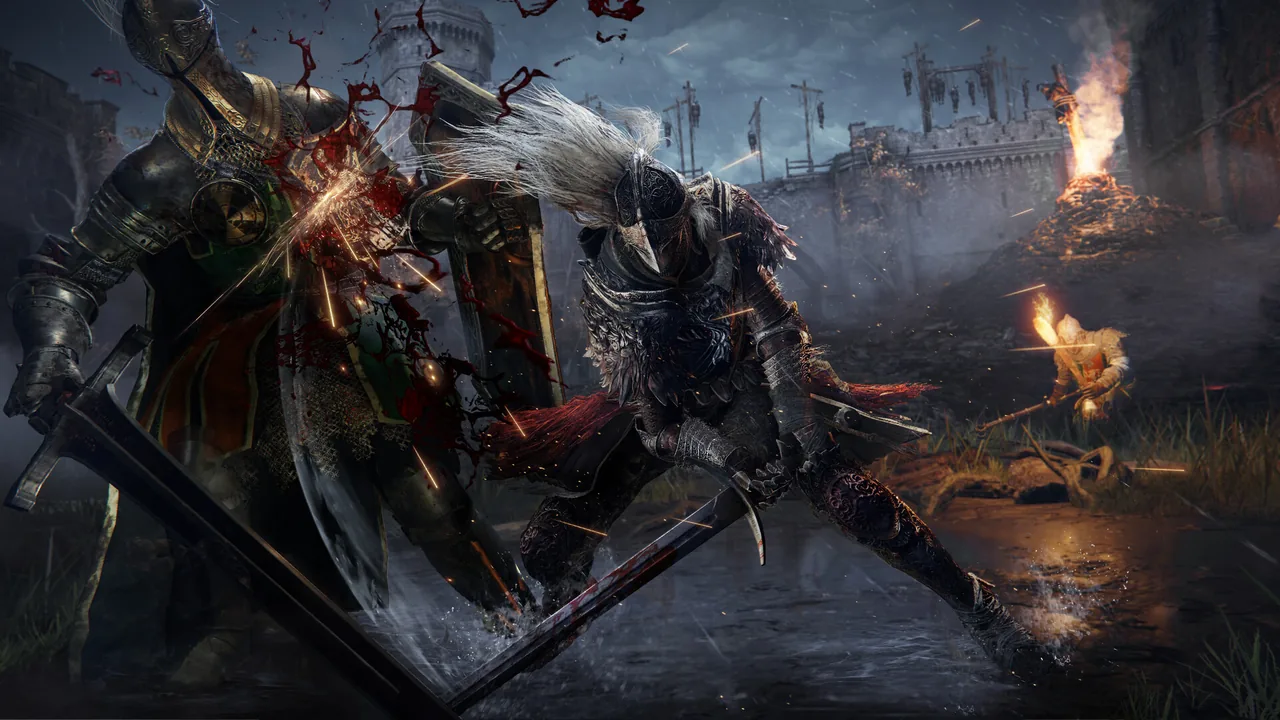
The moment-to-moment fighting is the part of the Souls formula Elden Ring didn't touch, and it didn't need to — stamina-gated attacks, i-frame dodges, weapon weight dictating your options, and bosses whose movesets you're expected to learn through repeated, informative deaths. What's new is Ashes of War, a system that lets almost any weapon be fitted with a skill (a guard counter, a leap attack, a ranged projectile) and an elemental or status affinity, independent of the weapon's base type. It's a genuinely clever piece of design: it means a straight sword and a curved sword aren't just stat-different, they can be built into completely different tools, and it goes a long way toward making unusual weapon choices viable instead of a novelty run.
Boss design mostly holds up to that same standard through the base game — big, telegraphed, readable attacks that punish greed rather than punishing failure to memorise. Where it strains is the back half of the main story and, more pointedly, in Shadow of the Erdtree: several of the hardest fights lean on long combo strings with minimal recovery windows between attacks, favouring players who've fought the boss enough times to know exactly when the string ends over players reading body language in real time. That's a real shift in what the game is asking of you, and it's worth being upfront that "get stronger elsewhere" — the base game's classic escape valve — helps less against a boss whose problem isn't your stats, it's the length of an unbroken attack chain.
Progression with almost no instructions
Elden Ring's other defining trait, for better and worse, is that it explains close to nothing about its own systems. There's no tutorial screen breaking down how Strength scaling interacts with a weapon's requirement, no in-game guidance on what an Ashes of War affinity actually changes numerically, no clear signposting of which stat governs which spell school. Everything is inferable from item descriptions if you read carefully and cross-reference, and a sizeable amount of the community's collective knowledge of how builds actually work came from players datamining and testing rather than anything the game tells you directly. For players who enjoy that kind of discovery, it's part of the appeal — Elden Ring trusts you to work things out. For players who just want to know whether a new sword is an upgrade, it's a genuine barrier, and it's the single most common reason newcomers bounce off character building even when they're enjoying the combat and exploration.
Runes — the game's shared currency and experience system — keep the classic Souls risk built in: die and you drop them at your death location, and dying again before recovering them loses them for good. It's a smaller sting here than in earlier games precisely because the open world gives you somewhere else to go if a particular death spot is proving fatal to revisit.
Shadow of the Erdtree, and the difficulty conversation it started
Released 20 June 2024 for NZ$64.99, Shadow of the Erdtree is not a coda — it's a full region, the Land of Shadow, built with the same density of legacy dungeons, side content and hidden bosses as anything in the base map, anchored by a story arc about Miquella and a returning, transformed Radahn that stands as some of the highest-budget content FromSoftware has ever produced for a single expansion. Critically it landed close to the main game — Metacritic sat at 95 on Xbox Series X, 94 on PS5 and 92 on Windows — but the player conversation around it was noticeably rockier, and it's worth being factual about why.
The expansion's own scaling system, Scadutree Blessings, is the mechanism that's supposed to keep you powerful enough to survive the Land of Shadow's harder enemies — you find fragments scattered through the new region and spend them to boost attack and defence specifically within the DLC. At launch, the fragments were sparse enough, and the enemy damage numbers steep enough, that a significant portion of the playerbase found early Shadow of the Erdtree bosses — the consort Radahn fight in particular — considerably harder than anything the difficulty curve up to that point had prepared them for. Director Hidetaka Miyazaki responded publicly that lowering the underlying difficulty would undermine what the studio was trying to build, but FromSoftware did ship a calibration patch shortly after launch that increased Scadutree Blessing effectiveness early in the expansion, which meaningfully softened the opening hours without touching the boss designs themselves. That's a genuine, documented middle ground — the studio didn't nerf the fights, it adjusted how quickly you're allowed to get strong enough to meet them.
The Steam numbers still show the difference in reception: the base game sits at Very Positive with roughly 93% approval across some 825,000 reviews, while Shadow of the Erdtree sits at Mostly Positive, around 71% across roughly 82,000 reviews — a real, measurable gap rather than a vocal minority. Worth being precise about what that gap is and isn't: it's not a quality complaint about the new region, story or content volume, which reviewers and players both rate highly. It's specifically a difficulty-and-pacing complaint from a slice of the audience who felt the expansion front-loaded its hardest demands before giving them the tools to meet them, and that's a fair, specific criticism rather than a vague one.
World, sound and running the thing
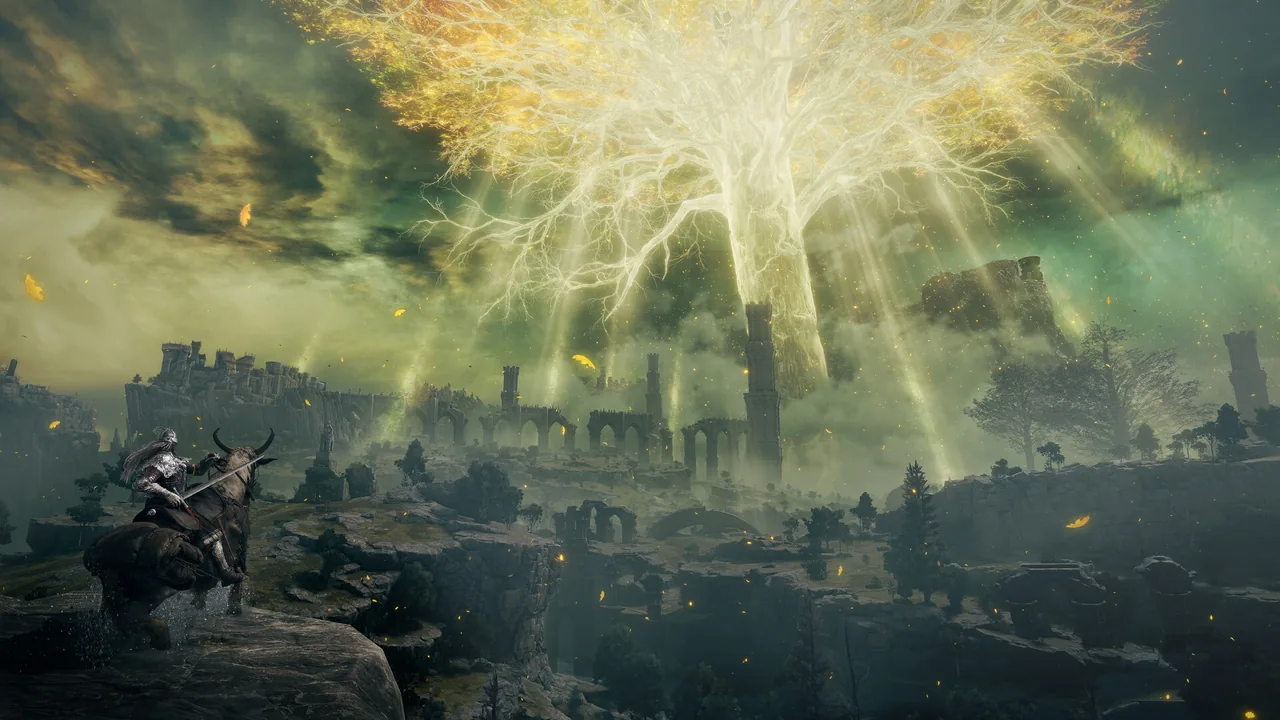
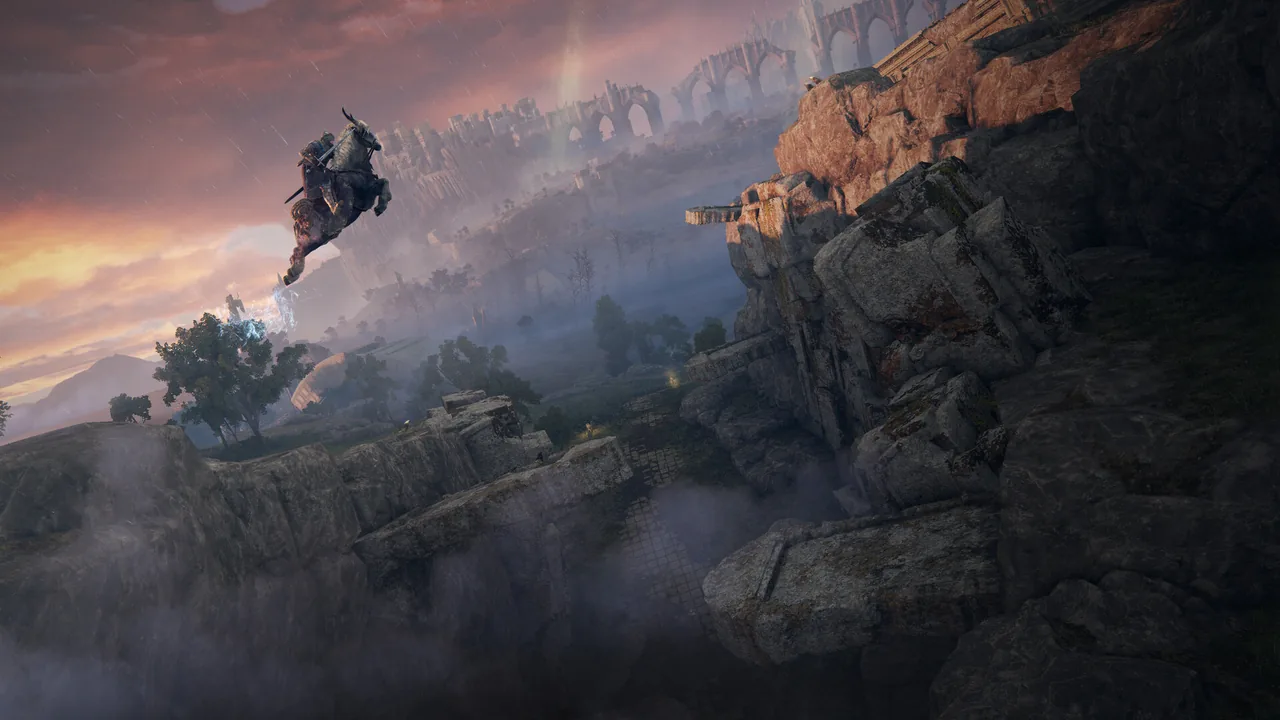
Visually, Elden Ring is one of the more striking fantasy worlds in the genre — not through raw technical fidelity but through composition: the silhouette of a distant castle against a golden sky, the scale of a dragon circling above a swamp you're about to walk into. Sound design carries an enormous amount of the tension in boss fights specifically — the exact right amount of warning before a big swing lands, footsteps and breathing cues that reward paying attention with your ears as much as your eyes. Where the presentation shows its age is performance: more than four years after release, PC and PS5 versions still exhibit frame pacing stutters during dense particle effects and certain boss transformations, a known and long-standing issue rather than anything specific to this review.
Multiplayer runs on the series' traditional summon-sign system — dropping and picking up cooperative summon signs, or invading another player's world for PvP — rather than anything resembling modern matchmaking. It works, and it's genuinely fun when it connects, but it can be finicky about connection and region, and it asks more patience of a co-op group than most contemporary online games do.
Verdict
Elden Ring earns its reputation honestly. Turning the Souls formula loose in an open world doesn't just make it bigger — it changes what the difficulty is for, because for the first time a wall you can't get past has an obvious door around it. That's a real design achievement, and it's the reason this holds up as one of the best action RPGs of the decade rather than just the biggest one. It's not without cost: the connective dungeons repeat past the point of novelty, the systems are explained to you almost not at all, and both the late main game and Shadow of the Erdtree lean harder on combo memorisation than the earlier, more patient fights that built the studio's reputation. Shadow of the Erdtree in particular is worth buying for the content and worth going in knowing it asks more of you, quickly, than the base game ever did — that's a documented, addressed issue, not an ongoing one.
Nine out of ten reflects a genre-defining game with a small number of specific, real flaws rather than a perfect one. If you've bounced off Souls games before because the difficulty felt like a locked door, this is the version of the formula built to let you walk around it instead. If you've already finished it and are looking for something built around the same bones in a much shorter session, our review of Elden Ring Nightreign covers what FromSoftware did when it compressed this same combat into a co-op roguelite instead.
Pricing checked 30 July 2026.
Pros and cons
Pros
- Six broad, distinct regions reward genuine exploration with real gear, spells and lore rather than filler collectibles
- Getting stuck on a boss has an actual escape valve — go level up, find better gear, or fight someone else first
- Ashes of War let almost any weapon be reshaped with a new skill and elemental infusion, keeping build variety high late into a run
- Boss choreography stays readable even at its most aggressive, so losing usually feels like a mistake you can name
- Shadow of the Erdtree adds a full region and story arc built to the base game's own standard, not a token epilogue
Cons
- Catacombs, tunnels and hero graves reuse the same handful of floor plans and the same recurring mini-bosses well past the point of novelty
- The game offers almost no in-fiction explanation of stat scaling, ashes of war affinities or how weapon requirements interact with damage
- Several late-game and DLC bosses lean on long, low-recovery combo strings that reward memorisation over the earlier fights' emphasis on reading an opponent
- Multiplayer runs on a summon-sign and password system that feels dated next to modern matchmaking, and can silently fail to connect
- Performance on PC and PS5 still shows frame pacing stutters during heavy particle effects, more than four years after launch
Screenshots
-
ELDEN RINGImage: FromSoftware, Inc. via Steam -
ELDEN RINGImage: FromSoftware, Inc. via Steam -
ELDEN RINGImage: FromSoftware, Inc. via Steam -
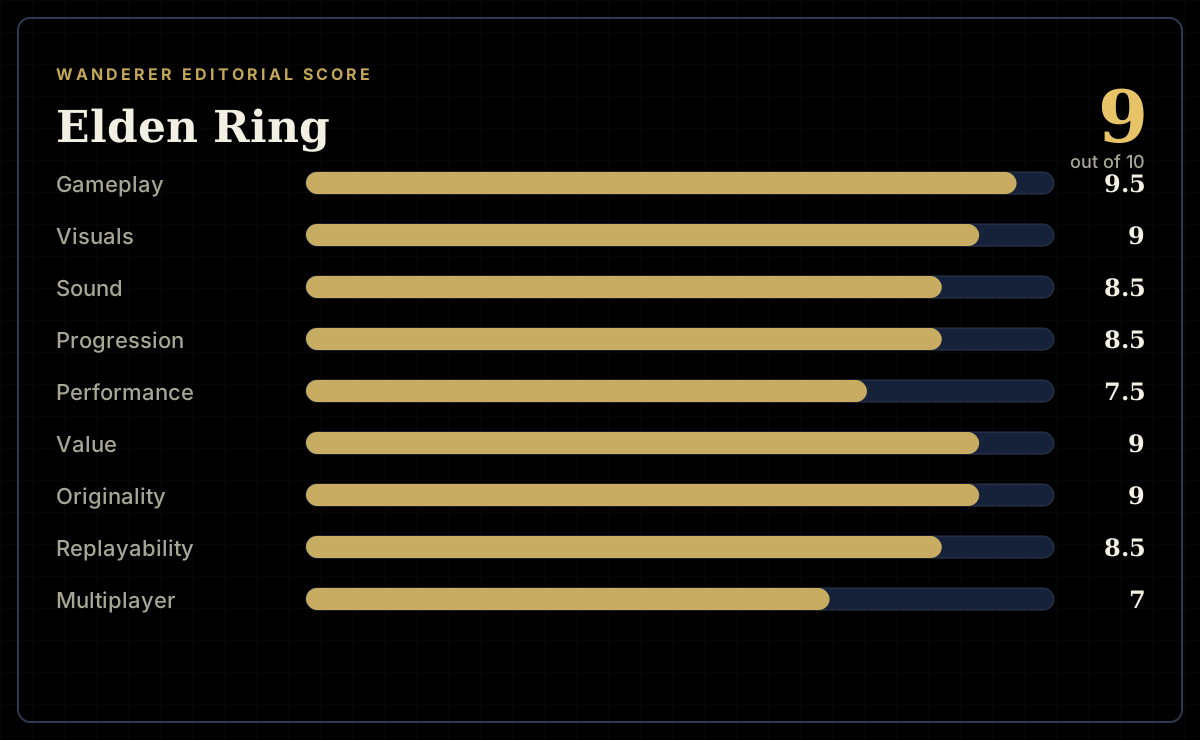
How the review scores each part of the gameWanderer Editorial -
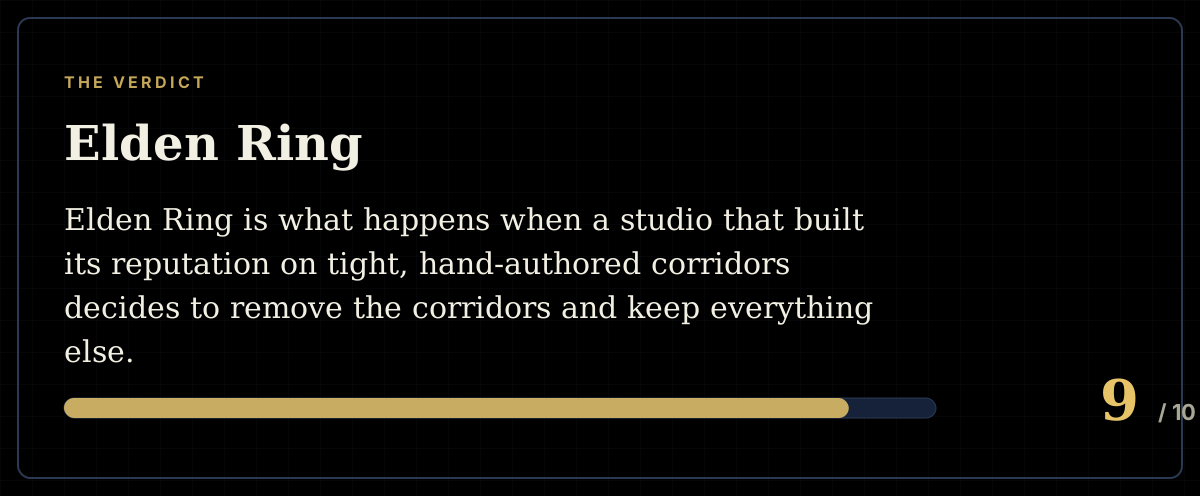
The short versionWanderer Editorial