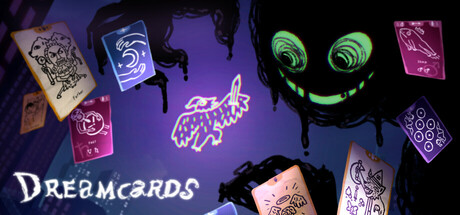
Game review
Dreamcards Review
8.5 / 10
- Developer
- Soneka Games
- Publisher
- Vsoo Games
- Released
- 19 August 2026
- Platforms
- ["Windows", "Linux"]
- Genre
- Strategy
A Roguelike Deckbuilder About Dreams, Memories, And The Nightmare That Wants Your Deck
Dreamcards, developed by Soneka Games and published by Vsoo Games and Soneka Games, released on Steam on August 19, 2026, at $9.99. It's a roguelike deckbuilder where the cards you draft during the day, representing memories, relationships, and everyday actions, become the deck you use each night to fend off a nightmare, with the whole thing wrapped in a hand-drawn, tarot-and-psychoanalysis-flavored aesthetic. Across all 55 English reviews read in full here, comfortably past this review's minimum sample, every single one of them positive, out of an all-language pool of 110 reviews sitting at 99% positive, "Very Positive" on Steam's own scale, this is a small team's first game that has landed with almost no dissent at all.
A Genre Awash In Slay The Spire Clones, And Reviewers Say This Isn't One
The most consistently repeated praise in this pool is that Dreamcards carves out real distance from the deckbuilding-roguelike genre's dominant template rather than iterating on it. "It also has a lot of content, with some really cool systems that won't even appear on your first run, and many unlockables... it has many similarities with games like Dominion, and doesn't feel at all like a copy of Slay the Spire or Balatro," wrote one reviewer. Another reviewer, a self-described "big fan of deckbuilding roguelikes (Slay The Spire, etc.)," was relieved to find the same thing: "The game does not disappoint!" A third put the comparison even more specifically: "This feels closer to a solo board game than a StS or Balatro-like in a good way," while another called it "a solo version of Star Realms mixed with the deck comboing potential of something like Yu-Gi-Oh or Slay the Spire 2." The throughline across this pool isn't that Dreamcards abandons the genre's mechanics, it's that reviewers repeatedly credit it with finding its own identity inside a genre that has, by their own account, become crowded with imitators.
Building Your Deck During The Fight Itself, Dominion-Style, Rather Than Between Runs
According to the game's own store page, matches split into a day phase, where players draft cards from six different strategy types, and a night phase, where those cards are played against the nightmare to accumulate points across seven nights, with the deck itself getting bought and reshaped mid-match rather than only between encounters. Reviewers repeatedly single this structure out, and repeatedly reach for the same specific comparison to describe it: "The deckbuilding is really fun, especially if you like games like Dominion," wrote one, echoed almost exactly by another who called the game "a single player dominion" and a third who described "deckbuilding mechanics reminiscent of dominion, and the more 'solitaire-like' style is a nice break from all the deckbuilders that focus on combat mechanics." One reviewer who has logged over 47 hours (2,834 minutes) elaborated on why that structure matters: it lets "deckbuilding-players find a lot" to chew on without the game ever feeling like a straightforward reskin of a combat-focused predecessor.
A Distinctive Dream-Logic Aesthetic Built Around Jung, Freud, And Genuinely Strange Card Names
Reviewers are just as consistent about the game's tone and presentation as they are about its mechanics. "As a psychology student myself, its been really fun to play it and discover how this wonderful team managed to input a bit of psychoanalysis into the game," wrote one reviewer. Another described the effect directly: "I like the use of Jung/Freud dream concepts and the art for the interactions and monster animations." A third, writing in Portuguese, praised "a temática envolvendo a filosofia do Carl Jung" (the theme involving Carl Jung's philosophy) as "um twist bem diferente" (a genuinely different twist) for the genre. One particularly memorable review captured the game's dream-logic storytelling in action: after describing a surreal, unsettling family dream sequence generated by the game's card interactions, the reviewer simply wrote, "Wait... what...?" before praising the deckbuilding underneath it. The hand-drawn art and its "goofy," "whimsical," and "cursed" (reviewers' own words, used approvingly) character designs come up in nearly every review in this pool, frequently cited as the thing that first caught a buyer's attention before the mechanics sealed the deal.
Real, Specific Balance Concerns Sit Alongside The Praise
Not every note in this pool is unqualified. One reviewer flagged a genuine difficulty problem: "the asthetic and storytelling is really cool. Unfortunately it is way too easy. I was able to get an infinite in both of my first 2 runs of the game quite easily. If you have deckbuilder game expirience this may not be for you." Another, eight hours and 43 of 100 unlocks in, raised a related concern about content variety: "I am starting to feel as if the performance cards are very similar. As they usually all have a mix of the same 4 effects." A third reviewer made a similar observation about consistency: "The one thing I will say I personally don't like about the game is how consistent each run feels once you know what you're doing." None of these reviewers walked back their overall recommendation, but together they sketch a specific, credible concern: for players who already know the deckbuilding-roguelike genre well, Dreamcards' current difficulty ceiling and card-pool depth may not hold up over dozens of runs the way its presentation immediately does.
A Small Team's First Game, Priced Fairly For What It Delivers
On value, this pool is close to unanimous. "For a small teams first game, this is an amazing one and is worth the 10 dollars, Please treat yourself," wrote one reviewer who received a review key and streamed it. Another, more bluntly: "The price is also fair." A third called it simply "a hidden indie gem I wish more people knew about" after trying the free demo first, a path several reviewers in this pool describe taking before buying on release day. Reported playtimes in the pool run notably high for a $9.99 release, several well past 20 hours and one past 47, a strong practical signal that the loop holds up in actual play even for the reviewers who flagged its ceiling.
Verdict
Dreamcards is a confident, distinctive first game from Soneka Games, one that takes a genre currently thick with Slay the Spire and Balatro imitators and finds real, reviewer-confirmed separation from both, leaning instead on Dominion-style mid-match deckbuilding and a genuinely strange, psychoanalysis-flavored dream aesthetic that reviewers across multiple languages single out unprompted. Its difficulty curve can be broken by experienced deckbuilder players faster than the game seems to intend, and its card pool, while large, draws some specific "these all feel similar" criticism from committed players deep into their unlock progress. But at $9.99, with a free demo available to try first and a genuinely unanimous reception across 55 English and 110 all-language reviews, this is an easy, confident recommendation, especially for anyone tired of the genre's more derivative entries.
Screenshots
-
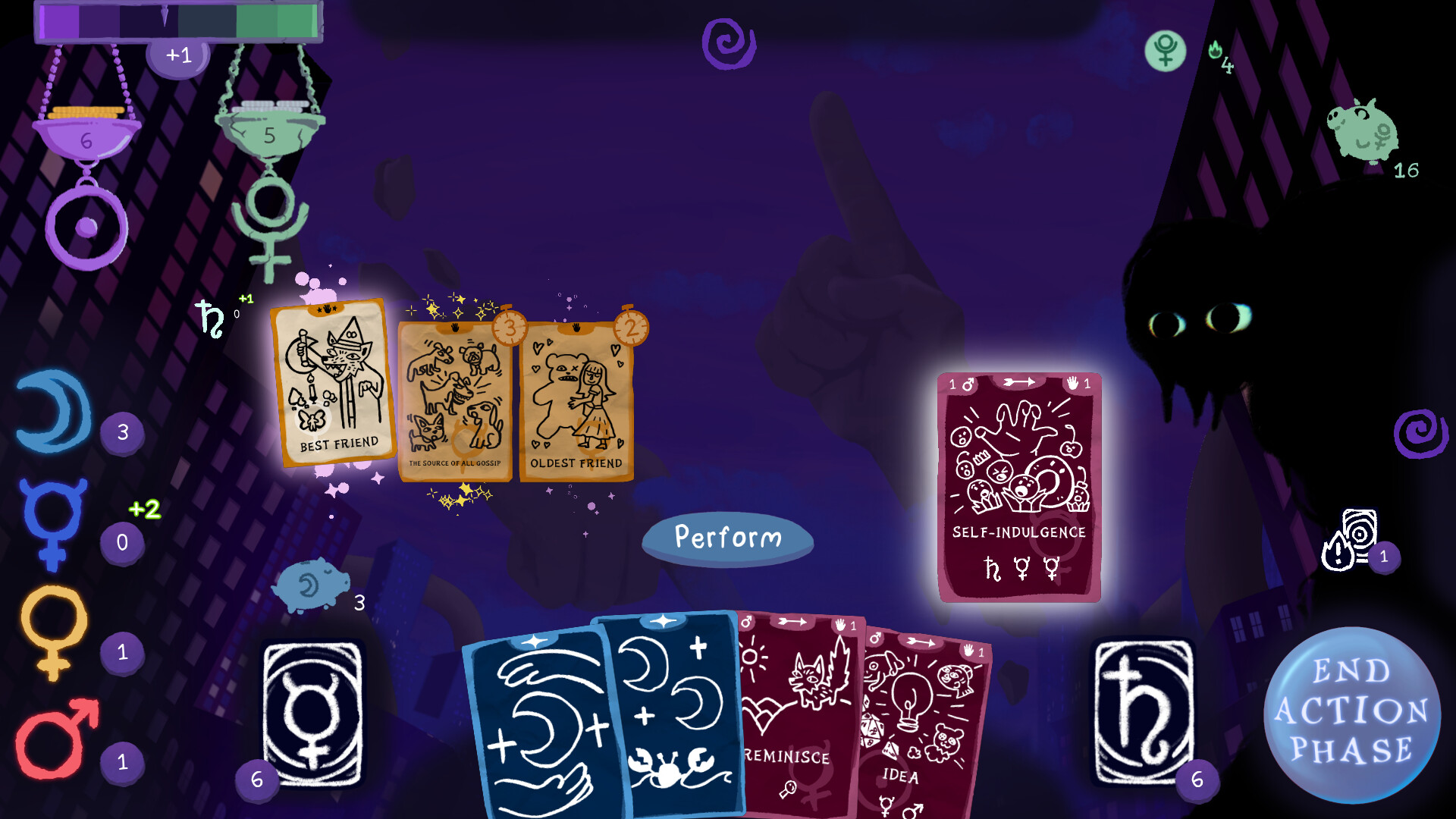
A night-phase confrontation with the nightmare, memory cards like Best Friend and Oldest Friend played against astrological resource symbols, the Dominion-like structure reviewers keep coming back to.Image: Soneka Games via Steam -
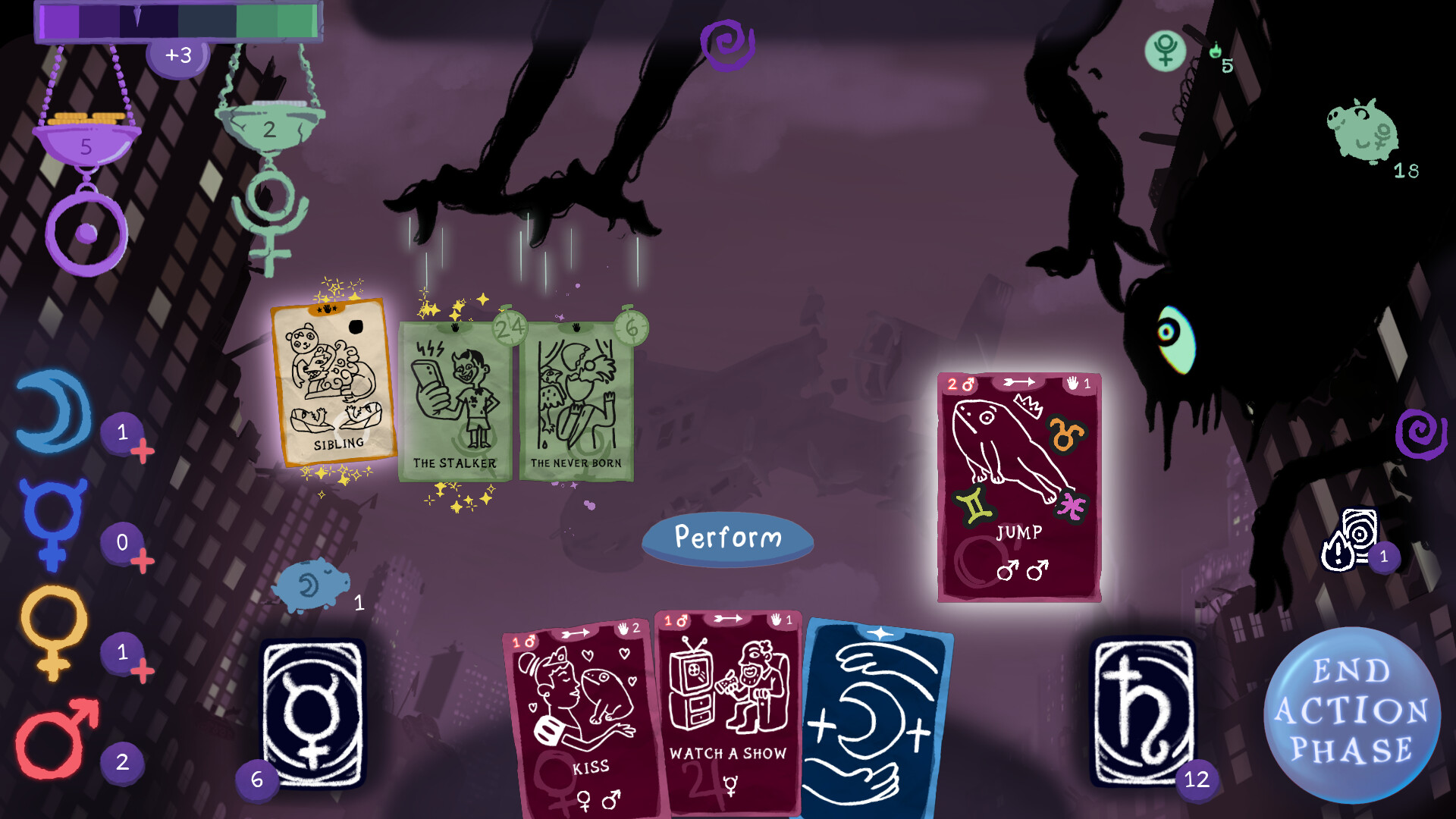
A later, busier deck with cards named Sibling, The Stalker, and The Never Born, the kind of dark, specific memory-card naming reviewers cite as core to the game's dream-logic storytelling.Image: Soneka Games via Steam -
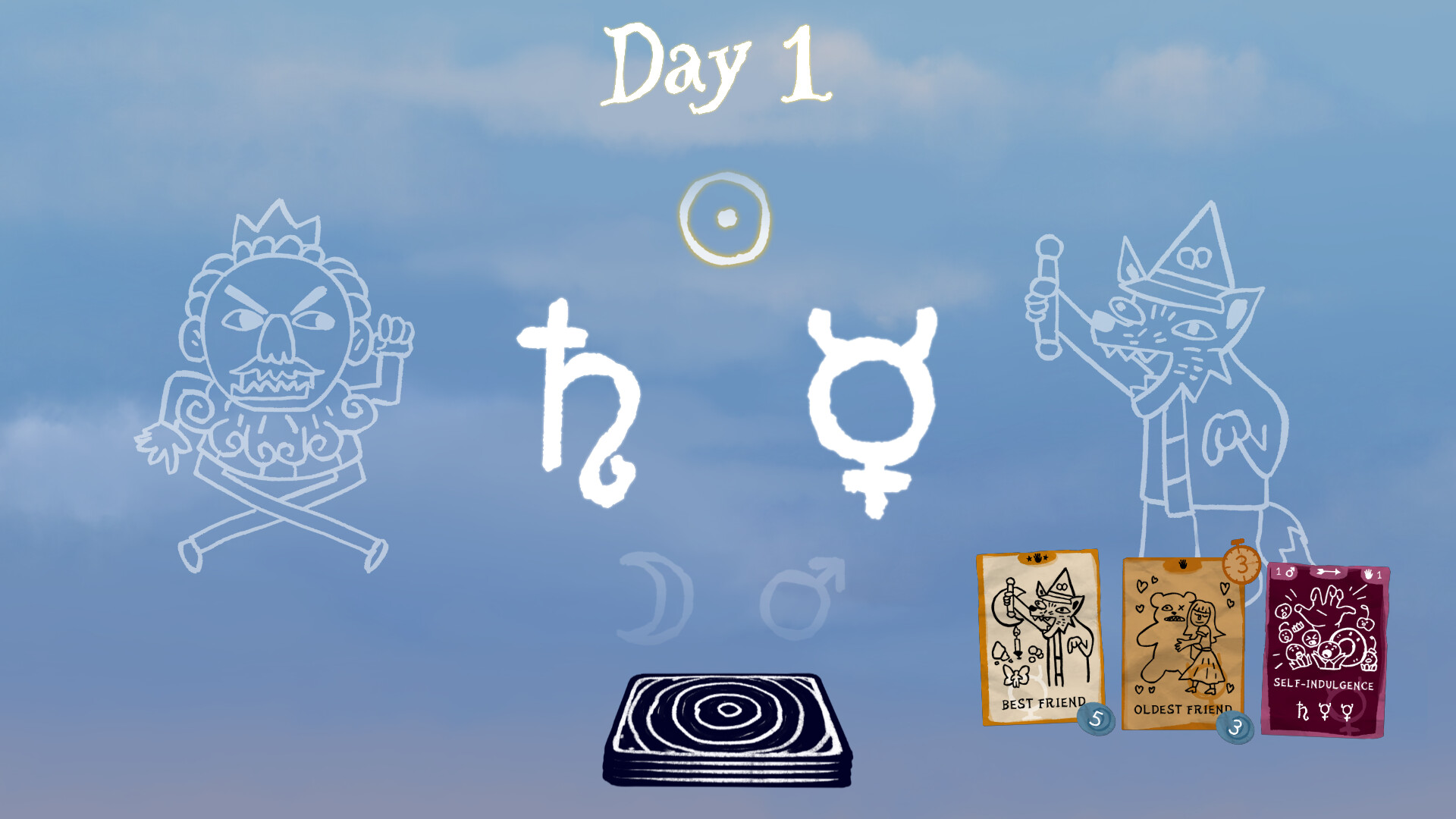
The start of a new day, the game's astrological and dream-tarot framing announced before a single card is drawn.Image: Soneka Games via Steam