Game review
Dinoblade
7 / 10
- Developer
- Team Spino LLC
- Publisher
- Team Spino LLC, Boltray Games
- Released
- 23 July 2026
- Platforms
- Windows
- Genre
- Action RPG
- Monetisation
- Premium, one-off purchase
- Players
- Single-player
The short version
Dinoblade turns a single viral clip of a Spinosaurus swinging a Great Sword into a genuinely playable Soulslike, and the combat mostly earns the comparisons to Sekiro and Monster Hunter it invites. What it can't yet do is finish the job a bigger team would have — a short campaign, a handful of unfair-feeling boss patterns, and visible rough edges keep it from being more than a very promising first outing.
Biggest strengths
- The core sword combat — combos, directional dodges, parries — genuinely delivers on the viral clip's promise of weight and spectacle
- Defeated bosses become summonable allies that grant both an active attack and a passive stat bonus, giving progression a build-crafting layer beyond flat numbers
- A distinctive, high-energy soundtrack and a game willing to be funny about its own premise (dinosaurs with swords, and it knows it)
Biggest weaknesses
- Several boss fights lean on rapid, near-unblockable attack strings that read as difficulty-through-unfairness rather than difficulty-through-clarity, especially from the third region onward
- The campaign is short for a full-price Soulslike — most players finish in four to eight hours, and a handful of reviewers who 100%'d it landed close to twelve
- Parrying rewards you with backward knockback rather than an opening, which stalls momentum in exactly the fights that most need it
Who it's for: Soulslike fans who want a shorter, cheaper, more absurd take on the formula, and anyone who remembers the original animation and wants to see it become a real fight.
Our recommendation: Worth buying at its current price for players who already like parry-and-dodge combat and can forgive a rough final third — try the free demo first if you're on the fence about the deflection timing, since that's the mechanic most likely to make or break the game for you.
7 / 10
Four years ago, a Sucker Punch animator named Jean Nguyen posted thirty seconds of a Spinosaurus swinging a sword the size of a rowboat, purely as a portfolio piece. It went viral because it looked like something out of Monster Hunter or Devil May Cry, except the thing holding the weapon had teeth instead of a face. Dinoblade is what happens when that clip doesn't just get liked and forgotten — it's a full, funded, one-developer Soulslike built to prove the fantasy in the animation could survive becoming an actual game you control. Mostly, it does. The combat that made the clip famous is still the best thing here. The rest of the game is still catching up to it.
The pitch, and why it mostly works
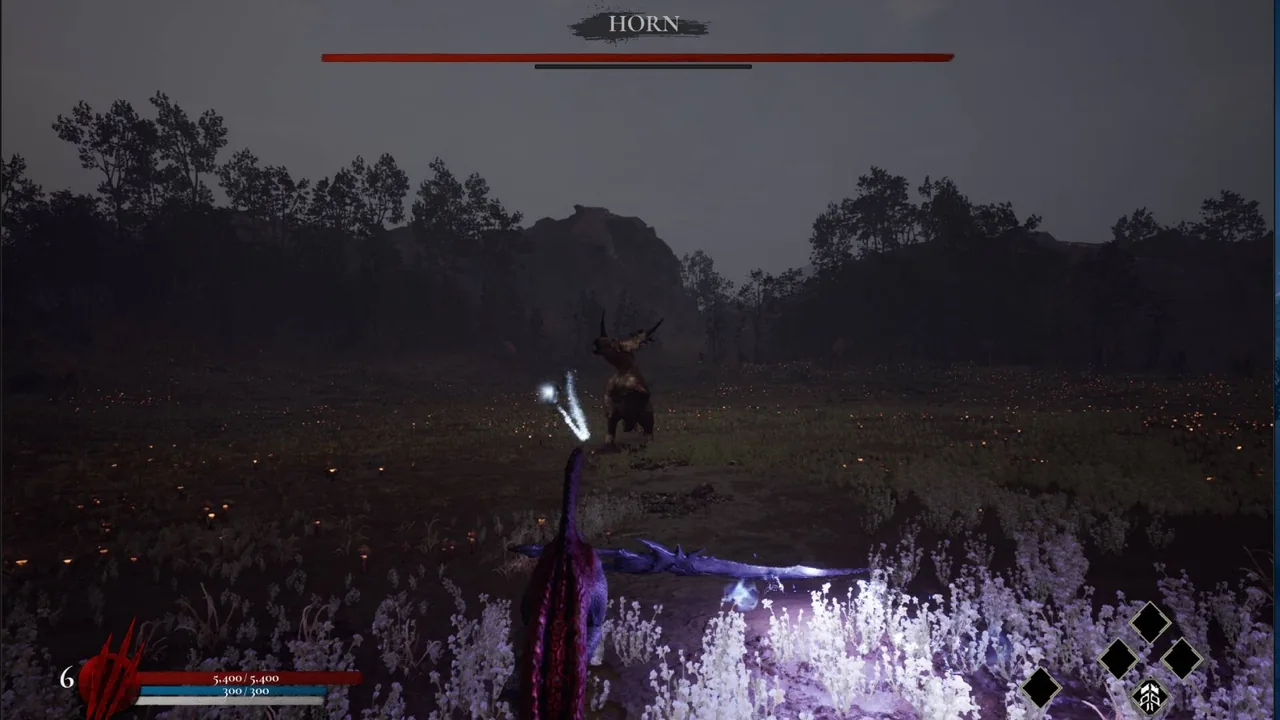
Dinoblade puts you in control of a young Spinosaurus carrying a colossal Great Sword, fighting across biomes ruled by rival dinosaur Alphas in a world reshaped by a cataclysmic extinction event. That's a thin premise and the game knows it — one of its own launch materials leans on "Conquer the Challenge" rather than story depth, and the plot mostly exists to string boss encounters together. What actually justifies the concept is the moment-to-moment combat: heavy, readable combo strings, directional dodges, and Sekiro-style parries that reward watching an enemy's wind-up rather than mashing a button. When a fight clicks, landing a clean parry into a finishing combo feels exactly like the viral clip promised it would — weighty, a little absurd, genuinely satisfying.
The problem is that "when a fight clicks" is doing real work in that sentence. The deflection window is noticeably less forgiving and less responsive than the game it's clearly borrowing from, and a successful parry knocks the target backward rather than opening it up — so instead of following a good read with a punish, you're often closing distance again before you can capitalize on it. Against a single boss with a clean attack pattern, that's a minor annoyance. Against the game's later encounters, several of which chain fast, semi-random attack strings with limited blockable windows, it turns momentum-killing into a recurring source of frustration rather than an occasional one. Players who've cleared other Soulslikes will recognize the difference between a fight that's hard because it's demanding and one that's hard because the tools you're given don't quite match what the encounter is asking of you. Dinoblade has fights of both kinds, and the ratio gets worse as the campaign goes on.
Progression that rewards fighting, not farming
Where Dinoblade distinguishes itself from a generic parry-em-up is what happens after a boss goes down. Defeated Alphas don't just disappear — they become summonable allies, each granting an active ability alongside a passive stat bonus, which turns the boss roster into a build-crafting resource rather than a checklist. Points earned from victories feed a small, direct stat spread (health, stamina, mana, strength) alongside four unlockable special attacks, so the skill tree never becomes the kind of sprawling, second-job system some genre entries lean on. It's a light touch, and it works in the game's favor: you're never staring at a menu deciding between a dozen nearly identical upgrade nodes, you're deciding which dead rival's power you want fighting beside you next.
That said, the systems don't run especially deep, and the campaign doesn't give them long to breathe. Player accounts of clear times cluster between four and eight hours for a first playthrough, with a full 100% completion — story, side content, all summons — landing closer to twelve for players who go out of their way to find everything. For a full-price release, that's on the short side even by Soulslike standards, where a shorter runtime is more forgivable than in most genres because replays and skill mastery carry weight. Dinoblade does give you a reason to come back — a Boss Rush mode unlocks once the final boss falls, letting you replay every major fight back to back — but it's an endurance test built from content you've already seen, not new content, and it won't convert players who wanted more world to explore rather than more chances to re-fight what they already beat.
Presentation carries more than the tech does
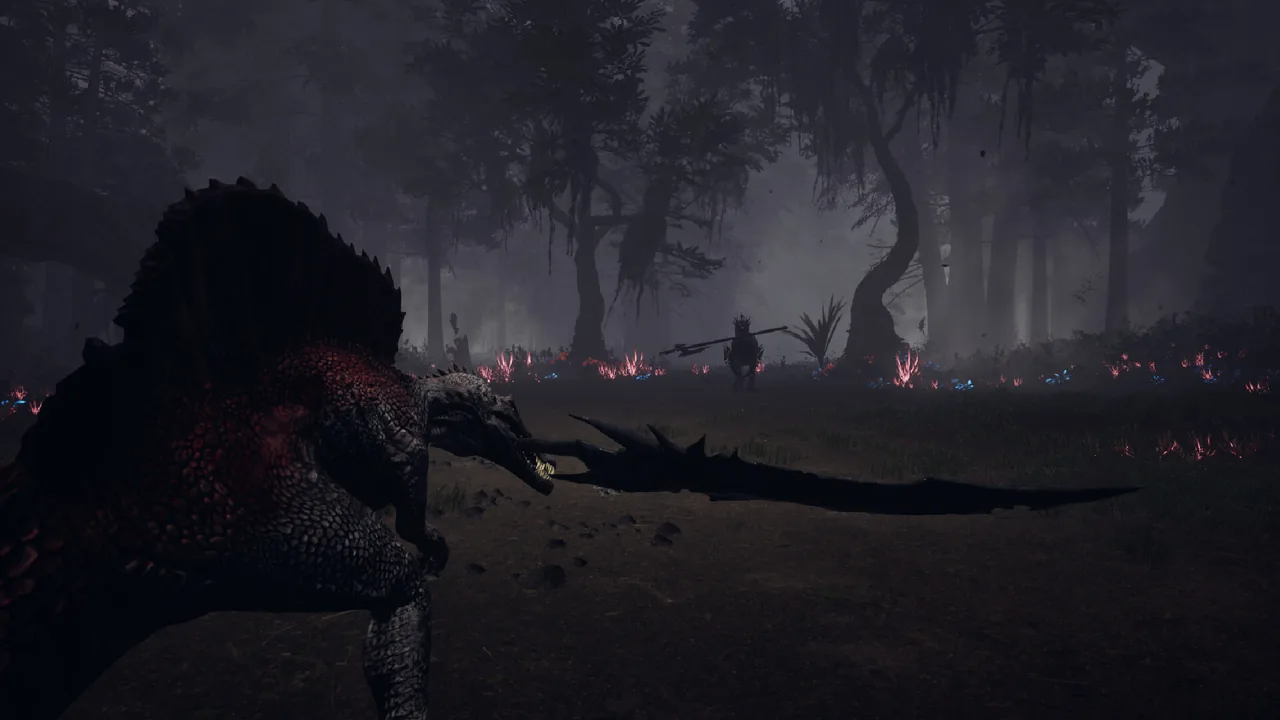
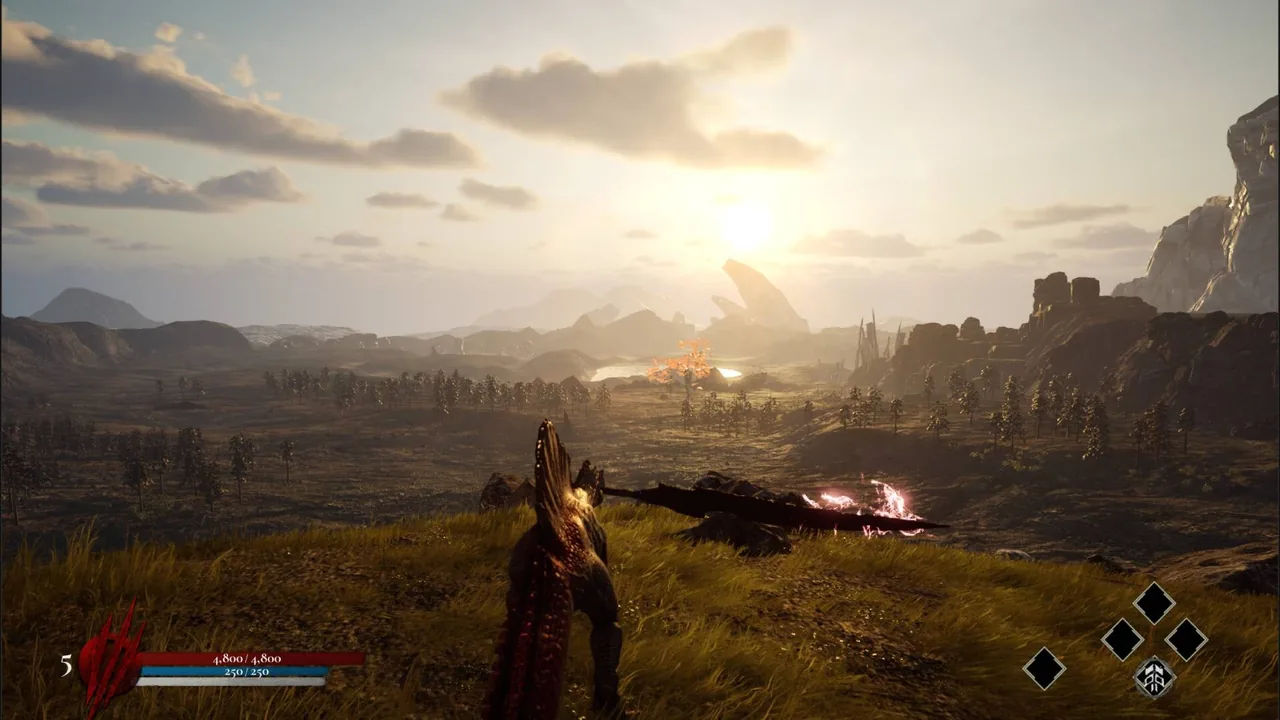
The soundtrack is one of the strongest, most consistently praised elements of the whole package — high-energy, a little theatrical, and clearly mixed to match the over-the-top premise rather than undercut it with something more restrained. The biome variety, from dry canyon to mist-shrouded jungle, gives each Alpha's arena a distinct visual identity, and the decision to let combat continue underwater is the kind of scope a solo developer usually cuts rather than ships. It's a game that clearly had more craft put into it than its origin story as a viral animation would suggest.
The seams show more on the technical side. Enemy AI occasionally stands idle mid-encounter rather than engaging, the lock-on camera can drop out during exactly the fast, multi-directional fights where you need it most, and text in places carries the kind of typo you'd expect a larger studio's localization pass to catch. None of this is disqualifying on its own — these are the visible marks of a team of one shipping a full-scope action RPG rather than a small vertical slice — but they add up across a playthrough, and a few of them (the camera drops specifically) intersect badly with the game's most demanding boss fights rather than staying confined to its quieter moments.
What player sentiment actually shows
Reception at launch is strongly positive — Very Positive on Steam, sitting around ninety percent positive across close to seventeen hundred reviews a week after release, which is a legitimately good result for a first commercial release from a one-person studio. Reading through that sentiment in bulk surfaces a consistent shape: praise clusters tightly around the combat feel, the soundtrack, and the sheer novelty of the premise actually working as a game rather than staying a gimmick, while criticism clusters just as tightly around the same two or three points — the short length relative to price, boss patterns that occasionally feel unfair rather than hard, and the knockback-on-parry design choice that keeps interrupting the game's own best moments. That's not a game with scattered, unrelated problems; it's a game whose strengths and weaknesses both trace back to the same small set of design decisions, which is generally a sign the underlying vision was sound even where the execution hasn't fully caught up to it yet.
A minority of players push further, arguing the "Soulslike" framing oversells what's here compared to genre benchmarks and that the concept needed a larger team and more development time to fully land. That reads as the harsher end of a real pattern rather than an outlier complaint — Dinoblade plays like exactly what it is: a genuinely talented solo developer's first full game, built on top of one spectacular idea, without the years of iteration a studio with a full combat-design team would have spent smoothing out the rough patches.
Players used to Wanderer's own approach to progression — where power is earned gradually and never demands split-second reflexes — should go in knowing Dinoblade asks for the opposite: precise timing under pressure, with real consequences for missing a read.
Final verdict
Dinoblade succeeds at the one thing it absolutely had to get right: making a viral animation's promise of a sword-wielding dinosaur feel as good under your own control as it looked in thirty seconds of someone else's demo reel. The combat has real weight, the boss-as-summon progression gives the RPG half of the equation genuine purpose, and the presentation — music especially — punches well above what a solo developer's budget usually buys.
It doesn't score higher because the things that would separate a good Soulslike from a genuinely excellent one are exactly where a bigger, more experienced team would have spent its remaining time: tuning boss patterns so difficulty reads as fair rather than random, fixing a parry system that punishes success with distance instead of opportunity, extending a campaign that a skilled player can finish in an afternoon, and polishing the visible seams — idle AI, camera drops, text errors — that a longer QA cycle would have caught. None of that erases what's genuinely good here. It just means Dinoblade is a strong first swing rather than a complete one, and the price should be weighed against a four-to-eight-hour campaign rather than the dozens of hours the genre's biggest names typically offer.
Price and Steam review data checked 30 July 2026.
Pros and cons
Pros
- The core sword combat — combos, directional dodges, parries — genuinely delivers on the viral clip's promise of weight and spectacle
- Defeated bosses become summonable allies that grant both an active attack and a passive stat bonus, giving progression a build-crafting layer beyond flat numbers
- A distinctive, high-energy soundtrack and a game willing to be funny about its own premise (dinosaurs with swords, and it knows it)
- Boss Rush mode unlocks after the final boss, giving completionists a reason to keep fighting once the story ends
- Underwater combat and full controller support show a level of craft beyond what a single-person studio's budget usually allows
Cons
- Several boss fights lean on rapid, near-unblockable attack strings that read as difficulty-through-unfairness rather than difficulty-through-clarity, especially from the third region onward
- The campaign is short for a full-price Soulslike — most players finish in four to eight hours, and a handful of reviewers who 100%'d it landed close to twelve
- Parrying rewards you with backward knockback rather than an opening, which stalls momentum in exactly the fights that most need it
- Typos, occasional idle enemy AI and lock-on camera drops are the kind of polish issues a larger QA pass would have caught
- No coop or multiplayer of any kind, and no roadmap for paid or free content has been confirmed at launch
Screenshots
-
DinobladeImage: Team Spino LLC via Steam -
DinobladeImage: Team Spino LLC via Steam -
DinobladeImage: Team Spino LLC via Steam -
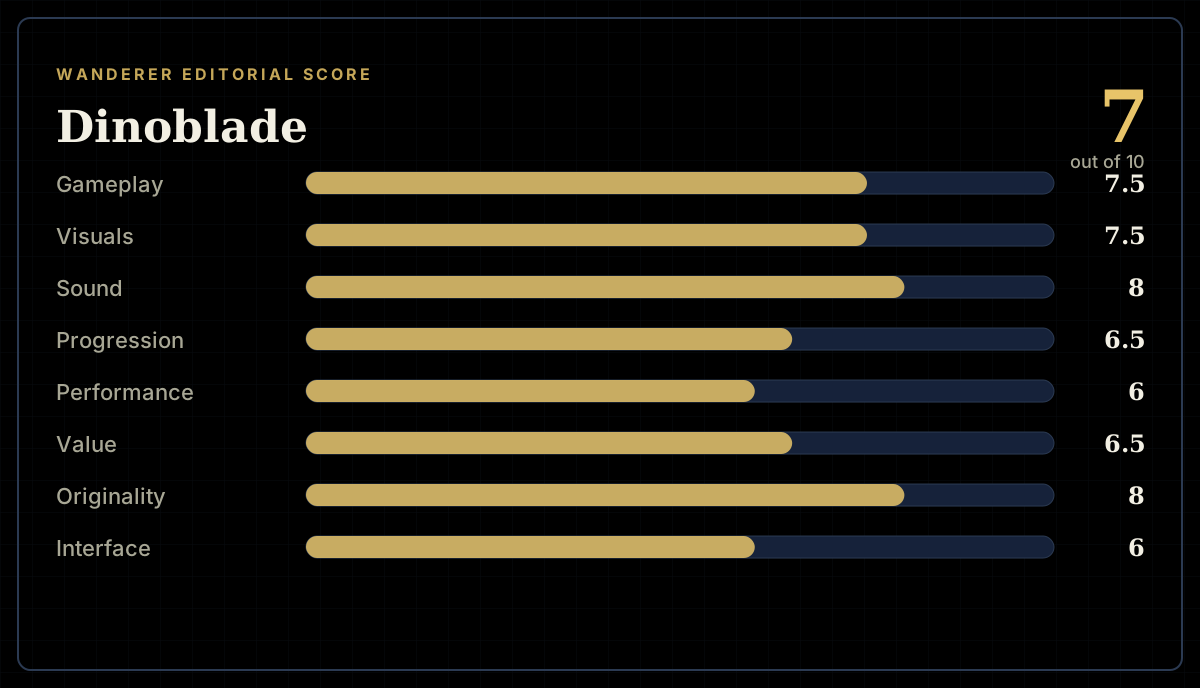
How the review scores each part of the gameWanderer Editorial -
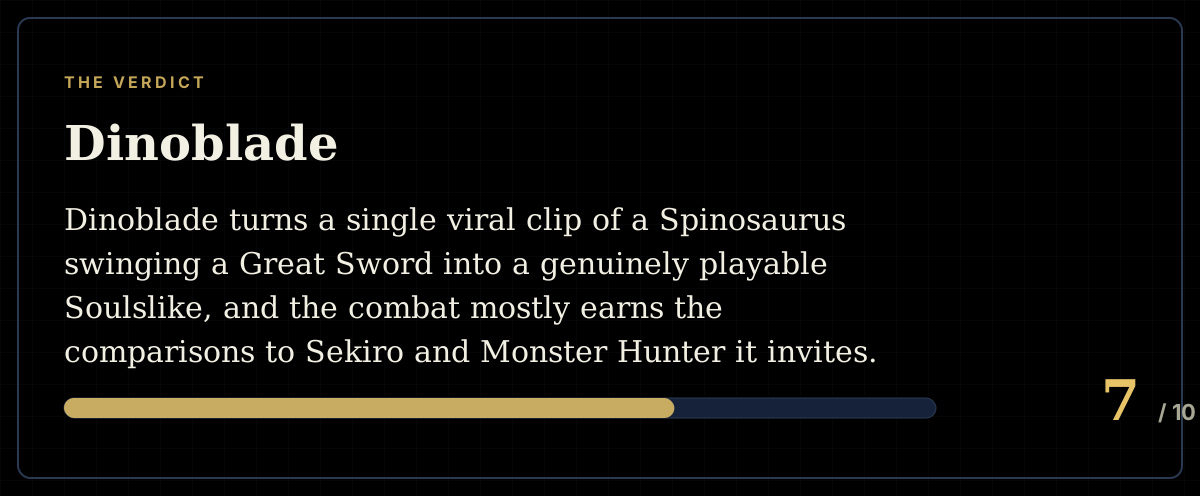
The short versionWanderer Editorial