
Game review
Demons' Timeline
7.5 / 10
- Developer
- DigitalCats
- Publisher
- DigitalCats
- Released
- 29 April 2026
- Platforms
- Windows
- Genre
- Adventure, Indie
- Monetisation
- One-time purchase
- Players
- Single-player
The short version
Demons' Timeline, released 29 April 2026 by solo studio DigitalCats, casts the player as Cyber Detective L, who solves supernatural "Paradoxes" entirely from his desk by scrolling Parrotter, a fictional stand-in for Twitter, and matching public accounts to their hidden alternates with help from a demon partner named Nyasuteria. Its review sample is Very Positive and consistently praises the core deduction loop as genuinely novel, singling out the density and believability of its fake social media simulation, a well-liked hint system that never locks players out of progress, and an ending that a large number of reviewers call the game's standout achievement. Recurring criticism centres on a repetitive middle stretch, a protagonist several reviewers describe as insufferable by design, and a mechanic that becomes trivially brute-forceable for veteran deduction-game players. One negative review also raises a specific, unverified concern about a passage of dialogue near the game's end that prospective buyers may want to look into themselves.
Biggest strengths
- A genuinely novel core mechanic, matching people's public and private social media accounts by piecing together age, occupation, and relationship clues scattered across a dense, believable fake-Twitter feed, earns consistent praise as a fresh angle on the deduction genre
- A hint system and brute-force-friendly design that never locks players out of progress or imposes fail states, repeatedly praised for making a reading-heavy, detail-dependent genre approachable without removing the option of a genuine, hint-free challenge for veterans
- An ending that a large share of the sample singles out specifically, tying together the game's supernatural mystery and its social-commentary themes in a way many reviewers describe as one of the best conclusions they've seen in the genre, alongside a widely liked companion character in Nyasuteria
Biggest weaknesses
- A recurring complaint describes the mid-game as repetitive, since every piece of evidence takes the same form of a social media post, several reviewers say the visual and emotional impact of each discovery flattens out once the novelty of the format wears off
- The protagonist, L, draws specific and repeated criticism for being one-note, pretentious, or actively grating by design, with more than one reviewer noting they had to push through his dialogue rather than enjoy it, even when they otherwise recommend the game
- Once players understand the underlying logic, the deduction system becomes straightforward to brute-force, since wrong answers carry no penalty, several reviewers wish for an optional harder difficulty mode to preserve challenge for experienced deduction-game players
Who it's for: Fans of reading-heavy deduction games like Return of the Obra Dinn, The Roottrees Are Dead, or The Case of the Golden Idol, and anyone drawn to a mystery built entirely around social media literacy and modern internet culture.
Our recommendation: A genuinely inventive deduction game with a well-realized central mechanic and an ending reviewers repeatedly single out as its best moment, worth its price for mystery fans willing to accept a slower middle stretch and a deliberately grating protagonist; read the sample's specific content concern for yourself before deciding.
7.5 / 10
Demons' Timeline opens with a premise built entirely around the modern habit of doomscrolling: Cyber Detective L never leaves his room, solving supernatural incidents called Paradoxes purely by reading through Parrotter, a fictional social media platform designed as a close stand-in for Twitter, with help from a demon partner named Nyasuteria who can sense the hidden truth behind what people post. Released 29 April 2026 by solo studio DigitalCats, its Very Positive review sample responds strongly to a mechanic that reviewers repeatedly describe as genuinely new territory for the deduction genre, while also being consistent about a handful of specific rough edges worth knowing about going in.
Solving crimes by scrolling a fake Twitter feed
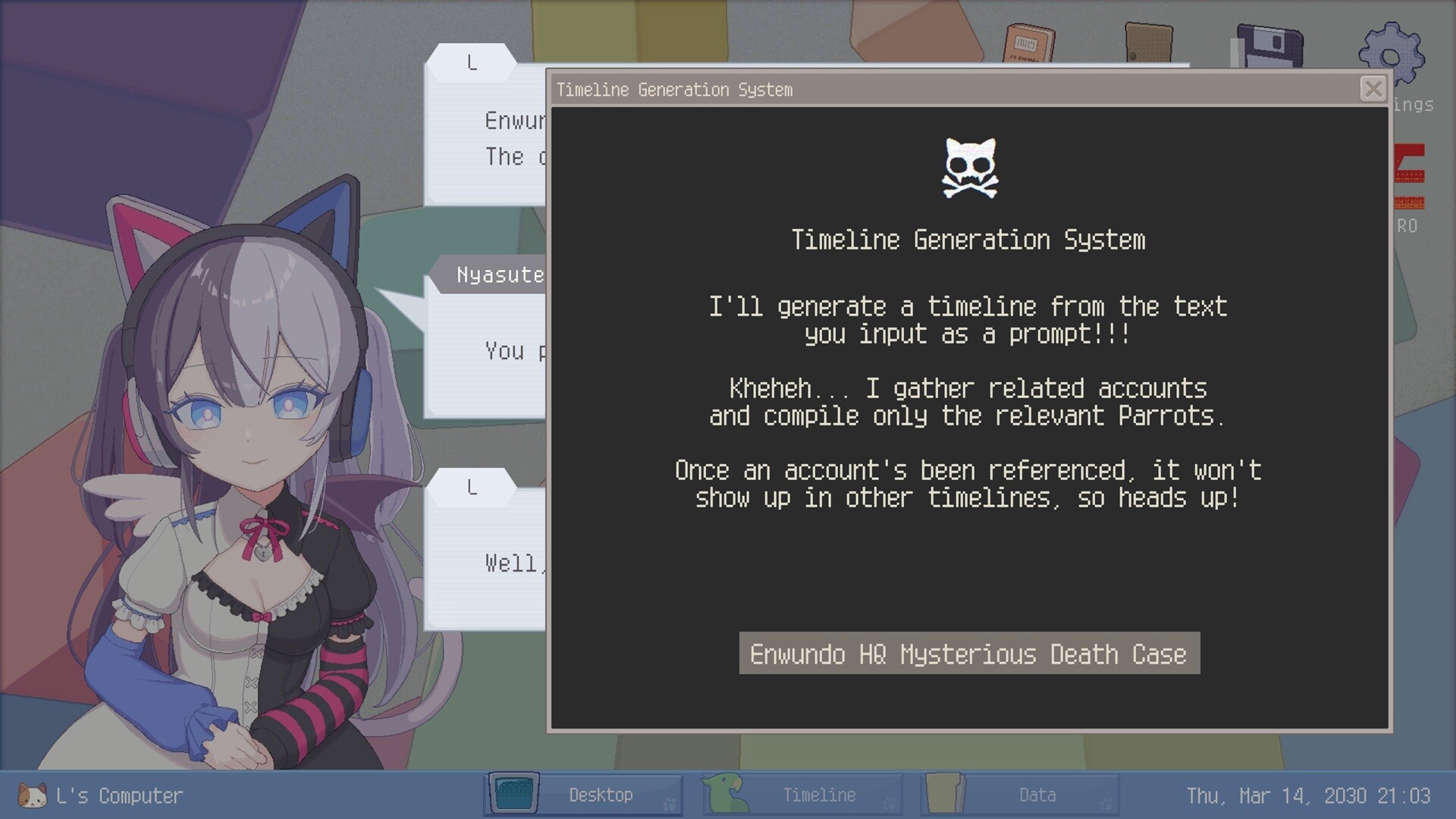
The core of the game has players sifting through a dense feed of posts from a mixture of suspects, witnesses, news accounts, and bystanders, working out which public-facing account belongs to which character and cross-referencing that against a hidden, more private alternate account for the same person. Age, profession, relationships, and writing style all become evidence, and reviewers describe the moment a match clicks into place, confirmed with an immediately satisfying sound cue, as one of the most consistently rewarding parts of the experience. Deleted posts can be recovered by cracking recovery passwords, and a final "deduction" phase for each case has players cite specific posts as evidence and fill in hashtag-formatted answers to lock in the full solution. Multiple reviewers compare the format favourably to Return of the Obra Dinn and The Case of the Golden Idol for its structure, while noting the social-media framing gives it a genuinely distinct identity within that lineage.
A fake internet that feels uncomfortably real
What reviewers single out most is the fidelity of the fake social platform itself. The rhythm of posts, the behaviour of anonymous accounts, and the specific texture of online subculture are described repeatedly as capturing something true about how people actually behave on real social media, to the point that several reviewers who called themselves "terminally online" say the gameplay felt uncomfortably natural. That density cuts both ways: it makes the investigative work feel authentic and the eventual payoffs land harder, but it also means the game leans heavily on reading comprehension and patience rather than any other kind of interaction, which the sample agrees won't suit every player.
An ending reviewers keep coming back to
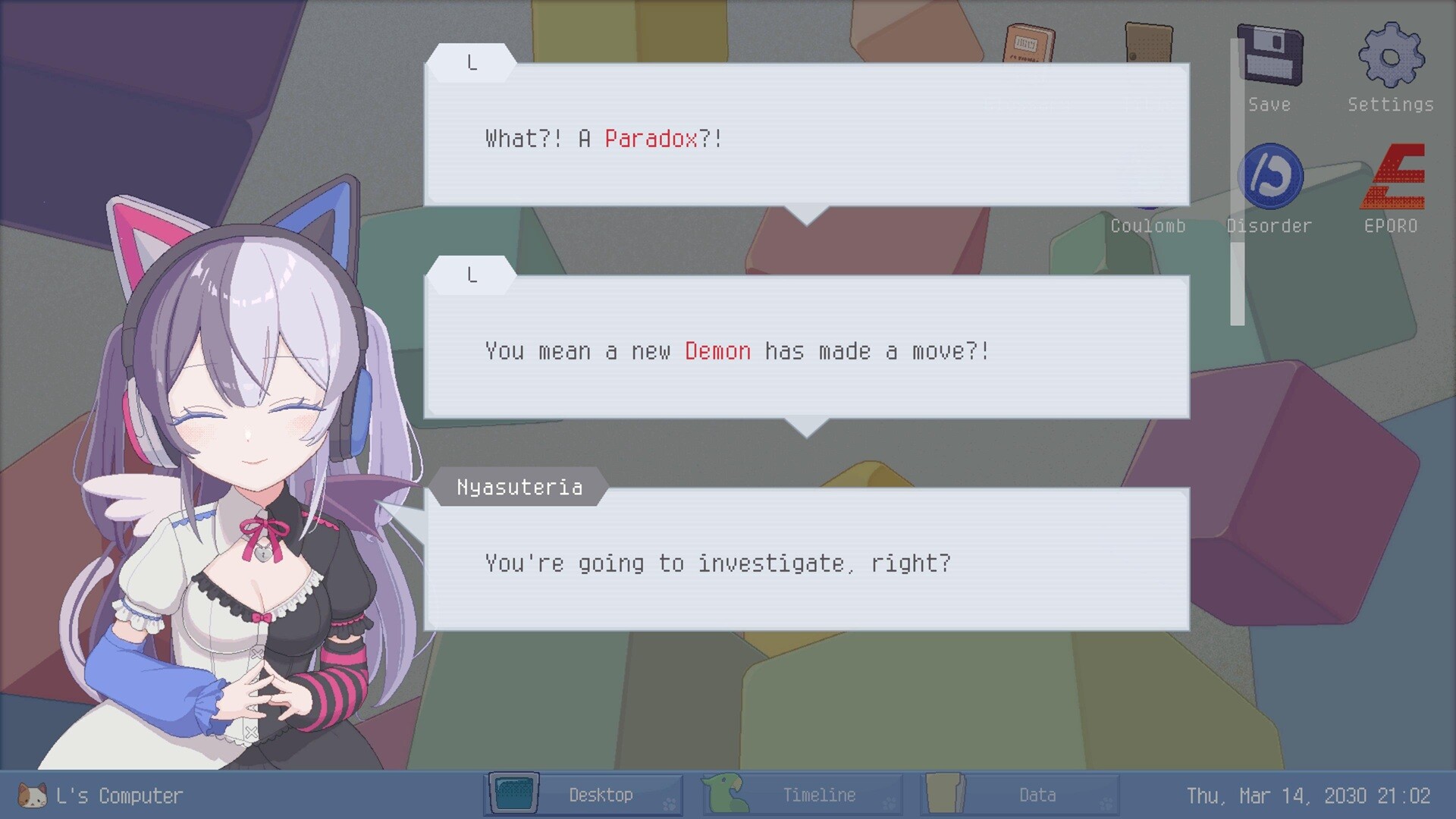
Across dozens of reviews, the ending comes up again and again as the game's standout achievement, tying its supernatural Paradox mystery together with its running commentary on identity and online personas in a way many reviewers call one of the strongest conclusions they've encountered in the genre. Several specifically credit the story's use of real physics concepts, drawing comparisons to Steins;Gate and the Zero Escape series, for grounding its more outlandish supernatural elements in something that still feels internally consistent. Nyasuteria, the demon companion who reacts expressively to each discovery on screen, is mentioned constantly and affectionately as one of the game's biggest draws in her own right, giving the otherwise solitary investigation work a genuine sense of company.
Where the momentum sags
Set against that praise, the review sample is just as consistent about where the game drags. A repeated complaint describes the mid-game as repetitive, since every piece of evidence takes the identical form of a social media post, several reviewers note the visual and emotional impact of each discovery flattens out once the format's novelty wears off, and a few describe finishing an entire timeline only to find the payoff underwhelming for the time invested. The protagonist, L, draws specific and repeated criticism as well, described variously as one-note, pretentious, or actively grating by design, with one reviewer noting they had to skip past chunks of his dialogue about "rational" versus "irrational" thinking to keep enjoying the story around him. Multiple reviewers make clear this is a deliberate character choice rather than a writing failure, but it's a friction point worth expecting going in.
Brute-forceable by design, for better and worse
Because wrong answers carry no real penalty and the game imposes no fail states or time limits, several reviewers note the deduction system becomes straightforward to brute-force once its underlying logic clicks, which the sample treats as a double-edged design choice. For newcomers to the genre, it keeps the game approachable and free of frustration; for veteran deduction-game players, several reviewers specifically wish for an optional harder difficulty mode to preserve some challenge once the pattern becomes clear. One detailed review also flags occasional pronoun mismatches in the English localization, male characters referred to as "she" and vice versa, as a source of confusion when trying to match accounts to identities, though notes the issue was infrequent enough not to derail the overall experience.
A concern worth reading about yourself
One further point deserves mention on its own terms rather than folded into general pacing complaints. A negative review in the sample describes a passage of dialogue near the game's end as containing what it calls transphobic content that doesn't appear connected to the story's main philosophical themes, characterising it as feeling more like inserted commentary than something that serves the plot. This is a single, specific claim from one reviewer in the sample and cannot be independently confirmed or refuted here, but it's detailed enough, rather than a vague or generic complaint, that anyone who cares about the issue should look into it directly before deciding to buy.
Final Verdict
Demons' Timeline succeeds at something genuinely difficult: building an entire detective game out of the specific, recognisable rhythms of scrolling social media, and following through with a supernatural mystery and an ending that its review sample repeatedly calls one of the genre's best. That achievement comes with real, consistently reported friction, a repetitive middle stretch, a deliberately abrasive protagonist, a system that becomes easy to brute-force, and the specific content concern raised above that deserves independent reading rather than a passing mention. For mystery fans drawn to reading-heavy deduction games and comfortable weighing those trade-offs themselves, it's a distinctive, well-reviewed entry worth its price; players who prioritise a likeable lead character or consistent pacing throughout should go in with tempered expectations.
Pros and cons
Pros
- A genuinely novel core mechanic, matching people's public and private social media accounts by piecing together age, occupation, and relationship clues scattered across a dense, believable fake-Twitter feed, earns consistent praise as a fresh angle on the deduction genre
- A hint system and brute-force-friendly design that never locks players out of progress or imposes fail states, repeatedly praised for making a reading-heavy, detail-dependent genre approachable without removing the option of a genuine, hint-free challenge for veterans
- An ending that a large share of the sample singles out specifically, tying together the game's supernatural mystery and its social-commentary themes in a way many reviewers describe as one of the best conclusions they've seen in the genre, alongside a widely liked companion character in Nyasuteria
Cons
- A recurring complaint describes the mid-game as repetitive, since every piece of evidence takes the same form of a social media post, several reviewers say the visual and emotional impact of each discovery flattens out once the novelty of the format wears off
- The protagonist, L, draws specific and repeated criticism for being one-note, pretentious, or actively grating by design, with more than one reviewer noting they had to push through his dialogue rather than enjoy it, even when they otherwise recommend the game
- Once players understand the underlying logic, the deduction system becomes straightforward to brute-force, since wrong answers carry no penalty, several reviewers wish for an optional harder difficulty mode to preserve challenge for experienced deduction-game players
- One negative review raises a specific, unverified concern about a passage of dialogue near the end of the game that it describes as transphobic and disconnected from the story's main themes, this cannot be confirmed or refuted from the review sample alone, but is specific enough that prospective buyers who care about the issue should look into it directly
Screenshots
-
Demons' TimelineImage: DigitalCats via Steam -
Demons' TimelineImage: DigitalCats via Steam -

Demons' TimelineImage: DigitalCats via Steam