
Game review
Ancient Farm
5.5 / 10
- Developer
- A2 Softworks
- Publisher
- Ultimate Games S.A., PlayWay S.A., Ultimate Publishing
- Released
- 7 January 2026
- Platforms
- Windows
- Genre
- Casual, Simulation
- Monetisation
- One-time purchase
- Players
- Single-player only
The short version
Ancient Farm trades the usual pastoral countryside for the banks of the Nile, tasking players with building a farm from nothing using hand tools, ancient Egyptian crops, and a trader as the only other character in the world. Reviewers consistently credit it with a genuinely fresh take on an overcrowded genre and praise its calm atmosphere, music, and building variety. Set against that is a Mixed review sample that returns again and again to the same specific complaints: a watering cycle so frequent it undermines the "casual" label the game markets itself with, a content ceiling reviewers say they hit within single-digit to low-teen hours, and a set of farming and livestock mechanics several reviewers call illogical or historically inaccurate for a game built entirely around its historical setting.
Biggest strengths
- A genuinely distinct setting among farming sims, with reviewers repeatedly praising the novelty of building an ancient Egyptian farm rather than another modern American or European homestead
- A calm, low-stress pace with no combat, hunger, or day-night cycle, praised by multiple reviewers as an intentionally relaxing alternative to more demanding survival-farming hybrids
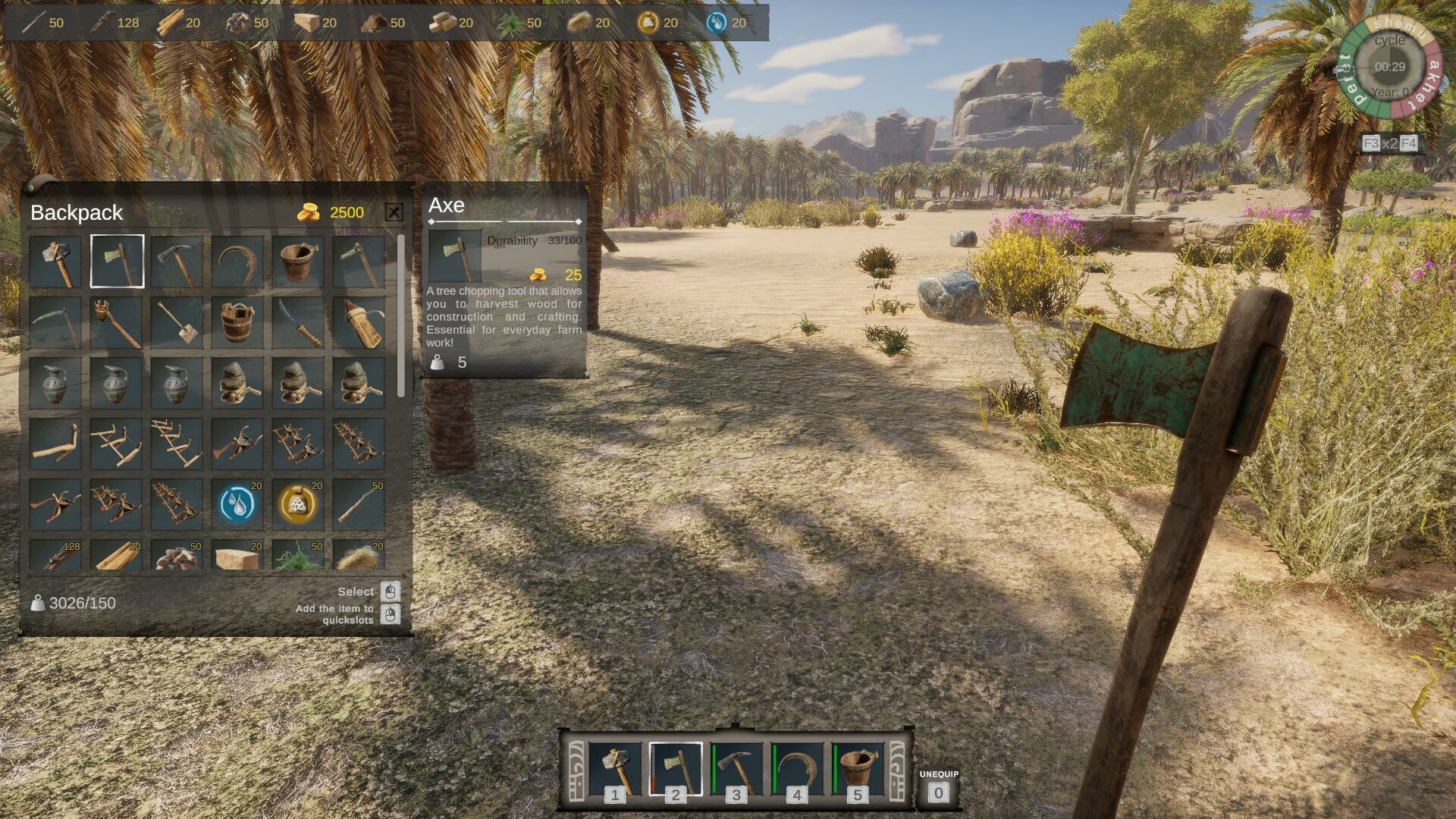
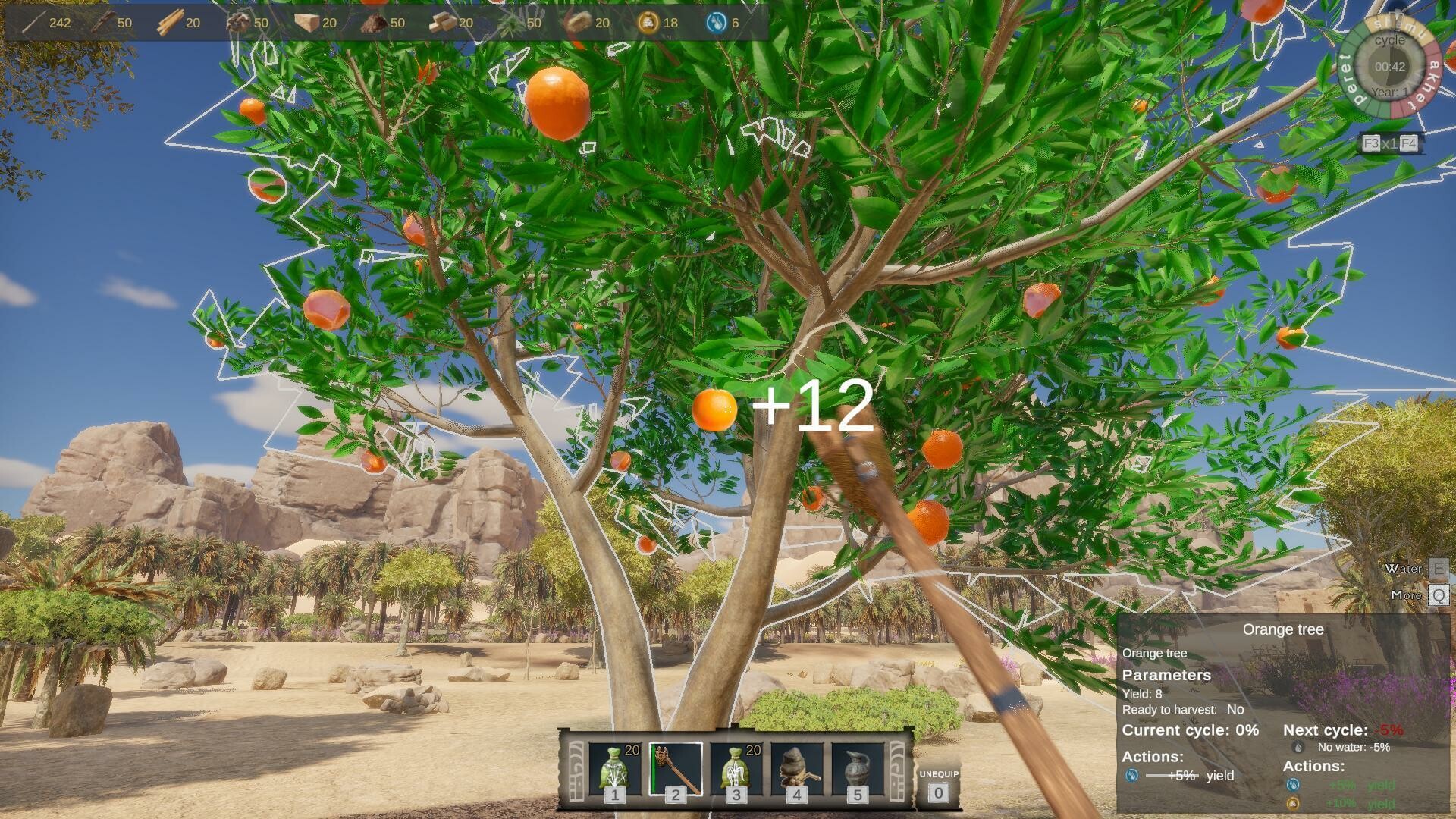
- Well-received music and visual design, with several reviewers specifically calling out the atmosphere and detailed building interiors as standout strengths
Biggest weaknesses
- The dominant complaint across the sample: crops and animals need watering roughly every seven real-time minutes with no pause function, which multiple reviewers say turns a game marketed as "casual" into a relentless, clock-driven chore rather than a relaxing building sim, and becomes worse rather than better as a farm grows
- Several reviewers with specific historical knowledge point out that the game's own setting undercuts its farming logic: the Nile is a static, unflooding river with no fertile-soil mechanic despite that flood cycle being central to real ancient Egyptian agriculture, and crops like corn, coffee, and sugar cane appear despite none existing in the region at the time
- A short content ceiling reviewers describe consistently: multiple reviewers report reaching the endgame temple, the game's most expensive and final building goal, within roughly ten to fourteen hours, with one reviewer fully completing the game in three hours and several noting there's nothing further to do once the final building is up
Who it's for: Fans of slow, low-stress building-and-farming sims who want a genuinely different setting and don't mind a short, currently thin experience, rather than players looking for the depth or automation of established genre leaders like Stardew Valley or Medieval Dynasty.
Our recommendation: A promising concept let down by a launch that a large share of its own review sample feels needed more time in early access; worth a look on sale for the setting alone, but go in expecting a short, repetitive loop rather than the deep management sim its scope suggests.
5.5 / 10
Ancient Farm asks a simple question the farming-sim genre has rarely bothered with: what if it wasn't a modern homestead, but an ancient Egyptian one? Players start with nothing on the banks of the Nile, working entirely by hand to plant, build, craft, and trade their way toward a handful of monumental construction goals, with only a travelling merchant for company. It's a premise reviewers give real credit for, and the resulting Mixed rating on Steam reflects a game whose atmosphere and idea are well liked even as a long, consistent list of specific complaints about its systems keeps pulling the score back down.
A setting the genre has been missing
The single most repeated compliment in the sample is simply that the setting feels new. Reviewers who describe themselves as tired of yet another grandpa's-farm origin story or yet another temperate-climate homestead call the shift to ancient Egypt refreshing on its own terms, and several specifically praise the building designs, detailed interiors, and overall visual and musical atmosphere as standout strengths for a first release. More than one reviewer frames the game as filling a gap they didn't realise existed: a calm, combat-free, hunger-free building sim that leans on its historical dressing rather than survival pressure to hold attention.
A watering clock the sample can't stop talking about
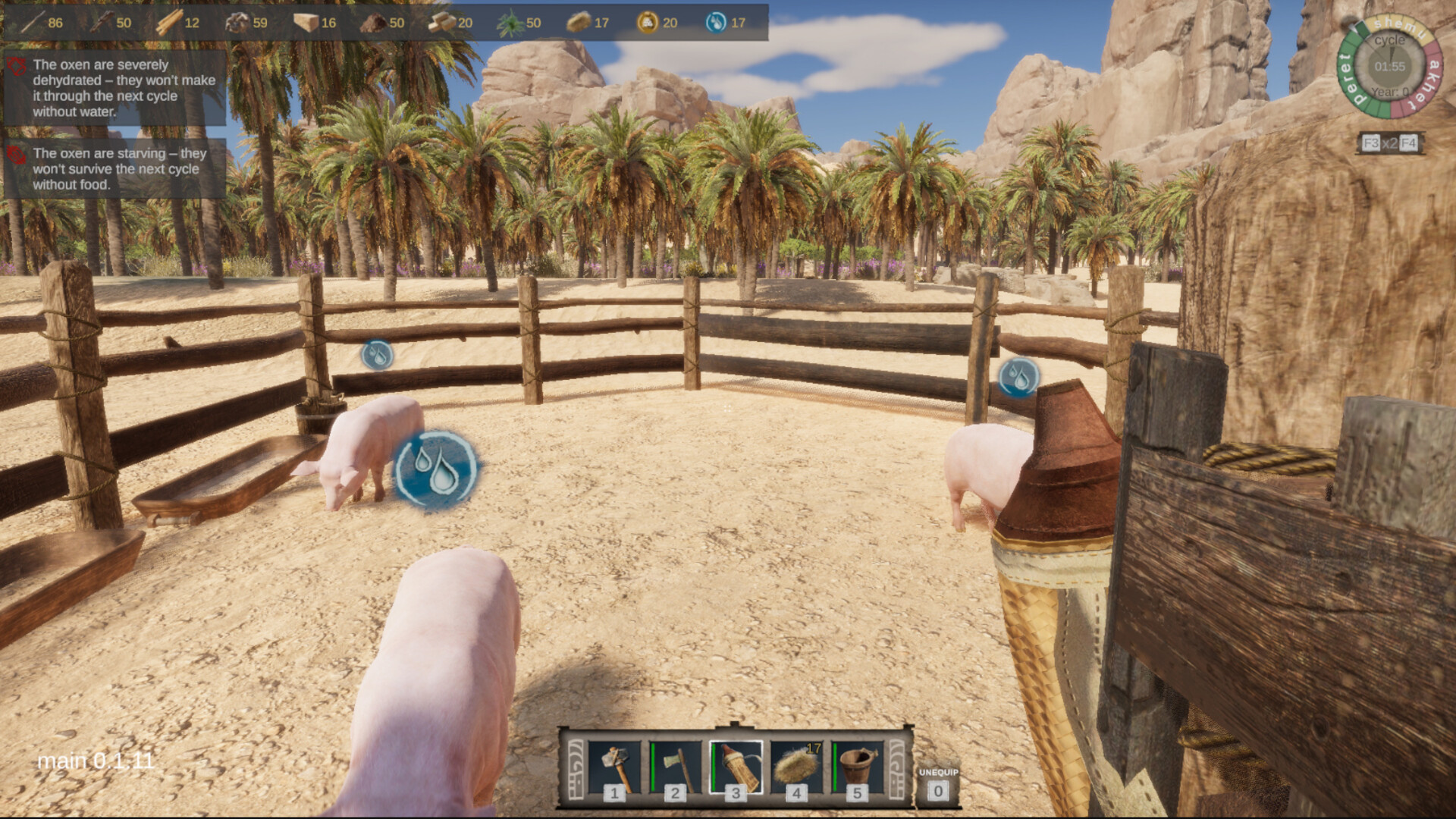
Set against that goodwill is the complaint that shows up in nearly every critical review and a fair number of positive ones too: crops and livestock need watering roughly every seven real-time minutes, with no way to pause the clock while managing the resulting workload. Multiple reviewers describe reaching a point, once a farm has even a modest spread of crops and animals, where the entire play session becomes a loop of running between water sources, fields, and pens rather than building or exploring anything new. One detailed review specifically contrasts this with the game's own "Casual" tag, arguing that a genuinely casual game shouldn't force players into a fixed real-time rhythm at all, and several others independently ask for an option to slow or pause the clock so they can work at their own pace instead of the game's.
Egyptian dressing on farming logic that doesn't quite add up
A more specific strand of criticism comes from reviewers who bring real knowledge of the setting to the review. The Nile itself is static, with no flooding and no fertile-soil mechanic, despite the annual flood cycle being the actual reason ancient Egyptian farming worked where it did; several reviewers call this a missed opportunity given how central it is to the setting the game is built around. The same reviewers point out that corn, coffee, and sugar cane are all growable crops despite none existing anywhere near ancient Egypt at the time. Separately, multiple reviewers flag the farming and livestock loop itself as internally inconsistent: harvested grain doesn't produce seed for replanting and must always be rebought from the trader, cattle and other livestock never breed and must likewise be continually repurchased rather than raised, and sheep are described as yielding wool only when butchered rather than through shearing. None of these individually break the game, but together they undercut the historical grounding that's otherwise the game's biggest selling point.
A short farm with not much waiting at the top
Progression is the sample's other major sore point. Multiple reviewers report reaching the game's endgame temple, by a wide margin the most expensive and final building goal, within roughly ten to fourteen hours, and one reviewer fully completed everything the game currently offers in three hours flat. Several note there's effectively nothing to do once that final building goes up, with one pointing out the finished temple can't even be entered. A handful of reviewers explicitly say they wish the game had launched into early access instead of a full 1.0 release, arguing the current amount of content doesn't match what a finished farming sim usually promises, even as they credit the developer with active post-launch patches, including a well-received well/watering addition several reviewers say meaningfully eased the core grind.
Rough edges around the systems that are here
Beyond the headline complaints, the sample surfaces a run of smaller but consistent quality-of-life issues. One detailed review describes losing a four-hour play session after accidentally clicking "load" from the menu with no confirmation prompt, overwriting recent progress instantly. Harvest debris left behind after clearing crops can only be removed one tile at a time with a shovel, with no faster tool available despite the game otherwise offering multi-row plows. The game shipped without controller support, a specific problem raised by a reviewer who relies on one for accessibility reasons. And several reviewers note that selling goods in bulk drops the price sharply within the same transaction, while harvested water can be sold in essentially unlimited quantity for guaranteed profit, an exploit multiple reviewers mention using deliberately once they discovered it.
Final Verdict
Ancient Farm has an idea worth pursuing and enough atmosphere, music, and visual craft that its review sample keeps giving it credit even while listing out everything that's currently wrong with it. What holds it at a Mixed rating isn't any single dealbreaker but the sheer consistency of the complaints: a watering system that works against the relaxed pace the game is selling, farming logic that doesn't track with its own historical setting, and a content ceiling multiple independent reviewers hit within a handful of hours. At NZ$21.99 for what several reviewers describe as a few hours of content wrapped in a genuinely appealing setting, it's easiest to recommend to genre fans specifically drawn to the ancient Egyptian theme, on sale, and with the expectation that this is a foundation still waiting for the updates its own developer appears to be working on rather than a finished, fully realised farming sim.
Pros and cons
Pros
- A genuinely distinct setting among farming sims, with reviewers repeatedly praising the novelty of building an ancient Egyptian farm rather than another modern American or European homestead
- A calm, low-stress pace with no combat, hunger, or day-night cycle, praised by multiple reviewers as an intentionally relaxing alternative to more demanding survival-farming hybrids
- Well-received music and visual design, with several reviewers specifically calling out the atmosphere and detailed building interiors as standout strengths
- A genuine variety of crops, animals, and craftable materials for a first release, giving players real options for how they build out their farm's production
- A developer reviewers describe as actively patching the game post-launch, including a well-received well/watering quality-of-life addition cited by multiple reviewers
Cons
- The dominant complaint across the sample: crops and animals need watering roughly every seven real-time minutes with no pause function, which multiple reviewers say turns a game marketed as "casual" into a relentless, clock-driven chore rather than a relaxing building sim, and becomes worse rather than better as a farm grows
- Several reviewers with specific historical knowledge point out that the game's own setting undercuts its farming logic: the Nile is a static, unflooding river with no fertile-soil mechanic despite that flood cycle being central to real ancient Egyptian agriculture, and crops like corn, coffee, and sugar cane appear despite none existing in the region at the time
- A short content ceiling reviewers describe consistently: multiple reviewers report reaching the endgame temple, the game's most expensive and final building goal, within roughly ten to fourteen hours, with one reviewer fully completing the game in three hours and several noting there's nothing further to do once the final building is up
- Specific farming and livestock systems several reviewers call illogical: harvested crops don't produce seed for replanting and must always be rebought from the trader, livestock never breed and must likewise always be rebought, and sheep are described as only yielding wool when slaughtered rather than through shearing
- Rough technical and quality-of-life edges reported across multiple reviews: no confirmation prompt before loading over an in-progress save, cited by one reviewer who lost a four-hour session this way, harvest debris that can only be cleared one tile at a time by hand, no controller support at launch, and an easily exploitable economy built around selling harvested water for guaranteed profit
Screenshots
-
Ancient FarmImage: A2 Softworks via Steam -
Ancient FarmImage: A2 Softworks via Steam -
Ancient FarmImage: A2 Softworks via Steam