
Game review
Deadline Savior
7.1 / 10
- Developer
- Cointinue Games
- Publisher
- Cointinue Games
- Released
- 30 August 2026
- Platforms
- PC
- Genre
- Idle Productivity RPG
What it actually is
Deadline Savior is upfront about what it isn't. The store page opens with a note explaining that this is not a traditional RPG you sit down and control: it's a desktop companion that turns a Pomodoro-style focus timer into an idle adventure. You set a task, start a focus session — the default is 25 minutes of work followed by a 5-minute break, though both are adjustable down to 5 minutes and up to an hour and a half — and while you're away from the game working on whatever you actually opened it to do, your hero travels, fights, and loots automatically. When the timer ends, you get to see what happened and spend the break managing gear, skills, and preparation for the next session.
It's a genre mashup that shouldn't be surprising anyone in 2026 — idle games and productivity timers have been circling each other for years — but Deadline Savior commits to the bit further than most. A small persistent overlay widget sits on the desktop showing the hero's level, HP, and remaining focus time while another application has focus, which is exactly the kind of "glanceable while you work" design a tool like this needs, and it's visible and functioning in the game's own screenshots rather than just described on the store page.
The idle RPG side holds up
Strip away the timer framing and there's a reasonably built idle RPG underneath. The early access build currently offers four playable classes (paladin, ranger, mage, and a fourth unlockable through play) out of a planned twelve, each with distinct stats and skill sets. Equipment drops by rarity across weapon and armour slots, with both active gear used in combat and passive accessories that modify stats. A "Time Sand" and "Codex" system lets players register found items permanently, so a class reset or new timeline run can re-summon previously discovered gear by spending accumulated currency rather than farming everything from scratch — a soft progression layer sitting on top of the reset structure that several long-time players single out as the system holding their attention across hundreds of hours.
Combat itself is automatic once a session starts. Preparation is where the actual decisions live: which gear to equip, which consumables to carry, and — per multiple reviewer accounts — which shrine or temple offerings to prioritise, since certain blessing effects are described as close to mandatory for surviving mid-game elite encounters. That preparation loop is also where the game's most consistent complaint shows up. Several reviewers, across multiple languages, describe specific classes as dramatically weaker than others in the current build; one detailed account describes clearing an early ranger playthrough only through repeated potion consumption and forced level-grinding against a boss, while a mage run through similar content on the same difficulty felt comparatively trivial. For a system this reliant on stat math working correctly, that kind of class-to-class gap is a real early access rough edge rather than a design choice players are meant to work around.
Where the productivity half adds friction
The parts of Deadline Savior that make it a genuinely interesting idea are also where it creates its own problems. A stamina system ties in-game progress to real focus time — the hero's adventure consumes stamina during a session, and if it runs out mid-session, the timer keeps counting but nothing in the game world moves. Multiple players flagged this as a design tension worth naming out loud: a tool built to reward staying focused for longer stretches can end up penalising exactly that behaviour once a player's stamina cap is exceeded, at least until levelling raises the ceiling. It's not a bug, but it's a friction point between the productivity tool and the RPG shell that the developer hasn't fully reconciled yet.
The other recurring complaint is more mundane: the window currently has a fixed minimum size around 1280×720, which is a genuine problem for a tool explicitly designed to run alongside other work on a shared screen. More than one reviewer specifically mentioned needing to keep it running at work and finding the minimum footprint awkward on a standard monitor, with requests for a smaller "compact mode" or freely resizable window showing up repeatedly. A desktop companion that can't shrink to companion-sized is a real usability gap for its stated use case, not a nitpick.
Onboarding is a mixed picture. A few reviewers describe being confused by the interface on first launch, unsure how the timeline-reset ("Goddess Blessing") system or shrine offerings connect to actual progress, and one account describes spending roughly thirty minutes exploring village menus before starting their first actual focus session — which undercuts the tool's own premise if a player opens it specifically to start working quickly. Others report the tutorial covering the basics adequately and getting into a session within minutes. The spread suggests the early access build's guidance is inconsistent rather than uniformly bad.
A likeable, well-supported early access build
What's notable given how recently this launched out of demo and playtest phases is how much history is already visible in the review sample. A meaningful number of reviewers reference having played across a demo, a closed test build, and now the early access release, with several logging playtimes well into the hundreds of hours accumulated across that whole span. That's an unusually long public testing runway for a small early access title, and it shows in how specific and constructive the criticism reads — this isn't a community reacting to something half-finished and abandoned, it's one that's been watching features get added update by update and has clear opinions about what's still missing.
The tone throughout is also worth noting: reviewers consistently describe the game as charming rather than gimmicky, citing the fantasy framing (a goddess of "Today" recruiting the player to fight back against a dragon representing procrastination) as silly in a way that works, and the post-session "adventure report" — a summary of total focus time, average session length, and a personality-style breakdown of work habits presented in RPG stat-sheet form — gets called out repeatedly as an unexpectedly satisfying touch rather than filler. Language support is broad: English, French, German, Japanese, Simplified and Traditional Chinese, Korean, Russian, Portuguese, Italian, and two Spanish variants are all listed, and the review sample itself spans most of those languages, which is a reasonable independent check that the localisation claim holds up in practice rather than being aspirational.
Currently Windows-only, with a handful of players explicitly asking for macOS support in reviews — worth flagging for anyone whose actual work happens on a Mac, since the whole premise depends on the tool running wherever the player's real focus sessions happen.
Who this is actually for
Deadline Savior isn't trying to be a deep RPG, and treating it as one on its own terms will disappoint anyone hoping for meaningful combat decisions or build complexity beyond gear and shrine choices. What it's trying to be is a Pomodoro timer with enough of an idle RPG wrapped around it that the ritual of starting a focus session feels like something rather than nothing — and on the evidence of a genuinely large, largely positive, and unusually well-informed review base, it's succeeding at that specific goal more often than not. The complaints that do surface are concrete and fixable rather than structural: a resizable window, better early guidance, and class rebalancing would address most of what's currently holding reviewers back from full enthusiasm. For anyone who has bounced off plain focus-timer apps before and wants a reason to actually start the next session, this is a well-supported early access build worth watching, with the caveat that "early access" here currently means eight of twelve promised classes still locked and a content ceiling players reach faster than the shrine and codex systems can disguise.
Screenshots
-
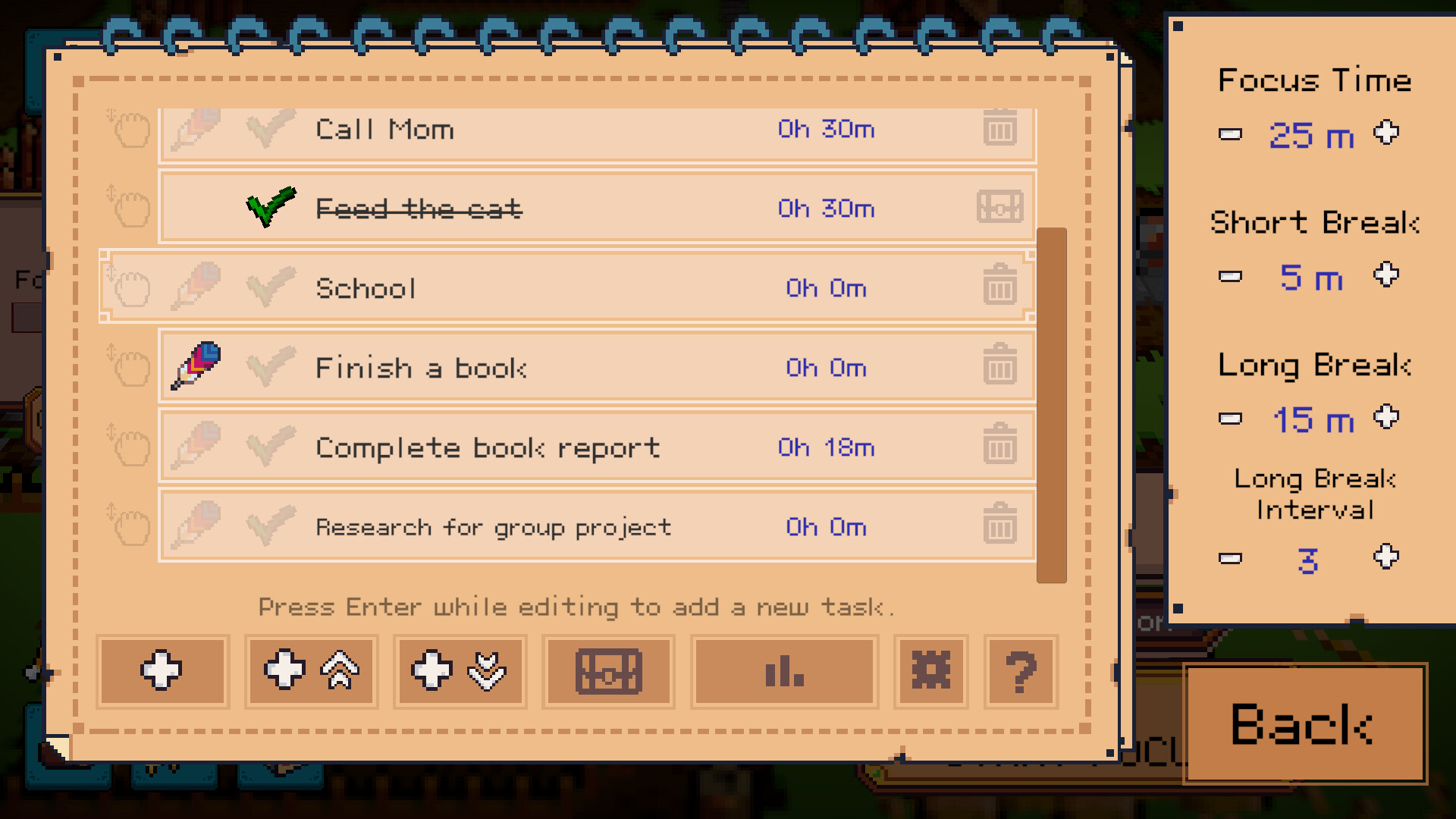
Real-world tasks sit in a list alongside Pomodoro-style timer settings that drive the hero's adventure progress.Image: Cointinue Games via Steam -
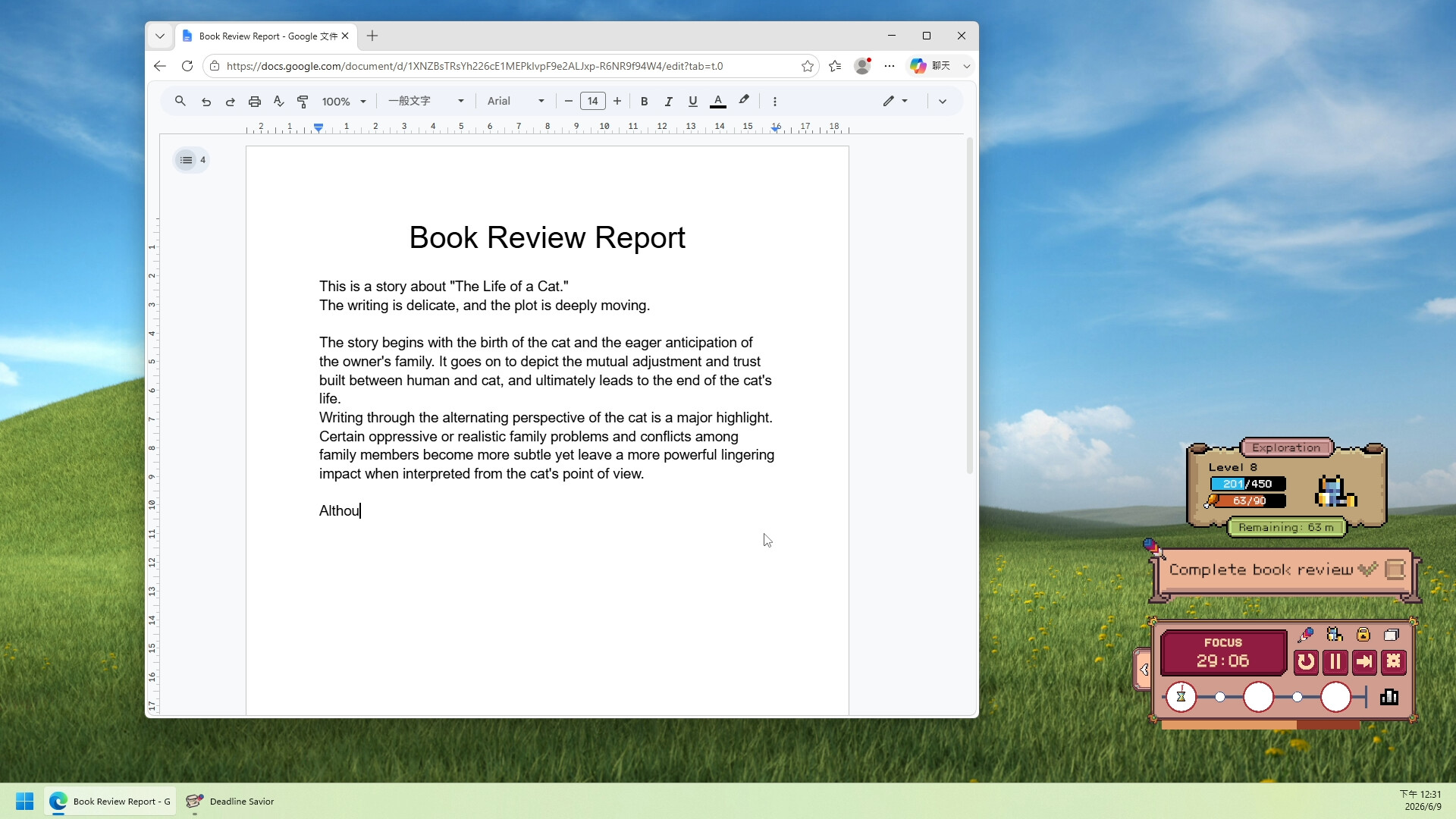
The persistent desktop overlay tracks hero level, HP, and time remaining while the player works in another application.Image: Cointinue Games via Steam -
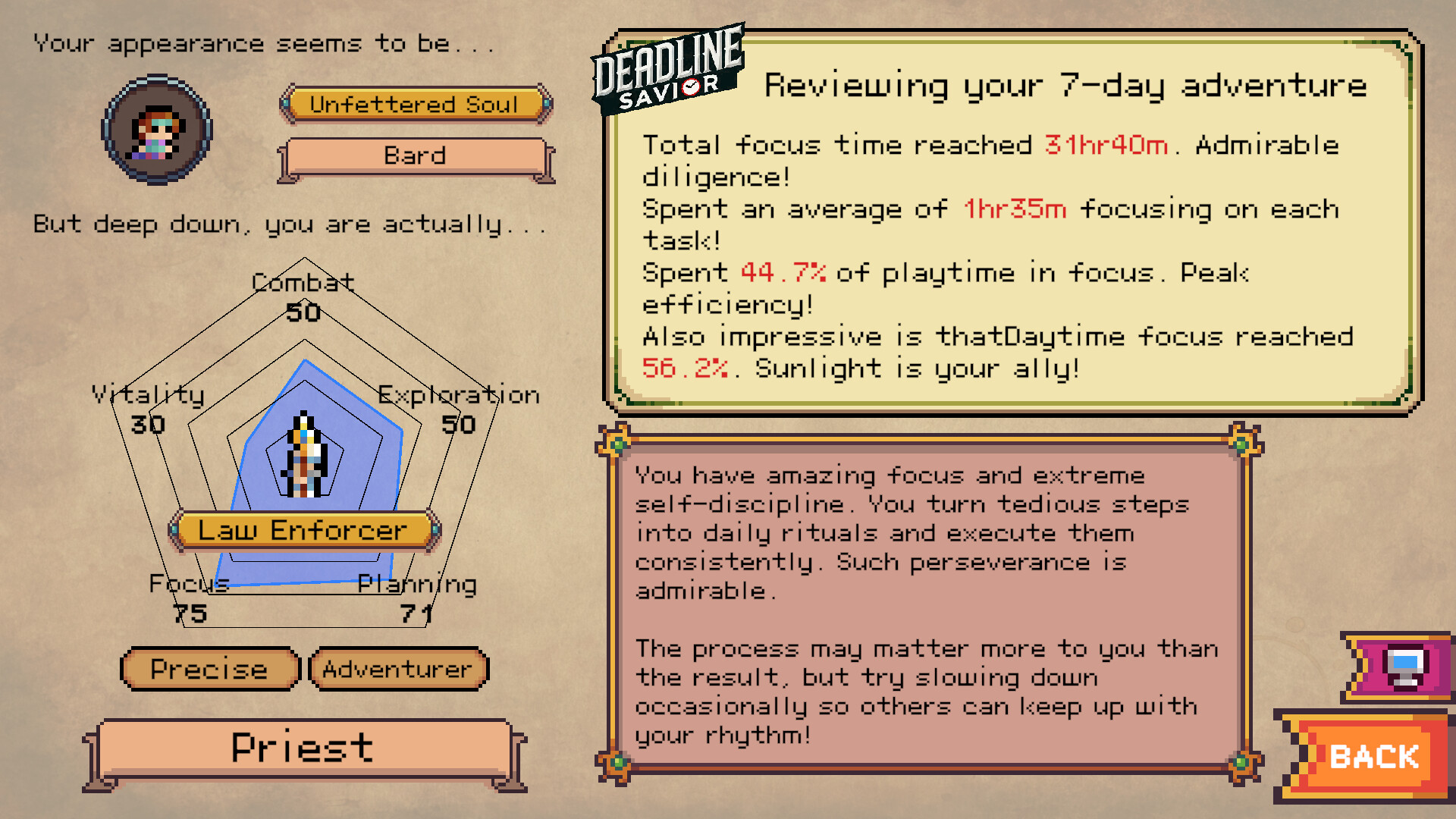
The post-session adventure report turns logged focus time into an RPG-styled personality breakdown of work habits.Image: Cointinue Games via Steam