
Game review
Darkwood
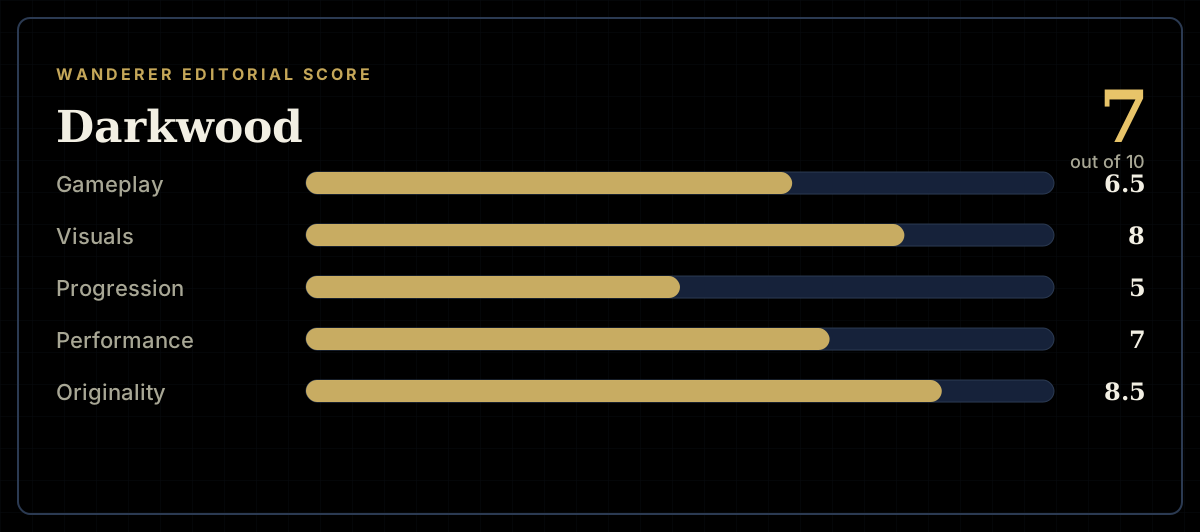
7 / 10
- Developer
- Acid Wizard Studio
- Publisher
- Hooded Horse, Acid Wizard Studio
- Released
- 17 August 2017
- Platforms
- Windows, macOS, Linux
- Genre
- Survival Horror RPG
- Monetisation
- Paid, one-time purchase. No in-app purchases or DLC.
- Players
- Single-player only.
The short version
Darkwood's top-down, flashlight-cone dread is genuinely unlike most horror games, and its reputation for a near-perfect opening is well earned — reviewers across a full decade agree on that point almost without exception. What a large and coherent share of the same review sample also agrees on is what happens after that opening: the fear fades once the map becomes familiar, and the day-scavenge, night-survive loop turns into repetitive chores rather than escalating tension. Steam's own achievement data backs this up with hard numbers rather than just anecdote — 73.7% of tracked players finish the prologue, but only 9.0% ever reach Chapter 2.
Biggest strengths
- A genuinely unique, dread-driven atmosphere built on limited flashlight vision and a real day/night survival cycle, distinct from most horror games' reliance on jump scares.
- A widely and specifically praised prologue that reviewers across a decade describe as one of the strongest openings in the genre.
- A distinctive, Slavic-folk-horror-inflected art style and sound design that holds up as genuinely unsettling rather than merely dark.
Biggest weaknesses
- A recurring, specific complaint across years of reviews: the horror fades once players learn which areas are dangerous, turning exploration into repetitive scavenging rather than sustained tension.
- Steam's own achievement data confirms a severe drop-off in engagement — only 9.0% of tracked players ever reach Chapter 2, closely matching what reviewers describe from experience.
- No auto-save on quitting is a specific, current complaint, with at least one 2026 review noting it's unclear how much progress is at risk before the next checkpoint.
Who it's for: Horror and survival fans who specifically want atmosphere and dread over jump scares, and who are prepared for that dread to diminish considerably once the map's dangers become known quantities.
Our recommendation: Worth playing for the atmosphere and opening hours alone; go in with realistic expectations that the mid-game repetition many reviewers describe is a real, common experience, not a minority complaint.
7 / 10
A dread that few horror games manage
Darkwood earns its reputation through a specific, well-executed idea: rather than scripted jump scares, it builds tension from limited information. The official screenshot captures the feeling precisely — a small, warm cone of flashlight illuminating a patch of gnarled, blood-red undergrowth against near-total darkness, with a faint red glow pulsing somewhere unseen just beyond it. The store page's own framing matches that mood exactly: "scavenge and explore a rich, ever-changing free-roam world by day, then hunker down in your hideout and pray for the morning light." That structure — days for cautious scavenging and crafting, nights for barricading and praying whatever's outside doesn't get in — gives the game's dread a mechanical foundation rather than relying purely on presentation. Reviewers across the entire span of the game's history converge on one specific point almost without exception: the prologue is exceptional. "Darkwood has a superb prologue. It sets the tone, it introduces the basic controls and mechanics, and it establishes just enough information about the setting to get you hooked," reads one representative review, and that sentiment repeats, in various phrasing, across reviews from 2017 through 2026.
The fear that fades, confirmed by hard numbers
What separates this review from simply repeating that praise is being able to check one of its most common qualifications against real data rather than taking it purely on faith. Reviewer after reviewer describes the same specific arc: strong at first, then diminishing. "The horror element of the game fades significantly once you understand which areas of the game are dangerous and which aren't," reads one 2022 review. Another, from the same year, puts it more bluntly: "Then it turns into a simulator of endless running around the map and looking for story items and loot. At some point, you realize that the enemies no longer scare you." A 2024 review makes the claim explicit and citable: "there's a reason that only 9% of players made it to Chapter 2, it's not for everyone." Steam's own global achievement statistics confirm that figure with striking precision — 73.7% of tracked players finish the prologue, but the "enter_ch2" achievement sits at exactly 9.0%. That's not a rounded approximation matching a vague impression; it's a specific number independently arrived at by both a player's memory and this outlet's own data pull, describing the same steep drop-off. A game can have an excellent opening and a real retention problem simultaneously, and the evidence here supports both being true at once rather than one cancelling out the other.
A recent, practical complaint worth flagging
Separate from the pacing conversation, a specific quality-of-life gap draws its own current complaint. A July 2026 review states plainly: "I would really enjoy playing this game if it saved automatically when you quit. Why is this not a feature? It is completely unclear how much longer you need to play before reaching the next autosave." For a slow-burn survival horror game built around careful, deliberate play, the risk of losing an uncertain amount of progress on exit is a real friction point, and one that's easy to overlook when summarising the game purely in terms of atmosphere and pacing. It's a small thing next to the broader retention question, but it's a concrete, actionable complaint rather than a matter of taste.
A minority who never connect with the horror at all
Separate from the "great start, fading fear" arc, a smaller but distinct group of reviewers describe never fully connecting with the game's specific style of horror in the first place. "It took me a very long time to admit to myself that I don't like this game," reads one 2022 review, going on to explain that the absence of jump scares — a deliberate design choice this review credits above — is itself the disconnect for a player who wanted a more conventional horror experience. Another reviewer frames it as a mismatch between the store page and the actual product: "The store page doesn't tell you the whole story. First and foremost, it's a survival game," suggesting some buyers arrive expecting a more purely horror-focused experience than the survival-and-crafting reality delivers. These aren't complaints about execution so much as expectation-setting, and they're worth separating from the achievement-confirmed retention drop-off discussed above — a player can love the genre Darkwood is actually offering and still burn out on it by Chapter 2, and a different player can correctly identify that the genre itself was never quite what they wanted, independent of pacing.
Judging a decade-long Early Access journey fairly
It's worth noting Darkwood's own development history when weighing the pacing complaints, since it spent roughly three years in Early Access before its 2017 full release — a genuinely unusual amount of iteration for a game this size, and one that shows in how tightly the surviving content is constructed even where reviewers wish there were more of it. A game built incrementally over years by a small team, with its most digestible, most heavily-tested content naturally clustering toward the beginning, is a plausible practical explanation for exactly the kind of front-loaded quality curve the review sample describes, distinct from any claim of a rushed or incomplete release. That context doesn't erase the retention numbers, but it does offer a more charitable frame than assuming the later chapters were simply designed worse than the earlier ones on purpose.
Final verdict
Darkwood deserves its reputation for atmosphere, and this review has no reservations recommending it on the strength of its opening hours alone — few horror games build dread this effectively without leaning on cheap scares. Where this score reflects real caution is in taking seriously, rather than dismissing, a specific and well-corroborated pattern describing what happens after that opening: a steep, achievement-confirmed drop in engagement as the map's dangers become known and the loop shifts from tension to routine. That's a fair trade for players who value the journey over completing every chapter, and a real disappointment for players expecting the prologue's intensity to sustain across the whole game. Both are honest readings of the same evidence, and this review wants a prospective buyer to know which one is more likely waiting for them before they start.
Pros and cons
Pros
- A genuinely unique, dread-driven atmosphere built on limited flashlight vision and a real day/night survival cycle, distinct from most horror games' reliance on jump scares.
- A widely and specifically praised prologue that reviewers across a decade describe as one of the strongest openings in the genre.
- A distinctive, Slavic-folk-horror-inflected art style and sound design that holds up as genuinely unsettling rather than merely dark.
- Real crafting and hideout-fortification systems that give the survival loop mechanical substance beyond pure atmosphere.
Cons
- A recurring, specific complaint across years of reviews: the horror fades once players learn which areas are dangerous, turning exploration into repetitive scavenging rather than sustained tension.
- Steam's own achievement data confirms a severe drop-off in engagement — only 9.0% of tracked players ever reach Chapter 2, closely matching what reviewers describe from experience.
- No auto-save on quitting is a specific, current complaint, with at least one 2026 review noting it's unclear how much progress is at risk before the next checkpoint.
- Several reviewers who otherwise respect the game's craft describe the mid-to-late game as feeling more like chores than survival horror.
Screenshots
-

DarkwoodImage: Hooded Horse via Steam -

DarkwoodImage: Hooded Horse via Steam -

DarkwoodImage: Hooded Horse via Steam -
How the review scores each part of the gameWanderer Editorial -
The short versionWanderer Editorial