
Game review
Crypt of the NecroDancer
8 / 10
- Developer
- Brace Yourself Games
- Publisher
- Brace Yourself Games, Klei Entertainment
- Released
- 23 April 2015
- Platforms
- Windows, macOS, Linux
- Genre
- Rhythm Roguelike RPG
- Monetisation
- Paid, one-time purchase, plus optional character and soundtrack DLC.
- Players
- Local co-op and versus modes are supported alongside the primary single-player roguelike campaign.
The short version
Crypt of the NecroDancer fuses roguelike dungeon-crawling with rhythm-game timing so successfully that it's still hard to name a real competitor a decade later — move, attack and cast every action on the beat of Danny Baranowsky's soundtrack, or import your own MP3s and let the game generate a dungeon to match. That fusion earns its Overwhelmingly Positive standing honestly. It also produces one of the steepest difficulty walls in the genre, and this outlet doesn't have to take reviewers' word for it: Steam's own achievement data shows only 7.8% of tracked players ever complete Zone 4, closely matching what players have been saying about the game's brutal difficulty curve since launch.
Biggest strengths
- A genuinely original fusion of rhythm-game timing and roguelike dungeon design that remains largely unmatched a decade after release.
- An excellent, purpose-built soundtrack by Danny Baranowsky, plus the option to import personal MP3s and have the game generate a dungeon synced to them.
- Deep replay value across multiple unlockable characters, each altering the core rules meaningfully rather than just reskinning the same playstyle.
Biggest weaknesses
- A genuinely brutal difficulty curve, confirmed by Steam's own achievement data — only 7.8% of tracked players ever complete Zone 4, and completion rates fall off sharply from Zone 1 onward.
- Reviewers repeatedly describe the rhythm and dungeon-crawling systems working against rather than with each other under pressure, since reacting intuitively to enemy patterns can conflict with staying precisely on beat.
- A specific, independently repeated complaint singles out the story character Aria as a poor playable-character choice, several reviewers calling her specifically unfun relative to the base character.
Who it's for: Rhythm-game and roguelike fans specifically excited by the combination, who have realistic expectations about a genuinely steep learning curve rather than assuming "Overwhelmingly Positive" means broadly accessible.
Our recommendation: A genre landmark worth playing, but go in understanding the difficulty curve is real, well-documented and not exaggerated by a vocal minority.
8 / 10
A fusion nothing else has fully matched
Crypt of the NecroDancer's premise sounds almost too simple to work: move, attack and use items in a roguelike dungeon, but only on the beat of the music. The store page's own framing captures both halves of the appeal directly — "move to the music and deliver beatdowns to the beat! Groove to the epic Danny Baranowsky soundtrack, or select songs from your own MP3 collection!" — and a decade of reviews confirm that fusion is more than a gimmick. The official key art shows exactly the tone that combination produces: a torch-wielding adventurer squaring off against a towering, spectral skeletal beast in a moody, hand-inked dungeon setting, equal parts horror-adjacent atmosphere and playful pixel-art energy. Reviewers across the entire span of the game's history single out the soundtrack specifically as one of its best-preserved elements, and the MP3-import feature — letting the dungeon itself generate around a player's own music library — remains a genuinely distinctive piece of design few other games have attempted, let alone matched.
The difficulty wall, confirmed by the game's own data
What separates this review from simply repeating the Overwhelmingly Positive badge is being able to check one of the review sample's most specific claims directly. A 2015 review, written shortly after launch, makes a pointed argument: "Why? Because that's how many people finish this game. The global achievement show 7% finish zone 4." Pulling Steam's own global achievement statistics for this game confirms that figure with striking precision more than a decade later: 41.2% of tracked players complete Zone 1, dropping to 22.9% for Zone 2, 14.6% for Zone 3, and 7.8% for Zone 4 — almost exactly the number that reviewer cited from memory or an earlier data pull. That's not a case of one frustrated player's impression standing in for the whole community; it's an objectively verifiable, still-current fact about how few players who own this game ever see its later content. Multiple reviewers describe the specific mechanical reason for that wall rather than just calling the game "hard" in the abstract: "memorizing the attack patterns just feels like homework, since you can't intuitively respond to them while also staying on beat," reads one 2022 review, and a 2025 review makes the same underlying point — that the core dungeon-crawling gameplay and the rhythm requirement can pull against each other under pressure, rather than reinforcing one another the way the pitch implies they should.
A specific character complaint that keeps recurring
One narrower but interesting pattern in the review sample: multiple reviewers, independently, single out Aria — a character tied to the game's story mode — as a specifically poor experience relative to the rest of the roster. "Why, oh why did you make Aria part of the story? She's simply not fun to play as for 95% of players out there," reads one review, and a separate review acknowledges this directly, opening with "basically the same thing all the other negative reviews say" before restating the same complaint about that character in different words. This is a different kind of criticism from the broader difficulty conversation — it's not about the game being too hard overall, but about one specific character's ruleset being disproportionately frustrating even for players otherwise comfortable with the core system. It's a narrow complaint, but a consistent and independently repeated one, and worth flagging for players approaching the story mode specifically rather than the base roguelike character.
Why the difficulty is defensible even where it frustrates
It's worth distinguishing this game's difficulty from the kind that reads as a design failure, because several reviewers who report bouncing off it are careful to make that distinction themselves. A 2015 review makes the point directly: "Just because your game is hard, doesn't mean it's good," before going on to argue the difficulty here specifically hides a lack of content behind punishing execution requirements rather than rewarding mastery with anything new. Other reviewers push back on that framing just as specifically — pointing to the roster of unlockable characters, each of which meaningfully changes the rules of engagement rather than simply reskinning the same run, as evidence that the later zones do offer real variety for players who reach them. Both readings can be true for different players: a roguelike that gates most of its content behind a genuinely severe skill wall is a legitimate design choice for the audience it's built for, and a legitimate dealbreaker for players who wanted a gentler on-ramp into that content. The achievement data settles the factual question of how few players actually get there; it doesn't settle whether that's a flaw or the intended shape of the experience, and reasonable reviewers land on both sides.
Final verdict
Crypt of the NecroDancer earns its landmark status the honest way: a genuinely novel design idea, executed with a soundtrack and presentation good enough to have outlasted a decade of imitators without ever being fully matched by any of them. What this review wants to make sure a prospective buyer understands, rather than assuming from the score alone, is that the difficulty is not exaggerated by a small vocal minority — Steam's own achievement data backs up exactly the kind of brutal difficulty curve reviewers have described since launch, and a specific character choice draws independently repeated frustration on top of that base difficulty. None of that changes the verdict on the core design, which remains excellent. It does mean going in with accurate expectations about how much of the later game most owners will actually see.
Pros and cons
Pros
- A genuinely original fusion of rhythm-game timing and roguelike dungeon design that remains largely unmatched a decade after release.
- An excellent, purpose-built soundtrack by Danny Baranowsky, plus the option to import personal MP3s and have the game generate a dungeon synced to them.
- Deep replay value across multiple unlockable characters, each altering the core rules meaningfully rather than just reskinning the same playstyle.
- Local co-op and versus modes add real variety beyond the core single-player roguelike loop.
Cons
- A genuinely brutal difficulty curve, confirmed by Steam's own achievement data — only 7.8% of tracked players ever complete Zone 4, and completion rates fall off sharply from Zone 1 onward.
- Reviewers repeatedly describe the rhythm and dungeon-crawling systems working against rather than with each other under pressure, since reacting intuitively to enemy patterns can conflict with staying precisely on beat.
- A specific, independently repeated complaint singles out the story character Aria as a poor playable-character choice, several reviewers calling her specifically unfun relative to the base character.
- At least one older review flags weaker Linux-specific controller support, an isolated but real platform gap.
Screenshots
-

Crypt of the NecroDancerImage: Brace Yourself Games via Steam -

Crypt of the NecroDancerImage: Brace Yourself Games via Steam -

Crypt of the NecroDancerImage: Brace Yourself Games via Steam -
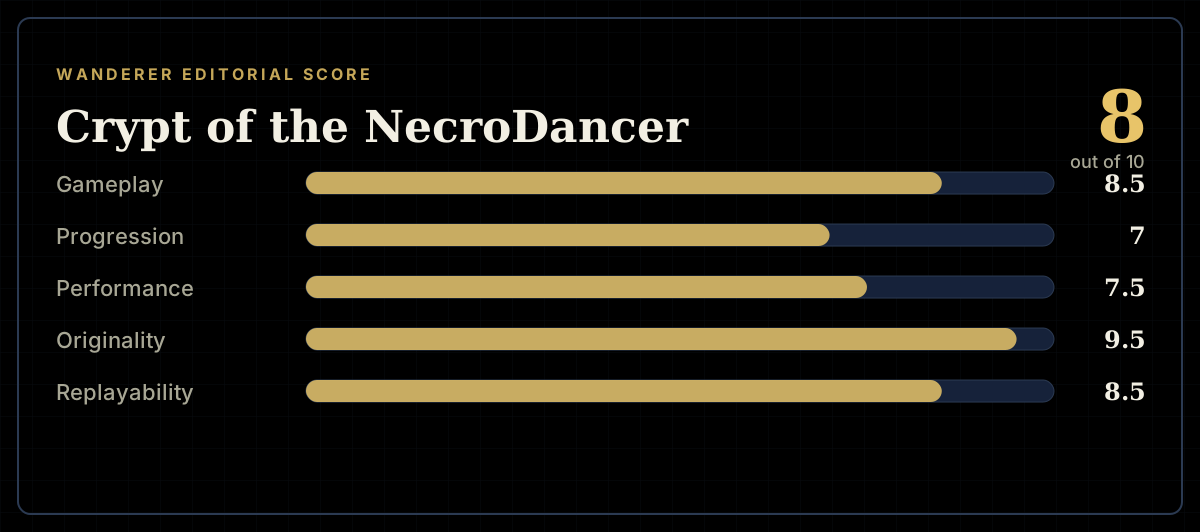
How the review scores each part of the gameWanderer Editorial -
The short versionWanderer Editorial