
Game review
Risk of Rain (2013)
5.5 / 10
- Developer
- Hopoo Games
- Publisher
- Gearbox Publishing, 2K
- Released
- 8 November 2013
- Platforms
- Windows, macOS, Linux
- Genre
- Roguelike Action RPG
- Monetisation
- Paid, one-time purchase, plus a separate DLC soundtrack. No in-app purchases.
- Players
- Online co-op for up to four players; several reviews report persistent connectivity problems specific to this mode.
The short version
Risk of Rain's core loop — stack items until either you or the escalating difficulty timer wins — remains as compelling as it was in 2013, and it's easy to see why it spawned one of the genre's most successful sequels. What can't be separated from a 2026 review is what's happened to the original since ownership passed to Gearbox in late 2022: a heavily corroborated wave of 2025-2026 reviews describes a new Take-Two/2K terms-of-service update adding data-collection language and making modding grounds for a ban, on a twelve-year-old single-player-capable game that never needed either. Roughly three in five of the negative reviews checked for this piece raise that exact complaint, independently, within the same few-month window.
Biggest strengths
- A genuinely tense escalating-difficulty structure — the longer a run lasts, the harder enemies get, forcing real risk-reward decisions about pacing rather than passive grinding.
- Deep item-stacking systems that let small individual pickups combine into dramatically powerful, often unpredictable builds.
- A distinct, well-regarded pixel art style and soundtrack that helped establish the visual identity the sequel later built on.
Biggest weaknesses
- A heavily corroborated, very recent wave of reviews (concentrated in 2025-2026) describes new Take-Two/2K/Gearbox terms of service and EULA changes adding data-collection language and a specific anti-modding clause to a game that previously had neither.
- Online co-op has drawn persistent connectivity complaints for years, including reports from 2018 of being effectively unable to play with friends at all.
- At least one 2026 review reports frequent crashes making the current build "unsatisfying to play."
Who it's for: Roguelike fans who want the original, more grounded Risk of Rain experience specifically, and are willing to weigh a legitimate current controversy over its new legal terms against the strength of the underlying game.
Our recommendation: The core game still holds up; read the current EULA and terms of service for yourself before agreeing to them, and consider the newer Risk of Rain Returns remaster if this game's ownership situation is a dealbreaker.
5.5 / 10
The escalation loop that started a franchise
Risk of Rain's pitch is simple and still effective more than a decade on: land on a hostile planet, fight through randomly generated stages collecting items that stack into increasingly absurd combinations, and race against a difficulty timer that only ever climbs. The store page's own framing is direct about the stakes — "with permanent death as a primary feature, players will have to play their best to get as far as possible" — and the game's own official screenshot shows exactly what that escalation looks like in practice: a player at level 13 facing down a "Wandering Vagrant" boss with 7,120 hit points while the difficulty readout in the corner reads, bluntly, "Impossible." That tension between wanting to explore for more items and needing to keep moving before the clock turns lethal is the entire design in miniature, and it's aged well enough that it remains the direct mechanical ancestor of Risk of Rain 2, one of the more successful roguelites of the last several years. Four-player online co-op adds a genuinely chaotic layer on top when it works, turning individually-collected items into a shared, increasingly ridiculous arsenal across the whole team.
A very recent controversy that dominates the current review sample
What makes 2026 a genuinely different moment to evaluate this specific game is a wave of reviews concentrated almost entirely within the last year or so, all raising the same pointed complaint. "HOW DARE YOU LOCK ME OUT OF A 12 YEAR OLD GAME BY UPDATING THE EULA TO ADD PREDATORY SPYWARE TERMS! Take-Two needs to keep their slimey hands off these games," reads one April 2025 review. A June 2025 review, titled "Updated Review for 2025," is more specific about the actual clauses: "Making it bannable to mod your game is one of the most disconnected [decisions]," going on to list several newly-added terms verbatim, including that "mods of all kinds are a bannable offense" and that players are "forced into arbitration" to keep playing while connected to the internet. Multiple independent reviews repeat nearly identical language about the same specific clauses, which reads as players quoting the actual updated document rather than describing a vague rumour — a genuinely different, more verifiable kind of complaint than typical review-bomb language. The consistent throughline across this wave is less about the base game's design and entirely about what a prospective buyer is now being asked to agree to in order to play it, following the ownership change to Gearbox (itself now under Take-Two/2K) documented in the game's own November 2022 news post.
This review can't independently audit the exact legal text of a EULA that may continue to change after publication, and it won't reproduce specific clauses secondhand as verified fact. What it can say is that the volume, specificity and consistency of these reports — arriving from many separate accounts within a tight, recent window rather than trickling in over years — makes this a real, current risk factor for anyone considering a purchase, not a fringe complaint to dismiss. Buyers concerned about it should read the current terms of service themselves before purchasing, rather than relying on either this review or the review-bomb wave as a substitute for checking the actual document.
Older, more familiar friction points
Separate from the terms-of-service wave, this game carries a longer-standing and more conventional complaint: online co-op reliability. A 2018 review states plainly, "to play online co-op with your friends or in general is impossible and the system needs an update," describing failed attempts to get a response from the developers. A more recent 2026 review reports the current build "crashes all the time," specifically recommending the newer Risk of Rain Returns remaster instead for anyone primarily interested in the 2D experience. Both complaints predate or sit alongside the ownership controversy rather than being caused by it, and are worth knowing about independently.
Why "just don't connect to the internet" isn't a clean workaround
Several reviewers in the terms-of-service wave suggest a specific workaround: play offline, or acquire the game through other means, to avoid agreeing to the updated terms while still enjoying a purchase already made. It's worth being clear-eyed about why that doesn't fully resolve the concern for every player rather than presenting it as a tidy solution. Risk of Rain's most distinctive feature beyond solo play is its four-player online co-op — exactly the mode that requires the internet connectivity the terms reportedly gate. A player who avoids agreeing to the new terms by staying offline is also opting out of a real, substantial part of what the game offers, which means the "just play offline" suggestion is really an argument for treating this as a smaller, single- player-only game than it was originally sold as, not a genuine way to have the full original experience without the new terms attached. That's a real trade-off worth naming plainly rather than treating the offline option as free of cost.
Final verdict
The design at the heart of Risk of Rain remains genuinely excellent, tense and replayable enough to have spawned one of the genre's most successful sequels, and this review doesn't want that lost under everything else covered here. But 2026 is not 2013, and a buyer today is agreeing to considerably more than they would have been a few years ago, according to a large, specific and recent cluster of first-hand reports. This review's score reflects both realities honestly: a strong game, wrapped in a current ownership and terms-of-service situation that a meaningful share of its own community considers a real reason not to buy it as things currently stand.
Pros and cons
Pros
- A genuinely tense escalating-difficulty structure — the longer a run lasts, the harder enemies get, forcing real risk-reward decisions about pacing rather than passive grinding.
- Deep item-stacking systems that let small individual pickups combine into dramatically powerful, often unpredictable builds.
- A distinct, well-regarded pixel art style and soundtrack that helped establish the visual identity the sequel later built on.
- Historically significant as the foundation for Risk of Rain 2, one of the genre's most successful modern roguelites.
Cons
- A heavily corroborated, very recent wave of reviews (concentrated in 2025-2026) describes new Take-Two/2K/Gearbox terms of service and EULA changes adding data-collection language and a specific anti-modding clause to a game that previously had neither.
- Online co-op has drawn persistent connectivity complaints for years, including reports from 2018 of being effectively unable to play with friends at all.
- At least one 2026 review reports frequent crashes making the current build "unsatisfying to play."
- Multiple reviewers recommend the newer Risk of Rain Returns remaster over this original release specifically because of the ownership and terms-of-service situation.
Screenshots
-

Risk of Rain (2013)Image: Gearbox Publishing via Steam -

Risk of Rain (2013)Image: Gearbox Publishing via Steam -

Risk of Rain (2013)Image: Gearbox Publishing via Steam -
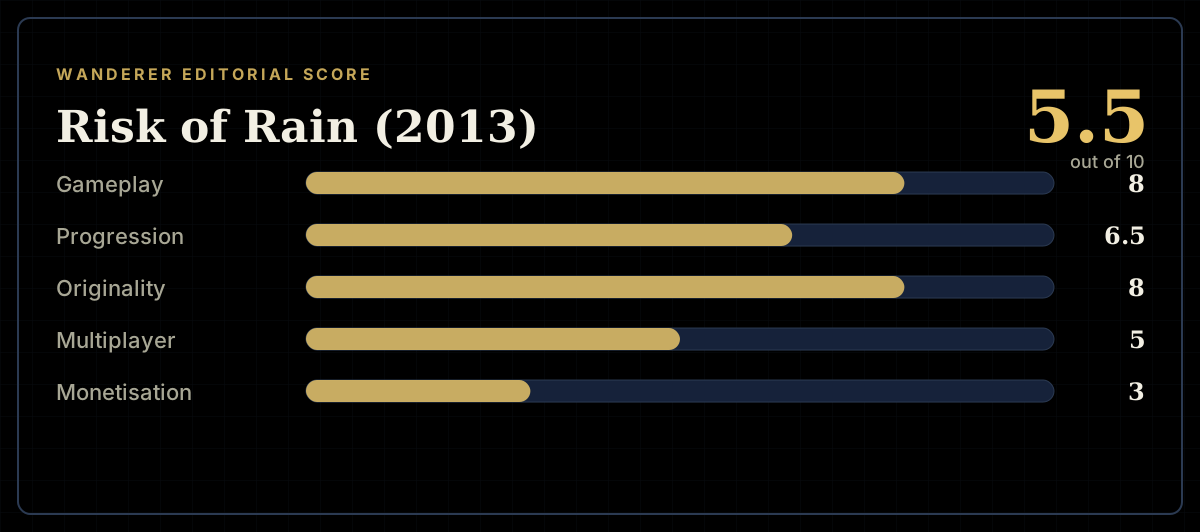
How the review scores each part of the gameWanderer Editorial -
The short versionWanderer Editorial