Game review
Crusader Kings III
7.5 / 10
- Developer
- Paradox Development Studio
- Publisher
- Paradox Interactive
- Released
- 1 September 2020
- Platforms
- Windows, macOS, Linux
- Genre
- Grand Strategy / Dynasty RPG
- Monetisation
- NZ$79.99 base plus 33 DLC entries. Pricing the 26 that carry a price on 4 August 2026 totals **NZ$652.74** — median NZ$7.99, with 8 items at NZ$30 or more. Some entries are bundles that overlap individual packs, so the true cost of owning everything is lower than that headline. A subscription option also exists.
- Players
- Online multiplayer supported
The short version
Crusader Kings III is a machine for producing stories about people. You don't play a country, you play a person with traits, stress, lovers, rivals and a lineage, and when they die you play their heir and inherit the mess. Nothing else generates narrative like it, the interface finally made the genre approachable, and its players average 117 hours. The problem is the storefront. Thirty- three DLC entries, and — by repeated player account — mechanics introduced into the base game whose solutions sit behind purchases, so a returning player can find a new problem they cannot address.
Biggest strengths
- The character system is the best in strategy gaming — traits, stress, relationships and inheritance combine into stories no scripted campaign could write
- Succession makes death a mechanic rather than a fail state; the dynasty is the real save file
- The most approachable Paradox game by a wide margin, with an interface that finally explains itself
Biggest weaknesses
- Thirty-three store entries, with 26 priced ones totalling over NZ$650 before accounting for bundle overlap
- Players report base-game mechanics whose remedies are DLC-locked, so free updates can introduce problems you must pay to solve
- Government types, cultural options and court systems that shape whole playstyles sit behind NZ$30-plus purchases
Who it's for: Anyone who wants emergent stories about characters rather than spreadsheets about borders, and who can accept an expansion model that never stops. Not for players who want a complete product for a single price.
Our recommendation: Buy the base game on sale and play a hundred hours before you consider any DLC — it's a complete, superb game on its own and you'll learn what you actually miss. When you do buy, pick the two or three expansions covering the thing you want to play with rather than the catalogue, and check the subscription option against your habits, since owning a subscription can interact awkwardly with bundle pricing during sales. Ignore the cosmetic packs entirely.
7.5 / 10
A player with 1,398 hours logged wrote a review with 722 helpful votes. It says, in full: "Stop charging so much for DLCs. I want to play this game with my buddies but they see the price tag and they get spooked."
That's the shape of Crusader Kings III's reputation. The game is beloved — 90% positive lifetime, 90% among recent buyers, a 117-hour median playtime. The reviews are about the shop.
What it does better than anything else
Most strategy games make you a nation. Crusader Kings makes you a person.
You are a specific medieval noble with traits — brave, lustful, deceitful, gout — and a stress meter, a marriage, a scheming brother and a claim on land you'd like to have. You play until you die, and then you play as your heir, inheriting whatever mess you left and whatever your vassals think of your family.
That single design choice produces stories nothing else generates. Your genius firstborn dies of smallpox and the realm passes to the drunk. A courtier you imprisoned twenty years ago becomes your grandson's regent. A murder plot succeeds and you spend a decade managing the consequences. None of it is written; all of it emerges from characters with opinions and a succession system that doesn't care about your plans.
CK3 is also, by a distance, the most approachable game Paradox have made. The interface explains itself, the tooltips are legible, and the on-ramp is gentle enough that people who bounced off the genre entirely can play this one. That accessibility is a genuine achievement and it's why the playerbase is so much larger than its predecessors'.
Five years of free patches have kept adding systems, and the base game today is substantially richer than the one that shipped — which reviewers from 2020 correctly criticised for having almost no mechanical difference between playing a Norwegian count and an African tribe.
The storefront
Now the part everyone writes about.
There are 33 DLC entries. I priced the 26 that carry a price on 4 August: NZ$652.74, with a median of NZ$7.99 and eight items at NZ$30 or more. Some of those entries are bundles overlapping individual packs, so nobody actually pays that full figure — but the shape is clear, and it's the same long-tail structure I found on The Sims 4, scaled up.
That alone would be an ordinary complaint. What makes CK3's case sharper is the second charge, and it comes from multiple independent reviewers.
A player with 185 hours describes returning after a few years to find a new mechanic — Legitimacy — which they kept losing, and which was causing them problems. They looked up how to raise it and found the means locked behind DLC. Another, with 579 hours, describes vassals unhappy about court grandeur and discovering that improving it requires the Royal Court expansion. A third, with 317 hours, notes that unique government types and hybrid cultures — whole categories of playstyle — sit behind individual purchases.
The pattern those describe is not "there is optional content you may buy." It's that free updates introduce systems into everyone's game whose remedies are sold separately. If that's accurate — and it's reported consistently by long-term players rather than by anyone with an axe to grind — it's a qualitatively different proposition from War Thunder's boosters or Sims kits, because it can make the game you already own worse until you pay.
There's a subscription option, and one player with 426 hours reports a genuinely absurd side effect: holding an active subscription marks their collection "Complete" to Steam, so they cannot buy discounted DLC bundles during a sale.
Why the dynasty is the real progression system
It's worth explaining what makes this game's progression different, because "you play a dynasty" undersells the mechanism.
In most strategy games your progress is stored in the world — territory held, buildings raised, technologies unlocked. Lose a war and you lose some of it, but the ledger persists. CK3 stores a large share of your progress in people, and people are mortal.
Your ruler's skills, their earned traits, the relationships they spent thirty years building, the alliances secured by their marriages — all of that evaporates the moment they die. What passes down is narrower: land, gold, dynasty prestige, and whatever opinion your heir has inherited along with the crown. So the game repeatedly takes your best asset away and asks what you built that survives without them.
That's why succession planning becomes the real strategy layer. You're not optimising a country, you're trying to ensure the next person is competent, legitimate and not immediately murdered by their siblings — which means marriage politics, education choices, partition laws and occasionally arranging an inconvenient relative's accident.
It also explains why failure here is enjoyable rather than punishing. Losing a war costs you provinces; losing a ruler costs you a character you knew, and produces a new one with different problems. The game's stories come from that churn, and a dynasty two centuries old carries the marks of every bad succession you survived.
Nothing else in strategy does this, and it's the reason the 117-hour median is plausible. You aren't replaying a campaign — you're continuing a family.
What the numbers say about the trend
Negative reviews by year: 11 in 2020, 7 in 2021, 11 in 2022, 9 in 2023, 17 in 2024, 29 in 2025, 16 so far in 2026.
The 2020 complaints were about content — thin regional variety, unfavourable comparisons to CK2. The 2024–26 complaints are about money, almost without exception, and they come from players with hundreds or thousands of hours. Sentiment overall hasn't collapsed — 90% recent is excellent — but the dissatisfaction that does exist has migrated entirely from the game to the business model.
7.5 out of 10. Rated 7.5 out of 10.
Judged as design, CK3 is a 9 and I'd defend it against anything in strategy. It is the best character-driven game ever made, it produces stories people retell for years, and it made an impenetrable genre welcoming. If you have any interest in medieval politics, buy it.
The score reflects that you are not buying a game so much as entering a subscription-shaped relationship with one, and that its own most experienced players — the 1,398-hour, 579-hour, 426-hour reviewers — are the ones writing about the price. Buy the base game, play a hundred hours, add two expansions, and stop. That version of CK3 is superb and costs a fraction of the catalogue.
Pros and cons
Pros
- The character system is the best in strategy gaming — traits, stress, relationships and inheritance combine into stories no scripted campaign could write
- Succession makes death a mechanic rather than a fail state; the dynasty is the real save file
- The most approachable Paradox game by a wide margin, with an interface that finally explains itself
- Enormous replayability across regions, religions, government types and self-set goals, reflected in a 117-hour median
- Free patches genuinely add systems to the base game rather than only fixing it
- Still 90% positive both lifetime and among recent buyers, five years and dozens of releases in
Cons
- Thirty-three store entries, with 26 priced ones totalling over NZ$650 before accounting for bundle overlap
- Players report base-game mechanics whose remedies are DLC-locked, so free updates can introduce problems you must pay to solve
- Government types, cultural options and court systems that shape whole playstyles sit behind NZ$30-plus purchases
- Negative reviews are rising year on year — 2025 was the worst yet — and are almost entirely about pricing rather than design
- Owning a subscription can interfere with buying discounted bundles, which players describe with real frustration
- The base game shipped with thin regional differentiation, and much of what fixed that was sold
Screenshots
-
Crusader Kings IIIImage: Paradox Interactive via Steam -
Crusader Kings IIIImage: Paradox Interactive via Steam -
Crusader Kings IIIImage: Paradox Interactive via Steam -
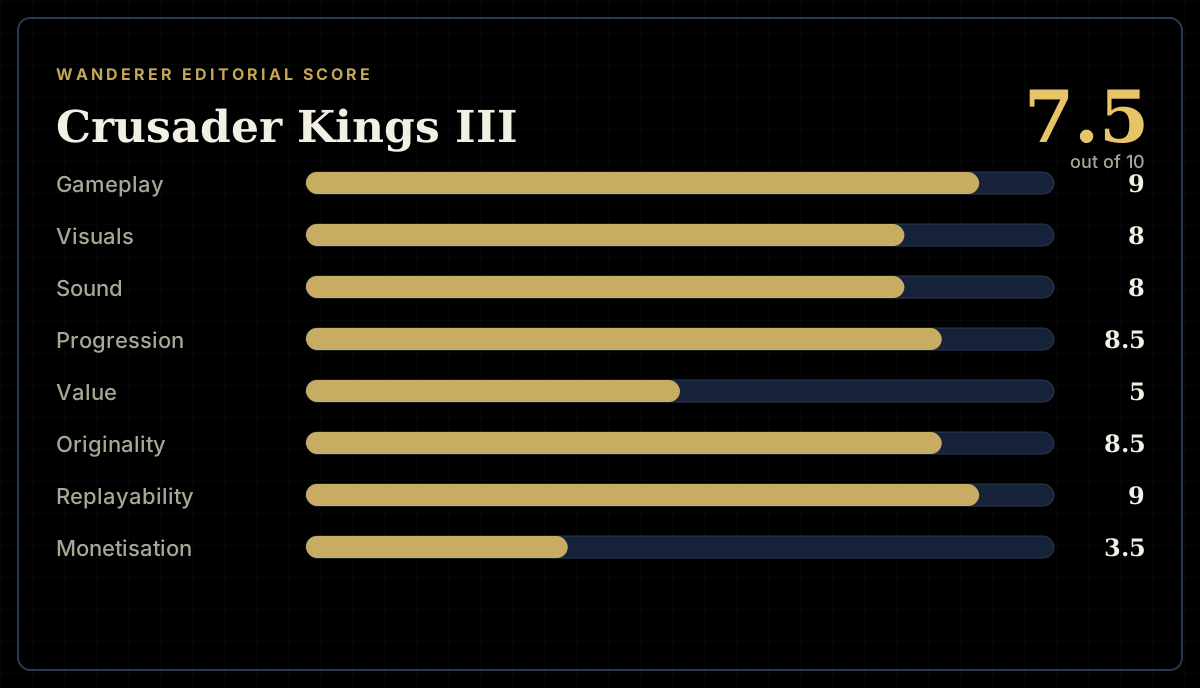
How the review scores each part of the gameWanderer Editorial -
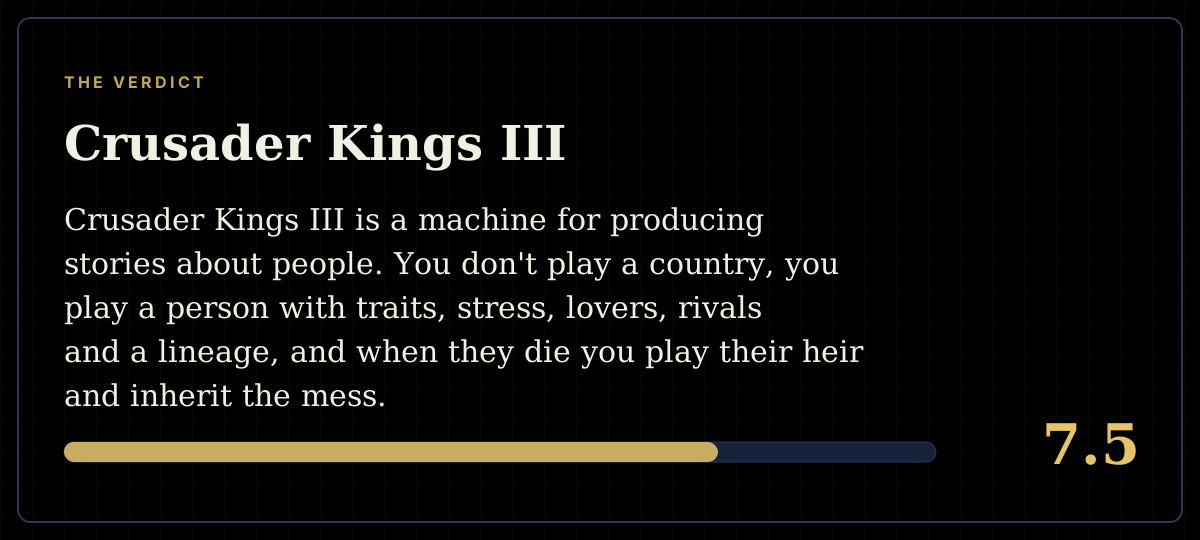
The short versionWanderer Editorial