
Game review
Corsair Fleet: Tides of Plunder Review
5 / 10
- Developer
- Velron Games
- Publisher
- Velron Games
- Released
- 14 September 2026
- Platforms
- ["Windows"]
- Genre
- Simulation
One Ship, an Idle Loop, and a Deck of Pirates
Corsair Fleet: Tides of Plunder pitches itself as a cozy pixel-art idle RPG about building a pirate empire from a single humble sloop. Ships are sent out on voyages of varying length and keep earning loot even while the game is closed, crew members are represented as cards that chain together for synergy bonuses, and turn-based naval battles against pirates, the Royal Navy, ghost ships, and krakens punctuate the otherwise hands-off progression. It's a genre combination — idle progression, light deck-building, and roguelike branching encounters — that has real potential, stitching together mechanics that usually live in separate games into a single cozy pirate wrapper.
Voyages, Crew Cards, and a Prestige Reset
The core structural idea is sound: short, medium, or long voyages let players choose how much risk and time commitment they want from a given trip, while branching encounters at sea mean no two voyages play out identically even with the same crew loadout. Selling recovered treasure unlocks legendary crew members, and a prestige system lets players reset their progress for permanent bonuses once a fleet's growth plateaus — a familiar idle-game structure, but one that pairs reasonably well with the deck-building crew system, since a prestige reset effectively becomes an opportunity to rebuild toward a different card synergy rather than just re-grinding the same build faster. Five ship classes scaling from sloop to war galleon, each facing off against one of five dedicated bosses, gives the escalation a clear shape even without direct hands-on play required at every step. Combat itself leans on turn-based cannon exchanges rather than reflex-driven action, which fits the game's stated "playable without timed input" accessibility option and its broader cozy framing — nothing here is meant to demand split-second reactions, and the roguelike branching encounters are pitched as strategic gambles (fight, flee, or risk everything for a bigger payout) rather than tests of mechanical execution. That's a sensible design choice for a game explicitly built around checking in periodically rather than sitting through full play sessions.
A Split Verdict From a Tiny Audience
With only two public reviews at the time of writing, Corsair Fleet doesn't have much of a track record to draw on, and what's there is sharply divided. The positive review, written in Simplified Chinese by a player with roughly 24 hours logged, describes it as "a pretty good idle game" — voyages take around 30 minutes, items collected upgrade the ship, treasure sales unlock legendary crew, and black-market crew members are described as one-time purchases worth planning around. That reviewer specifically recommends buying medicine and supplies before setting sail, calling the game good value for money overall — a grounded, mechanically specific endorsement from someone who's clearly spent real time with the systems.
The negative review tells a very different story, and it's a serious one. Written in English, it describes the game as an "Alpha Build Game Concept, NOT a playable game," reporting game-breaking issues, menu and language problems that blocked progress past the first load-in, and — most damning — a total lack of developer response after being invited into a public test thread. The reviewer explicitly says they raised these concerns a week before writing the review and received no updates or acknowledgment in that time, and directly questions whether the release was more about collecting early sales than delivering a working game. That's a genuinely serious accusation of developer unresponsiveness, not a minor complaint about balance or difficulty, and it deserves to be weighed heavily even against a single positive counterexample.
Weighing a Cozy Pitch Against a Troubling Silence
It's entirely possible both reviews are accurate reflections of different experiences — idle games can vary wildly in how smoothly they run depending on save state, language settings, or which specific systems a player happens to interact with first, and the Chinese-language reviewer's detailed, mechanically grounded praise doesn't read like an outlier written in bad faith. But a credible, specific report of unaddressed game-breaking bugs and total developer silence in the first week after launch is hard to look past for a $5.99 release with essentially no independent verification to counterbalance it. It's also worth noting that the storefront's own screenshots are watermarked "Development Build," and one captain's-log entry mixes an untranslated line of Turkish in among otherwise English text — small details, but ones that align with the negative reviewer's complaint about rough, unfinished presentation rather than contradicting it. A cozy pirate idle game with deck-building crew synergies is a genuinely appealing pitch, and the positive review suggests that pitch can work when the game is functioning as intended — but "as intended" is doing a lot of work in that sentence when one of only two public reviews says it wasn't, for them.
An Idle Genre That Lives or Dies on Trust
Idle and incremental games occupy an unusual position in the review ecosystem: their appeal depends almost entirely on a player trusting that progress will keep accumulating fairly while they're not watching, which makes developer responsiveness matter more here than it would in a game built around active, moment-to-moment engagement. A bug that silently halts offline progression, or a crew synergy that doesn't calculate correctly while the game is idling in the background, is far easier to miss and far more damaging to the core pitch than an equivalent bug in a game the player is actively staring at. That context makes the negative review's specific complaint — game-breaking issues left unaddressed during an invited test period — land harder than it might for a more actively-played genre, since the entire value proposition of an idle game rests on the assumption that the numbers are actually ticking up correctly behind the scenes.
Verdict
Corsair Fleet: Tides of Plunder combines idle progression, light deck-building, and roguelike naval encounters into a cozy pirate concept with real promise, and one detailed positive review suggests that promise is achievable when the game runs as designed. But a second review describing game-breaking issues and total developer silence during an invited test period is a serious enough red flag, on a review base this small, to warrant real caution. At under six dollars it's a low-cost gamble either way, but prospective buyers should go in aware that the jury on basic playability is still very much out, and watch for signs of active post-launch support before expecting a smooth first voyage.
Screenshots
-
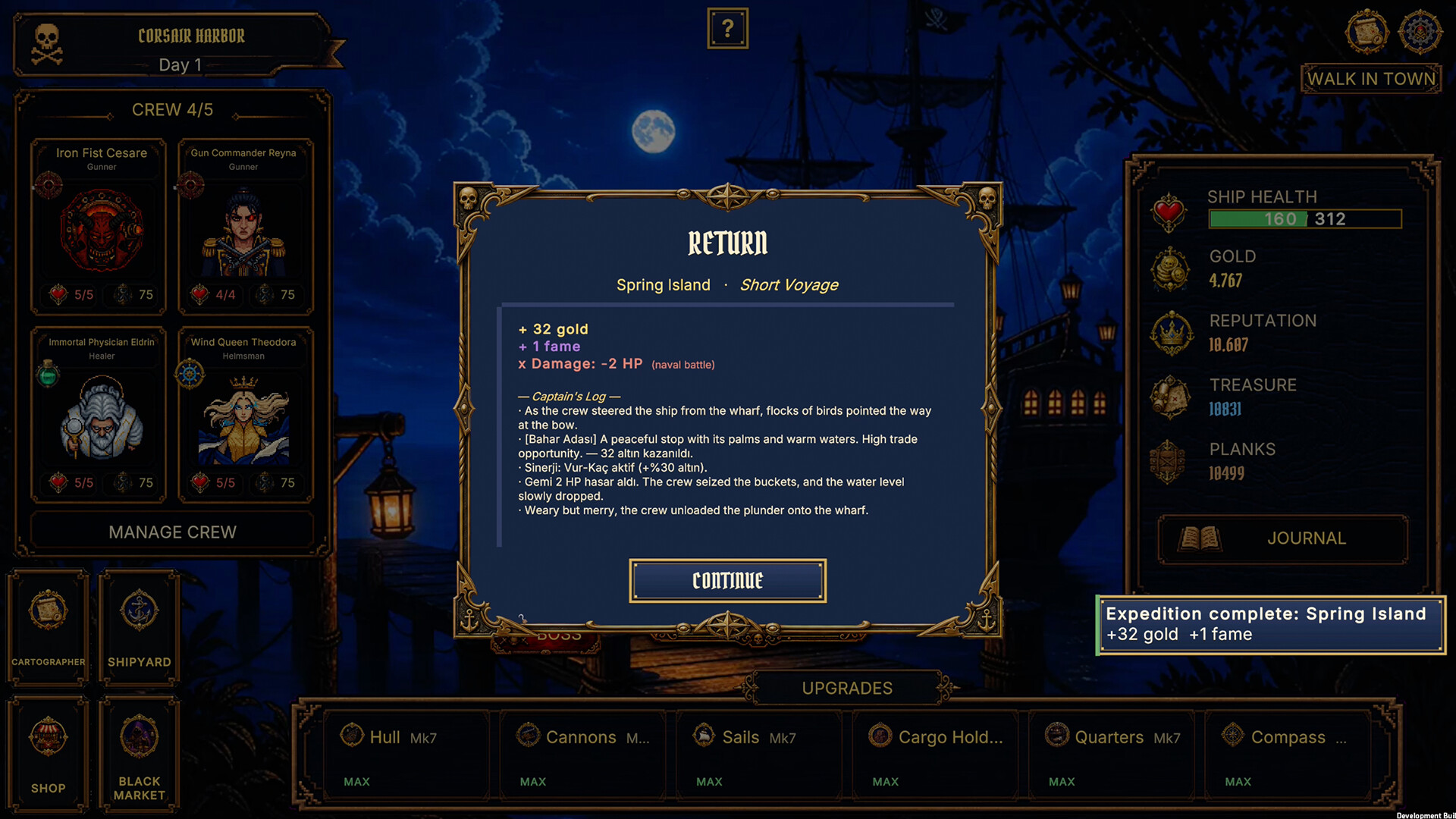
A voyage-return summary at Corsair Harbor — note the untranslated Turkish line in the captain's log, alongside the English UI.Image: Velron Games via Steam -
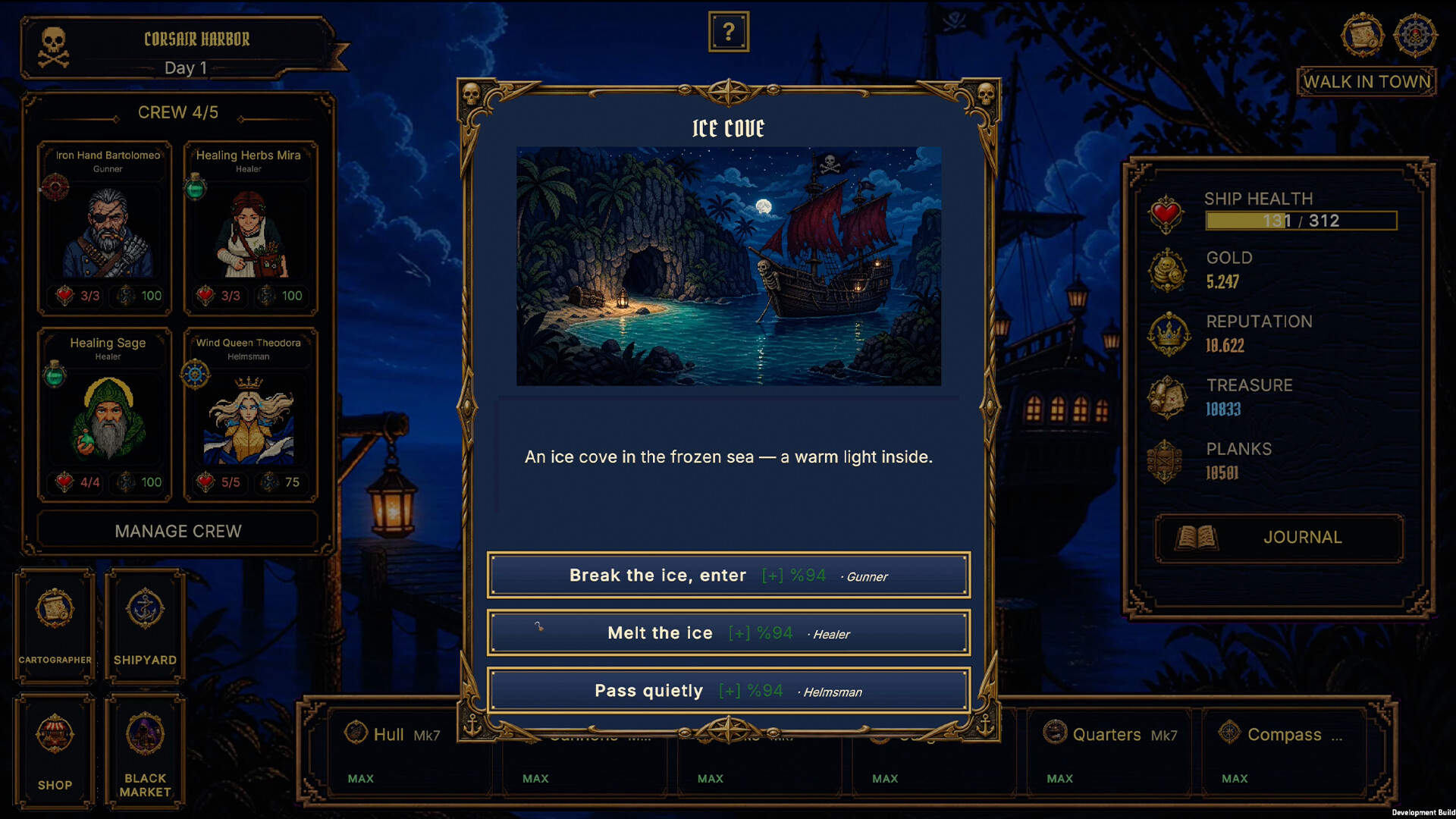
A branching voyage encounter, offering different crew-tied approaches. The store's own screenshot carries a 'Development Build' watermark.Image: Velron Games via Steam -
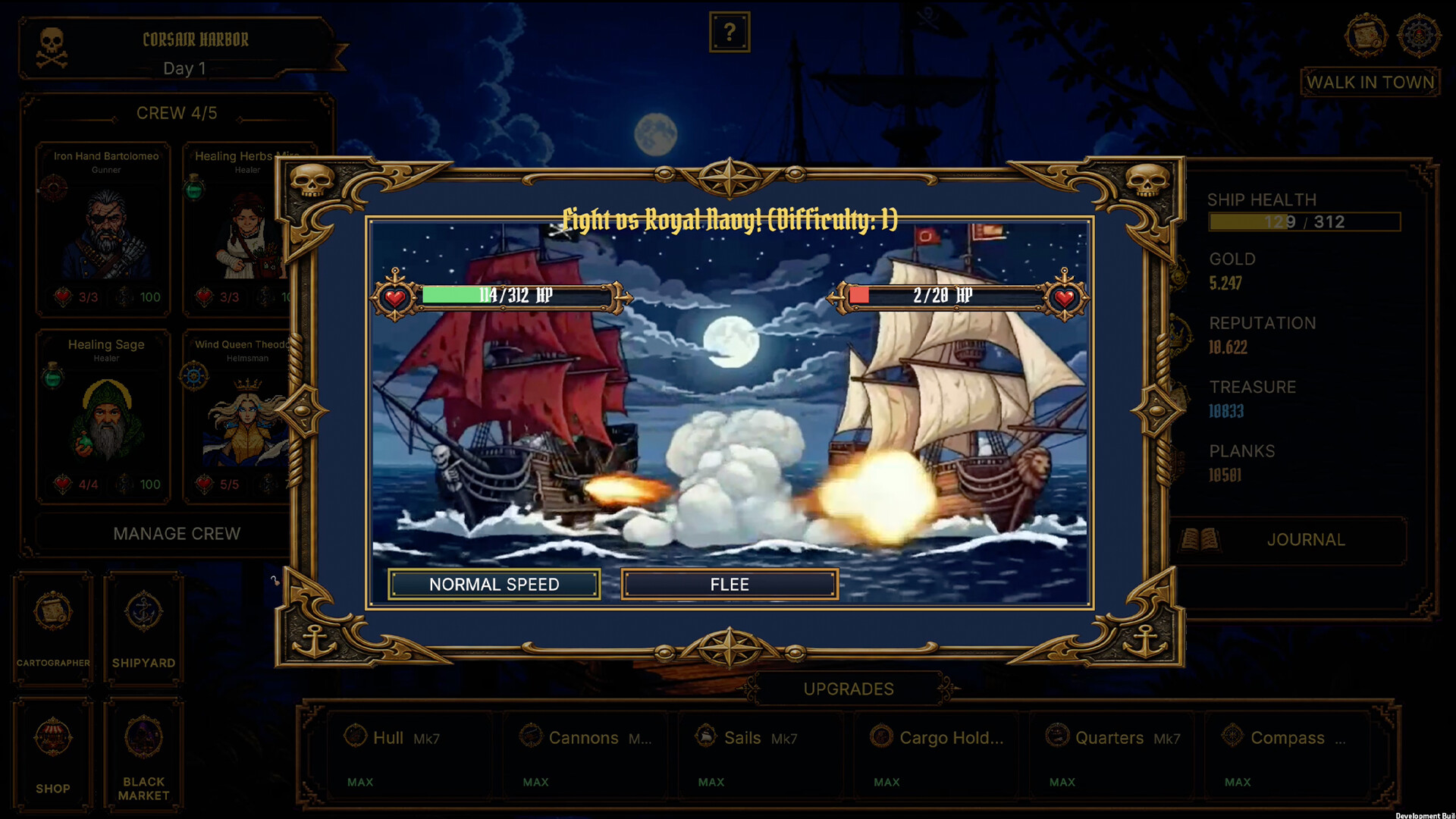
Turn-based cannon fire against a Royal Navy ship, one of the game's several enemy factions.Image: Velron Games via Steam