
Game review
Cat God Ranch
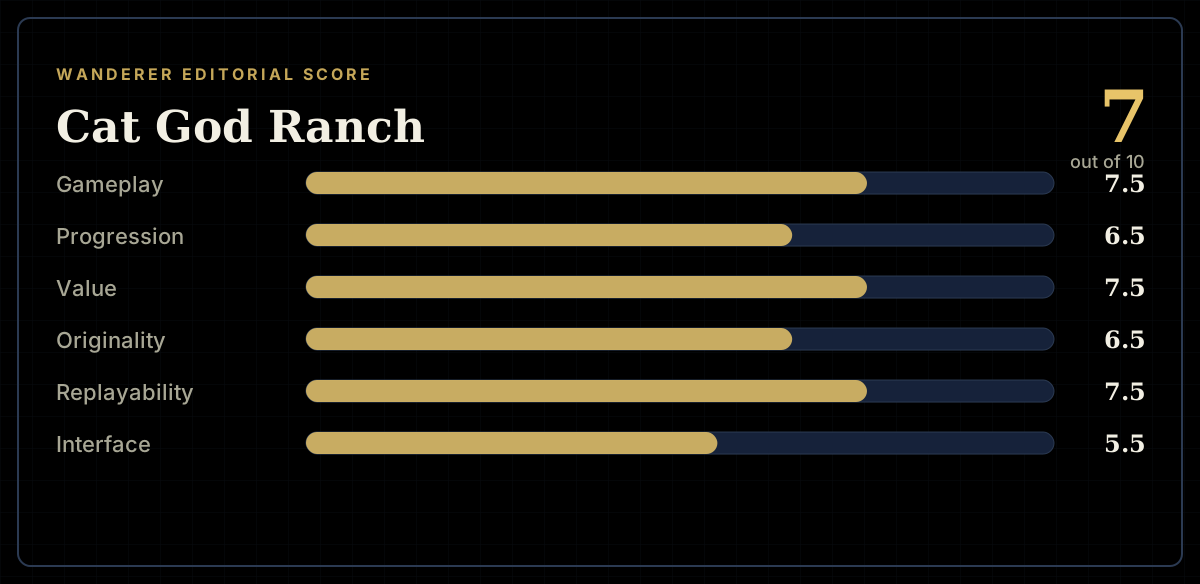
7 / 10
- Developer
- CrazyPotato Studio
- Publisher
- CrazyPotato Studio
- Released
- 13 September 2024
- Platforms
- Windows, macOS
- Genre
- Slot-machine synergy roguelike deckbuilder
- Monetisation
- One-time purchase, with two paid DLC packs and a separate mobile version available
- Players
- Single-player only
The short version
Cat God Ranch takes the slot-machine synergy formula popularised by Luck Be a Landlord and rebuilds it around collecting, breeding, and combining over 100 animal species across seven families, all in service of paying weekly tribute to a demanding, capricious Cat God. Reviewers who know the genre's most famous predecessor consistently describe this as a genuine, worthy successor rather than a cheap clone, praising its depth, its charm, and its sheer volume of content. The developer has backed that reception with one of the most commercially successful and consistently supported small releases documented in this lane — hitting major sales milestones within days of launch and continuing active development, DLC, and console and mobile ports for over two years since. The main drag on an otherwise glowing picture is a genuinely rough English localisation that a significant share of English-speaking reviewers flag directly, alongside a small but concerning handful of reports describing corrupted save data.
Biggest strengths
- The core slot-machine synergy loop is repeatedly and specifically praised by reviewers familiar with Luck Be a Landlord as a genuine, worthy successor rather than a shallow clone, with several calling it their new favourite in the genre
- The sheer scope of content draws consistent praise, with over 100 animals across seven distinct families, more than 100 prop cards, and multiple cat gods each offering genuinely different playstyles and strategic approaches
- The developer has sustained an exceptionally dense, two-year-plus support record, including two paid content DLCs, console ports to Nintendo Switch, controller and Steam Deck support, and continued balance updates and leaderboard resets throughout
Biggest weaknesses
- The English localisation draws a specific, repeated complaint across the review sample, with multiple reviewers describing card and mechanic descriptions as imprecisely worded or genuinely difficult to parse, occasionally undermining the strategic clarity the genre depends on
- At least one detailed reviewer reports the game's own scoring can hit an integer overflow at very high values, causing a stage that should be cleared based on the displayed score to fail unexpectedly
- A small number of reviewers report serious save-corruption incidents, with one describing local and cloud save data being erased or corrupted on multiple separate occasions despite substantial prior progress
Who it's for: Fans of Luck Be a Landlord and similar slot-machine synergy roguelikes who want a deeper, animal-themed take on the format with substantially more content to unlock. Less suited to players who need polished, native-quality English text to fully enjoy a game's systems.
Our recommendation: A strong, easy recommendation for genre fans at its price, backed by an unusually trustworthy long-term support record. Go in aware the English localisation is functional but rough around the edges, and keep occasional manual backups of your save given a small number of reported corruption incidents.
7 / 10
Cat God Ranch belongs to a specific, well-defined lineage: the slot-machine synergy roguelike popularised by Luck Be a Landlord, where a board fills with symbols each round and your job is to build combinations that generate enough value to survive. What Cat God Ranch adds to that formula is theme and scale — over 100 collectible animals across seven distinct families, all working (or eating each other) toward a shared goal of appeasing a demanding, capricious Cat God who can shut your ranch down if tribute isn't paid. This review's sample is unusually direct about where the game sits relative to its inspiration, and unusually consistent in judging it favourably.
A genre successor its own audience takes seriously
Reviewers with deep familiarity with the genre's touchstone don't hedge their praise. "Another fine entry into the Luck be a Landlord category. It is polished, with loads of content and fun mechanics," one writes, while another goes further: "My favorite successor to Luck Be a Landlord so far," specifically crediting added auto-battler shop mechanics and distinct animal families for improving replayability. A third describes an unexpectedly deep hook: "surprisingly deep and satisfying considering its casual look... I'm 3 hours deep going 'I can't believe that my tiger ate my eagle which ate my dormice.'" This isn't faint praise dressed up as enthusiasm — these are reviewers actively comparing the game against a well-regarded, specific genre benchmark and finding it holds up.
A rough translation that doesn't fully undercut the design
The most consistently repeated criticism concerns the English localisation, and it's worth taking seriously given how mechanically dense this genre tends to be. "The atrocious English translation ruins a game with immense potential," one reviewer writes, while a more measured account notes "the translation leaves something to be desired, but... it's at least consistent and you get used to it." That range of reactions — from genuinely frustrated to merely inconvenienced — suggests the translation issues are real but not uniformly disqualifying, and several reviewers explicitly recommend pushing through the rough wording because the underlying systems reward the effort.
Specific bugs worth knowing about
Beyond translation, two more concrete technical issues appear in the sample. One detailed reviewer describes an integer-overflow bug at very high score values, where a stage that should clearly be cleared based on the displayed score fails to register as passed — a specific, reproducible-sounding issue rather than vague dissatisfaction. More seriously, at least one reviewer reports local and cloud save data being corrupted or erased on multiple separate occasions after substantial investment, torn between recommending the game and flagging a real risk to hard-won progress. Given how much of this genre's appeal depends on long, escalating runs, save reliability is a legitimate thing to flag directly for prospective buyers.
An exceptional, well-documented commercial and support story
What sets Cat God Ranch apart from many small releases in this lane is the sheer scale of its documented success and ongoing support. The developer's own partner-events feed reports 20,000 sales within five days of the 13 September 2024 launch and 100,000 within the first month — genuinely strong numbers for an indie release at this price point. That commercial momentum has translated into sustained investment: two paid DLC packs through 2025, console ports to Nintendo Switch, a separate mobile release, controller and Steam Deck support added in early 2025, and continued balance updates and seasonal content running into a "Daily Challenge Mode" release as recently as May 2026. That's an unusually strong, verifiable track record for a small studio's debut release.
Being direct about the language gap in this review's evidence
It's worth being transparent about a limitation in this specific review: Cat God Ranch's audience is overwhelmingly non-English-speaking, with only 150 lifetime English reviews against roughly 2,200 across all languages. The English-language sample this review draws on is real and detailed, but it represents a small fraction of the game's total reception, and the translation complaints specifically may carry less weight for the vast majority of the game's actual player base experiencing it in its native language.
What the achievement data confirms about long-term depth
Steam's own completion figures back up the review sample's account of genuine long-term content. A tutorial-completion milestone sits at a healthy 96.4%, confirming the game is approachable for newcomers, but the curve falls off steeply toward the harder end, with numerous seasonal and late-game achievements — tied to the "Winter" and "Frozen" content added via DLC — sitting at or below 1%. That's a meaningfully wide spread, consistent with a game that's easy to pick up but genuinely difficult to fully master, and it lines up with reviewers' accounts of returning to the game repeatedly across new content drops rather than exhausting it in a single sitting.
A theme that earns its own specific praise
Beyond the mechanical comparisons to its genre predecessor, reviewers consistently single out the animal theme itself as a genuine strength rather than surface-level dressing. The sound design in particular draws repeated, specific mentions — multiple reviewers describe the cacophony of different animal noises triggering simultaneously as a specific source of delight, and the sheer variety of creatures, from alpacas to crocodiles to hyenas, gives the collection aspect real appeal independent of the underlying strategic systems. For a genre that can sometimes feel abstract and numbers-driven, grounding the mechanics in a charming, varied bestiary is a real point in the game's favour.
Final verdict
Cat God Ranch earns genuine, specific praise from a genre whose fans don't hand out favourable comparisons lightly, backed by one of the most commercially successful and consistently supported small releases this lane has documented — two years of sustained content, ports, and updates following an exceptionally strong launch. Its English localisation is a real, repeated point of friction, and a handful of reported save-corruption incidents are worth taking seriously, but neither undoes what is, by its own dedicated audience's account, a genuinely worthy addition to its specific genre. Recommended for slot-machine roguelike fans looking for real depth and content at a fair price.
Pros and cons
Pros
- The core slot-machine synergy loop is repeatedly and specifically praised by reviewers familiar with Luck Be a Landlord as a genuine, worthy successor rather than a shallow clone, with several calling it their new favourite in the genre
- The sheer scope of content draws consistent praise, with over 100 animals across seven distinct families, more than 100 prop cards, and multiple cat gods each offering genuinely different playstyles and strategic approaches
- The developer has sustained an exceptionally dense, two-year-plus support record, including two paid content DLCs, console ports to Nintendo Switch, controller and Steam Deck support, and continued balance updates and leaderboard resets throughout
- The game achieved rapid, well-documented commercial success, reaching 100,000 sales within the first month according to the developer's own public announcements, reflecting genuine broad appeal beyond a niche audience
- Steam achievement data confirms real long-term challenge and depth, with numerous late-game and seasonal-content achievements sitting below 1%, indicating substantial replayable content for the most dedicated players
Cons
- The English localisation draws a specific, repeated complaint across the review sample, with multiple reviewers describing card and mechanic descriptions as imprecisely worded or genuinely difficult to parse, occasionally undermining the strategic clarity the genre depends on
- At least one detailed reviewer reports the game's own scoring can hit an integer overflow at very high values, causing a stage that should be cleared based on the displayed score to fail unexpectedly
- A small number of reviewers report serious save-corruption incidents, with one describing local and cloud save data being erased or corrupted on multiple separate occasions despite substantial prior progress
- This review's own English-language sample is thin relative to the game's overall reach, with only 150 English reviews against roughly 2,200 lifetime reviews across all languages, meaning the game's audience and feedback are overwhelmingly non-English-speaking
- At least one reviewer notes the game's balance feels less tightly tuned than Luck Be a Landlord itself despite additional systems like auto-battler shop mechanics, suggesting added scope hasn't uniformly translated into equally polished execution
Screenshots
-

Cat God RanchImage: CrazyPotato Studio via Steam -

Cat God RanchImage: CrazyPotato Studio via Steam -

Cat God RanchImage: CrazyPotato Studio via Steam -
How the review scores each part of the gameWanderer Editorial -
The short versionWanderer Editorial