
Game review
Beholder 2
6 / 10
- Developer
- Warm Lamp Games
- Publisher
- Alawar
- Released
- 4 December 2018
- Platforms
- Windows, macOS
- Genre
- Dystopian bureaucracy narrative strategy
- Monetisation
- One-off purchase, no in-game currency, ads or gameplay-affecting purchases
- Players
- None; single-player only
The short version
Beholder 2 keeps its predecessor's core promise — navigate a totalitarian state through morally compromising choices, climb or expose a corrupt system from the inside — but relocates the action from an apartment building you secretly surveil to the halls of the Ministry where you now work directly. Reviewers who enjoyed the original are unusually consistent that this specific change cost the series something real: several describe missing the sense of being "a component in a synchronized mechanism" that made the first game's surveillance loop distinctive, finding the new office setting's tasks repetitive across levels in a way the original's varied tenant stories weren't. Compounding that disappointment, multiple independent reviewers report a specific, checkable bug where Authority points — a core progression currency — stop accumulating from normal interactions, making advancement "very difficult" for reasons that have nothing to do with the story or setting debate. A serious, separately reported save-corruption issue was later fixed according to at least one returning player, a genuine positive sign of continued support even where the core design disagreement remains unresolved.
Biggest strengths
- The dark, morally compromising premise remains genuinely engaging for a meaningful share of reviewers, who describe getting drawn progressively into "more messed up things" as the story escalates
- A real "actual work" mechanic — literally processing paperwork and applications as part of your cover — gives the political intrigue a grounded, tangible activity to build around
- Multiple distinct endings reward replaying with different moral approaches, and reviewers share specific, informed tips (such as avoiding arresting bosses) for players chasing full completion
Biggest weaknesses
- A large, consistent share of reviewers who played the original Beholder describe this sequel as a clear downgrade, with more than one suggesting the developer should have released it under a different name entirely rather than as a direct sequel
- Multiple independent reviewers report a specific bug where Authority points, a core progression currency, stop accumulating from normal interactions, making advancement "very difficult" independent of any story or design complaints
- The shift from 2D apartment-building surveillance to a 3D ministry-office setting draws repeated criticism for losing the original's distinctive "cog in a machine" feeling and replacing it with repetitive, same-feeling tasks across levels
Who it's for: Fans of dark, choice-driven bureaucratic satire willing to accept a genuinely different structure from the original Beholder rather than a direct continuation of its specific loop. Less suited to players hoping for more of exactly what made the first game distinctive, since a meaningful share of returning fans say this sequel doesn't deliver that.
Our recommendation: Worth a try at a discount if the dystopian office-politics premise appeals on its own terms; original Beholder fans specifically should moderate expectations given how consistently the game's own returning audience describes it as a lesser follow-up.
6 / 10
Beholder 2 casts players as a fresh intern at the central ministry of a totalitarian state, promoted straight from the surveillance-state paranoia of the original Beholder into the very bureaucracy that game satirized from the outside. Released in December 2018, it built a Very Positive but noticeably more divided reception than its predecessor — 82% across 1,050 English reviews — and reading through the sample reveals a specific, well-articulated reason for that gap: players who loved the first game are unusually consistent about exactly what this sequel changed, and exactly why they miss it.
A setting change its own fans keep naming as the problem
The most repeated, most specific criticism concerns the shift from apartment-building surveillance to ministry office work. One detailed reviewer puts it precisely: "Completely different vibe from the Beholder 1. In this game you don't feel like a component in a synchronized mechanism, sensation that you could obtain in Beholder 1 you will never experience in Beholder 2." Another agrees on the verdict while crediting real effort: "Beholder 2 is still a fun sequel, but moving from a residential building to a government ministry didn't work quite as well for me. The new setting has some interesting ideas, but it loses a lot" of what made the original distinctive. A third reviewer goes further, suggesting the change was severe enough to warrant a different title entirely: "If I were the developer or the publisher, I would rename it and release under a different name. But it's not Beholder." That level of specific, converging agreement — not "this sequel is worse" in the abstract, but naming the exact same structural change as the cause — is worth taking seriously as an accurate diagnosis rather than simple sequel fatigue.
A specific bug blocking progress, separate from any design debate
Beyond the setting disagreement, a real, checkable technical problem recurs independently across reviews. One reviewer's entire review reads simply: "Authority gaining bug." A separate, more detailed reviewer confirms the same specific issue: "authority points are bugged and I don't get any from interactions which makes the game progression very difficult." Since Authority is one of the game's core resources for advancing through the story, this isn't a minor annoyance — it's a progression-blocking bug independently reported by more than one player, worth treating as an accurate account of at least an intermittent issue in the shipped game rather than one player's misunderstanding of the systems.
A real fix for a real, serious bug
To the developer's credit, at least one specific technical problem does appear to have been resolved. One reviewer's account traces the full arc: they played "years ago" and hit "a bug with the save" that lost significant progress after a long grind, prompting them to uninstall in frustration; returning recently, they report "the bug had been fixed" and found themselves enjoying the game again. That's a genuine, dated before-and-after account of a serious issue being addressed, worth crediting directly rather than assuming every technical complaint in an older game's review sample remains permanently unresolved.
The dark satire that still lands for some
Despite the setting debate, the core writing still connects with a real share of the audience. One reviewer describes the loop with real specificity: "Really interesting 'work' simulator (U will have to actually do your job to get money) and then do the other things on the side at the same time to advance this dark story. Was really interesting." Another, with over 3,000 hours logged, calls it their favorite in the series and offers a specific, informed completion tip: avoid arresting bosses if you want to see every ending without replaying. That level of specific, practical engagement suggests the story and choice systems still reward invested players, even if the moment-to-moment feel changed in ways the broader review sample says it shouldn't have.
A darkness some reviewers find flat rather than sharp
Distinct from the setting complaint, a separate thread argues the tone itself doesn't land the way the original's did. One reviewer who says they typically love story- and choice-driven games writes: "I like dark and bleak as much as the next person but this one just was boring bleak which is never good." That's a useful, precise distinction to preserve — it's not that the subject matter is too dark for this reviewer's taste, but that the specific execution of dark tone failed to generate the tension or engagement the same reviewer expects from the genre. A separate reviewer frames the same underlying issue as a pacing problem more than a tonal one, describing "more time walking than playing" and calling the overall experience "a dredge to even try to play." Both readings point to the same underlying issue from different angles: whatever made the first game's specific blend of dread and dark comedy work, several reviewers say this sequel dilutes it into tedium rather than intensifying it.
Repetition across levels
A further specific structural complaint, distinct from the setting-change debate, concerns level variety. One reviewer summarizes it directly: "You do same tasks, objectives on every level," suggesting the ministry setting's individual missions don't differentiate themselves the way the original's varied tenant storylines did. Combined with the tedium complaints above, this paints a coherent picture of a game whose structural repetition compounds its setting problems rather than existing as a separate, unrelated issue — the same office environment repeated across missions with similar task types gives less opportunity for the kind of per-tenant character work that made the original's cast memorable.
Verdict
Beholder 2 keeps its predecessor's dark political satire intact while relocating it somewhere its own returning fans consistently say doesn't suit it as well — a specific, well-articulated design disagreement rather than vague sequel disappointment. A real, independently-reported Authority progression bug compounds that frustration for some players, while a separately confirmed fix for an older, more serious save-corruption issue shows genuine continued attention from the developer. Worth trying for the premise on its own merits; original Beholder fans should expect something meaningfully different, not more of the same.
Sources: Steam store page and appdetails API (release date, pricing, platform data); Steam's aggregate review data (query_summary totals, English-language sample); individually read user reviews, both positive and negative, sorted by helpfulness and recency; Steam's global achievement statistics API.
Pros and cons
Pros
- The dark, morally compromising premise remains genuinely engaging for a meaningful share of reviewers, who describe getting drawn progressively into "more messed up things" as the story escalates
- A real "actual work" mechanic — literally processing paperwork and applications as part of your cover — gives the political intrigue a grounded, tangible activity to build around
- Multiple distinct endings reward replaying with different moral approaches, and reviewers share specific, informed tips (such as avoiding arresting bosses) for players chasing full completion
- A serious, previously reported save-corruption bug that could erase significant progress has since been fixed, according to at least one reviewer who returned to the game specifically to confirm it
- Achievement data confirms real engagement across a meaningful stretch of the campaign, not just an early tutorial section
Cons
- A large, consistent share of reviewers who played the original Beholder describe this sequel as a clear downgrade, with more than one suggesting the developer should have released it under a different name entirely rather than as a direct sequel
- Multiple independent reviewers report a specific bug where Authority points, a core progression currency, stop accumulating from normal interactions, making advancement "very difficult" independent of any story or design complaints
- The shift from 2D apartment-building surveillance to a 3D ministry-office setting draws repeated criticism for losing the original's distinctive "cog in a machine" feeling and replacing it with repetitive, same-feeling tasks across levels
- Several reviewers describe the pacing as genuinely tedious rather than tense, with one calling the dark tone "boring bleak" rather than compellingly bleak
- At least one reviewer reports a launch crash preventing the game from even starting, with no resolution found at the time of writing
Screenshots
-

Beholder 2Image: Alawar via Steam -

Beholder 2Image: Alawar via Steam -

Beholder 2Image: Alawar via Steam -
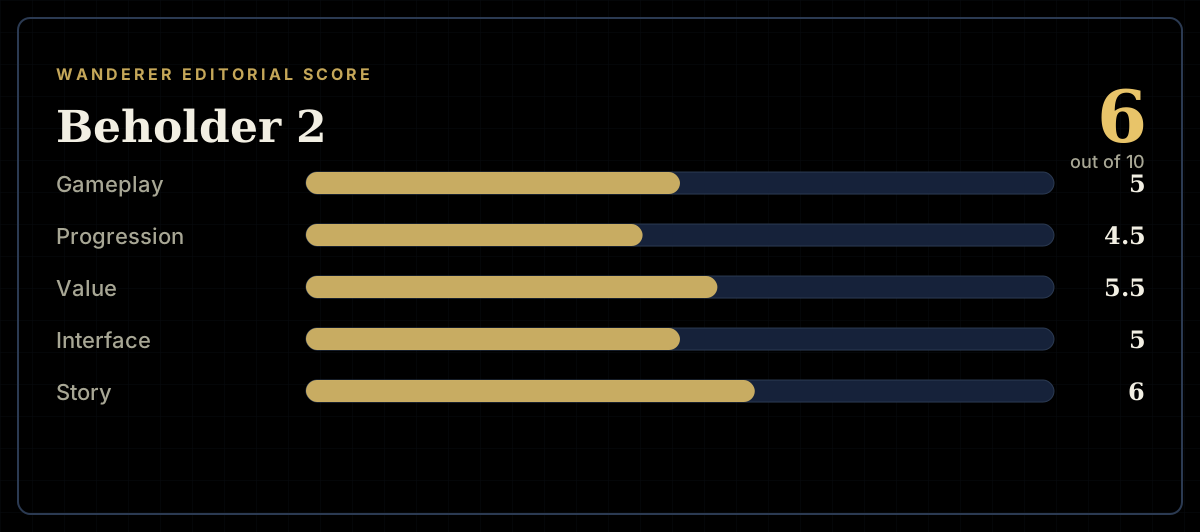
How the review scores each part of the gameWanderer Editorial -
The short versionWanderer Editorial