
Game review
Anthropomachy
5 / 10
- Developer
- Toy Box Lab
- Publisher
- Toy Box Lab
- Released
- 24 May 2019
- Platforms
- Windows
- Genre
- Strategy
- Monetisation
- Paid, no in-app purchases found
- Players
- false
The short version
The premise — playing a Greek god fighting modern skepticism for worshippers, structured like Plague Inc. with faith instead of infection — is genuinely distinctive, and reviewers who pushed past the opening hours found real strategic texture in choosing which powers and territories to prioritise. But a punishing, under-explained tutorial means most players apparently never get that far, and development stopped one month after the 1.0 launch with no news update since.
Biggest strengths
- Distinctive core idea: spreading a Greek deity's worship across real-world territories using Plague Inc.-style systemic spread rather than direct control
- Several reviewers who stuck with it describe genuine strategic depth in choosing which of twelve major and nine minor gods' abilities to develop
- Developer visibly responded to feedback during Early Access, with reviewers noting balance and UI changes across patches
Biggest weaknesses
- Tutorial is widely reported as unclear, leaving new players lost on basic mechanics
- A cooldown system on god powers draws specific criticism as an odd fit for a single-player strategy game
- No news update since December 2019, one month after the 1.0 release — a reviewer explicitly calls it "Abandonware"
Who it's for: Strategy fans who specifically want the god-game/Plague Inc. hybrid premise and are willing to fight through a rough tutorial to get to the interesting part.
Our recommendation: Worth a look on a discount if the premise appeals, but go in expecting to need a wiki or a few false starts before it clicks.
5 / 10
What it is
Anthropomachy casts the player as one of twelve major or nine minor Greek gods trying to reclaim a world that has drifted into skepticism. Rather than direct control over followers, the game runs on systemic spread across 71 distinct real-world territories, each modelled with its own stats and existing religious presence — the developer's own comparison in player discussions, and the one nearly every reviewer reaches for independently, is Plague Inc., but with faith and miracles instead of a pathogen. You develop your chosen god's traits, build temples, cast blessings or curses, and watch scepticism and worship spread or recede territory by territory rather than through any direct combat or dialogue.
It entered Early Access on 24 May 2019, reached its 1.0 release on 1 November 2019, and shipped a final patch (v1.20) one month later on 3 December 2019. The Steam news feed has carried nothing since — over six years of silence on a game whose own Early Access-era update log shows a real, regular cadence beforehand: five documented patches across the roughly six months before 1.0, then one more, then nothing. That pattern shows up directly in the review corpus: one reviewer, writing in 2021, simply calls it "Abandonware."
The idea works better than the execution
What sets Anthropomachy apart from most god-games and most idle-adjacent strategy titles is the premise itself, and reviewers who engaged with it at length back that up. One long-session player describes buying the game specifically for its resemblance to Plague Inc. and "Pandemic but with gods," and while they note it isn't quite that, they also describe a "long haul game" that rewards playing carefully according to systems the developer clearly designed with intent, rather than a shallow numbers-go-up loop. Another reviewer, after an early lukewarm reaction, came back following a patch that reworked stat sliders and rebalanced pacing, and reports being fully won over by the changes — a rare thing to see documented in a review corpus, and a genuine data point in the developer's favour for at least the Early Access period covered here.
Where the corpus turns hostile is almost entirely at the front door. Multiple reviewers, independently and without prompting each other, describe getting lost early: "the tutorial is not very helpful, and you can easily get lost with how to proceed, or what to do," writes one; another calls out a "lack of information about how stuff works behind the curtains." A third reviewer's complaint is more specific and more damaging to the core loop's credibility as a strategy game: cooldowns on the god powers you use to convert or coerce territories, in a single-player game with no opposing AI racing you on a clock. That's a mechanic that reads as a pacing choice ported over from a different genre without reconsidering whether it fits here, and it's exactly the kind of friction that turns "long haul strategy game" into "waiting around."
A confirmed pattern, not a guess
The achievement data corroborates the tutorial complaints rather than just echoing anecdote. Across 39 tracked achievements, the single highest completion rate recorded is 19.8% — meaning even whatever the easiest possible achievement is, fewer than one in five players who own the game have ever triggered it. That is an unusually low ceiling; most games, even difficult ones, have some achievement (often just "start the game" or "finish the tutorial") sitting well above 50%. A curve that never clears 20% at its peak points to a genuinely high early drop-off rate across the entire playerbase, not just the vocal minority who left written reviews — which lines up precisely with the specific "I got lost early" complaints rather than contradicting them.
Separately, one reviewer's complaint that "it's too easy and becomes a clicker very fast" points at a different failure mode for players who do get past the opening: once the systemic interactions are understood, the moment-to-moment play apparently flattens into repeated power-activation clicks without much decision-making left, which several other reviews' descriptions of repetitive late runs support.
An Early Access story with no ending written
The Early Access-to-1.0 arc here is worth stating plainly because it's fully documented rather than inferred: real, regular patches for roughly six months, a 1.0 release, one more patch, then silence. That is a shorter post-launch support window than most Early Access journeys of this length promise, and it means whatever was still rough at 1.0 — the tutorial complaints keep showing up in reviews dated well after the final patch — was never going to be addressed. A 2024-dated review notes having half the achievements after only two hours and calling the game "repetitive" once its systems are understood, which suggests the ceiling on how much this game had to offer was reached quickly by at least some players, and nothing has been added since to raise it.
Where it lands against the genre it's borrowing from
It's worth being precise about what Anthropomachy takes from Plague Inc. and what it doesn't, because the comparison reviewers keep reaching for cuts both ways. Plague Inc.'s enduring appeal is that its systemic spread is legible almost immediately — a new player can watch an infection creep across a world map and intuit, within minutes, which levers to pull next. Anthropomachy borrows the map-and-spread structure but not that legibility: the same systemic feedback loops that made reviewers who stuck around call it a genuine strategy game are, by several accounts, opaque enough on first contact that most players never get to feel them working. That's not a fatal flaw in the design itself — the underlying systems, going by the positive reviews, are sound — but it is a fatal flaw in how those systems are taught, and teaching is exactly the area no patch ever arrived to fix after 1.0.
Verdict
Anthropomachy has a genuinely uncommon premise for the strategy space it sits in, and the reviewers who pushed through its rough onboarding found real systemic depth worth defending. But a tutorial that measurably loses most of the playerbase before they ever see that depth, an odd cooldown system that undercuts the strategic tension it's meant to create, and six-plus years of total silence since a single post-launch patch mean this is a game to go into with a strategy guide already open in another tab, not one to trust to teach itself.
Pros and cons
Pros
- Distinctive core idea: spreading a Greek deity's worship across real-world territories using Plague Inc.-style systemic spread rather than direct control
- Several reviewers who stuck with it describe genuine strategic depth in choosing which of twelve major and nine minor gods' abilities to develop
- Developer visibly responded to feedback during Early Access, with reviewers noting balance and UI changes across patches
Cons
- Tutorial is widely reported as unclear, leaving new players lost on basic mechanics
- A cooldown system on god powers draws specific criticism as an odd fit for a single-player strategy game
- No news update since December 2019, one month after the 1.0 release — a reviewer explicitly calls it "Abandonware"
- Global achievement data shows even the single easiest achievement was earned by under 20% of players, suggesting most people bounce off before reaching meaningful content
Screenshots
-

AnthropomachyImage: Toy Box Lab via Steam -

AnthropomachyImage: Toy Box Lab via Steam -

AnthropomachyImage: Toy Box Lab via Steam -
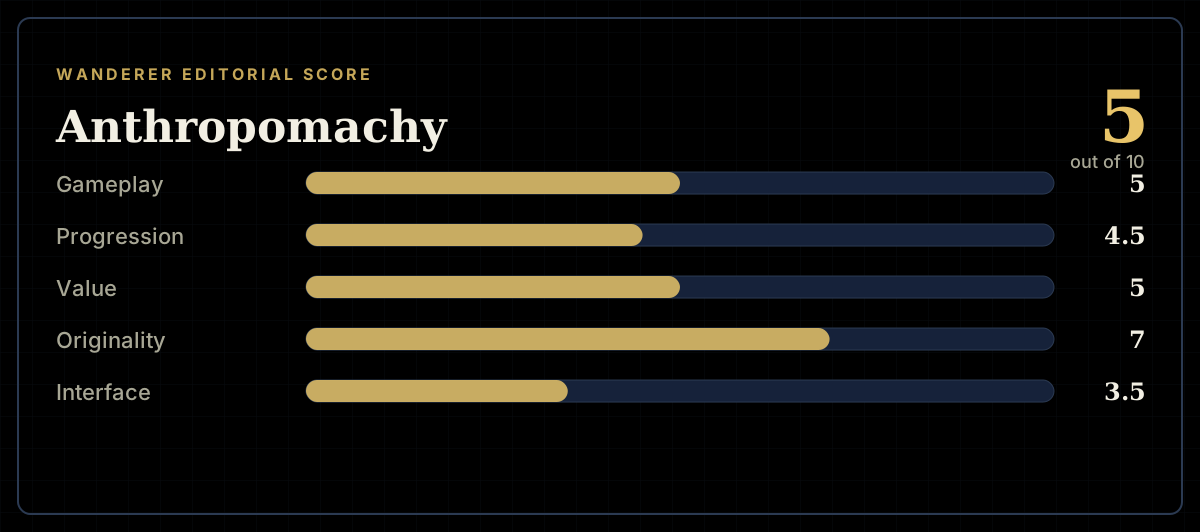
How the review scores each part of the gameWanderer Editorial -
The short versionWanderer Editorial