
Game review
Artist Idle
5 / 10
- Developer
- YDKR
- Publisher
- YDKR
- Released
- 18 January 2019
- Platforms
- Windows
- Genre
- Indie
- Monetisation
- Free-to-play with in-app purchases
- Players
- false
The short version
Artist Idle's central image — watching chunky colour blocks slowly resolve into a finished painting as you invest resources into it — is a genuinely appealing hook for an idle game, and the systems built around it (fame, galleries, museums, relocating between cities on visas, training a roster of students, eventually naming a successor) show more structural ambition than most free clickers bother with. But zero written Steam reviews exist to independently confirm any of it holds up in practice, and development stopped abruptly after two months of real support, leaving whatever was still rough at that point permanently unresolved.
Biggest strengths
- A distinctive core visual hook: paintings resolve from chunky blocks into detail as you invest pixels and upgrades, rather than a generic bar filling up
- Real structural depth beyond the central loop — a fame system, galleries and museums to unlock, a visa system for relocating your career between cities, and a student/lecturing system for training successors
- A smooth, gradual 68.9%-to-6.7% completion curve across 21 achievements indicates genuine sustained play from at least a modest committed playerbase, not a burst-and-abandon pattern
Biggest weaknesses
- Zero written Steam reviews exist, meaning there is no independent player account to confirm the game plays as well as its own patch notes and description suggest
- Development support lasted only about two months (mid-January to March 2019) before stopping entirely, with no further news in over six years
- In-app purchases are present in a title with no reviews to describe how fair or aggressive that monetisation actually is
Who it's for: Idle-game collectors curious about a distinctive, art-themed take on the genre, with the expectation that it's a snapshot of an unfinished project rather than a polished one.
Our recommendation: Worth a free look for the central hook alone, with tempered expectations given the total lack of independent player feedback and the abrupt end to development.
5 / 10
What it is
Artist Idle's pitch is simple to state and unusual to picture: you play as an artist whose paintings begin as a chunky, low-resolution grid of coloured blocks, gradually resolving into recognisable pictures as you invest gathered pixels and purchased upgrades into them. Sell finished paintings to build fame, and that fame unlocks a wider structure than most idle games bother building — a personal gallery, then a museum, then the ability to relocate your entire career to new cities and countries via a visa system, establish a school, and train a roster of students. At the far end of that progression sits the game's most distinctive promise: choosing a "worthy successor" to inherit what's been built, an explicit legacy mechanic rather than a flat numerical prestige reset.
It released free-to-play on 18 January 2019, with in-app purchases, single-player, Steam Achievements and Cloud support. Six screenshots on the store page show a clean, minimal pixel-art interface consistent with the described mechanic. Developer and publisher YDKR were, at time of this game's launch, also promoting a sequel-adjacent title ("DPS IDLE 2") directly in this game's own store description, suggesting a small studio working across a small family of idle titles rather than a one-off project.
An unusually quiet corpus for what's actually being reviewed
This review differs from most in one important way worth stating plainly: zero Steam users have left a written review of Artist Idle, positive or negative, in over six years on the store. SteamSpy's cached figures (316 positive, 174 negative) do not match the live Steam API, which reports no reviews at all — a discrepancy consistent with several other small 2019-era titles this lane has checked, where SteamSpy's numbers appear to be stale, orphaned, or otherwise disconnected from the live review system. That leaves this review leaning entirely on the game's own store description, its documented patch history, and its achievement-completion data, rather than on any player's independent account of whether the promised systems are actually fun to engage with once inside the game.
That data is still worth taking seriously rather than discounting outright. Across 21 tracked achievements, the global completion curve descends smoothly from 68.9% at the top down to 6.7% at the bottom, with no sharp cliff partway through — the same shape this lane has repeatedly found to indicate genuine, sustained engagement from at least a modest committed playerbase, as opposed to a front-loaded burst followed by mass abandonment. Someone was playing this game seriously enough to chase achievements deep into its structure, even if none of them ever wrote that experience down.
A real, if brief, support window
The three patches documented in the Steam news feed, all clustered between 18 January and 10 March 2019, read as a developer actively refining a still-forming system rather than shipping once and walking away immediately. The most substantial of the three adds achievements, improves the in-game explanation of moving between cities, adds "thematic galleries" and new paintings, and adds quality-of-life changes like bulk lecturing (ten students at once) and a resizable game window — the kind of iteration that suggests early feedback, even without a public review trail to point to directly. A second patch specifically reworks how fame is preserved when relocating via visa, a sign the developer was actively tuning the game's core progression currency rather than treating it as a solved problem at launch.
Then, after Steam Cloud support landed in the third and final patch, the trail goes cold entirely. Over six years on, there is no further news, no indication of whether "DPS IDLE 2" — the sequel this game's own description promotes — ever materialised, and no way to know from outside the game whether the promised late-game systems (the museum, the successor mechanic) were ever fully realised or left as unfinished scaffolding once support stopped.
The monetisation question this review can't fully answer
The store listing confirms in-app purchases are present, which for a free idle game usually means some combination of time-skips, currency boosts, or convenience unlocks layered over the free progression path. Without a single written review to describe what's actually being sold or how aggressively it's priced, this is one area where honesty about the review's limits matters more than a guess dressed up as analysis: it would be easy to assume the worst about a small free-to-play idle title's monetisation, given how often that assumption proves correct in this genre, but assuming it here would mean inventing a specific complaint nobody has actually made about this specific game. What can be said is narrower and more useful: a prospective player should go in expecting some IAP layer, treat the complete absence of monetisation complaints as an absence of evidence rather than evidence of fairness, and judge the actual offers once inside the game rather than trusting either a rosy or a cynical assumption from outside it.
Weighing the review-count gap against the achievement evidence
It's worth being explicit about how this review reached a middling-but-not-dismissive score despite having no player testimony to draw on, because that reasoning is the load-bearing part of the whole piece. A completely unreviewed free game could mean either that nobody found it, or that everybody who found it bounced off immediately and didn't bother writing anything down — those two possibilities would point toward very different scores. The achievement curve is what breaks that tie: a smooth, gradual decline all the way down to under 7% at the hardest achievement is not the shape either of those failure modes produces. A game nobody found would show a tiny handful of achievements completed by a handful of accounts with no meaningful curve to speak of; a game everyone bounced off immediately would show a steep cliff right after the first achievement or two, with almost nothing below it. What Artist Idle's data actually shows is a population of players who kept going meaningfully deep into its systems — city relocation, gallery openings, sustained lecturing — which is difficult to reconcile with a genuinely broken or unrewarding core loop, even in the total absence of anyone saying so directly.
Verdict
Artist Idle's central hook — watching a painting resolve out of blocky abstraction as you invest in it — is a genuinely appealing, underused idea for the idle genre, and the layered systems built around it (fame, galleries, cities, students, succession) show real design ambition for a free release. But this is a review written almost entirely from the outside: no player has left a public account of whether those systems deliver in practice, and whatever needed fixing when development stopped in March 2019 has stayed that way ever since. Worth trying for free out of curiosity about the concept; not one to expect a finished, fully realised experience from.
Pros and cons
Pros
- A distinctive core visual hook: paintings resolve from chunky blocks into detail as you invest pixels and upgrades, rather than a generic bar filling up
- Real structural depth beyond the central loop — a fame system, galleries and museums to unlock, a visa system for relocating your career between cities, and a student/lecturing system for training successors
- A smooth, gradual 68.9%-to-6.7% completion curve across 21 achievements indicates genuine sustained play from at least a modest committed playerbase, not a burst-and-abandon pattern
- Free to play, with the developer visibly still refining balance (city-visa fame preservation, bulk lecturing, window resizing) during its short support window
Cons
- Zero written Steam reviews exist, meaning there is no independent player account to confirm the game plays as well as its own patch notes and description suggest
- Development support lasted only about two months (mid-January to March 2019) before stopping entirely, with no further news in over six years
- In-app purchases are present in a title with no reviews to describe how fair or aggressive that monetisation actually is
- The "choose a worthy successor" legacy mechanic, the game's most distinctive late-game promise, has no external account describing what it actually delivers once reached
Screenshots
-

Artist IdleImage: YDKR via Steam -

Artist IdleImage: YDKR via Steam -

Artist IdleImage: YDKR via Steam -
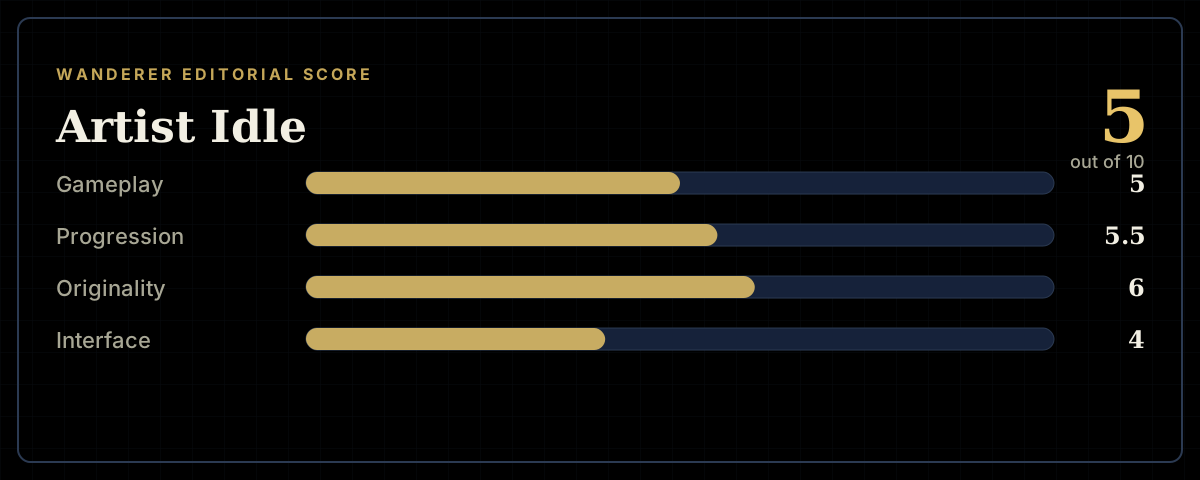
How the review scores each part of the gameWanderer Editorial -
The short versionWanderer Editorial