
Game review
Leaf it Alone
6.5 / 10
- Developer
- Eternity
- Publisher
- Eternity
- Released
- 30 October 2025
- Platforms
- Windows
- Genre
- Incremental / Simulation
- Monetisation
- Premium, one-off purchase; no in-app purchases, ads or DLC found
- Players
- Single-player only, with online leaderboards for completion speed
The short version
Leaf it Alone takes a chore nobody enjoys in real life and turns it into a small, satisfying incremental: pick up leaves by hand, graduate to a rake, then a leaf blower, then repaired vacuum chutes built into the walls, and watch a cluttered yard visibly clear as your tools get faster. The tool-upgrade loop is the whole pitch, and it works — every new implement makes the last one feel like a memory of a slower game.
The problem is that the pitch runs out. There is one house, one yard, and one story beat waiting at the end of it, and most players are finished in one to three hours with nothing built in to bring them back beyond a leaderboard time and a fussy completion achievement. For its asking price that is a defensible trade. As a game to recommend without a caveat, it's a harder sell.
Biggest strengths
- The hand-to-rake-to-blower upgrade chain gives every purchase an immediate, visible payoff instead of an abstract multiplier
- Clearing a zone to 100% pays back with a stacking economy bonus, extra cash, or a speed boost, which makes route planning matter for the harder achievements
- Runs comfortably on modest hardware, with several players specifically noting it performed well on low-spec machines
Biggest weaknesses
- The entire game takes place in one house and yard, and a large share of negative reviews are simply asking for more locations to clean
- No control remapping is offered, which specifically punishes left-handed players stuck with a right-handed default
- There is no on-screen prompt pointing you toward the last stray leaf in a zone, so finishing an area often turns into a slow visual hunt across the same ground
Who it's for: Players who want a short, low-stress incremental to clear in an evening and don't mind that the credits roll just as the systems start clicking.
Our recommendation: Buy it on a sale, or go in already knowing it's a single sitting rather than a game with a tail — the tool progression is genuinely well built, it just doesn't have anywhere to go once you've built it.
6.5 / 10
There's a small, specific pleasure in incremental games when a tool upgrade actually changes how a space feels to move through, rather than just changing a number on a tooltip. Leaf it Alone builds its entire runtime around that one feeling. You start with nothing but your hands and a leaf bag, dragging yourself across a yard buried in autumn debris, and every dollar you earn goes straight back into making the next pass faster. By the time you've unlocked a leaf blower and started repairing the vacuum chutes built into the walls, the same yard that took ten minutes to clear by hand takes ten seconds. It's a genuinely good trick. The trouble is there's only one yard to play it in.
The loop: from bare hands to a house that vacuums itself
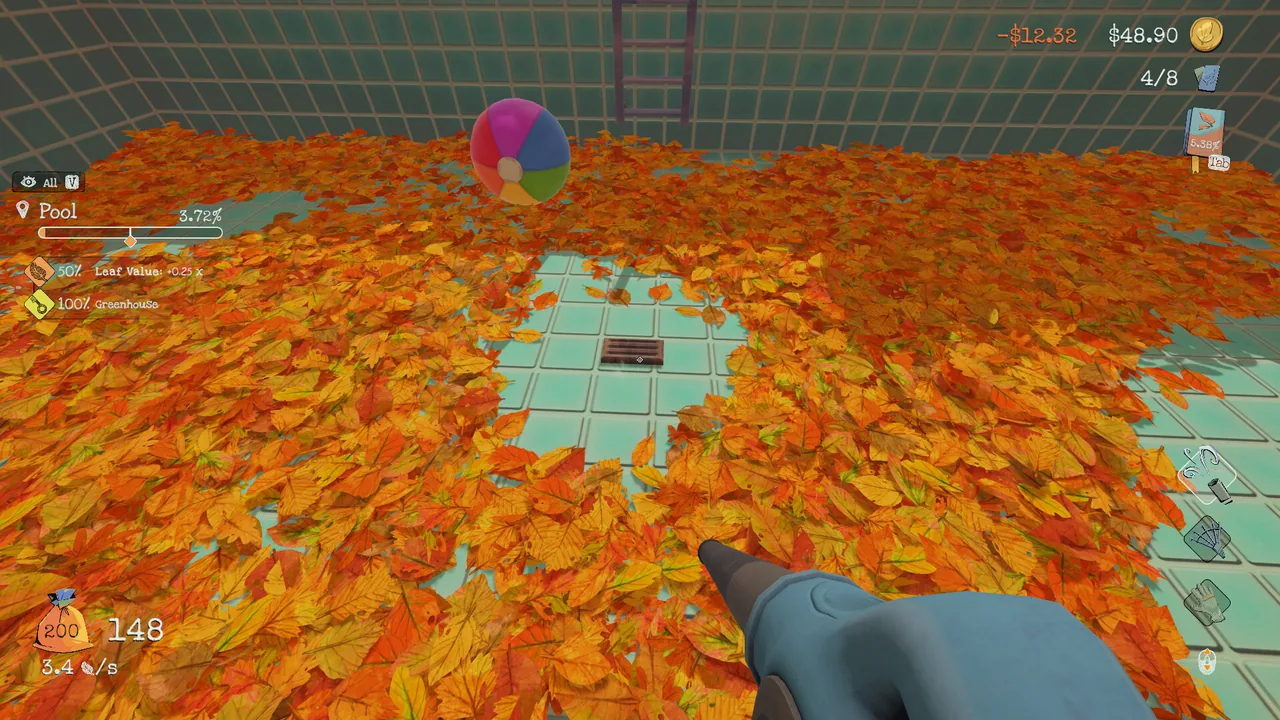
The structure is simple enough to explain in one sentence and Eternity doesn't try to dress it up as anything more. You clear leaves, bank the cash each leaf is worth, and spend that cash on better ways to clear leaves. The starting toolkit is your hands and a leaf bag you empty into the trash by hand. A rake comes next, covering more ground per swing. The leaf blower after that turns raking into something closer to a lawn-care fantasy, herding whole drifts of leaves in one pass. Late-game money goes into repairing built-in vacuum chutes scattered around the property, which quietly automate parts of the yard you've already cleared once.
What elevates this above a pure clicker is the completion bonus tied to each zone. Clear an area to 100% and it pays back in one of several ways: a permanent 25% boost to what every future leaf is worth, a flat cash bonus, extra sprint speed, or access to the next zone. That turns the order you clean the yard in into an actual decision rather than a formality — several of the game's harder achievements, including one for banking a set total of cash, effectively require planning a specific route through the value-boosting zones first. It's a smart bit of design sitting on top of what could have been a completely mindless loop, and it's the strongest evidence that Eternity understood incremental design better than the premise suggests.
A short, and surprisingly memorable, ending
Without spoiling specifics, the game doesn't stay purely cozy all the way through. Achievement names hint at it before you get there, and enough players have mentioned it unprompted in their reviews that it's clearly landing as intended: the tone shifts late, briefly and deliberately, in a way that reframes what you've been doing for the previous hour. It's a smart use of a short runtime — there's no room for a subplot, so the game earns its one twist by committing to it fully rather than foreshadowing it to death. Players expecting a straightforward cleaning sim seem to come away remembering this moment more than the raking itself, which says something about how much personality got packed into so little space.
Where the runtime works against it
The recurring complaint across negative reviews isn't a bug or a balance problem, it's simpler than that: there's one house, and once it's clean, the game is over. Most players finish in one to three hours, several report closer to ninety minutes, and there's no new-game-plus, no second property, no procedural variation to extend the loop once the tool tree is maxed out. The economy-boosting zone system that makes the first playthrough interesting has nothing left to do on a second pass except retread the same layout faster. A leaderboard tracking completion speed gives dedicated players something to chase, but it's a speedrunning hook layered onto a game that otherwise sells itself on being unhurried, not a genuine replay incentive.
That tension shows up literally in the achievement list. One trophy asks you to finish the entire game in under forty minutes — a fine challenge for a completionist, but a strange fit for a game whose whole pitch is "relax and clean up at your own pace." Players chasing 100% completion report the speedrun achievement as the one that turns a chill afternoon into a stressful one, and it's easy to see why: nothing else in the design asks you to play against a clock.
Interface and accessibility gaps
The controls are straightforward and full controller support is a genuine plus for a game this low-key, but the keyboard-and-mouse default has no remapping option, which is a real problem for left-handed players rather than a minor inconvenience. The other recurring friction point is more subtle: nothing on screen points you toward the last leaf standing in a zone once you're down to the stragglers. Because 100% completion is required to trigger a zone's bonus and move on, finishing an area often turns into a slow visual sweep back across ground you already covered, hunting for the one leaf tucked behind a bush or fence post. A handful of players have also reported a specific bug where a leaf blower gust pushes a leaf through a wall geometry gap, leaving it permanently unreachable and the zone stuck below 100% with no fix short of restarting the save. It doesn't sound like it's common, but when it happens it blocks progress entirely, which is a rough thing to hit in a game this short.
Presentation and performance
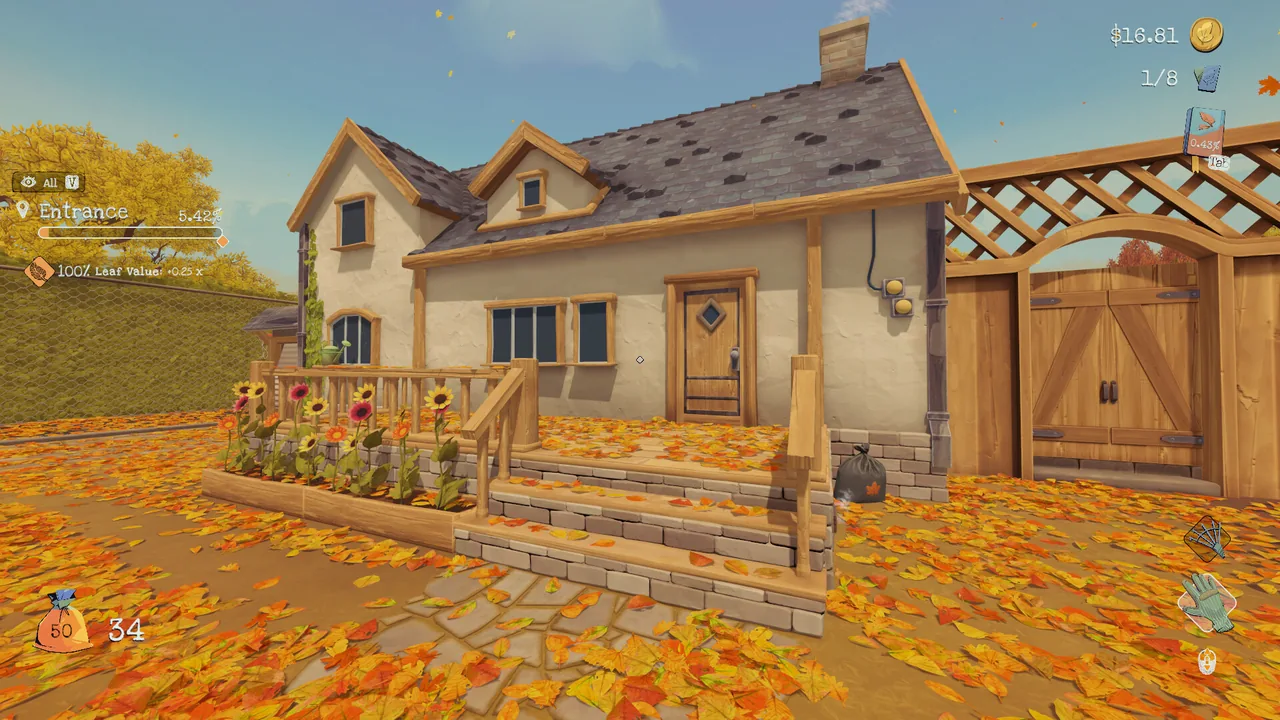
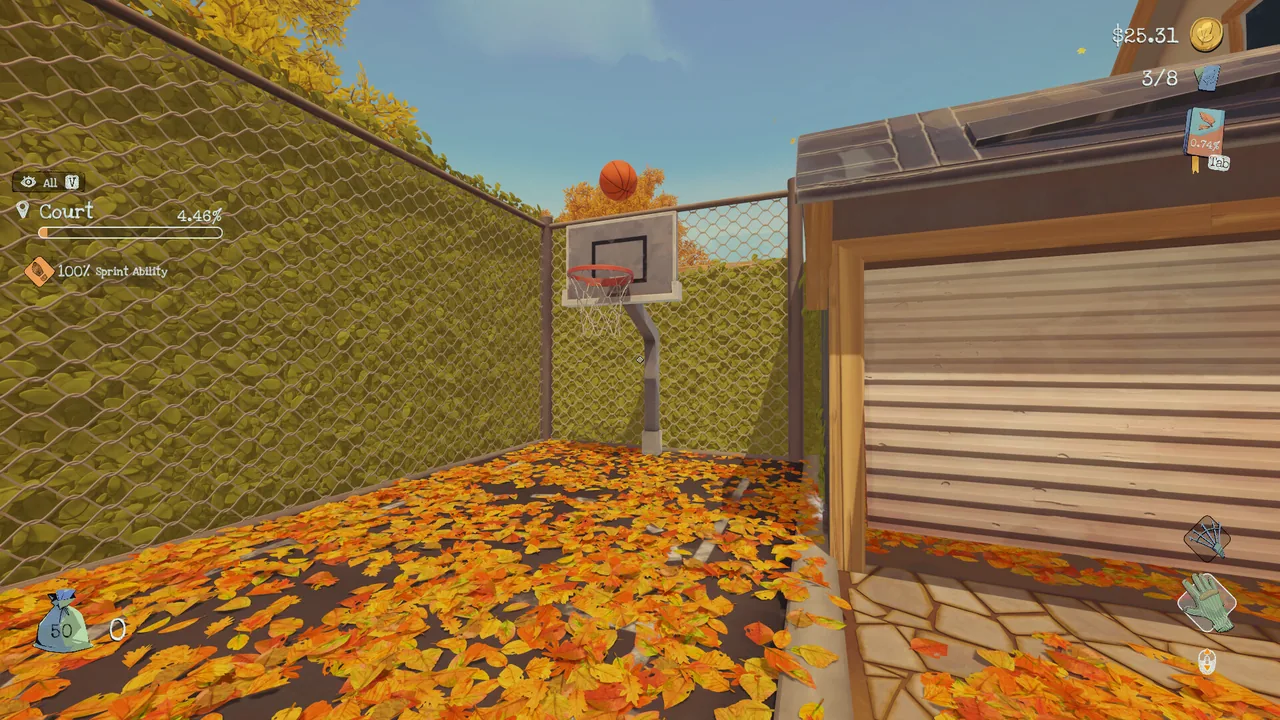
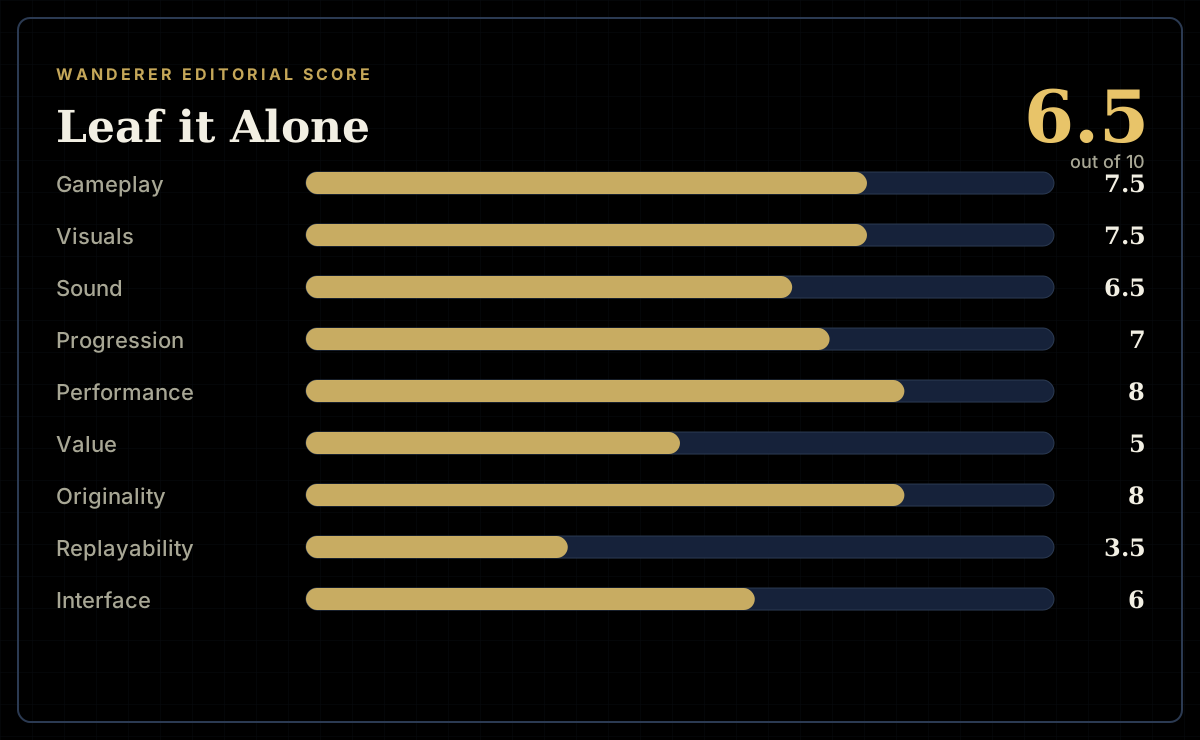
The art style is warm and uncomplicated — a believably lived-in yard rendered in a soft, low-poly style that suits the cozy framing without asking much of the hardware running it. Several reviewers specifically called out that it ran smoothly on older or lower-spec machines, which matters for a game clearly aimed at a casual, browser-adjacent audience rather than enthusiasts with high-end rigs. Sound design is functional rather than memorable; more than one player mentioned expecting background music that didn't seem to be there, suggesting the ambient audio mix could use another pass. None of this is a serious mark against the game, but it doesn't add much to the experience either.
Value and verdict
At roughly six US dollars, Leaf it Alone is priced like what it is: a tightly scoped, single-serving incremental rather than a game built to hold you for a season. Judged purely on cost-per-hour, a two-hour runtime at this price is fine, not exceptional, and it sits well below almost every other incremental in this genre on pure playtime. What keeps the score from dropping further is how competently the short runtime is used — the tool progression is genuinely well tuned, the completion-bonus routing gives the achievement hunt real texture, and the closing twist earns its keep. What keeps it from climbing higher is that none of that adds up to a game with legs. There's no second house, no seasonal content, nothing pulling you back after the credits roll beyond a leaderboard entry.
Buy it if a short, novel incremental with a real hook and a memorable closing beat sounds like a good way to spend an evening, ideally when it's discounted. Skip it if you're shopping for something with the kind of long-tail progression that makes Wanderer's own idle systems worth returning to daily — that's simply not the game Eternity set out to make.
Pros and cons
Pros
- The hand-to-rake-to-blower upgrade chain gives every purchase an immediate, visible payoff instead of an abstract multiplier
- Clearing a zone to 100% pays back with a stacking economy bonus, extra cash, or a speed boost, which makes route planning matter for the harder achievements
- Runs comfortably on modest hardware, with several players specifically noting it performed well on low-spec machines
- The closing story beat is a genuine tonal swerve that reviewers keep bringing up unprompted, without the game ever needing to say a word
- Full controller support and a low-pressure difficulty curve make it an easy game to hand to a non-gamer for an hour
Cons
- The entire game takes place in one house and yard, and a large share of negative reviews are simply asking for more locations to clean
- No control remapping is offered, which specifically punishes left-handed players stuck with a right-handed default
- There is no on-screen prompt pointing you toward the last stray leaf in a zone, so finishing an area often turns into a slow visual hunt across the same ground
- The sub-40-minute speedrun achievement sits awkwardly against a game that otherwise markets itself as chill and unhurried
- A reported wall-clipping bug can strand a leaf out of reach and block a zone from ever reaching 100%, with no in-game fix beyond restarting
Screenshots
-
Leaf it AloneImage: Eternity via Steam -
Leaf it AloneImage: Eternity via Steam -
Leaf it AloneImage: Eternity via Steam -
How the review scores each part of the gameWanderer Editorial -
The short versionWanderer Editorial