
Game review
Milo's Tiny Fish Pond
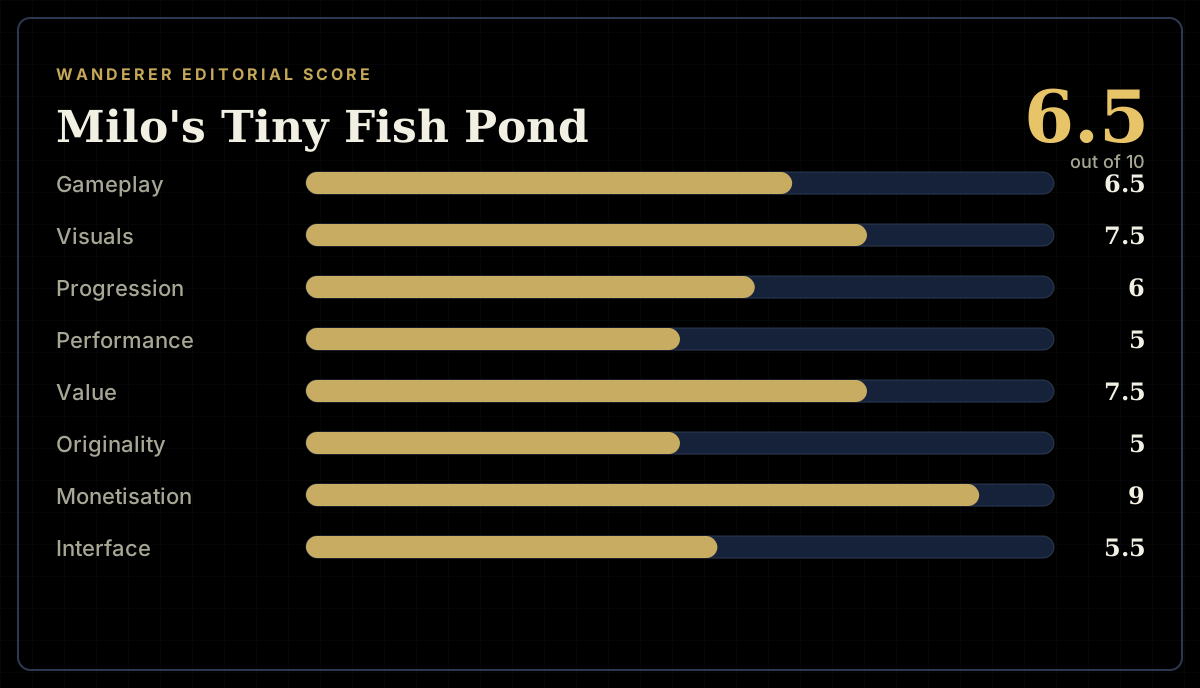
6.5 / 10
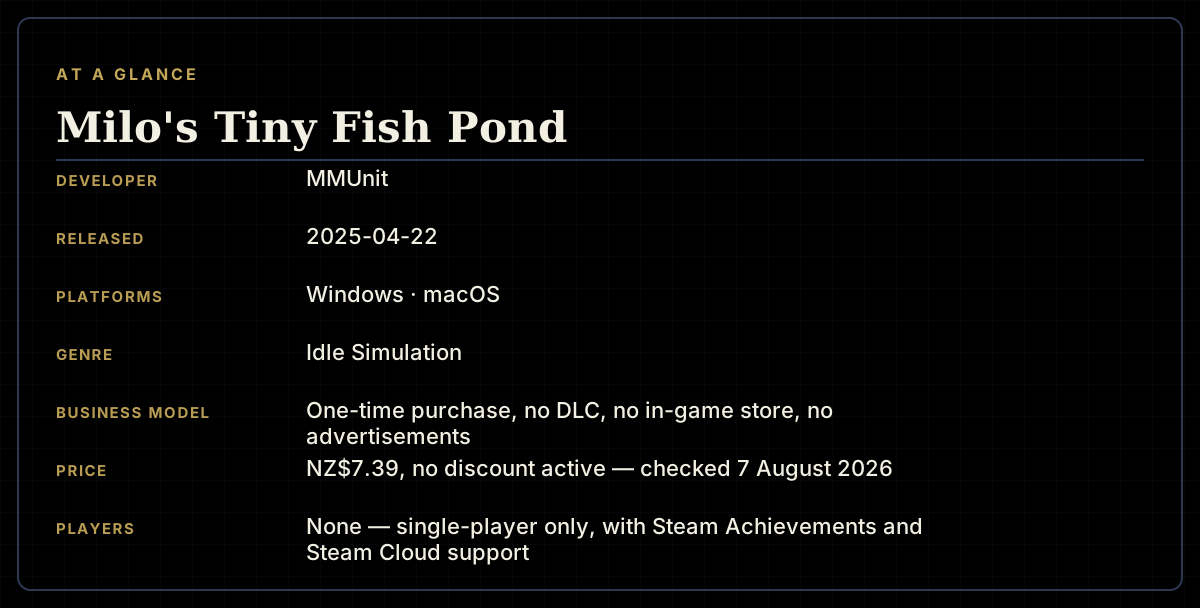
- Developer
- MMUnit
- Publisher
- MMUnit
- Released
- 22 April 2025
- Platforms
- Windows, macOS
- Genre
- Idle Simulation
- Monetisation
- One-time purchase, no DLC, no in-game store, no advertisements
- Players
- None — single-player only, with Steam Achievements and Steam Cloud support
The short version
Milo's Tiny Fish Pond draws a live-growing pond as a transparent layer over your actual desktop — the storefront's own screenshots show fish swimming across an open word processor, not just a wallpaper — and its community's own vote-weighted tags confirm Idler sits third overall, well clear of any hybrid-genre red flag. Tank capacity as high as 150 fish and real per-species personality tags show a developer who understood the genre's known friction points better than some rivals. What holds it back is thinner evidence and a rougher edge: a corpus of just 51 reviews fifteen months on, two independent reports of a severe memory leak that cost one player a near-complete save, and thirteen months of silence since the last patch.
Biggest strengths
- The pond overlay renders as a genuine transparent layer above any open application, not just the desktop wallpaper — the storefront's own screenshots show it running across an open word processor
- A single pond can hold up to 150 fish before it needs managing, several times the tight caps that force constant sell-offs in comparable games this library has reviewed
- Per-fish personality tags, individual growth timers and at least five distinct biomes give the collecting loop more texture than a bare rarity ladder
Biggest weaknesses
- The two most detailed negative reviews both describe the same failure independently — a severe apparent memory leak that crashed the game, and in one case destroyed a save close to full collection
- The single most-upvoted negative review reports the shop and fish-info windows rendering on top of every other application with no reliable way to dismiss them short of closing the game
- Speeding up growth by feeding requires holding the right mouse button for minutes at a stretch, and the toggle that fixes this is undocumented enough that reviewers describing the tedium don't mention it
Who it's for: Players who want a genuine, hands-off pond to run behind their other windows and don't mind a rougher, less battle-tested game than the library's better-known aquarium idlers.
Our recommendation: At NZ$7.39 with no IAP anywhere in sight, it's a fair asking price for what's here — just go in aware the corpus backing that price is small, the memory-leak reports are real even if rare, and nothing has shipped since June 2025.
6.5 / 10
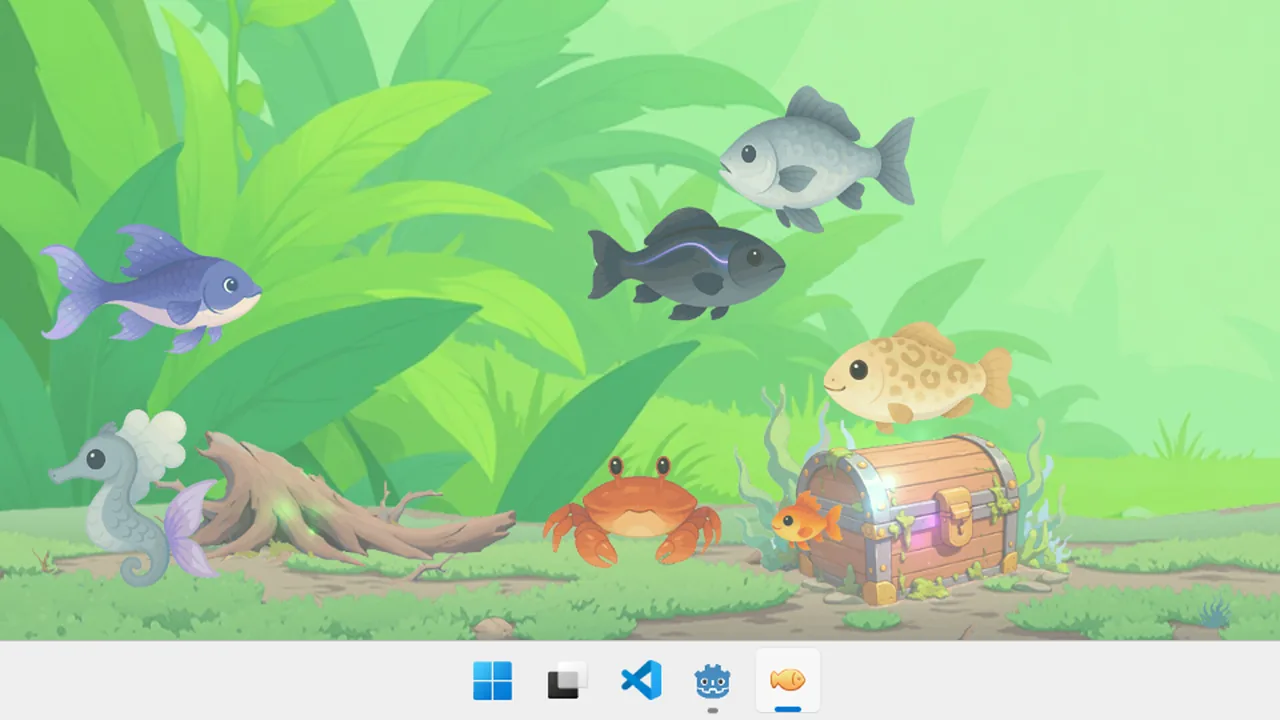
Look at Milo's Tiny Fish Pond's own promotional screenshots and one of them isn't showing off a wallpaper at all — it's a live word-processing window, WPS Office, open and mid-document, with fish swimming placidly along a translucent strip at the bottom of the screen and a coin counter ticking up in the corner. That's the whole pitch made literal: this isn't a screensaver you glance at, it's a pond that sits on top of whatever you're actually doing. It's a small design choice that says more about how carefully MMUnit thought about the "desktop companion" half of this genre than the store description does, and it's worth leading with because everything else about this game is a more familiar story.
Confirming the idler tag, properly
Milo's Tiny Fish Pond's official Steam genres — Casual, Indie, Simulation — say nothing about idling at all, which is exactly the kind of gap the vote-weighted community tags exist to close. Pulling them from the InitAppTagModal script rather than the developer-ordered pills at the top of the page: Casual leads with 73 votes, Simulation second at 65, and Idler third at 48 — comfortably ahead of Incremental (26) and with nothing resembling the Quick-Time Events or Inventory Management tags that turned out to signal a hybrid identity elsewhere in this library. There's no dating-sim or active-combat surprise hiding under the label here. The mechanics agree with the votes: fish mature on real-world timers, income accrues whether the window has focus or not, and the storefront's own copy promises earnings "even when the game is closed." This is a genuine idler, not an aggregator artefact, and it belongs in the conversation with Wanderer's Cornerpond review and Chillquarium review on its own mechanical merits.
What it actually does differently
The buy-grow-sell-collect skeleton is the same one every aquarium idler in this corner of Steam shares, Milo's included: open packs, place fry in a pond, watch a growth bar fill over minutes to hours, sell the grown adults, reinvest in bigger ponds and better food. Where it earns real credit is in two specific decisions that read like a direct answer to this genre's most common complaint.
First, capacity. Cornerpond's tight fish inventory forces a sell-off every ten to fifteen minutes or the whole loop stalls — one of that game's most consistent complaints. Milo's largest pond shown in its own screenshots, the Ice Crystal Pond, holds up to 150 fish before it needs attention. That's not a subtle difference; it's the same core loop built to tolerate being left alone for a genuinely long stretch, which matters more for an idler than almost any other single number.
Second, the overlay itself. Chillquarium and Joyquarium both run as a tank sitting somewhere on your screen; Milo's runs as a transparent band drawn over whatever window has focus, wallpaper or working document alike, which is the detail the WPS Office screenshot exists to prove. Individual fish also carry small personality tags — "leisurely," "sluggish" and similar descriptors turned up on the fish examined in the storefront screenshots — sitting alongside real-time growth stats, a maturity cycle, and a sale price that scales with output rate. None of that reframes the genre the way a breeding system or a tank ecology would, and originality is scored accordingly low, but it's more thought about the specific friction points of this exact subgenre than a reskin would bother with.
The achievement curve: a slope, not a cliff
Milo's 23 tracked achievements form a gentler curve than some of its rivals'. ACH_BEGIN, almost certainly a first-catch or tutorial milestone, sits at 86.0%. A wealth-related achievement (ACH_RICH) holds 46.5%, and four sequential pond-unlock achievements slide from 50.3% down to 38.5% as the required investment grows. A fully-upgraded-feeding achievement (ACH_FOOD_MAX) sits at 37.1% — over a third of everyone who has ever owned the game pushed that upgrade path to its end, which is a healthier midgame retention number than a lot of genre peers post. Then the curve settles into the achievements for fully collecting each of the game's five-plus named biomes (Wave, Stream, Coral, Forest and Deep Sea among them, per the storefront's own achievement art), which cluster tightly between 24.4% and 16.0%.
That's worth comparing directly against Cornerpond's equivalent data, which drops from a healthy 19.3% full-collection rate straight down to a brutal 6.4% for full-collection-at-every-rarity — a real cliff at the very top tied to the same RNG wall its 300-to-900-hour critics complain about. Milo's curve never does that. Its bottom achievements sit in the high teens, not single digits, which suggests the top-end grind here, while real, isn't quite the multi-hundred-hour wall Cornerpond's is. The trade-off is a smaller sample to draw that conclusion from — Milo's achievement percentages are measured across a much smaller ownership base than a 2,700-review game's.
Where the negative reviews actually point
Only six negative reviews exist across all languages, out of 51 total, so all six were read directly rather than sampled. Two describe the same class of problem independently and in specific, credible terms: one player at 40.4 hours reports the game "inexplicably" leaking memory in the background, sometimes consuming more than 50GB of RAM before crashing, and says a subsequent crash corrupted their save entirely, with Steam Cloud only having synced a partial file. Another, at 324.9 hours and close to finishing the full species dex, describes hitting a bug that wiped their save outright — reacting, in their own words, with resignation more than anger ("well, guess I get to do it all again"). A third report, in Korean at 29.2 hours, is a single line stating a save was lost. Three separate lost-or-corrupted-save reports out of six negative reviews is a real pattern worth taking seriously even at this sample size, and it's the single biggest reason performance scores as low as it does here.
The most-upvoted negative review, at 109.3 hours, raises a different but equally concrete complaint: legendary-tier fish drop rates are low enough that fifty pack openings can produce zero, only four ponds are available which isn't enough capacity once several rare fish are competing for the achievement, fish can't be moved between ponds once placed, and — most pointedly — the shop and fish-information panels render on top of every other window on the desktop with no reliable way to dismiss them, "not even to open a document." That's a genuine interface flaw for a game whose entire premise is running quietly behind your other work, and it echoes the unclickable-window complaints that turn up in Cornerpond's corpus too.
One smaller, more forgivable complaint: feeding fish to speed their growth means holding the right mouse button down, and one negative reviewer describes needing to hold it for ten-plus minutes at a stretch when placing dozens of fry at once. An English-language positive review mentions a workaround — hold right-click, then tap spacebar to toggle auto-feeding on — but nothing in the storefront description documents it, and the negative reviewers describing the tedium give no sign of knowing it exists.
A corpus too small to be confident in
Set against Cornerpond's 2,708 reviews and Joyquarium's 570, Milo's Tiny Fish Pond has drawn 51 reviews total fifteen months after launch — 45 positive, 6 negative, 88.2% overall, which Steam labels "Very Positive." Restricting to reviews from verified Steam purchases (excluding review keys and gifted copies) brings that to 42 total, 36 positive, 85.7%, matching the "Positive" badge the storefront itself displays. Either way, this is a thin evidence base by the standards of this library's other pond games, and the English-language slice is thinner still: just 4 reviews, all positive, nowhere near enough to draw an independent conclusion from on its own.
The corpus is overwhelmingly Simplified Chinese — 41 of 51 reviews, or 80% — which tracks with the developer's own patch notes, all of which were posted to Steam News in Chinese only, with no separate English version even though the storefront lists English as a fully supported interface language. The Chinese-language score, 87.8% positive, sits close enough to the all-languages figure (88.2%) that this reads as a genuinely Chinese-market-led release rather than a fan brigade skewing an otherwise different number — the same shape Wanderer's Joyquarium review found in its own, larger Chinese-majority corpus.
One more pattern worth naming plainly: median playtime among the six negative reviewers is 74.8 hours, against 18.5 hours for the 45 positive reviewers. Six reviews is too small a sample to treat as proof of anything on its own, but the direction is consistent with the genre's general shape — people who stick around long enough to hit a save-corrupting bug or a legendary-drop wall are, almost by definition, the people who were enjoying it up to that point.
Support since launch, and after
MMUnit shipped patches at a reasonable clip through the game's first two months — six version updates between release on 22 April 2025 and 25 June 2025, mostly bug fixes and UI polish per the Chinese-language patch notes (sort-by-output-rate, cloud save logic, UI scaling options, a fix for an experience-gain stall on inactive ponds). Then nothing. As of this review, more than thirteen months have passed with no further update, patch note or announcement of any kind. MMUnit's Steam publisher page shows exactly one other release, Battle On! Hero Academy, dated 22 October 2025 — four months after Milo's last patch — which is consistent with a small studio finishing one project and moving to the next rather than actively maintaining this one. The current concurrent-player count checked for this review read zero, a single dated snapshot rather than a trend, but consistent with a quiet, low-traffic release this far past its last update.
Final verdict
Milo's Tiny Fish Pond gets more right about this specific subgenre than its review count would suggest. The true desktop-overlay trick, the generous pond capacity, and an achievement curve that slopes rather than cliffs all point to a developer who studied what makes this kind of game frustrating and built around it. At NZ$7.39 with no DLC, no in-game store and nothing resembling a microtransaction anywhere on the storefront, the monetisation is as clean as anything else in this library.
It doesn't score alongside Cornerpond or Chillquarium because the evidence backing it is thinner and rougher at the edges: a corpus of 51 reviews is a small foundation to build confidence on fifteen months out, two independently-reported memory-leak and save-loss incidents are a real technical risk rather than a fluke, and a shop window that can't be dismissed over other applications undermines the exact desktop-companion pitch that makes the rest of the design worth praising. Buy it for a well-thought-out pond that happens to be under-reviewed and currently unsupported — not for the safety of a much larger, longer-tracked player base the way its rivals in this library offer.
Players who want the same idea with a much larger, better-documented track record should read Wanderer's Cornerpond review or Chillquarium review first. Those who want their fish tank paired with an actual persistent world and other people to show it to might also want to look at Wanderer.
Pros and cons
Pros
- The pond overlay renders as a genuine transparent layer above any open application, not just the desktop wallpaper — the storefront's own screenshots show it running across an open word processor
- A single pond can hold up to 150 fish before it needs managing, several times the tight caps that force constant sell-offs in comparable games this library has reviewed
- Per-fish personality tags, individual growth timers and at least five distinct biomes give the collecting loop more texture than a bare rarity ladder
- A single NZ$7.39 purchase with no DLC, no in-game store and no advertisements anywhere in the storefront listing
- Achievement data shows real mid-game depth rather than a curve that collapses after the tutorial — over a third of tracked owners fully upgrade feeding and unlock every pond
Cons
- The two most detailed negative reviews both describe the same failure independently — a severe apparent memory leak that crashed the game, and in one case destroyed a save close to full collection
- The single most-upvoted negative review reports the shop and fish-info windows rendering on top of every other application with no reliable way to dismiss them short of closing the game
- Speeding up growth by feeding requires holding the right mouse button for minutes at a stretch, and the toggle that fixes this is undocumented enough that reviewers describing the tedium don't mention it
- No update has shipped since a 25 June 2025 patch — more than thirteen months of silence — and the developer's next Steam release landed five months later, suggesting the studio moved on
- The review corpus is still tiny fifteen months after launch: 51 reviews in total, of which only 4 are in English, far too few to independently verify any of the above at scale
Screenshots
-

Milo's Tiny Fish PondImage: MMUnit via Steam -

Milo's Tiny Fish PondImage: MMUnit via Steam -
Milo's Tiny Fish PondImage: MMUnit via Steam -
How the review scores each part of the gameWanderer Editorial -
The game at a glanceWanderer Editorial -
The short versionWanderer Editorial