
Game review
Minami Lane
6.5 / 10
- Developer
- Blibloop, Doot
- Publisher
- Doot Tiny Games, Wholesome Games Presents
- Released
- 28 February 2024
- Platforms
- Windows, macOS
- Genre
- Cozy management sim
- Monetisation
- One-time purchase, no in-game store or additional currency purchases
- Players
- Single-player only
The short version
Minami Lane hands you one small street, a handful of building types, and a rotating cast of villagers to keep happy, framing management-sim fundamentals — balancing two customer groups, optimizing layout, petting the occasional cat — inside a deliberately tiny, deliberately gentle package. The art direction and overall presentation draw close to unanimous praise across this review's sample, and its low price and short runtime are explicitly, repeatedly framed by the developer and by many reviewers as a feature rather than a limitation. What tempers that goodwill is an equally consistent secondary chorus: reviewers who liked what they played but wanted more of it, describing a campaign completed in a handful of hours and a core loop that settles into repetition well before the credits roll.
Biggest strengths
- The art style, animation, and overall presentation draw close to unanimous, specific praise across the review sample, repeatedly described as adorable, cute, and meticulously crafted regardless of a reviewer's overall recommendation
- The core management loop of balancing housing, shops, and villager happiness is genuinely well-tuned for a low-stress, mouse-only session, with several reviewers specifically praising it as ideal for playing while relaxed or distracted
- The developer's own honest framing of the game's short scope and low price is credited by multiple reviewers as a deliberate, respectful design choice rather than a shortfall to apologize for
Biggest weaknesses
- The single most repeated criticism across the review sample, even from otherwise positive reviewers, is that the campaign is very short and the core gameplay loop becomes repetitive well before it ends, with several reviewers reporting completion in well under six hours
- Customization options are described by multiple reviewers as more limited than the "build your own street" framing implies, with one detailed review specifically flagging restricted building variety and layout choices
- At least one reviewer describes disliking the forced edge-scrolling camera control and the lack of a checklist tracking daily progress on side objectives like cat-petting and trash collection
Who it's for: Fans of very low-stakes, low-stress management games who want a beautiful, short, complete experience for a single sitting or two, and who are buying with clear expectations about scope rather than hoping for a deep, expandable town-builder.
Our recommendation: A worthwhile, inexpensive treat for cozy-game fans who value presentation and calm pacing over depth or length — just go in expecting a few hours of content, not an ongoing management sim you return to for weeks.
6.5 / 10
Minami Lane gives you exactly one street to look after: a handful of empty plots, a rotating cast of villagers with wants and needs, and a small set of buildings to unlock and arrange in whatever configuration keeps the most people happy. It's a tiny game in every sense — small team, small scope, small price — and this review's sample is unusually consistent about both what that smallness buys and what it costs.
A genuinely lovely, low-stress little world
The presentation is the least contested part of this game's reception. "Beautiful, cosy, and super relaxing," one reviewer writes, a sentiment echoed almost word-for-word across dozens of others regardless of their final recommendation. Another distills the appeal even more directly: "Pet cats??? Ramen?!?!! SOLD!!!!" A more detailed positive review lays out the actual mission structure clearly: "Complete game missions per managed street through balancing several factors... population (housing, elderly, young), people's wants (elderly vs young preferences on products), beautification (increasing aesthetics points), cats" — a tidy summary of a design that's simple to describe and, by wide agreement, genuinely satisfying to sit with for the length of a cup of tea.
The complaint almost everyone eventually reaches
Set against that goodwill is an equally consistent secondary pattern, and what makes it notable is how often it comes from reviewers who otherwise liked the game. "I absolutely understand that this is the charming result of a project with a limited scope. But that its limitations are intentional doesn't result in me having good reasons to ignore its weaknesses," one reviewer with 374 minutes logged writes, going on to describe the core loop's "depth" as resting almost entirely on balancing two customer groups against each other — a mechanic that doesn't meaningfully deepen as the campaign progresses. Another, more blunt: "Overall meh, this just failed to completely come together as a real game, and I feel like I paid for a tutorial, demo or someone's school project," while still noting the whole campaign took only four hours to finish. This isn't a case of a scattered handful of impatient buyers; it's a genuinely wide swath of the sample, including reviewers who ultimately recommended the game, converging on the same underlying observation.
The developer's honesty is itself part of the story
What's distinctive about Minami Lane's reception, compared to many short indie games facing the same complaint, is how many reviewers explicitly credit the developer for framing the scope honestly upfront rather than treating brevity as a hidden flaw discovered after purchase. "I appreciate the developer clearly stating what to expect, and that is part of why I purchased shortly after release," one reviewer writes. Another puts it plainly: "It's awesome that it was created by a very small team and in just 6 months," treating the short runtime as a fair trade given the resources behind it rather than a broken promise. That's a genuinely different framing from a game that oversells its own scope, and it shapes how forgiving this review's sample is willing to be about the length complaint.
What the achievement data actually shows
Steam's own completion figures line up neatly with the reviewer consensus rather than complicating it. The first main mission sits at a healthy 88.6%, falling gradually through the campaign's later missions to 56.8% by the third, a smooth and expected falloff for any game with a linear mission structure. Where the data gets more interesting is the tail: several side-objective achievements — perfecting every shop, satisfying every customer type, fully clearing trash daily — sit between 10 and 31 percent, confirming that most players who finish the main story don't feel pulled back to chase full completion. That's consistent with a game whose core loop, once understood, doesn't offer enough new wrinkles to reward a second or third careful pass, exactly the shape of complaint the negative sample describes in its own words.
A confirmed record of ongoing care, not neglect
None of this review's sample raises an abandonment concern, and this review can confirm directly why: Minami Lane's partner-events feed documents genuinely sustained post-launch attention, including a February 2024 demo release ahead of launch, six new language additions and full gamepad support within months, Steam Deck verification, several dated bug-fix updates running well into 2025, and continued developer visibility through a 2026 announcement of their next project. Whatever this game's content-depth limitations are, they read as a deliberate scope decision made and communicated up front, not the product of a developer who walked away early.
Weighing the smaller, sharper complaints
A few more specific gripes round out the negative sample without changing its overall shape. One reviewer flags a genuine control annoyance: "i wish i could disable edge scrolling, it really drives me nuts and is the main reason i just closed the game," a fair usability complaint distinct from the broader content-depth critique. Another notes the difficulty ceiling is unusually low even for a cozy game: "it is too easy. I passed each level in one try." Neither complaint is widespread enough to be decisive on its own, but both are concrete, specific, and worth passing along rather than folding into the general "it's short" verdict, since a future patch could address either without touching the game's fundamental scope.
Final verdict
Minami Lane is a small, beautifully made, and honestly marketed cozy management game that delivers real, if brief, satisfaction, backed by a developer whose confirmed post-launch support record shows genuine ongoing care rather than a quick cash-and-run release. Buy it expecting a few relaxed hours rather than a deep, expandable town-builder, and its low price and gentle pacing make it an easy, low-risk recommendation within that scope.
Pros and cons
Pros
- The art style, animation, and overall presentation draw close to unanimous, specific praise across the review sample, repeatedly described as adorable, cute, and meticulously crafted regardless of a reviewer's overall recommendation
- The core management loop of balancing housing, shops, and villager happiness is genuinely well-tuned for a low-stress, mouse-only session, with several reviewers specifically praising it as ideal for playing while relaxed or distracted
- The developer's own honest framing of the game's short scope and low price is credited by multiple reviewers as a deliberate, respectful design choice rather than a shortfall to apologize for
- Sandbox mode after the main missions gives players who want to keep building a low-pressure way to continue without needing new content to be added
- Steam's own partner-events feed documents sustained, active post-launch support well beyond launch, including new-language additions, Steam Deck verification, and continued bug fixes into 2025, directly ruling out any abandonment concern
Cons
- The single most repeated criticism across the review sample, even from otherwise positive reviewers, is that the campaign is very short and the core gameplay loop becomes repetitive well before it ends, with several reviewers reporting completion in well under six hours
- Customization options are described by multiple reviewers as more limited than the "build your own street" framing implies, with one detailed review specifically flagging restricted building variety and layout choices
- At least one reviewer describes disliking the forced edge-scrolling camera control and the lack of a checklist tracking daily progress on side objectives like cat-petting and trash collection
- Achievement data shows a fairly steep falloff from an 88.6% opening-mission milestone down to roughly 10-30% for several late-game and side-objective achievements, consistent with reviewer reports that most players finish the story but don't feel pulled to fully complete every optional layer
- A handful of reviewers describe the difficulty as too low even by cozy-genre standards, reporting they passed every mission on their first attempt with little tension
Screenshots
-

Minami LaneImage: Doot Tiny Games via Steam -

Minami LaneImage: Doot Tiny Games via Steam -

Minami LaneImage: Doot Tiny Games via Steam -
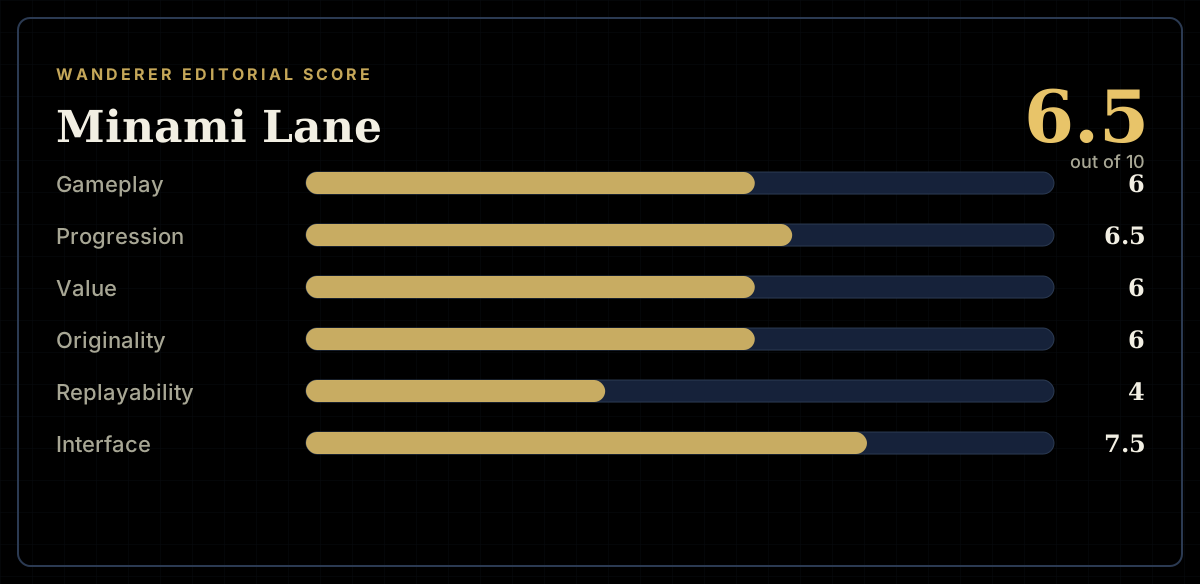
How the review scores each part of the gameWanderer Editorial -
The short versionWanderer Editorial