
Game review
Alluris
6 / 10
- Developer
- 562 Interactive
- Publisher
- 562 Interactive
- Released
- 11 October 2019
- Platforms
- Windows
- Genre
- RPG
- Monetisation
- Paid, no in-app purchases found
- Players
- false
The short version
Alluris takes the Reigns formula — swipe left or right on a card to resolve an event — and builds a genuine fantasy RPG around it, with races, classes, followers and items that meaningfully change how choices play out. For the right mood, several reviewers describe it as the closest thing to solo tabletop storytelling they've found on a screen. But an unexplained 500-day time limit, a documented balance flaw letting completed events be farmed repeatedly, and content that noticeably starts repeating on longer playthroughs keep it from being more than a charming, finite curiosity.
Biggest strengths
- A genuine RPG layer underneath the swipe-card format, with race, class, follower and item combinations reviewers say meaningfully change how runs play out (one calls a Treant Barbarian build "so much health, you are never in fear of your life")
- A relaxing, low-pressure pace that several reviewers specifically praise for evoking solo tabletop storytelling without needing other players
- Real variety across different biomes (forest, desert, mountains, caves) each with distinct events and encounters
Biggest weaknesses
- A 500-day time limit exists but is never explained to the player, leading to confusion when a run ends unexpectedly
- No quest log for side quests, making it easy to lose track of an objective picked up earlier in a run
- A specific, documented balance flaw: certain area events and scenarios can be repeated indefinitely for experience and rewards even after they should be considered complete
Who it's for: Fans of Reigns-style choice-card games who specifically want deeper RPG character building layered on top, and players looking for a relaxing, low-commitment fantasy adventure.
Our recommendation: A good pick on sale for a handful of charming, replayable short sessions, with realistic expectations about its content eventually running dry.
6 / 10
What it is
Alluris presents its fantasy world one card at a time: an event or encounter appears, and the player swipes left or right to choose how to respond, in the Reigns lineage of minimalist decision-based adventure games. What sets Alluris apart from a straightforward Reigns clone is the RPG layer built around that core format — players choose a race and class at the start of a run, recruit followers, collect items, and level up, all of which meaningfully shape which cards appear and how choices resolve. The game's own pitch leans into flexibility of tone, too: players can pursue heroic or villainous paths, with one reviewer specifically noting the option to simply "save a colony of bears from some lumberjacks" as an example of the kind of small, specific, memorable story a run can produce.
It released on 11 October 2019 at NZD 12.39, developed and published by 562 Interactive. Its 122-review English corpus is strongly Very Positive (109 to 13), and the praise running through it is consistent in a specific way: reviewers aren't calling this a groundbreaking or technically ambitious game, they're calling it a relaxing, charming way to spend a handful of hours, which is exactly the register the game itself seems to be aiming for.
The tabletop-adjacent appeal
Several reviewers reach for the same comparison independently: this is what solo Dungeons & Dragons might feel like without needing other players. One puts it simply — "nerd that loves DnD but has no friends to play with. Solution: Alluris." — while a more measured review credits the game with communicating "the feeling of wandering in the countryside and stumbling on some random stuff every now and then" effectively, even while scoring its graphics and narration lower than its gameplay. The character-building layer gets specific, enthusiastic praise for producing genuinely memorable combinations: beyond the Treant Barbarian mentioned above, reviewers describe experimenting with different race-class pairings across multiple short playthroughs as one of the game's strongest draws, aided by unlockable starting options that keep successive runs feeling at least somewhat distinct from each other.
Where the design gets in its own way
The most detailed critical review in the corpus identifies a specific, concrete balance problem rather than a vague complaint about repetition: certain area events and scenarios "can repeat... over and over again for experience and rewards when obviously you've already completed" them, something the reviewer argues "SHOULD NOT be repeatable." That's a real design oversight rather than a difference of opinion about difficulty or pacing — a farmable loophole that undercuts whatever sense of consequence the game's choice-driven structure is meant to provide.
A second, more structural complaint concerns communication: the game runs on a 500-day internal clock that ends a playthrough once it expires, but multiple reviewers report the game never actually tells the player this limit exists, leading to runs ending abruptly and unexpectedly. A related complaint about missing quest-tracking compounds the same basic problem — Alluris asks players to keep track of ongoing threads and a hidden countdown without giving them the tools to do either easily.
A finite experience, honestly assessed
Multiple reviewers are candid about the game's ceiling once its content is substantially explored. "It is not infinite, so it will start to repeat soon, even with unlocked backgrounds and races," one writes, while still recommending the game overall; another reports losing patience partway through "grinding through all of the outcomes" despite enjoying the earlier hours. A blunter comparison suggests the game "seems like it should be an ad supported free-game on my phone" — not meant as a compliment, but as an honest description of where its content depth actually sits relative to a $12 PC purchase. That's a fair, specific criticism rather than dismissive: the format and presentation genuinely evoke mobile choice-adventure games, and Alluris doesn't do enough with its extra budget and premium pricing to fully escape that comparison once the initial charm wears off.
What the achievement data says about completion
Alluris tracks 40 achievements, and the completion curve tells a fairly specific story about how players actually engage with it. A cluster of achievements tied to reaching different regions — a monastery, an island, an "Atlantica" area — sit in a relatively tight band between 62% and 78%, suggesting most players who commit to a run do see a meaningful cross-section of the game's content before stopping. But achievements tied to full mastery are much rarer: playing every race sits at 6.6%, and full game completion sits at just 1.9%. That gap between "saw most of the content" and "finished everything" lines up closely with the reviewer accounts above — plenty of players get a satisfying handful of hours out of a run or two before the repetition sets in, but relatively few push all the way through to see literally everything the card pool has to offer, which is consistent with a game whose content pool, while varied, isn't deep enough to reward that kind of exhaustive play.
Tone and writing
The writing itself draws mixed but specific reactions. Several reviewers enjoy Alluris's sense of humour and describe walking away with "a few crazy stories" worth retelling, which lines up with the game's own framing of itself. But at least one reviewer specifically flags anachronistic modern slang — "Bruh," "Duh," "Naw" — as breaking the fantasy setting's immersion, self-deprecatingly noting this reaction "shows your age" while still recommending the game overall. That's a fair, minor criticism to weigh depending on personal taste: a fantasy adventure aiming for a light, comedic tone throughout will read as charming to some and jarring to others when contemporary phrasing shows up in a medieval setting, and Alluris leans hard enough into humour that this choice feels deliberate rather than accidental.
Verdict
Alluris succeeds at being exactly what it sets out to be for its first several playthroughs: a relaxing, RPG-flavoured take on the Reigns formula with real character-building variety and a light, frequently funny tone. An unexplained time limit, a documented repeatable-rewards exploit, and content that eventually runs dry keep it from being more than that, and reviewers are largely honest about the point of diminishing returns. A good pick for a few charming, low-stakes fantasy afternoons, best bought on sale given how finite its content ultimately is.
Pros and cons
Pros
- A genuine RPG layer underneath the swipe-card format, with race, class, follower and item combinations reviewers say meaningfully change how runs play out (one calls a Treant Barbarian build "so much health, you are never in fear of your life")
- A relaxing, low-pressure pace that several reviewers specifically praise for evoking solo tabletop storytelling without needing other players
- Real variety across different biomes (forest, desert, mountains, caves) each with distinct events and encounters
- Good replayability across multiple short playthroughs thanks to unlockable starting races and backgrounds, at least until the card pool has been substantially exhausted
Cons
- A 500-day time limit exists but is never explained to the player, leading to confusion when a run ends unexpectedly
- No quest log for side quests, making it easy to lose track of an objective picked up earlier in a run
- A specific, documented balance flaw: certain area events and scenarios can be repeated indefinitely for experience and rewards even after they should be considered complete
- Content is finite and noticeably begins repeating on longer or repeated playthroughs, with several reviewers explicitly comparing the eventual staleness to what they'd expect from a free mobile app rather than a paid PC game
- Modern slang ("Bruh," "Duh," "Naw") in the writing breaks fantasy immersion for at least one reviewer, and the game has received no updates since release
Screenshots
-

AllurisImage: 562 Interactive via Steam -

AllurisImage: 562 Interactive via Steam -

AllurisImage: 562 Interactive via Steam -
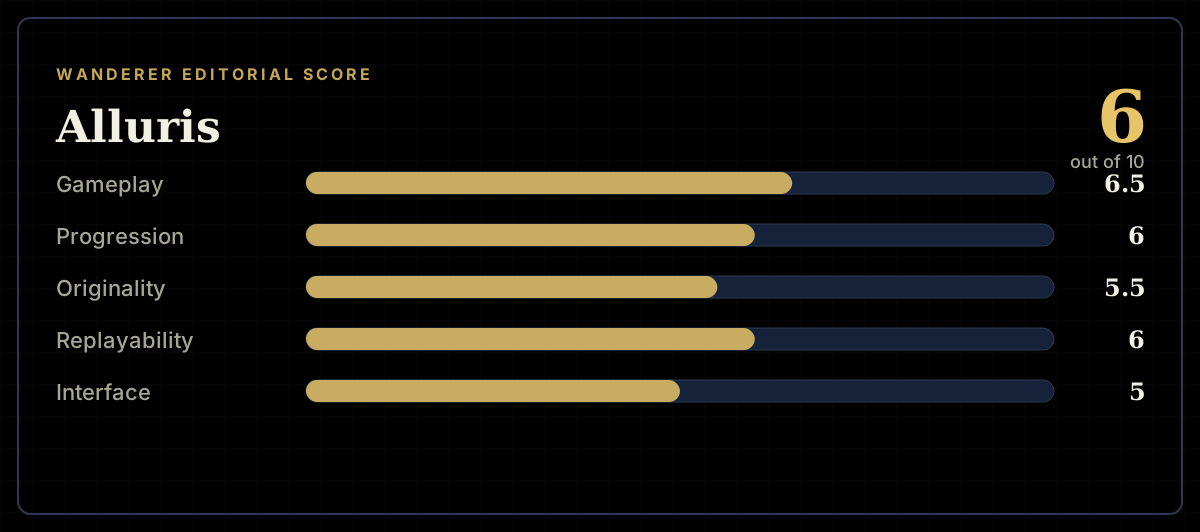
How the review scores each part of the gameWanderer Editorial -
The short versionWanderer Editorial