
Game review
Alice's Gaze
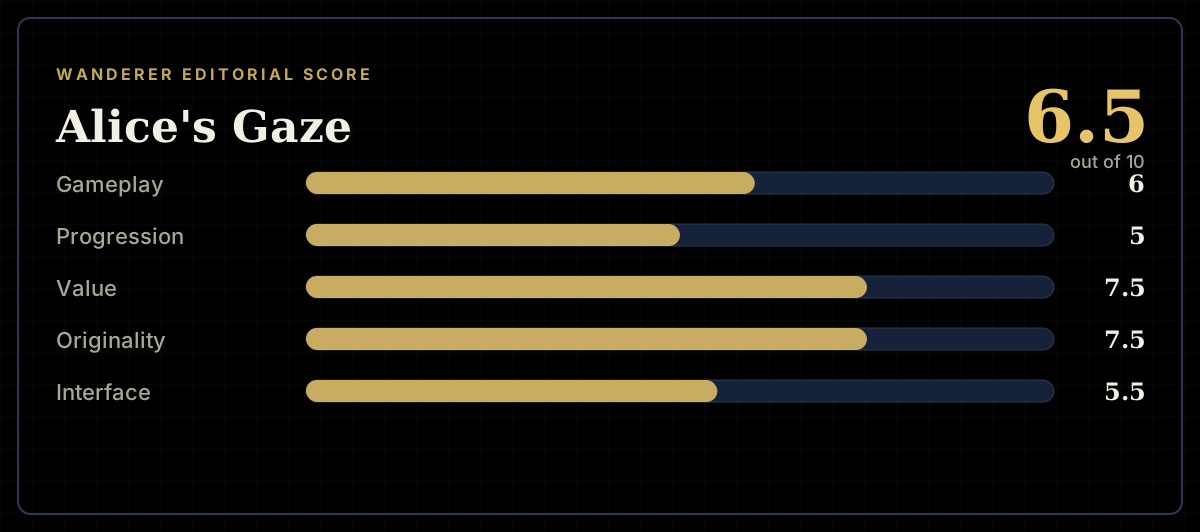
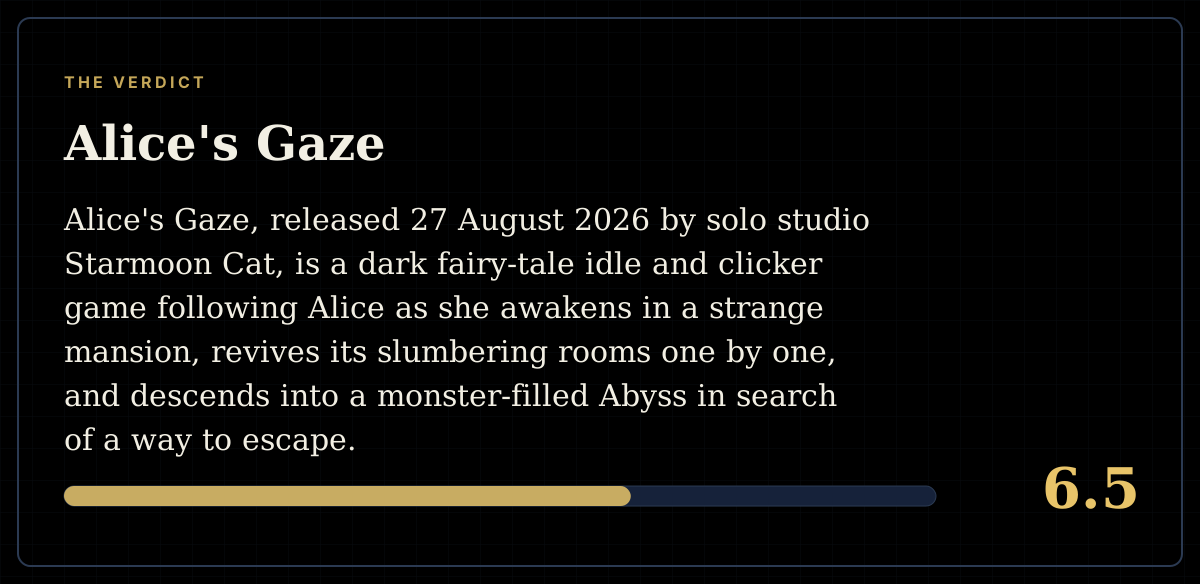
6.5 / 10
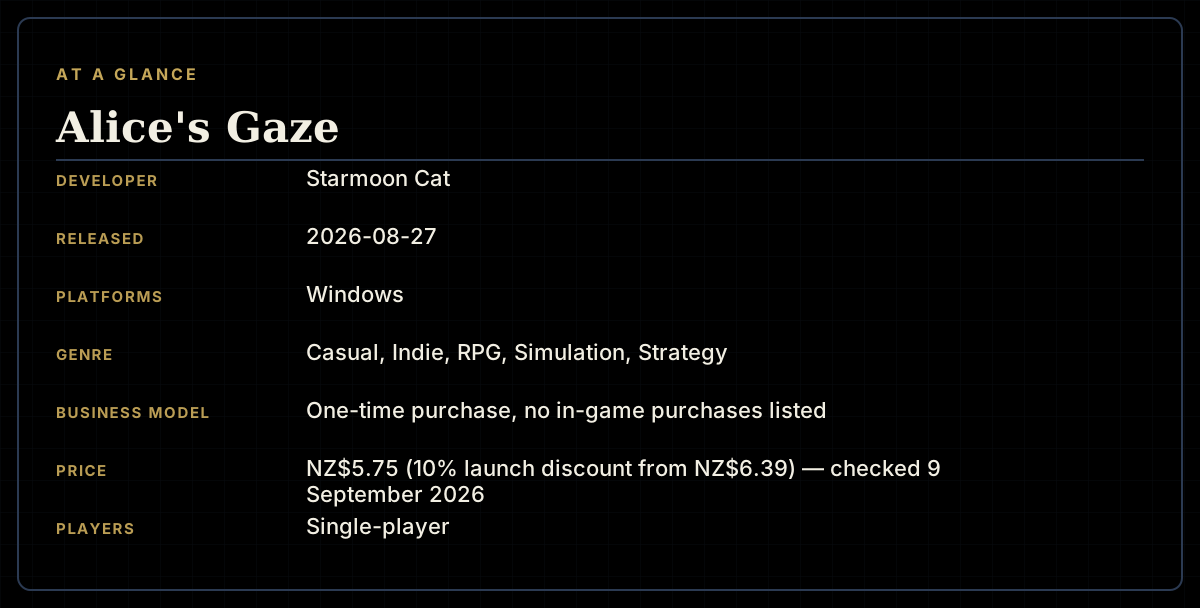
- Developer
- Starmoon Cat
- Publisher
- Starmoon Cat
- Released
- 27 August 2026
- Platforms
- Windows
- Genre
- Casual, Indie, RPG, Simulation, Strategy
- Monetisation
- One-time purchase, no in-game purchases listed
- Players
- Single-player
The short version
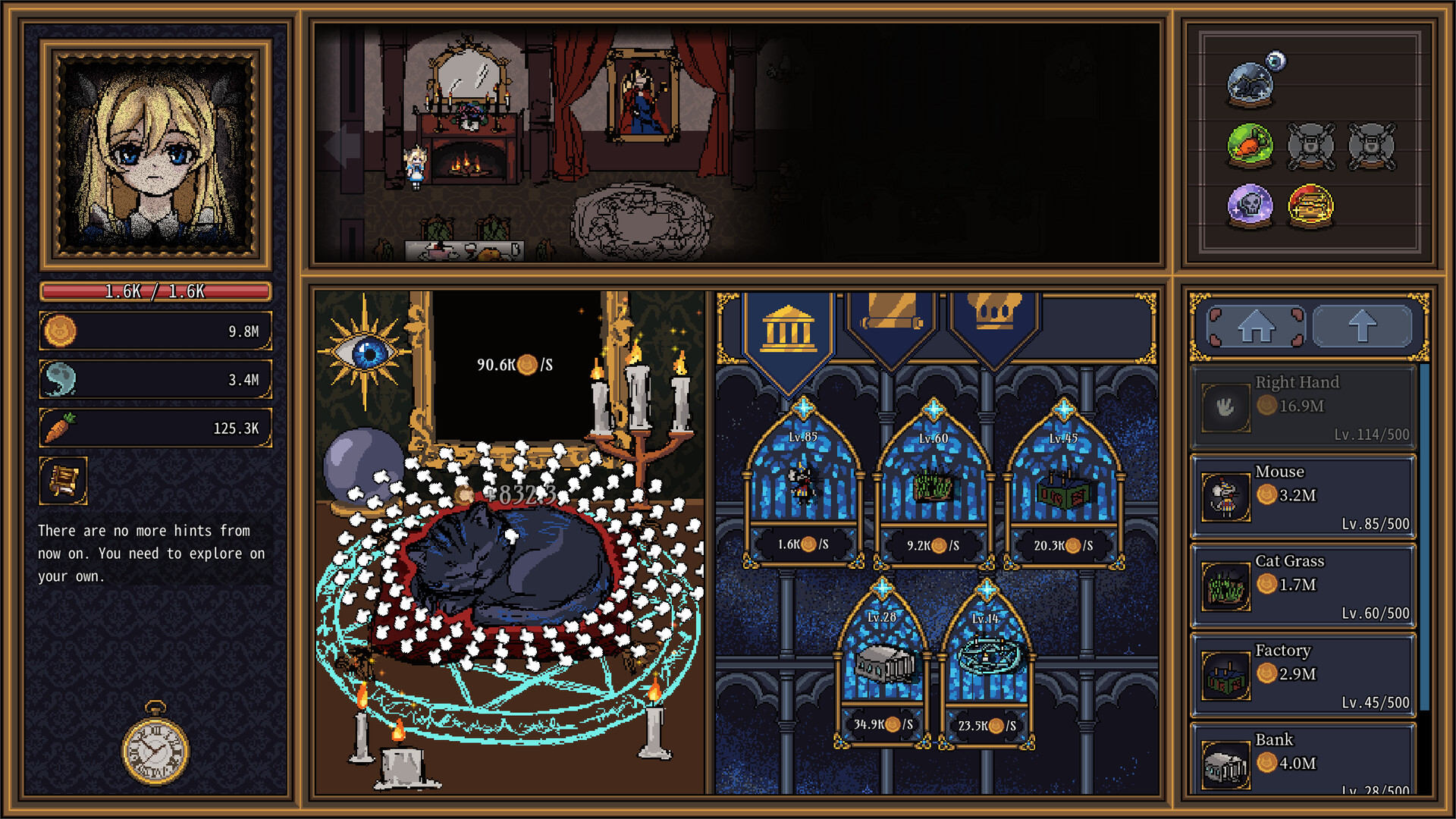
Alice's Gaze, released 27 August 2026 by solo studio Starmoon Cat, is a dark fairy-tale idle and clicker game following Alice as she awakens in a strange mansion, revives its slumbering rooms one by one, and descends into a monster-filled Abyss in search of a way to escape. It sits Very Positive with a substantial sample of 166 reviews, and reading widely through it reveals a game reviewers genuinely love for its atmosphere sitting alongside a specific, widely and independently documented structural problem. Reviewers consistently praise the grimdark, RPGMaker-inspired art style, an "uncomfy cozy" horror-adjacent tone several describe as genuinely distinctive within the idle genre, and a cheap, satisfying price for roughly seven to ten hours of content completable in a single binge session. Set against that praise, a large number of reviewers, including several writing detailed, thoughtful non-recommendations despite clearly enjoying earlier sections, describe the game's late-game Abyss dungeon system as a poorly scaled, unskippable time sink: with no speed-up function, reaching the floors required for full completion and achievements can take ten or more additional hours of largely passive waiting, well past the point where the underlying story or gameplay has anything new to offer.
Biggest strengths
- The game's dark fairy-tale art style and atmosphere draw overwhelming, specific praise, with reviewers repeatedly describing genuinely gorgeous pixel art, a distinctive grimdark aesthetic reminiscent of RPGMaker horror games, and a rare, well-executed "uncomfy cozy" tone
- The soundtrack draws specific, repeated appreciation, and multiple reviewers separately note genuine care in small narrative and thematic details, including specific references reviewers identify to the SCP Foundation and Junji Ito's horror manga
- Value draws consistent praise at this specific price point, with multiple reviewers describing several genuinely enjoyable hours of active progression for only a few dollars, well ahead of typical genre expectations for cost per hour of engagement
Biggest weaknesses
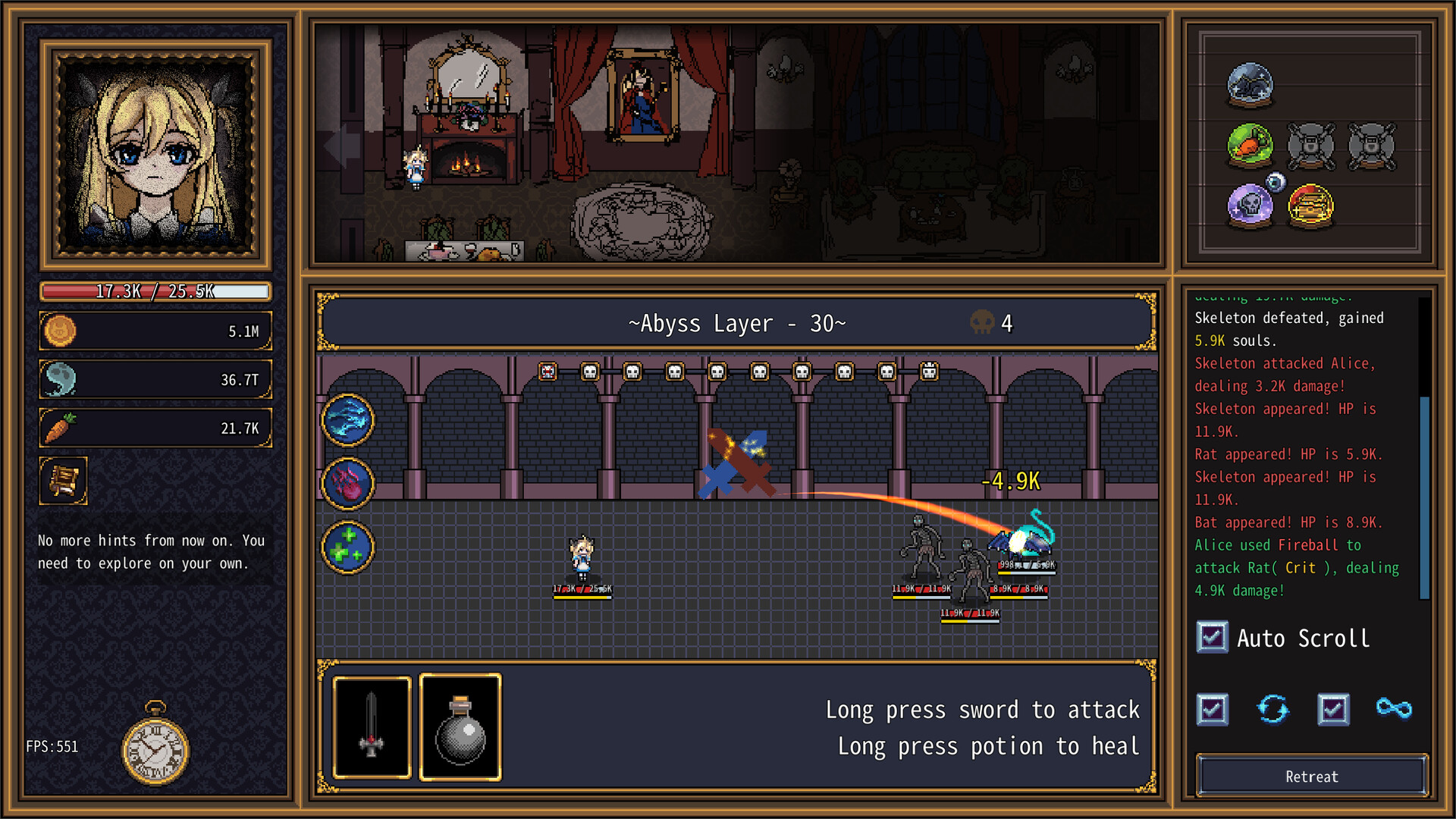
- A large number of reviewers, including several writing detailed non-recommendations despite clearly enjoying earlier sections, describe the late-game Abyss dungeon as a poorly scaled, unskippable time sink, with no speed-up function and floors that can take ten or more hours of largely passive waiting to clear for full completion and achievements
- Multiple reviewers separately report the game's story effectively stops partway through, with the remaining playtime consisting of grinding through content that no longer meaningfully advances the plot the earlier hours had set up
- At least one detailed reviewer reports the combat and enemy scaling in the Abyss breaks down, with players quickly outscaling monsters entirely, removing any meaningful challenge from encounters that still take real, unskippable time to work through regardless
Who it's for: Fans of atmospheric, short-form idle and incremental games looking for genuine dark fairy-tale aesthetic and a satisfying few hours of active progression, who are prepared to either stop before or specifically tolerate the widely-reported late-game grind if chasing full completion or achievements.
Our recommendation: Worth it at this low price for the atmosphere and the first several hours alone; temper expectations for the back half of the game, and don't go in expecting to reach 100% completion quickly given the specific, well-documented Abyss pacing problem.
6.5 / 10
Introduction
Alice's Gaze, released 27 August 2026 by solo studio Starmoon Cat, is a dark fairy-tale idle and clicker game following Alice as she awakens in a strange mansion, revives its slumbering rooms one by one, and eventually descends into a monster-filled Abyss in search of a way to escape. It sits Very Positive with a substantial sample of 166 reviews, and reading widely through it reveals a game reviewers genuinely love for its atmosphere and presentation, sitting alongside a specific, widely and independently documented structural problem serious enough that several reviewers who otherwise clearly enjoyed the game still recommend against it.
Genuine atmosphere, gorgeously realised
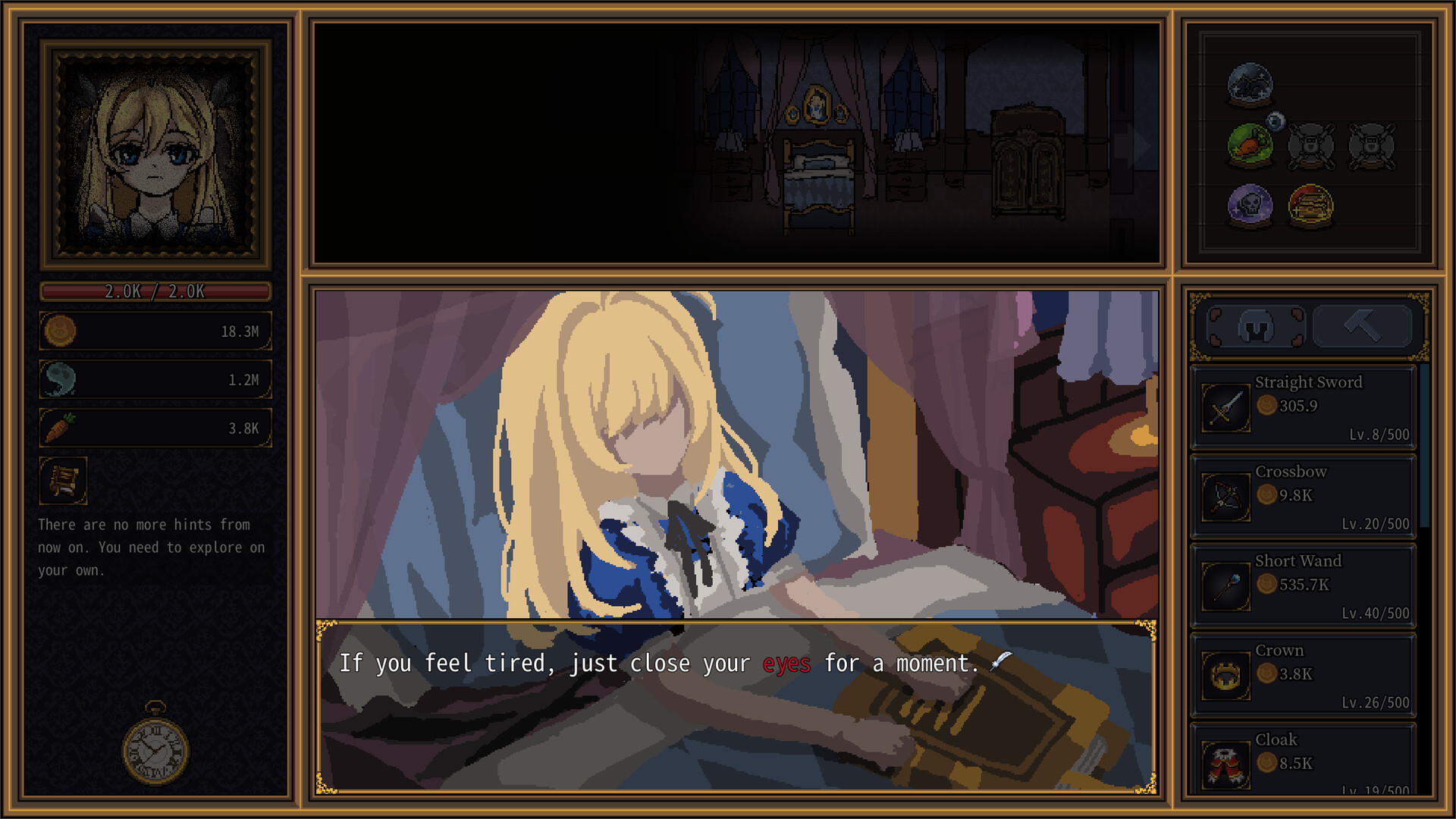
The clearest, most consistent praise across this sample concerns presentation. Reviewers overwhelmingly describe the game's grimdark, RPGMaker-inspired pixel art as gorgeous and lovingly detailed, and multiple reviewers specifically praise the game's ability to strike an unusual, well-executed tone one reviewer memorably describes as "uncomfy cozy" — creepy and unsettling while still remaining genuinely comfortable and inviting to spend time in, like being wrapped in a blanket while watching a horror movie. The soundtrack draws its own specific, repeated appreciation, and multiple reviewers separately note genuine thematic care in the writing, including specific, apparently deliberate references to the SCP Foundation and to Junji Ito's horror manga that reviewers read as a sign the developer understands the genre they're drawing from.
Real value for a short, satisfying binge
A second consistent theme concerns value. Reviewers repeatedly describe several genuinely enjoyable hours — typically seven to ten — of active, engaging progression for a price several specifically call cheap even by idle-genre standards, and multiple reviewers describe completing the entire game in a single extended sitting with real satisfaction rather than fatigue. Reviewers also praise the variety of minigames and progression systems layered on top of the core clicking and idling loop, describing genuine attempts at mechanical variety across the game's different unlockable systems rather than one formula stretched thin across the whole runtime.
The Abyss: a specific, widely-documented pacing failure
Set directly against that praise, this review found an unusually consistent, specific and well-corroborated structural complaint concerning the game's late-game content, generally referred to by reviewers as the Abyss. Multiple detailed reviewers, several explicitly framing their reviews as reluctant or tentative non-recommendations despite enjoying earlier sections, describe this dungeon-crawling endgame system as a poorly scaled time sink: with no speed-up function available, reaching the floor depths required for full completion and achievements can take ten or more additional hours, largely spent passively waiting rather than actively engaging with the game. One reviewer frames this directly as a failure specific to the incremental genre itself, arguing that "nothing you do in the game matters" once the Abyss becomes the sole remaining progression gate, since the time required to clear it is fixed regardless of player skill or strategy.
A story that stops, and combat that trivialises itself
Compounding that pacing problem, multiple reviewers separately report the game's story effectively stops partway through, leaving the Abyss as a mechanically isolated grind disconnected from the narrative hook that drew players in during the earlier hours. At least one detailed reviewer adds a further, specific wrinkle: combat and enemy scaling inside the Abyss reportedly breaks down entirely, with players quickly outscaling monsters to the point that encounters pose no meaningful challenge — yet still consume the same fixed, unskippable time investment regardless. That combination, a section simultaneously too easy to be engaging and too slow to be skippable, is a specific and unusually pointed criticism distinct from a more generic "this game gets grindy late" complaint.
Smaller technical and design complaints
Beyond the Abyss, this review found a handful of smaller but specific complaints. At least one reviewer reports text-rendering bugs in the English version, with some text overflowing its textbox and becoming unreadable, and line breaks splitting words in apparently random places rather than at natural word boundaries. A separate reviewer notes the absence of offline progression, stating this explicitly as a design choice they're personally fine with rather than a bug, and multiple reviewers separately describe individual early-game progression systems, including a resource-collection mechanic, as unusually slow relative to the cost of upgrading them, well before the Abyss becomes the dominant late-game complaint.
Weighing genuine early strength against a specific late failure
Taken as a whole, this review reads Alice's Gaze as a game whose first several hours largely deliver on real, well-earned praise for atmosphere, presentation and short-form pacing, only to introduce a specific, well-corroborated structural failure in its final act that a meaningful share of otherwise enthusiastic reviewers found serious enough to override an overall recommendation. That's a different, more specific situation than a game that's simply mediocre throughout, and this review's moderate score reflects genuine respect for what the earlier hours accomplish weighed directly against how seriously and how consistently reviewers document the Abyss as undermining that accomplishment for anyone chasing full completion.
Final Verdict
Alice's Gaze pairs genuinely gorgeous dark fairy-tale presentation and a distinctive, well-executed atmosphere with real value for its low price, delivering several satisfying hours reviewers consistently praise. What holds this score down is a specific, widely and independently documented structural failure in its late-game Abyss system: an unskippable, poorly-scaled time sink that stops the story cold and trivialises its own combat while still demanding ten or more hours of largely passive waiting for full completion. Worth it at this price for the atmosphere and the earlier hours alone; go in with tempered expectations for the back half, and don't chase 100% completion without accepting the specific grind reviewers have consistently documented.
Pros and cons
Pros
- The game's dark fairy-tale art style and atmosphere draw overwhelming, specific praise, with reviewers repeatedly describing genuinely gorgeous pixel art, a distinctive grimdark aesthetic reminiscent of RPGMaker horror games, and a rare, well-executed "uncomfy cozy" tone
- The soundtrack draws specific, repeated appreciation, and multiple reviewers separately note genuine care in small narrative and thematic details, including specific references reviewers identify to the SCP Foundation and Junji Ito's horror manga
- Value draws consistent praise at this specific price point, with multiple reviewers describing several genuinely enjoyable hours of active progression for only a few dollars, well ahead of typical genre expectations for cost per hour of engagement
- Multiple reviewers specifically praise the variety of minigames and progression systems layered on top of the core idle loop, describing genuine attempts at mechanical variety rather than a single repeated formula stretched across the whole runtime
Cons
- A large number of reviewers, including several writing detailed non-recommendations despite clearly enjoying earlier sections, describe the late-game Abyss dungeon as a poorly scaled, unskippable time sink, with no speed-up function and floors that can take ten or more hours of largely passive waiting to clear for full completion and achievements
- Multiple reviewers separately report the game's story effectively stops partway through, with the remaining playtime consisting of grinding through content that no longer meaningfully advances the plot the earlier hours had set up
- At least one detailed reviewer reports the combat and enemy scaling in the Abyss breaks down, with players quickly outscaling monsters entirely, removing any meaningful challenge from encounters that still take real, unskippable time to work through regardless
- At least one reviewer reports specific text-rendering bugs in the English version, with some text overflowing its textbox and becoming unreadable, and line breaks splitting words in seemingly random places
- The game offers no offline progression, which at least one reviewer notes explicitly, and several other reviewers separately describe specific individual progression systems, including an early resource-collection mechanic, as unusually slow relative to their cost to upgrade
Screenshots
-
Alice's GazeImage: Starmoon Cat via Steam -
Alice's GazeImage: Starmoon Cat via Steam -
Alice's GazeImage: Starmoon Cat via Steam -
How the review scores each part of the gameWanderer Editorial -
The essentials at a glanceWanderer Editorial -
The short versionWanderer Editorial