
Game review
Yooka-Laylee and the Impossible Lair
7.5 / 10
- Developer
- Playtonic Games
- Publisher
- Playtonic Friends
- Released
- 8 October 2019
- Platforms
- Windows
- Genre
- Platformer
- Monetisation
- Paid, no in-app purchases found
- Players
- false
The short version
Where the original Yooka-Laylee chased Banjo-Kazooie's collectathon formula and left many reviewers cold, Impossible Lair pivots hard toward 2D Donkey Kong Country-style platforming layered on top of a genuinely charming 3D overworld puzzle-box, and the reviewer consensus is that the pivot worked. Tight controls, memorable music from two celebrated Rare-era composers, and forty distinct stage variants add up to one of 2019's better-received platformers — dragged down only by a genuinely poor piece of menu design and a title challenge whose difficulty spike several reviewers argue crosses from 'appropriately named' into 'badly designed.'
Biggest strengths
- Tight, responsive 2D platforming controls that reviewers consistently compare favourably to Donkey Kong Country, including underwater sections singled out as unusually well-designed for the genre
- A real, celebrated soundtrack from David Wise and Grant Kirkhope, with reviewers noting each stage gets its own distinct theme, including 8-bit remixes for altered stage variants
- A clever core structural gimmick: modifying the 3D overworld (for instance, by altering paintings) changes the corresponding 2D stage, effectively doubling the level count to roughly 40 distinct stages across 20 base levels
Biggest weaknesses
- An unskippable studio logo sequence at startup that several reviewers call excessive on its own, made worse by a specific design flaw: the in-game "save & quit" menu option routes back through the same logos before actually closing the game
- The titular Impossible Lair, the game's final gauntlet, is reported as a roughly 30-minute continuous challenge with little to no mid-level checkpointing, which multiple reviewers argue is an unfair difficulty spike rather than a fitting capstone, even while acknowledging the game's own branding sets that expectation
- At least one reviewer describes the overall package as feeling "kinda rushed" despite genuine enthusiasm for its individual pieces, citing a handful of specific, seemingly avoidable rough edges
Who it's for: Fans of Donkey Kong Country-style 2D platforming and anyone who bounced off the original Yooka-Laylee's collectathon structure but still wants the same charm and music pedigree.
Our recommendation: A strong, easy recommendation for platformer fans, especially at a discount — just brace for the unskippable startup sequence and the notoriously difficult final challenge it's named after.
7.5 / 10
What it is
Yooka-Laylee and the Impossible Lair follows the chameleon-and-bat duo from Playtonic Games' first title into a structurally different kind of game entirely. Rather than the open, collectathon-heavy 3D worlds of the original — a deliberate homage to Banjo-Kazooie and Banjo-Tooie that several reviewers here describe as underwhelming — Impossible Lair splits its design in two: a fully explorable 3D overworld map filled with its own puzzles and secrets, connecting to twenty distinct 2D side-scrolling platforming stages built squarely in the Donkey Kong Country mold. A clever structural twist doubles that content: manipulating elements of the overworld, such as pouring honey into specific paintings, alters the corresponding 2D stage into a meaningfully different variant, bringing the effective stage count to roughly 40. The soundtrack carries real pedigree, composed by David Wise (Donkey Kong Country) and Grant Kirkhope (Banjo-Kazooie), with reviewers noting each stage gets its own distinct musical theme, including chiptune remixes for altered variants.
It released on 8 October 2019 at a list price of NZD 54.95, developed by Playtonic Games — largely composed of former Rare developers — and published under the Playtonic Friends label. Its 603-review English corpus sits at a strong Very Positive (492 to 111), and the throughline across nearly every review, positive or critical, is the same specific comparison: this game succeeds by embracing Donkey Kong Country's structure and feel far more directly than its predecessor embraced Banjo's.
A genuine course correction, according to reviewers who played both
Reviewers who played the original Yooka-Laylee are consistently the most enthusiastic about this sequel's direction, framing it explicitly as a course correction rather than more of the same. "As a fan of old-school platformers, Yooka-Laylee disappointed me," writes one, citing worlds that felt "too vast" and collecting that "felt like a chore" — before praising Impossible Lair as "a joy to play, learning from many of the original's mistakes." Another states plainly there's "no need to buy or play the original" to enjoy this one, calling it possibly "the most underrated game on Steam" given how few reviews it has relative to its quality. The core 2D platforming draws the strongest, most specific praise: "gameplay is tight and challenging, level design is great," with particular credit given to underwater stages that one detailed reviewer singles out as unusually fun execution of a notoriously difficult platforming environment to get right.
Two specific, avoidable flaws
Set against that praise, the corpus converges on two concrete, specific complaints rather than vague dissatisfaction. The first is almost comically mundane but genuinely disruptive: one detailed review documents that the game's unskippable studio logo sequence at startup is bad enough on its own, but becomes a real usability problem because the "save & quit" option in the overworld menu routes players back through those same logos before the game actually closes — meaning properly exiting requires sitting through the full splash sequence a second time, with a specific button press needed at the end to confirm the exit. That's a straightforward QA oversight rather than a design philosophy, and a strange one to ship in a release this otherwise polished.
The second concerns the game's namesake challenge directly. The Impossible Lair itself — the final, title-referenced gauntlet — is reported by multiple reviewers as a continuous, largely checkpoint-free challenge running around 30 minutes for a single attempt. One reviewer calls designing a final boss this long and difficult "with no checkpoints... just poor game design," explicitly acknowledging the game is named for exactly this kind of difficulty while still arguing the specific execution — an extreme spike relative to everything before it, with no partial credit for a near-complete run — crosses from intentionally hard into unfairly punishing.
Reading the achievement data alongside the difficulty complaints
The completion curve across the game's 47 achievements gives useful, specific shape to the difficulty conversation above. Early achievements — collecting an initial batch of coins, rescuing the first captured bees, equipping a basic Tonic upgrade — sit in a reasonably healthy 40-60% range, suggesting most buyers engage seriously with the core loop rather than bouncing off immediately. But achievements tied to full completion and full Tonic collection cluster tightly around 4-6%, including the achievement for finishing the game outright at just 6.1%. That's a meaningfully steep drop for a platformer whose main-line stages, per most reviewer accounts, are challenging but fair — which lines up precisely with the specific complaint about the Impossible Lair itself functioning as a late, disproportionate wall relative to everything that came before it, rather than the whole game gradually filtering out players stage by stage. In other words, the data suggests most of the attrition happens at one specific point near the very end, not gradually throughout — exactly the shape you'd expect if a single, unusually difficult capstone challenge is the primary reason full completion is rare.
The Tonic system and structural depth
Beyond the headline platforming, several reviewers point to the game's "Tonic" system — unlockable modifiers that can be equipped to change how a stage plays, similar in spirit to Donkey Kong Country's collectible mechanics — as adding real structural depth for players who want more than a single playthrough. One reviewer writing after collecting every achievement specifically calls out the hub-world puzzles and overall sense of "charm and personality" as standout qualities alongside the platforming itself, suggesting the game's appeal extends meaningfully beyond its core stages for players willing to dig into its optional systems. That combination — strong core platforming, a clever overworld-stage-variant gimmick, and an optional Tonic layer for deeper engagement — is a fuller package than a straightforward DKC homage might suggest at a glance, even before accounting for the specific praise the soundtrack receives throughout the corpus.
Verdict
Yooka-Laylee and the Impossible Lair succeeds precisely where reviewers say its predecessor struggled: tight, responsive 2D platforming with real Donkey Kong Country pedigree, a genuinely clever overworld structure that meaningfully doubles its content, and a soundtrack from two of the genre's most respected composers. A startup sequence that intrudes even on quitting and a brutal, largely checkpoint-free final challenge are real, specific blemishes rather than fatal flaws, and most of this game's own reviewers treat them as exactly that — frustrations worth naming, in an otherwise excellent platformer worth playing regardless.
Pros and cons
Pros
- Tight, responsive 2D platforming controls that reviewers consistently compare favourably to Donkey Kong Country, including underwater sections singled out as unusually well-designed for the genre
- A real, celebrated soundtrack from David Wise and Grant Kirkhope, with reviewers noting each stage gets its own distinct theme, including 8-bit remixes for altered stage variants
- A clever core structural gimmick: modifying the 3D overworld (for instance, by altering paintings) changes the corresponding 2D stage, effectively doubling the level count to roughly 40 distinct stages across 20 base levels
- A creative, exploration-friendly overworld with genuine puzzle content that multiple reviewers say they enjoyed as much as the platforming stages themselves
Cons
- An unskippable studio logo sequence at startup that several reviewers call excessive on its own, made worse by a specific design flaw: the in-game "save & quit" menu option routes back through the same logos before actually closing the game
- The titular Impossible Lair, the game's final gauntlet, is reported as a roughly 30-minute continuous challenge with little to no mid-level checkpointing, which multiple reviewers argue is an unfair difficulty spike rather than a fitting capstone, even while acknowledging the game's own branding sets that expectation
- At least one reviewer describes the overall package as feeling "kinda rushed" despite genuine enthusiasm for its individual pieces, citing a handful of specific, seemingly avoidable rough edges
- Achievement data shows only about 6% of players fully complete the game, partly attributable to the front-loaded difficulty of that final challenge relative to the rest of the campaign
Screenshots
-

Yooka-Laylee and the Impossible LairImage: Playtonic Friends via Steam -

Yooka-Laylee and the Impossible LairImage: Playtonic Friends via Steam -

Yooka-Laylee and the Impossible LairImage: Playtonic Friends via Steam -
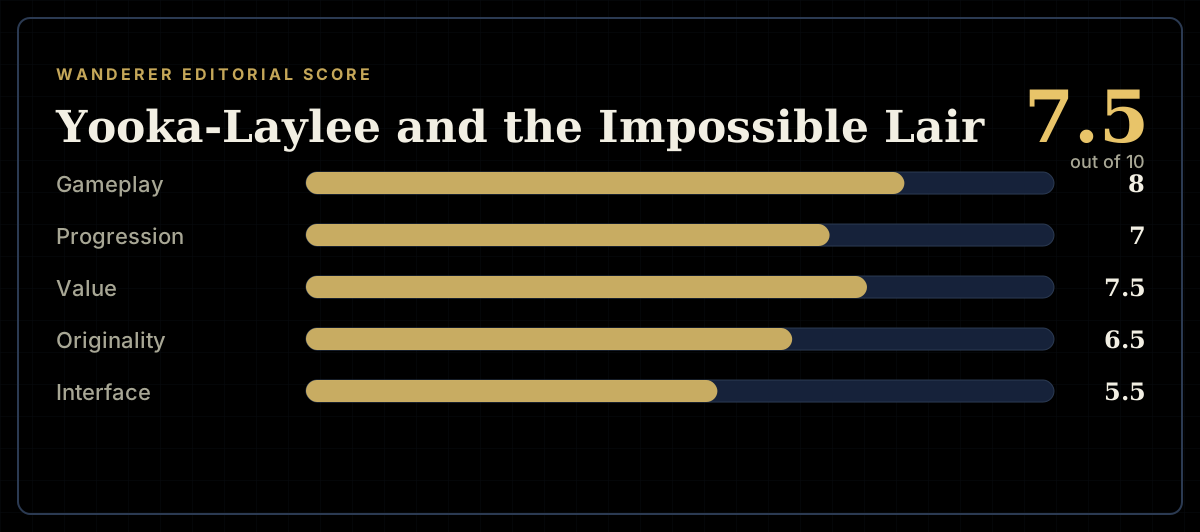
How the review scores each part of the gameWanderer Editorial -
The short versionWanderer Editorial