
Game review
Abathor
6 / 10
- Developer
- Pow Pixel Games
- Publisher
- JanduSoft
- Released
- 25 July 2024
- Platforms
- Windows, Steam Deck
- Genre
- Retro sword-and-sorcery action platformer
- Monetisation
- One-time purchase, no in-game store or additional currency purchases
- Players
- Local and online co-op for up to four players
The short version
Abathor sends four distinct sword-and-sorcery heroes through fifty-odd 16-bit levels directly channeling the arcade DNA of Golden Axe, Rastan, and Castlevania. This review's sample shows a passionate, deeply nostalgic core audience embracing the tribute wholeheartedly, with several reviewers logging dozens of hours across multiple difficulty settings and full achievement completion. What tempers that affection, repeated across a large and specific portion of the negative sample, is a persistent complaint about movement and combat feeling sluggish — a criticism that, notably, at least one reviewer says survived even after the developer shipped a major update specifically responding to community feedback.
Biggest strengths
- The homage to Golden Axe, Rastan, and Castlevania is executed with genuine care and specificity, earning heartfelt recognition from reviewers who grew up with those exact games
- The four-character roster offers real, distinguishable playstyles, with reviewers describing each run feeling meaningfully different depending on the chosen hero
- Multiple reviewers describe substantial, lasting engagement, with some logging over 30 hours across difficulty tiers and full achievement completion, praising deep lore connections to Greek mythology
Biggest weaknesses
- A widely and specifically repeated complaint concerns overall movement and attack speed, which multiple reviewers describe as sluggish enough to undermine the flow of combat, with at least one reviewer stating a documented major update failed to meaningfully address the issue
- Several reviewers describe a difficulty curve that stays too easy for most of the game before spiking sharply and unfairly at the final stage, creating a jarring mismatch in challenge pacing
- Multiple reviewers report specific performance problems, including significant framerate drops when more than a few enemies appear on screen simultaneously
Who it's for: Fans of classic arcade sword-and-sorcery side-scrollers like Golden Axe and Rastan looking for a faithful, challenging modern tribute with co-op support, who can tolerate deliberately weighty, old-school movement pacing rather than fast, fluid modern platforming.
Our recommendation: A genuinely loving throwback for fans of its specific inspirations, best sampled via the demo first given how consistently reviewers disagree on whether its intentionally weighty movement feels authentic or simply sluggish.
6 / 10
Abathor wears its inspirations proudly on its sleeve: Golden Axe's cooperative barbarian combat, Rastan's arcade platforming rhythm, Castlevania's deliberate weight, all rendered in genuine 16-bit style across fifty-plus levels and four distinct playable heroes. This review's sample shows real, deep affection from players who grew up on those exact games — and a specific, well-documented complaint from an equally sizable group about how that tribute actually feels to control.
A tribute that lands for its intended audience
The nostalgic praise here is specific and heartfelt. "Altered Beast, Castlevania, Golden Axe, Rastan Saga, SEGA, SNES, Arcades – If any of those make you feel nostalgic, read on. You don't want to ignore this side scrolling masterpiece," one reviewer writes. Another, after full completion, offers a considered endorsement: "This game is a work of art. Over my 30 hours and multiple playthroughs on all difficulties, I can whole-heartedly say that this game checks all of the boxes for me; lore with ties to Greek mythology, different playable characters that vast[ly change how each run feels]." A third distills the pure nostalgic joy directly: "This game is such an incredible blast from the past.. I was there Gandalf.. 3000 years ago.. Golden Axe, Conan and all the golden classics… And the CRT filter is the" perfect finishing touch.
The movement complaint that dominates the negative sample
Set against that affection, this review's negative sample converges with unusual consistency on one specific mechanical issue: how the game actually feels to move through. "This game is excruciatingly slow. The attacks, the movements, it's like crawling through tar (doesn't matter which character you choose either as agility has [nothing] to do with movement speed)," one reviewer writes. Crucially, that same reviewer directly addresses the developer's subsequent patching efforts: "They put out a big update and STILL never sped it up to make it playable." Another reviewer, initially positive, changed their assessment for the same underlying reason: "CHANGING MY POSITIVE REVIEW TO NEGATIVE- Initial impressions were very good... Game is way too easy on the default difficulty until the last stage, where there is a ridiculous difficulty spike." A third sums up the specific frustration with the game's foundational feel: "Modern devs really need to stop building retro inspired games based on modern gaming principles... I played it for just over an hour, and there was hardly ANY challenge at all to it."
A confirmed, direct developer response — with mixed results
This review found genuine evidence of the developer engaging directly with this exact feedback, which makes the persistence of the complaint particularly notable. Among the positive reviews is what appears to be a comment from the developer themselves: "after the latest tweaks based on community feedback (thanks!!), I can finally say the game has become what I had dreamed of." This review independently confirmed via the partner-events feed that a v1.1 patch and a subsequent larger "Big Update" were both genuinely released in the months following launch. That the movement-speed complaint still surfaces in reviews written after those updates — as the "STILL never sped it up" reviewer explicitly notes — suggests the developer's changes may have addressed some aspects of community feedback without fully resolving this specific, foundational concern.
A late, unfair difficulty spike
Beyond pacing, several reviewers describe a specific structural problem with how challenge escalates. "Game is way too easy on the default difficulty until the last stage, where there is a ridiculous difficulty spike as they throw waves of cheap, frustrating enemies at you," one reviewer writes, a complaint echoed by another who notes the game offers "hardly ANY challenge at all" for most of its runtime before an abrupt shift. That's a specific pacing critique distinct from the broader movement-speed complaint, suggesting the game's difficulty curve wasn't smoothly tuned across its full length even where the core combat mechanics work as intended.
Real, specific technical and design complaints
A handful of more targeted issues round out the negative sample. "I'm often dipping down to 5 frames per second if there are more than 4 enemies on the screen," one reviewer reports, describing a genuine optimization gap rather than a subjective pacing complaint. Another flags a specific control-design flaw: "Whoever decided that the consumable should be the same button combo as trying to attack 'upwards'" created frequent unintended actions during combat — a fair, concrete usability critique.
What the achievement data confirms about the difficulty curve
Steam's own completion figures are broadly consistent with the reviewer-described pattern. An early milestone sits at a strong 84.9%, but achievements tied to harder difficulty tiers and full completion collapse to between 1.1% and 3.1% — a steep drop that fits with reviewer reports of an easy default experience giving way to a genuinely demanding late-game and higher-difficulty content, whatever the underlying cause of that difficulty spike.
A developer still actively supporting the game
Whatever the persistence of the movement-speed complaint, this review found clear evidence the developer hasn't walked away. Abathor's partner-events feed documents a v1.1 patch, a subsequent larger content update, Steam Deck verification, and — as recently as 2026 — an "Ultimate Edition" update, showing sustained, multi-year investment in the game well past its 2024 launch.
Final verdict
Abathor is a genuinely loving, detailed tribute to a specific era of arcade sword-and-sorcery games, earning real devotion from the exact audience it's built for — but its widely and specifically reported sluggish movement feel is a real, persistent concern that at least one reviewer says survived a documented major patch aimed at addressing it. Sample the demo first to judge the pacing for yourself before committing, since this review's sample shows genuine, sharp disagreement on whether that weight reads as authentic homage or simple sluggishness.
Pros and cons
Pros
- The homage to Golden Axe, Rastan, and Castlevania is executed with genuine care and specificity, earning heartfelt recognition from reviewers who grew up with those exact games
- The four-character roster offers real, distinguishable playstyles, with reviewers describing each run feeling meaningfully different depending on the chosen hero
- Multiple reviewers describe substantial, lasting engagement, with some logging over 30 hours across difficulty tiers and full achievement completion, praising deep lore connections to Greek mythology
- The developer is directly and visibly responsive to community feedback, having posted personally about implementing changes based on player input, and shipping a documented v1.1 patch plus a subsequent larger content update
- Steam Deck verification and continued 2026 "Ultimate Edition" support confirm ongoing developer investment well past the initial 2024 launch
Cons
- A widely and specifically repeated complaint concerns overall movement and attack speed, which multiple reviewers describe as sluggish enough to undermine the flow of combat, with at least one reviewer stating a documented major update failed to meaningfully address the issue
- Several reviewers describe a difficulty curve that stays too easy for most of the game before spiking sharply and unfairly at the final stage, creating a jarring mismatch in challenge pacing
- Multiple reviewers report specific performance problems, including significant framerate drops when more than a few enemies appear on screen simultaneously
- A meaningful portion of the negative sample describes middle-game level design and enemy variety as uninspired relative to the strength of the opening levels and later boss encounters
- At least one reviewer flags a specific control-design complaint, noting the same input combination is shared between using a consumable item and attacking upward, leading to unintended actions during combat
Screenshots
-

AbathorImage: JanduSoft via Steam -

AbathorImage: JanduSoft via Steam -

AbathorImage: JanduSoft via Steam -
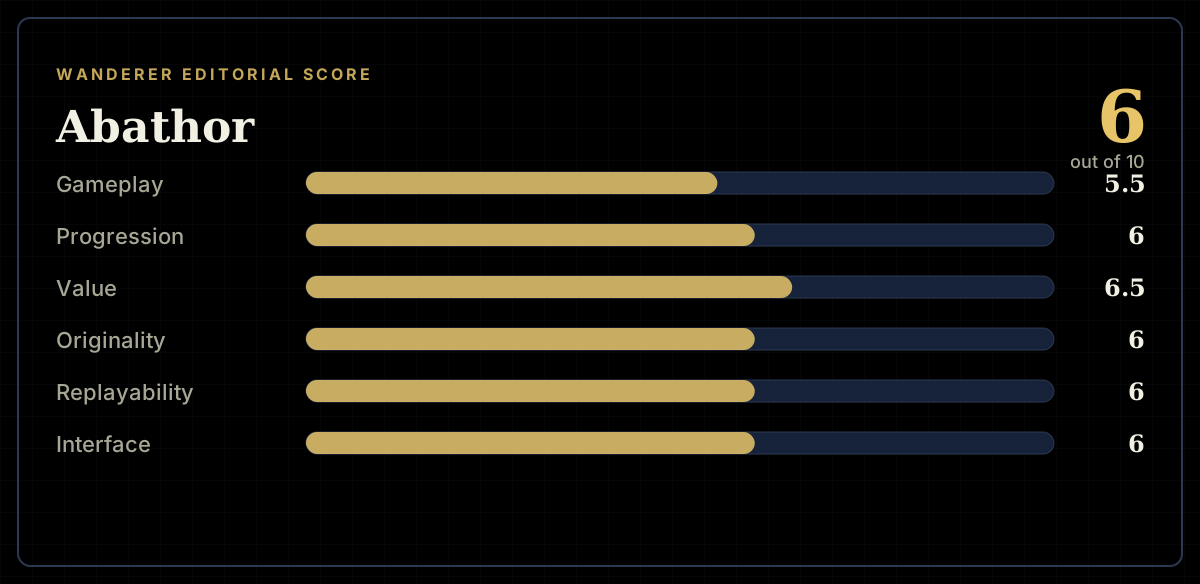
How the review scores each part of the gameWanderer Editorial -
The short versionWanderer Editorial