
Game review
Trover Saves the Universe
6.5 / 10
- Developer
- Squanch Games, Inc.
- Publisher
- Squanch Games, Inc.
- Released
- 4 June 2019
- Platforms
- Windows
- Genre
- Adventure
- Monetisation
- Paid, no in-app purchases found
- Players
- false
The short version
Trover Saves the Universe puts a wheelchair-bound alien named Chairorpian in remote control of Trover, a two-headed dog-monster, across a short comedic platforming adventure narrated almost entirely in Justin Roiland's improvised, rambling voice-acting style. Whether that's a selling point or a dealbreaker splits the review corpus cleanly in two: fans of Rick and Morty's specific chaotic energy find it consistently hilarious, while a detailed, sizeable minority calls the same writing an unedited, overlong bit that wears out its welcome well before the credits.
Biggest strengths
- A genuinely distinctive, improvised comedic voice throughout, written and performed by Justin Roiland in the same style that made Rick and Morty a hit
- Solid, smooth platforming and light puzzle mechanics that reviewers consistently describe as functional and enjoyable in their own right, separate from the comedy layer
- Playable fully without a VR headset on a standard monitor and controller, despite being designed with VR in mind — a point the corpus repeatedly clarifies for buyers who assume VR is mandatory
Biggest weaknesses
- A substantial, detailed critical minority argues the humour has no comedic timing or real jokes underneath the rambling, calling it "annoying after playing some hours" and needing "someone to edit" Roiland's writing down
- A specific, serious technical bug: multiple reviewers report the game fails to launch at all on 10th-generation-and-newer Intel CPUs, with no error message and no apparent fix
- The main story runs a short 4-6 hours, and multiple reviewers argue the asking price doesn't match that content volume even accounting for optional dialogue
Who it's for: Existing Rick and Morty and Justin Roiland fans specifically, more than general comedy-game or platformer audiences.
Our recommendation: Worth it on sale for Roiland fans; a real gamble at full price for anyone unsure whether his specific humour lands for them, and worth checking CPU compatibility first given a documented launch-failure bug.
6.5 / 10
What it is
Trover Saves the Universe puts the player in the role of a wheelchair-bound alien called a Chairorpian, who can't move under their own power but can remotely control Trover, a small, two-headed dog-like creature, to platform, fight and solve light puzzles across a chain of small, surreal worlds in pursuit of stolen dogs that power the universe. It's the first game from Squanch Games, the studio founded by Justin Roiland, co-creator of Rick and Morty, and the writing and voice performance throughout carry that show's specific, heavily improvised comedic style directly into a game for the first time. It released on 4 June 2019 at NZD 36.99, built with VR as its original design intent but fully playable on a flat monitor with a standard controller — a point the review corpus returns to constantly, correcting what several reviewers describe as a common misconception that a headset is required.
Its 2,349-review English corpus sits at a strong Very Positive (2,127 to 222), and reading through it in depth reveals a corpus split cleanly along one specific axis: how a given reviewer feels about Roiland's particular brand of rambling, adlib-heavy comedy, more than any disagreement about the game's mechanics themselves.
The comedy is the whole pitch, for better and worse
Positive reviews consistently frame the game as essentially interactive Rick and Morty, and mean that as the highest possible praise. "It's basically a couple channels from the inter-dimensional R&M episodes realized as small worlds," writes one reviewer, while another calls the voice acting and script "top notch entertaining" with "very chill vibes all the way through." Multiple reviewers specifically recommend genuinely stopping to listen to background conversations between NPCs rather than rushing past them, since that's reportedly where much of the game's best material lives — "if you don't hit them it's hilarious," one notes about enemies left to banter with each other rather than immediately attacked.
The detailed critical case makes the opposite argument about the exact same writing style. "This is not a game. It's an interactive joke that goes on too long," reads one blunt assessment, while a longer, heavily-upvoted review argues that Roiland "is funny in small and scripted bits but fails to be anything more than annoying after playing some hours of this content," concluding that "what he needs now is someone to edit him." A separate reviewer draws a sharper distinction for anyone expecting Rick and Morty's sharper edges: "if you enjoy Rick and Morty for the social commentary, you won't find much of that here... it's all just sort of adlib writing." That's a genuinely useful distinction for a prospective buyer — this isn't a comedy game trying to replicate the show's satirical bite, it's built entirely around Roiland's specific improvisational voice, unfiltered and extended across several hours.
A real, documented technical problem
Beyond taste in comedy, this review needs to flag a concrete, serious bug independently reported by multiple players: the game reportedly fails to launch at all on newer Intel CPUs (10th generation and beyond), with no error message displayed and no clear resolution offered. One affected reviewer specifically traces this back through their own troubleshooting, confirming it as a known CPU-generation compatibility issue rather than a one-off local problem. That's a meaningfully different kind of complaint from subjective dissatisfaction with the humour — a genuine purchase-blocking risk for anyone running current hardware, worth checking before buying regardless of how a prospective player feels about the comedy question above.
Value for a short experience
Length draws a consistent, specific complaint even from reviewers who otherwise enjoyed the game. The main story runs roughly 4-6 hours, and one detailed reviewer, after noting their tracked playtime was inflated by leaving the game idle on a menu screen for days, estimates their actual completion time at under 5 hours, arguing the price would feel fairer with a $10 reduction. That's a fair, specific value calculation rather than a vague "too short" complaint, and it's echoed by several other reviewers making the same rough math independently.
What the mechanics look like underneath the jokes
It's worth separating out what the game plays like from what it sounds like, since several reviewers make a point of praising the mechanics specifically as more solid than a comedy-first game might lead a skeptic to expect. One reviewer without VR hardware describes the platforming as "smooth" and the puzzles as well-paced, calling the whole package "solid" on pure gameplay terms alone. Another breaks the structure down plainly: players control two characters simultaneously — the stationary Chairorpian, who can teleport and manipulate the environment from fixed vantage points, and Trover, who does the actual platforming, fighting and puzzle-solving on the ground. That two-character control scheme is a genuinely distinctive structural choice for a platformer, forcing players to think about camera placement and teleport positioning as a real mechanical layer rather than a gimmick bolted onto conventional single-character platforming. Reviewers who focus on this side of the game consistently rate it well independent of how they feel about the jokes layered on top, which suggests Squanch Games built a functional game first and used the comedy as the delivery vehicle, rather than leaning on humour to paper over weak mechanics.
The VR question in practice
Given how much of the review corpus spends time correcting the assumption that VR is required, it's worth stating plainly for this review's own record: Trover Saves the Universe works as a complete, standalone experience on a flat monitor with a standard controller, and the large majority of reviewers quoted throughout this piece played it that way rather than in VR. For players who do own a headset, the game supports it as an alternative presentation layer rather than the only way to experience the content, though the one specific complaint about Xbox-controller-only VR play noted above suggests the VR implementation itself may not have been as fully realized as the flat-screen experience — a detail worth investigating directly against current hardware before assuming full VR motion-control support is guaranteed.
Verdict
Trover Saves the Universe is a well-built platformer wrapped entirely around a single creative voice's specific comedic style, and whether that voice lands is close to the entire question a prospective buyer needs to answer for themselves. Existing Rick and Morty fans are likely to find exactly what they're hoping for; anyone unconvinced by Roiland's improvisational, unfiltered rambling should expect the same jokes to wear thin well before the (admittedly short) story wraps up. Check CPU compatibility before buying regardless of which camp you're in.
Pros and cons
Pros
- A genuinely distinctive, improvised comedic voice throughout, written and performed by Justin Roiland in the same style that made Rick and Morty a hit
- Solid, smooth platforming and light puzzle mechanics that reviewers consistently describe as functional and enjoyable in their own right, separate from the comedy layer
- Playable fully without a VR headset on a standard monitor and controller, despite being designed with VR in mind — a point the corpus repeatedly clarifies for buyers who assume VR is mandatory
- A short but replayable structure that rewards players who stop to listen to optional background dialogue and NPC banter, adding real extra content for those willing to slow down
Cons
- A substantial, detailed critical minority argues the humour has no comedic timing or real jokes underneath the rambling, calling it "annoying after playing some hours" and needing "someone to edit" Roiland's writing down
- A specific, serious technical bug: multiple reviewers report the game fails to launch at all on 10th-generation-and-newer Intel CPUs, with no error message and no apparent fix
- The main story runs a short 4-6 hours, and multiple reviewers argue the asking price doesn't match that content volume even accounting for optional dialogue
- At least one reviewer reports the VR version requires a standard Xbox controller rather than tracked VR motion controllers, despite the game's VR-first design intent
- Achievement data shows a steep drop from 81.3% for an early milestone to just 2.9% for game completion, consistent with reviewer reports of the humour or pacing losing players well before the ending
Screenshots
-

Trover Saves the UniverseImage: Squanch Games, Inc. via Steam -

Trover Saves the UniverseImage: Squanch Games, Inc. via Steam -

Trover Saves the UniverseImage: Squanch Games, Inc. via Steam -
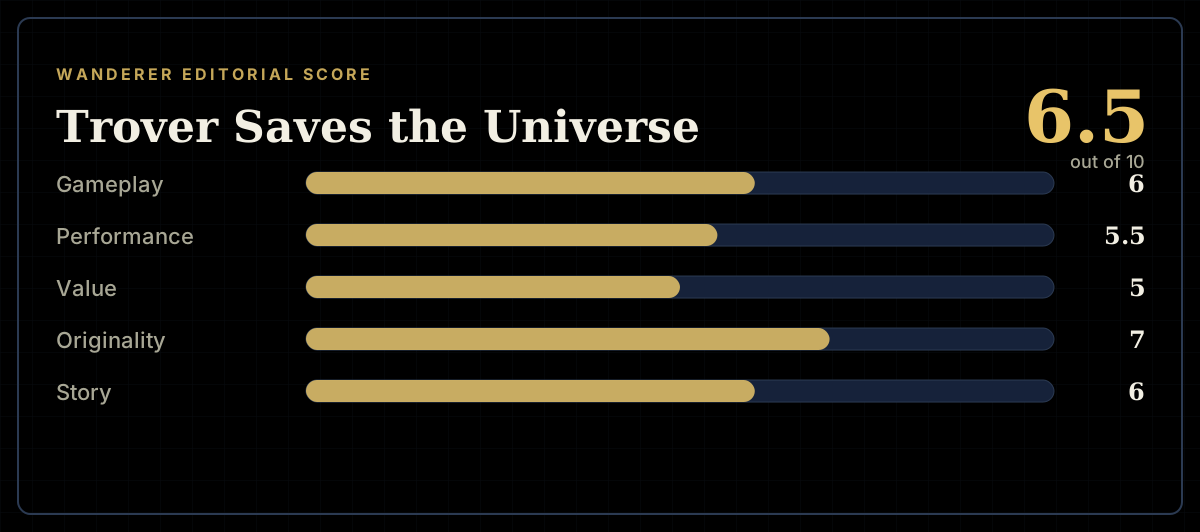
How the review scores each part of the gameWanderer Editorial -
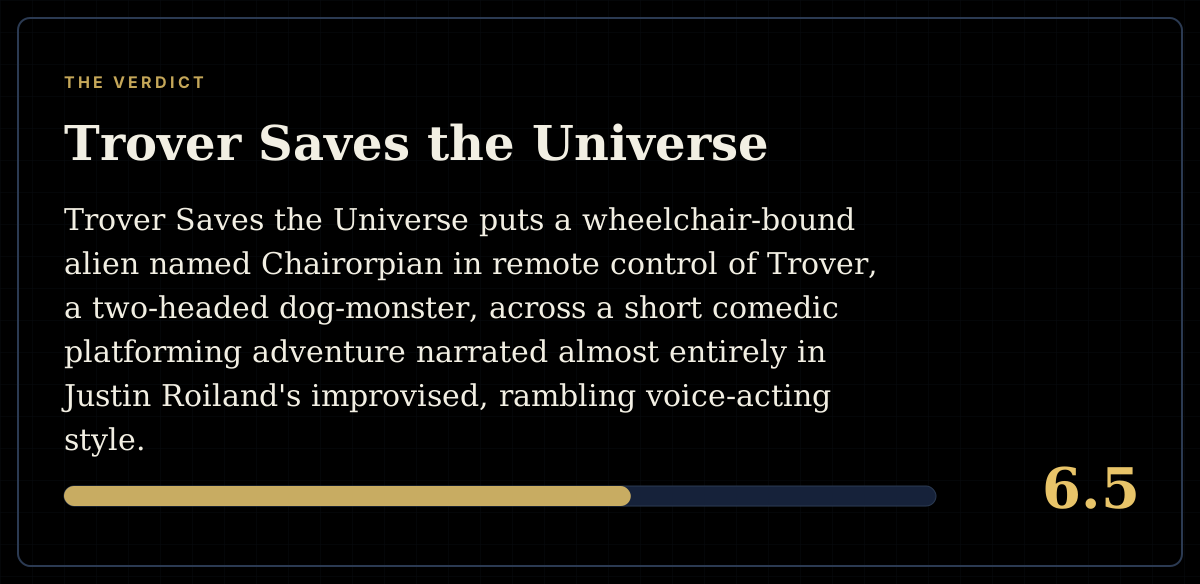
The short versionWanderer Editorial