
Game review
Ultros
7 / 10
- Developer
- Hadoque
- Publisher
- Kepler Interactive
- Released
- 13 February 2024
- Platforms
- Windows, macOS, PlayStation 4, PlayStation 5, Nintendo Switch
- Genre
- Metroidvania
- Monetisation
- One-time purchase, no in-game currency
- Players
- Single-player
The short version
Ultros strands the player aboard The Sarcophagus, a cosmic, living space station shaped like a monstrous womb, trapped in a time loop that resets each time a central boss is defeated. Critics landed it at a solid 81 on Metacritic and 79 "Strong" on OpenCritic, praising its environmental storytelling and psychedelic visual identity while flagging real reservations about long-term engagement — reservations Steam's own audience echoes closely, Very Positive at 80.1% across roughly 785 reviews. The art direction and score are close to undisputed highlights across every review this piece drew from. What divides opinion is the loop structure itself: progress through each cycle carries forward in the form of plants cultivated across resets, but much of the exploration, backtracking and combat sequences must be repeated each time regardless, and multiple detailed reviews — including one posted more than a year after launch — document a serious bug where a common metroidvania dash action can corrupt save data entirely, costing one player 16 hours of progress before they adopted manual backup saving as a workaround.
Biggest strengths
- Psychedelic art direction is close to universally praised, with vivid, hand-animated visuals critics single out as one of the year's most distinctive metroidvania aesthetics
- The soundtrack draws consistent, specific praise across nearly the entire review spectrum, including from reviewers otherwise critical of the gameplay
- Cultivating plants that persist and grow across time-loop resets, opening new paths in later cycles, is credited by multiple reviewers as a genuinely inventive core mechanic
Biggest weaknesses
- A detailed review documents a specific, serious bug where dashing back into a room just exited — an extremely common metroidvania action — can corrupt save data entirely, costing that player 16 hours of progress before adopting manual backup saves as a workaround
- A separate detailed review reports repeated crashes when expanding a specific late-game system, blocking access to the game's intended ending without starting an entirely new save
- The time-loop structure requires repeating substantial exploration, combat and even a combat-training sequence each new cycle, which multiple reviewers describe as tedious well before the story's later loops
Who it's for: Players drawn to distinctive, ambitious art direction and willing to embrace a genuinely unconventional take on metroidvania structure will find something no other game in the genre quite resembles. Players who need tight, responsive combat or dislike repeating content across resets should sample the demo first, and anyone concerned about save reliability should back up saves manually given the specific, documented bug reports below.
Our recommendation: Recommended for genre fans specifically curious about its take on time-loop structure and its genuinely singular visual identity, particularly at a discount. Back up your save data manually given the documented corruption reports, and go in aware that the loop's repeated content is a deliberate design choice some players love and others find genuinely tedious well before the story concludes.
7 / 10
A metroidvania that resets itself, on purpose
Ultros drops the player into The Sarcophagus, a station shaped like a cosmic womb hosting an ancient, imprisoned entity, trapped in a black-hole-adjacent time loop that resets whenever a central boss falls. That structural choice — a metroidvania built around repeated cycles rather than a single, linear unlock progression — is the single most divisive thing about the game, and it's worth understanding before anything else, since critics and Steam's own audience broadly agree on almost everything surrounding it. Critics rated the game 81 on Metacritic and 79 "Strong" on OpenCritic, specifically praising a level of environmental storytelling that goes beyond the genre's usual notes-and-lore-tablets approach. Steam's audience backs that up at Very Positive, 80.1% across roughly 785 reviews — solid numbers, but with enough specific, substantive dissent in the negative sample to be worth taking seriously rather than dismissing.
What nobody disputes
Art direction is where consensus is closest to total. Ultros's psychedelic, hand-animated visual style is repeatedly singled out by critics and players alike as one of the year's most distinctive takes on the genre, vivid enough that even reviewers who found the moment-to-moment gameplay frustrating still credit the presentation without reservation. The soundtrack earns the same consistent praise. And the core innovation of cultivating plants that persist and mature across the game's resets — opening new paths, providing new resources — is credited by multiple detailed reviews as a genuinely clever way to make a time-loop structure feel like it's building toward something rather than simply repeating itself pointlessly.
Where the loop wears thin
The trouble, according to a real and specific slice of both critics and players, is that plant cultivation alone doesn't carry the whole weight of justifying repeated cycles. Multiple detailed reviews describe having to re-traverse substantial exploration and combat content each new loop, including, in at least one case, a mandatory combat-training sequence repeated at the start of every cycle regardless of the player's actual skill level. One especially candid review captures the frustration bluntly: cultivating plants is "a brilliant concept," but the mechanic sits inside a structure that otherwise demands "repeat every single thing you've done from the start at least a few times," turning what should be a rewarding return trip into simple busywork. Combat draws its own specific criticism, with several reviewers citing inconsistent dodge-timing windows, and at least one detailed review points out a genuine design contradiction: the game teaches players to kill enemies for loot in its opening hours, then shifts to actively discouraging combat encounters in the mid-game, without clearly signalling that the intended strategy has changed.
A related, frequently repeated complaint concerns navigation. Several reviewers describe rooms that look similar enough to make orientation genuinely difficult, compounded by a lack of clear environmental or systemic clues about which specific plants should be cultivated in which specific locations — a real problem given how limited the game's cultivation resources are relative to the number of viable planting spots. For a genre that usually prides itself on rewarding a player's growing spatial memory of its map, several reviewers say Ultros's deliberately disorienting, psychedelic aesthetic works against that core genre pleasure rather than complementing it.
The bugs worth knowing about before you buy
Separate from design disagreements, at least two detailed reviews document specific, serious technical problems. One, posted in September 2025 — well over a year after launch — describes a save-corrupting bug triggered by dashing back into a room just exited, an extremely routine metroidvania action, costing that player 16 hours of progress before they began manually backing up their saves as a precaution; the review explicitly warns other players to do the same until a fix is confirmed. A second, separate review describes repeated crashes specifically when expanding a late-game system, blocking that player from reaching the game's intended good ending without starting an entirely new save file. Both are specific, dated, first-hand accounts rather than vague rumours, and they're worth treating as a real reason to maintain manual save backups regardless of how the loop-repetition design lands for you personally.
A deliberate design bet, not an accident
It's worth being fair to what Ultros is actually attempting, since several of the complaints above are the direct, foreseeable consequence of a genuine design risk rather than sloppy execution. Building a metroidvania around mandatory repetition is a real gamble — the genre's whole appeal usually rests on a map that opens up permanently as the player grows more capable, and asking players to retread ground they've already mastered cuts directly against that expectation. Hadoque clearly understood the risk and built the plant-cultivation system specifically to offset it, giving each cycle at least some forward motion even when the exploration itself repeats. Whether that offset is enough is exactly where critics and players diverge, and it's a fair, substantive disagreement about a genuinely ambitious structural choice rather than a case of a developer failing to notice an obvious problem.
Verdict
Ultros earns its solid critical reception honestly on the strength of a genuinely distinctive visual identity and a clever, if imperfectly executed, core idea about cultivation persisting across resets. Where it loses a real and specific share of its audience is in how much of the actual playing experience that cultivation mechanic is asked to redeem — repeated exploration, inconsistent combat, and, for at least a documented few, save-corrupting bugs serious enough to cost dozens of hours of progress. For players drawn specifically to ambitious art direction and willing to meet an unconventional structure on its own terms, there's real substance here. For players who need their metroidvania's combat and navigation to feel tight and reliable above all else, the specific complaints above are worth reading in full before committing, and backing up your save regularly is cheap insurance either way.
Pros and cons
Pros
- Psychedelic art direction is close to universally praised, with vivid, hand-animated visuals critics single out as one of the year's most distinctive metroidvania aesthetics
- The soundtrack draws consistent, specific praise across nearly the entire review spectrum, including from reviewers otherwise critical of the gameplay
- Cultivating plants that persist and grow across time-loop resets, opening new paths in later cycles, is credited by multiple reviewers as a genuinely inventive core mechanic
- Critics rated the game solidly, 81 on Metacritic and 79 on OpenCritic's "Strong" tier, crediting deep environmental storytelling layered into an otherwise familiar genre structure
- Runs well on modest hardware, with at least one reviewer specifically praising strong Steam Deck performance and battery efficiency at reduced power draw
Cons
- A detailed review documents a specific, serious bug where dashing back into a room just exited — an extremely common metroidvania action — can corrupt save data entirely, costing that player 16 hours of progress before adopting manual backup saves as a workaround
- A separate detailed review reports repeated crashes when expanding a specific late-game system, blocking access to the game's intended ending without starting an entirely new save
- The time-loop structure requires repeating substantial exploration, combat and even a combat-training sequence each new cycle, which multiple reviewers describe as tedious well before the story's later loops
- Combat is criticised by several reviewers as inconsistent, with unreliable dodge timing windows, and the game's own design sends mixed signals — early cycles reward killing enemies for loot, while later cycles discourage it, a contradiction at least one detailed review calls out directly
- Exploration guidance is a specific, repeated complaint: several reviewers describe rooms that look too similar to navigate confidently and limited environmental or in-game clues about which plants to cultivate where, given the game's genuinely limited resources
Screenshots
-

UltrosImage: Kepler Interactive via Steam -

UltrosImage: Kepler Interactive via Steam -

UltrosImage: Kepler Interactive via Steam -
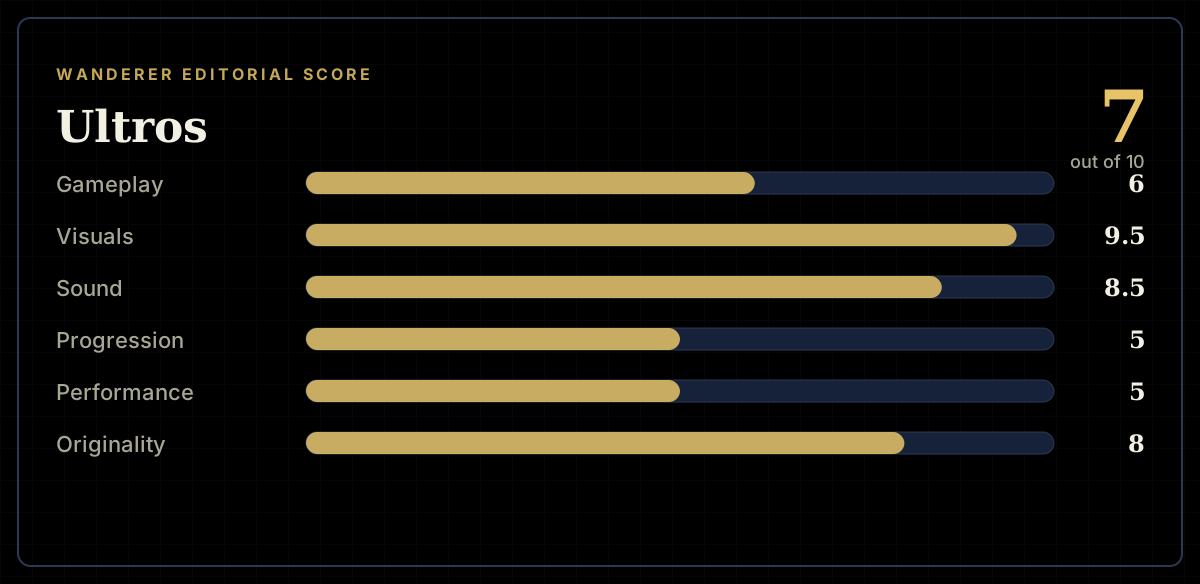
How the review scores each part of the gameWanderer Editorial -
The short versionWanderer Editorial