
Game review
WitchHand
5.5 / 10
- Developer
- Jon Nielsen
- Publisher
- HopFrog
- Released
- 7 February 2024
- Platforms
- Windows
- Genre
- Card-based automation and 4X strategy
- Monetisation
- One-time purchase, no in-game store or additional currency purchases
- Players
- Single-player only
The short version
WitchHand folds Stacklands' card-based crafting-and-automation formula into a witch-themed 4X strategy layer, letting players choose from several distinct witches, each with unique spells and playstyles, while building an ever-expanding board of resource cards and production chains. Reviewers are unusually candid and consistent about exactly where this game sits: a cute, competent, clearly-labelled variation on an established formula rather than a meaningful evolution of it, drawing constant, direct comparisons to both Stacklands and Cultist Simulator. The charming presentation and genuinely different witch playstyles earn real early-game enthusiasm, but a large and specific share of the same reviewers describe the mid-to-late game turning into repetitive busywork, performance degrading as the board fills with cards, and an ending several call underwhelming and inconclusive relative to the build-up. This is a competent, likeable game operating squarely within its genre's established ceiling rather than pushing past it.
Biggest strengths
- The witch theme and presentation draw consistent, genuine praise, with reviewers describing the art, music, and overall atmosphere as charming and a meaningful improvement over the genre's more plain-looking predecessors
- Multiple distinct playable witches, each with unique spells, buildings, and playstyles, give real variety to how a given playthrough can unfold, with reviewers specifically praising the different strategic approaches each enables
- The ability to pause the game at any time draws specific praise as a welcome quality-of-life feature relative to genre peers that don't offer it
Biggest weaknesses
- The single most repeated observation across the review sample is a direct, largely unfavourable comparison to Stacklands and Cultist Simulator, with reviewers consistently describing WitchHand as a solid variation on those games' established formula rather than an improvement on it
- A large share of reviewers describe the mid-to-late game as devolving into repetitive busywork, with the core loop of acquiring cards and expanding the play area failing to introduce meaningfully new decisions as it scales
- Performance is a specific, repeated complaint once the board fills with hundreds or thousands of cards, with multiple reviewers reporting frame rates dropping significantly in the late game on systems that ran the early game smoothly
Who it's for: Fans of Stacklands, Cultist Simulator, and similar card-based crafting-automation games who want a cute witch-themed variation on that specific formula, and who don't need a second playthrough to get their money's worth. Less suited to players hoping for a meaningfully deeper or more narratively satisfying take on the genre.
Our recommendation: Worth it at a discount for fans of the card-factory genre specifically, especially if the witch theme and multiple playable characters appeal to you. Go in expecting a solid single playthrough rather than lasting replay value, and be ready for the mid-game pace to slow down.
5.5 / 10
WitchHand's pitch layers a witch-themed civilization-building fantasy on top of a mechanical foundation this review's sample recognises immediately and names constantly: the card-based crafting-and-automation loop popularised by Stacklands, with a dash of the exploratory strangeness Cultist Simulator built its reputation on. That's not a criticism reviewers are shy about stating directly — it's close to the default framing for how this game gets discussed, and the review sample is unusually consistent and self-aware about exactly where WitchHand lands relative to both of those touchstones.
A charming variation, honestly labelled as one
Reviewers who enjoy the genre tend to recommend WitchHand in almost the same breath as naming its inspirations. "If you enjoyed Stacklands, this is that with a different theme (and you know, other new stuff) - but really that's it - it's Stacklands," one reviewer writes, framing the recommendation as conditional on already liking the format rather than as a standalone pitch. Another calls it "Magical Stacklands. Or, what if Cultist Simulator was far more casual and understandable," praising the ability to pause at any time as a genuine improvement. That's a real strength worth crediting on its own terms — several distinct playable witches, each with meaningfully different spells and strategic approaches, give the game more built-in variety than a straightforward reskin would offer.
The mid-game wall reviewers keep describing
Set against that early enthusiasm, an unusually consistent complaint describes a specific turning point partway through a typical playthrough. "I was super into it for the first 4-ish hours and then things just kind of hit a wall of tedium," one reviewer writes, and the pattern recurs with striking regularity across otherwise very different reviews: genuine early enjoyment giving way to repetitive card-stacking with diminishing strategic novelty. "Trying to be efficient at doing so was fun for the first 10 hours or so, but all that's waiting for you at the corner is more of the same, so don't expect a lot of depth," another writes. This isn't a complaint about difficulty — it's a complaint about the game's core loop failing to introduce meaningfully new decisions as it scales, which is a more structural problem for a genre built entirely around that scaling.
Performance that degrades exactly when the game gets busiest
A specific, repeated technical complaint compounds the pacing issue: as the board fills with hundreds or even over a thousand cards in the late game, frame rate is widely reported to drop significantly. "Runs badly once there are a lot of cards moving around. Starts locked at 60 fps, gets worse as you progress and got to around 40 fps in the end game," one reviewer writes, noting the drop coincides directly with the moments the game spawns the most cards at once. That's an unfortunate overlap — the exact stretch of the game already drawing complaints for feeling repetitive is also the stretch where performance most noticeably suffers.
A thin mystery, and an ending that doesn't quite land
Several reviewers specifically compare WitchHand's exploration and narrative content unfavourably to Cultist Simulator's sense of mystery. "What Cultist simulator had and this one misses is wonder... The exploration here leads to very basic stuff," one reviewer writes. That thinness extends to the ending itself, which multiple reviewers describe as inconclusive: "the ending felt very underwhelming and inconclusive, felt all my playthrough went to just beat the bad thing and nothing happens," one writes — a real letdown for players who invested many hours building toward a climactic final confrontation.
A developer who supported the game, then moved on cleanly
To its credit, this review can confirm the developer followed through with real post-launch investment: two distinct content updates, "Fated Future" and "Phoenix Fire," arrived within five months of the February 2024 launch, and patches continued through November 2025. By February 2026, the developer had announced a new, unrelated project — a clean, reasonable trajectory for a small studio that shipped a complete game and supported it for close to two years, rather than one abandoning promised content mid-stream.
What the achievement data says about how the drop-off actually happens
Steam's own completion figures line up closely with the review sample's account of the game front-loading its appeal. Early spell-casting and quest achievements sit comfortably above 90%, confirming most buyers get well into the opening hours successfully, but completion falls steadily rather than cliff-like toward the harder content, with achievements tied to the "Phoenix Fire" and "Advanced Settings" additions settling around 20-22%. That's a real but moderate drop-off — not evidence of a game abandoned en masse, but consistent with reviewers' accounts of enthusiasm cooling gradually as the mid-game tedium sets in, rather than players bouncing off immediately or pushing all the way through regardless.
A theme that earns credit even where the mechanics don't fully evolve
It's worth being fair to the specific thing WitchHand does add on top of its inspirations: the witch theme isn't purely cosmetic. Multiple reviewers specifically credit the different witches' unique spell sets and thematic quirks — from a Chef Witch cooking stat-boosting meals to a Chaos Witch overpowering enemies directly — with giving the familiar card-crafting loop a genuine reason to try a second character even if a full second playthrough doesn't ultimately hold everyone's interest. That's a real design contribution, even if it doesn't fully offset the structural pacing and ending complaints raised throughout this review.
Final verdict
WitchHand is a competent, genuinely charming entry in the card-factory genre that mostly succeeds at what it explicitly sets out to be: Stacklands with witches, cute presentation, and a bit more mechanical variety through its multiple playable characters. Its own reviewers are refreshingly honest that it doesn't meaningfully push past its genre's established ceiling, and a real, consistent mid-game tedium wall, late-game performance issues, and an underwhelming ending keep it from standing entirely on its own merits. Worth a look at a discount for fans of the specific genre it's operating in; temper expectations if you're hoping for something that surpasses Stacklands or Cultist Simulator rather than sitting comfortably alongside them.
Pros and cons
Pros
- The witch theme and presentation draw consistent, genuine praise, with reviewers describing the art, music, and overall atmosphere as charming and a meaningful improvement over the genre's more plain-looking predecessors
- Multiple distinct playable witches, each with unique spells, buildings, and playstyles, give real variety to how a given playthrough can unfold, with reviewers specifically praising the different strategic approaches each enables
- The ability to pause the game at any time draws specific praise as a welcome quality-of-life feature relative to genre peers that don't offer it
- The developer shipped two distinct post-launch content additions, "Fated Future" and "Phoenix Fire," within five months of launch, followed by continued patches through late 2025, reflecting real ongoing investment in the project
- At least one reviewer with over 100 hours logged confirms the game held their attention for a very long time even while being candid that meaningful replayability effectively ends after the first main boss
Cons
- The single most repeated observation across the review sample is a direct, largely unfavourable comparison to Stacklands and Cultist Simulator, with reviewers consistently describing WitchHand as a solid variation on those games' established formula rather than an improvement on it
- A large share of reviewers describe the mid-to-late game as devolving into repetitive busywork, with the core loop of acquiring cards and expanding the play area failing to introduce meaningfully new decisions as it scales
- Performance is a specific, repeated complaint once the board fills with hundreds or thousands of cards, with multiple reviewers reporting frame rates dropping significantly in the late game on systems that ran the early game smoothly
- The narrative and exploration elements are described by several reviewers as thin, with one directly contrasting it against Cultist Simulator's sense of mystery and finding WitchHand's equivalent content comparatively unremarkable
- Multiple reviewers describe the ending as underwhelming and inconclusive relative to the build-up, with at least one stating the entire playthrough builds toward defeating a final threat with little further payoff afterward
Screenshots
-

WitchHandImage: HopFrog via Steam -

WitchHandImage: HopFrog via Steam -

WitchHandImage: HopFrog via Steam -
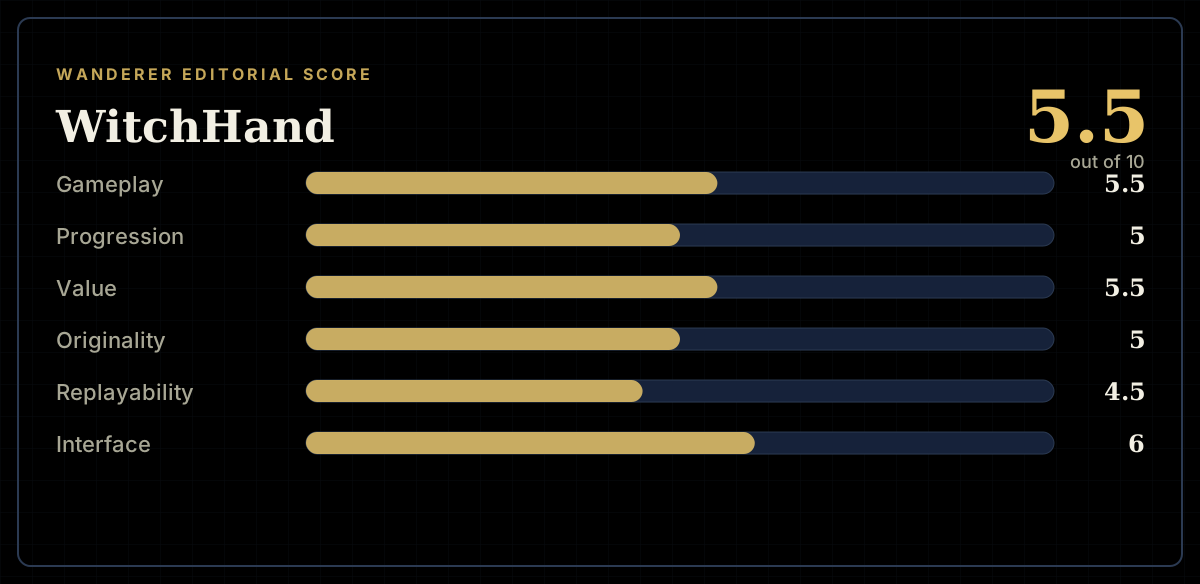
How the review scores each part of the gameWanderer Editorial -
The short versionWanderer Editorial