
Game review
Windward Isles
7 / 10
- Developer
- Meridian Studios
- Publisher
- Meridian Studios
- Released
- 3 September 2026
- Platforms
- Windows, Linux
- Genre
- RPG
A Fifty-First Consecutive Launch Without a Single Review
Windward Isles launched on Steam on 3 September 2026 as a full release for Windows and Linux, and at the time of writing has zero user reviews. That's a meaningful silence for a sandbox trading game specifically, since the entire appeal of "buy low, sell high, chart your own course" rests on whether the simulated economy actually feels alive over a dozen-plus-hour career, and that's exactly the kind of long-haul judgment that normally needs a fleet of players comparing routes and prices to settle.
A Career From Deckhand to Windward Sovereign
The pitch casts the player as a rising sailor working their way from a lowly deckhand up to the "Windward Sovereign," the sea's highest honour, across a stated full career of a dozen hours or more. That framing puts Windward Isles closer to a career-RPG structure than a pure trading sim — rank and reputation, rather than raw net worth alone, are presented as the actual endpoint, with new harbours charting themselves as the days pass rather than the whole map being available from the outset. Two factions, the Royal Navy and the Brotherhood, are each stated to keep score of the player's deeds, with smuggling contraband pleasing one and angering the other — a reputation system that ties the moment-to-moment trading decisions directly back into the career-long rank progression, rather than treating faction standing as flavour text layered on top of an otherwise faction-blind economy. Screenshots confirm the rank ladder is a real, tracked value rather than a narrative conceit: one HUD reads "Deckhand • Day 1," while another, later in a run, reads "Fleet Broker • Day 1" with 80,000 gold banked, showing the title in the corner of the screen actually changes as the career progresses.
Eighteen Goods, Ten Harbours, and a Market That Actually Moves
The trading loop is described with a specific claim worth testing: prices drift day to day, shortages spike, and festivals lift an entire port's demand, with no single harbour dealing in everything and rarer luxuries like amber, ivory, and ambergris only appearing as the player's voyage matures. A "trade card" system that surfaces where a given good sells highest and what a run is actually worth removes some of the tedium of manually comparing eighteen goods across ten harbours by hand, while still leaving the actual routing decision to the player. A screenshot showing an on-screen sell prompt for "12 Gems to the merchant (173 g each)" gives a concrete, specific number to that pitch, rather than leaving "prices drift day to day" as an unverifiable marketing line — a per-unit price tied directly to a single sell action is exactly the kind of granular pricing a living market needs to actually feel alive rather than abstracted into a single lump-sum transaction. Warehouses, harbour investments, moneylenders, and insurance are all listed as additional systems layered on top of the base buy-low-sell-high loop, which is a reasonable amount of economic depth for a sandbox that's explicitly selling "no timers, no fail states" as a core design pillar rather than a race against a countdown clock.
Eight Ships and Broadside Combat With Real Stakes
Combat is built around broadside naval fighting rather than the arcade-style ramming common to smaller sailing games: firing port and starboard, cycling around for a fresh volley, switching between chain and grape shot, and combat skills like a bursting mortar, a double broadside, a rigging-shredding chain volley, or a defensive brace-and-mend option. Boarding a raider once its hull drops below a third gives the player a choice between plundering its cargo and gold directly or sending the captured ship off to sail in a personal prize fleet for daily dividends — a meaningful decision between an immediate payout and a slower, compounding one, which gives naval combat a genuine economic dimension rather than existing purely to clear a threat. The fleet itself is stated to run eight distinct ship classes from a nimble Cutter up to a mighty Man-o'-War, with the grandest ships-of-the-line only available at the great fortress capitals, tying the top of the ship-upgrade ladder to specific, presumably harder-to-reach locations rather than a flat currency purchase anywhere on the map. Three difficulty modes — Relaxed, Standard, and Cutthroat — plus a dedicated Peaceful mode with no enemies at all, is an unusually wide accessibility spread for a game built around naval combat, explicitly accommodating players who want the trading and exploration loop without any combat risk whatsoever. The store page's promise of "named corsair captains who come hunting as your fortune grows" checks out directly in a screenshot showing a pirate ship near Isla Perdida flagged onscreen as "Salt-Scar Bruno" rather than a generic "Pirate Vessel" label, which suggests these named-threat encounters are individually scripted rather than a randomly generated title slapped on a stock enemy type.
A Premium Price for a Career-Length Sandbox
At NZ$21.99 with no discount, Windward Isles sits well above the budget-indie price point common to most of this run of unreviewed launches, positioning itself instead against mid-tier trading and naval-combat sims rather than a quick, disposable playthrough. There's no mention of any additional monetisation, DLC, or in-app purchases on the store page, which is a straightforward one-time-purchase pitch for a game whose stated dozen-hour-plus career length would make any bolted-on live-service layer feel especially at odds with the "no timers, no fail states" philosophy it's selling. Fifteen listed Steam Achievements — including named milestones like "Open for Business," "The Silk Road," and "Windward Sovereign" — map fairly directly onto the trading and rank-progression systems described, suggesting the achievement list was built to track the same career arc the store page promises rather than being a generic completionist checklist bolted on afterward. Broad language support across fourteen languages, alongside Windows and Linux platform coverage, suggests a wider simultaneous international launch than most titles in this segment attempt.
Verdict
Windward Isles pitches a career-length age-of-sail sandbox built around a living, day-to-day-shifting economy across ten harbours, a faction-reputation system tying trade decisions to a Royal Navy versus Brotherhood standing, and broadside naval combat with a genuine plunder-or-invest choice once a raider is beaten. Screenshots back several of those specific claims with hard numbers rather than leaving them as store-page language: a rank readout that actually changes from "Deckhand" to "Fleet Broker" across a career, a per-unit gem price tied to a direct sell prompt, and a named pirate captain, Salt-Scar Bruno, flagged individually rather than generically. The eight-ship fleet, three difficulty modes plus a combat-free Peaceful option, and an achievement list that maps directly onto the promised deckhand-to-Sovereign career arc all suggest a reasonably complete systems set for a full release rather than an early, thin build. It launched on 3 September 2026 with zero user reviews so far, so whether the market genuinely feels alive across a full dozen-hour career, and whether the higher NZ$21.99 price is justified by that promised depth, remain unverified by anyone outside the studio.
Screenshots
-
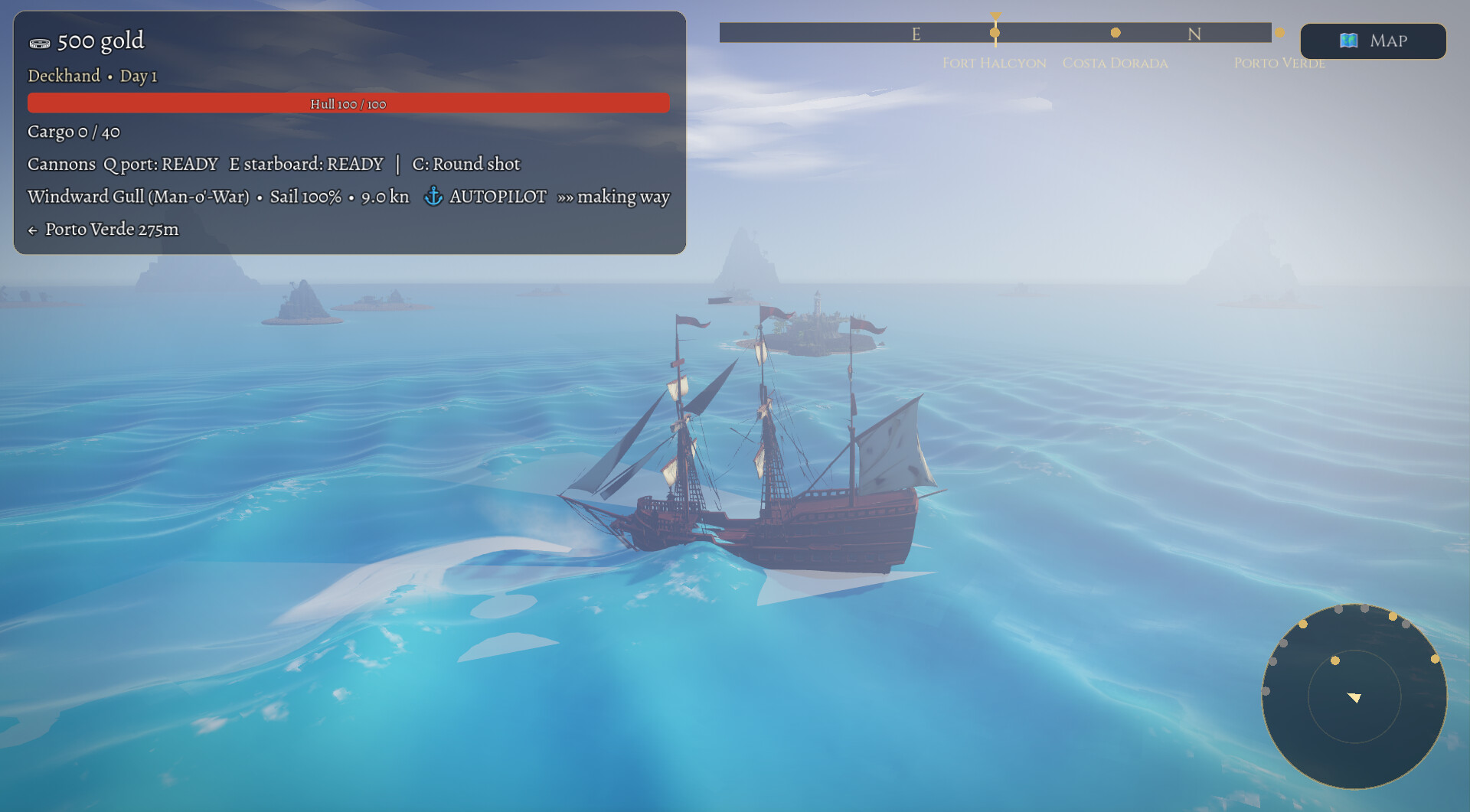
The heading strip naming three specific harbours by name, and the always-visible hull, cargo, and cannon-readiness readout, confirm the day-to-day navigation and combat HUD is built around exactly the systems the store page describes.Steam store page -
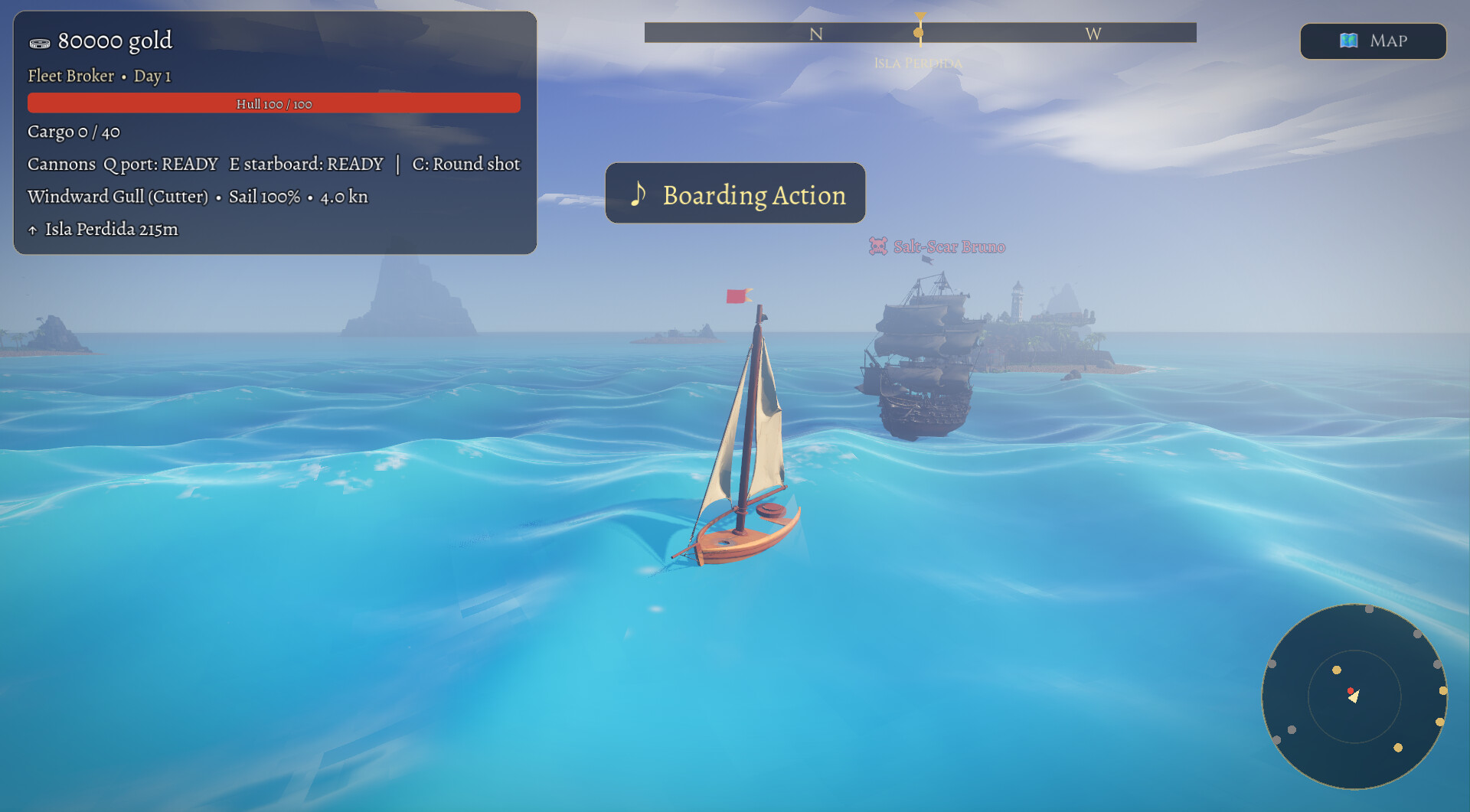
A named pirate captain, Salt-Scar Bruno, flagged onscreen exactly as the store page promises for its \"named corsair captains who come hunting\" system, confirms that feature is a real, individually identified threat rather than a generic enemy label.Steam store page -
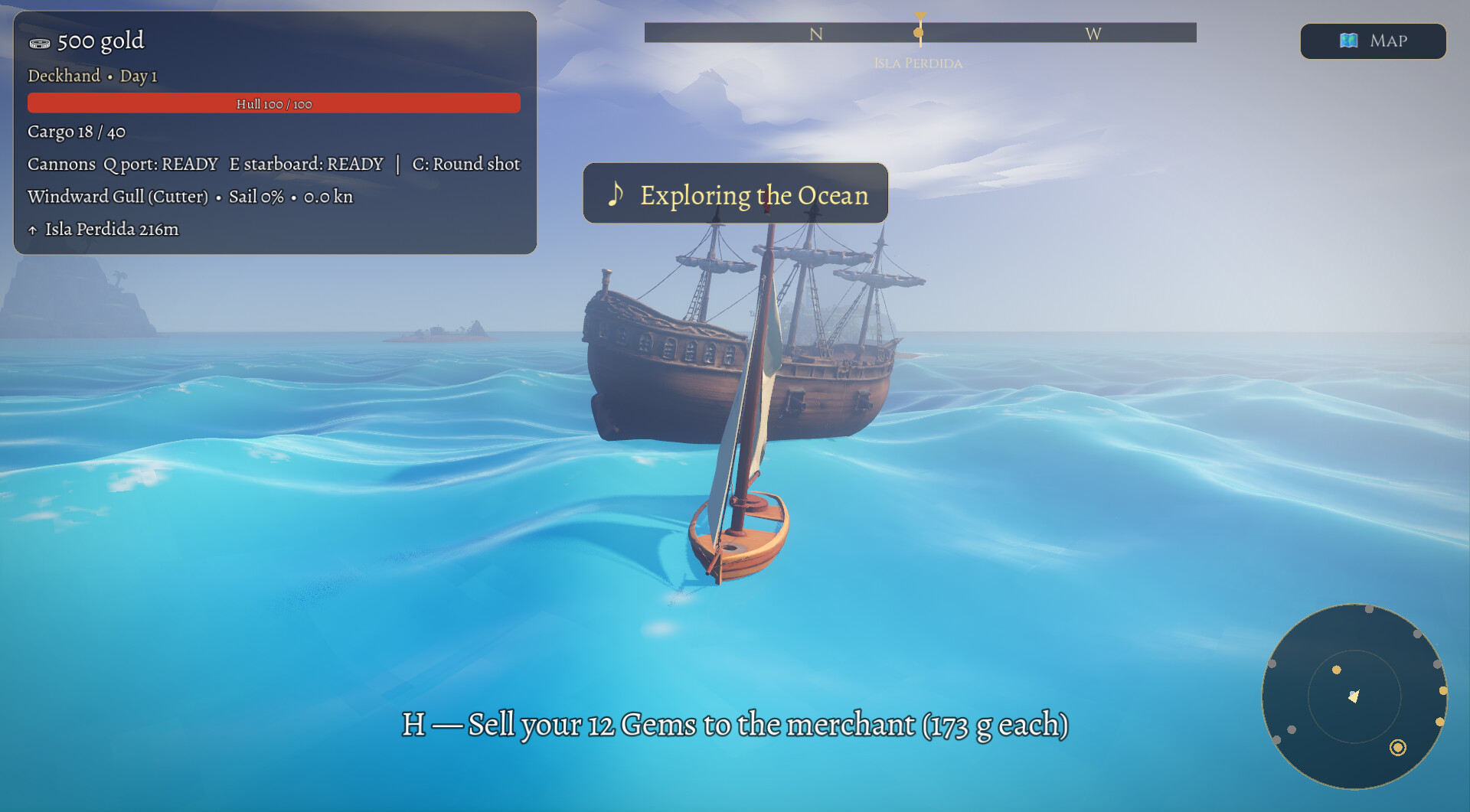
A specific per-unit gem price of 173 gold each, tied to a direct sell prompt, backs up the store page's claim of a market with real, moving prices rather than a flat universal sell rate.Steam store page