Game review
Wildfrost
7.5 / 10
- Developer
- Deadpan Games, Gaziter
- Publisher
- Chucklefish
- Released
- 12 April 2023
- Platforms
- Windows, macOS, Linux
- Genre
- Roguelike Deckbuilder
- Monetisation
- Premium, one-off purchase — no in-game purchases
- Players
- Single-player
The short version
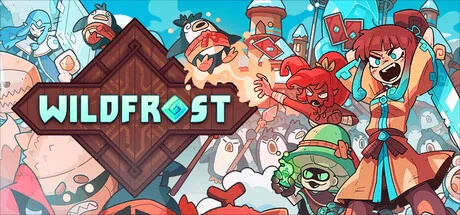
Wildfrost is a card-battler roguelike built around a limited-unit-slot system distinct from Slay the Spire's single-hero structure, wrapped in genuinely beautiful hand-drawn art. Its reception was sharply split at launch, and the divide is worth understanding rather than flattening into one side being simply wrong: veteran roguelike-deckbuilder players largely defend the difficulty as fair once understood, while others describe runs so polarized by early item luck that skill can feel almost beside the point.
Reception has genuinely improved since launch through patches, and reviewers on both sides agree the presentation and core concept are strong — the disagreement is specifically about balance and how much of the difficulty is deliberate design versus rough edges still being sanded down.
Biggest strengths
- A distinctive limited-unit-slot structure that meaningfully differs from Slay the Spire's single-hero deckbuilding format
- Genuinely beautiful, charming hand-drawn art and presentation, praised even by the game's harshest critics
- Real depth for players willing to learn its systems, with veteran roguelike-deckbuilder fans defending its difficulty as fair rather than broken
Biggest weaknesses
- A significant share of reviewers describe runs as heavily polarized by early item luck, with skill mattering less than the genre's best entries in unfavourable starts
- Difficulty is steep even by roguelike-deckbuilder standards, and several reviewers who tried to engage fairly still found it more frustrating than rewarding
- Some players describe the game as feeling like a proof of concept even after updates, rather than a fully realised final product
Who it's for: Roguelike deckbuilder fans comfortable with steep, Slay the Spire-or-harder difficulty curves, and who want a genuinely distinct unit-based structure rather than a single-hero variant.
Our recommendation: A strong buy for genre veterans specifically; more caution warranted for players newer to roguelike deckbuilders, given how consistently the difficulty and run-to-run polarization come up as the central point of disagreement.
7.5 / 10
Wildfrost enters a genre Slay the Spire more or less defined, and it makes its case for distinctiveness immediately: rather than building a single hero's deck, you field a limited number of unit cards at once, each occupying a slot that can be knocked out, swapped, or sacrificed — a structurally different puzzle from the genre's usual format, wrapped in some of the most charming hand-drawn art in the space. What followed at launch was one of the more genuinely interesting reception splits this session has covered, and it's worth understanding both sides rather than picking one to represent the whole picture.
A genuinely distinct card-battler structure
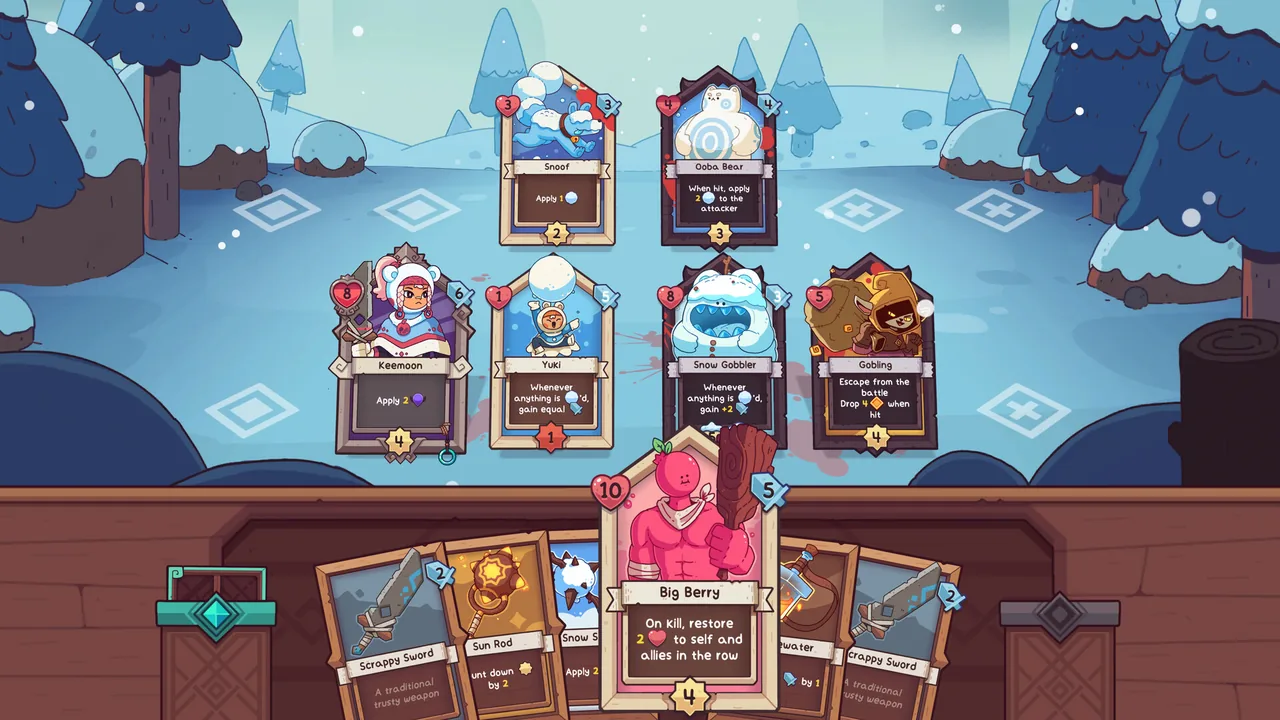
The limited-unit-slot system is Wildfrost's clearest point of difference from its most obvious comparison points. Managing which units occupy your limited board space, when to sacrifice one for a stronger effect, and how positioning interacts with enemy patterns gives the genre's familiar deckbuilding loop a real structural twist. Paired with genuinely beautiful presentation that even the game's harshest critics single out for praise, it's a game built on real, distinctive ideas rather than a reskin of an established formula.
A difficulty divide worth taking seriously on both sides
Where opinion splits sharply is difficulty and balance. A significant number of reviewers describe runs as heavily polarized by early item luck — get a strong opening and the run snowballs, get a weak one and skill can feel almost irrelevant to the outcome, a complaint several frame as the worst possible failure mode for a game in this genre. Set against that, genre veterans push back just as directly, arguing that Slay the Spire and Monster Train asked exactly the same kind of patience when players first encountered their toughest bosses, and that Wildfrost's difficulty is fair once its specific systems are actually understood rather than approached with expectations carried over from other deckbuilders. Both camps are engaging with the same game honestly; they simply disagree about where "hard but fair" ends and "unbalanced" begins.
Reception that's measurably improved
What's worth noting plainly is that this divide has narrowed since launch. Reviewers reference an early period where the game's score dipped meaningfully lower than it sits at today, and ongoing balance patches are credited by several with improving the experience directly, even by players who remain more critical than not. The current, more solidly Very Positive standing reflects real post-launch work rather than a static launch-day snapshot.
A separate note on the publisher
A smaller number of reviewers raise a dated but real concern unrelated to Wildfrost's own quality: publisher Chucklefish faced a documented 2019 controversy over unpaid labour on an earlier project, Starbound, where several contributors reported working extensively without the pay they'd been promised. That's a legitimate historical fact about the publisher worth knowing if it factors into your purchasing decisions, though it says nothing about this specific game's design or the team that built it.
Final verdict
Wildfrost brings genuine structural originality and gorgeous presentation to a genre that can otherwise feel crowded with similar takes, and its difficulty — whether you land on the "fair" or "polarized" side of that debate — is at least a real, considered design choice rather than carelessness. It settles at 7.5, reflecting a game that's earned its recovery from a rockier launch reception through real post-launch work, while acknowledging the balance complaints are specific and reasonable enough that this isn't a universal recommendation for every roguelike deckbuilder fan.
Price and review data checked 5 August 2026.
If you'd rather your strategic progression persisted without the risk of a run-ending early-game snowball, Wanderer keeps its own systems more forgiving throughout.
Pros and cons
Pros
- A distinctive limited-unit-slot structure that meaningfully differs from Slay the Spire's single-hero deckbuilding format
- Genuinely beautiful, charming hand-drawn art and presentation, praised even by the game's harshest critics
- Real depth for players willing to learn its systems, with veteran roguelike-deckbuilder fans defending its difficulty as fair rather than broken
- Reception has measurably improved since launch through ongoing balance patches
Cons
- A significant share of reviewers describe runs as heavily polarized by early item luck, with skill mattering less than the genre's best entries in unfavourable starts
- Difficulty is steep even by roguelike-deckbuilder standards, and several reviewers who tried to engage fairly still found it more frustrating than rewarding
- Some players describe the game as feeling like a proof of concept even after updates, rather than a fully realised final product
- Publisher Chucklefish carries a dated but real 2019 controversy over unpaid labour on an earlier project, which some reviewers raise as a separate ethical consideration unrelated to this game's own quality
Screenshots
-
WildfrostImage: Chucklefish via Steam -
WildfrostImage: Chucklefish via Steam -
WildfrostImage: Chucklefish via Steam -
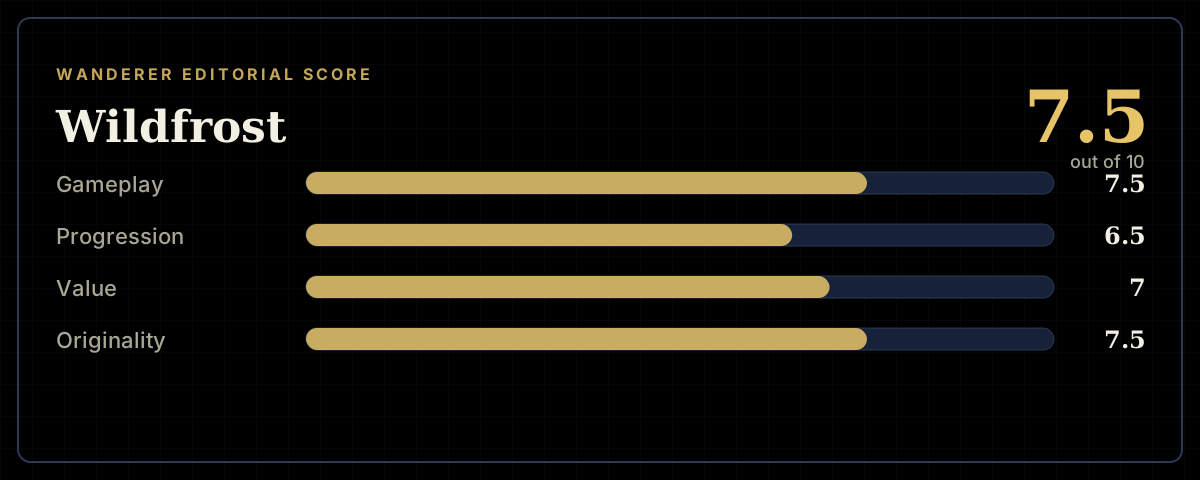
How the review scores each part of the gameWanderer Editorial -
The short versionWanderer Editorial