
Game review
Whiteout Survival
6.5 / 10
- Developer
- Century Games Pte. Ltd.
- Publisher
- Century Games Pte. Ltd.
- Released
- 12 February 2023
- Platforms
- iOS, Android
- Genre
- 4X Strategy City-Builder
- Monetisation
- Free to play with hero and skin gacha, chief/troop gear upgrades, a 12-tier VIP subscription-style ladder, building and research speed-up timers, multiple concurrent event packs, and direct IAP up to $99.99 per item. No in-app advertising of any kind
- Players
- Server-based alliances fighting shared Bear Hunt and Frost Dragon events, contesting Sunfire Castle territory, and competing in the seasonal State vs State (SVS) war cycle. No direct 1v1 PvP outside alliance and server conflict
The short version
Whiteout Survival earns its place as one of the biggest mobile games on Earth honestly for about a month. The furnace-and-frost survival hook is well art-directed, the opening progression drip is genuinely generous, and the alliance layer gives a usually-solitary genre real social stakes. Then State vs State season one arrives, gear refinement demands materials that only exist behind a paywall, and the game quietly reclassifies you as either a payer or scenery for someone else's war effort.
Biggest strengths
- The first two to three weeks front-load new systems, heroes and building tiers fast enough that there is rarely a session with nothing meaningful to do
- Frostpunk-adjacent art direction gives the freezing city and its furnace glow a genuine sense of place that most furnace-and-troops clones don't bother with
- Alliance-based Bear Hunts and Frost Dragon events make cooperative play feel load-bearing rather than decorative, unlike guilds that amount to a shared chat window
Biggest weaknesses
- Widgets, the material needed to enhance Exclusive Gear, are obtainable only through paid packs or the rotating Mystery Shop, with no free-to-play route to them at all
- State vs State's Furnace-weighted scoring means a server's outcome is decided largely by which alliance's whales showed up, not by the median player's effort
- Chief Gear's Legendary tier depends on Lunar Amber, the rarest upgrade material, which is overwhelmingly sourced from special packs rather than earned drops
Who it's for: Players who enjoy slow-building city management with a real social layer, and who can treat the endgame as spectator sport once their own alliance's spenders take over the leaderboard. A poor fit for anyone who wants competitive standing without opening their wallet.
Our recommendation: Worth playing free through the first Furnace tiers and your alliance's first Bear Hunt events, where the game is close to its best self. Stop and reassess once State vs State starts asking for gear materials the shop sells and nothing else does.
6.5 / 10
Introduction
Whiteout Survival opens with a blizzard, a dying fire and a chief who has to choose between warming the shelter or feeding the crew. It's a strong hook, and Century Games knows it — the game has spent three straight years as one of the two or three highest-grossing mobile titles on the planet, pulling in something on the order of $3 billion in lifetime player spending by the middle of 2025 and continuing to clear roughly $100 million a month into 2026. Numbers like that don't happen through bad design. They mean a huge number of people found something worth returning to every day for years. The interesting question isn't whether Whiteout Survival is well made — it clearly is. It's where the good version of the game stops and the spending starts, because those two things are not the same moment, and the gap between them is where most of the internet's frustration with this game actually lives.
The furnace loop
Strip away the ice and the survivors and Whiteout Survival is a familiar shape: build queues, research trees, troop training, and a hero-led combat layer bolted on top. What holds it together is the Furnace, the building that gates every other structure's maximum level — you can't push the Sawmill, the Infirmary or Hero Hall past your current Furnace tier. It's a smart piece of systems design: new players are never lost hunting for what to upgrade next, because the Furnace tells them.
Combat runs through a roster of collectible heroes (Molly, Jeronimo, Natalia and dozens more), each contributing troop bonuses and active skills to squads that fight largely on their own. Hero shards drop from events, the shop and the seasonal State vs State reward track, and rank-up requires stacking enough of one specific hero rather than any hero of matching rarity — stingier than rivals where a hero you don't want can still feed into one you do.
Where the wall actually is
The first two to three weeks are close to the best version of this genre gets on mobile. New buildings, new heroes and new event chains land often enough that a free player never runs dry, and the early Furnace tiers ask for patience rather than payment. This part of the game deserves the credit it rarely gets in the discourse around it — it isn't a bait-and-switch from minute one.
The wall shows up once alliance-level competition starts mattering, and it shows up in specific, nameable places rather than as a vague vibe. Chief Gear upgrades past the early tiers need Design Plans and, at the top, Lunar Amber — a material overwhelmingly sourced from special packs rather than farmed drops. Exclusive Gear, a separate late-game gear track, needs Widgets to enhance, and Widgets have no free-to-play source at all: pack or Mystery Shop, full stop. That's not a generalised "everything is a bit harder now" complaint, it's one specific item that is sold and nothing else. The VIP ladder compounds it: VIP 6 grants a second permanent march queue, letting a spender run two simultaneous gathering or attack actions where a non-spender runs one, which is a direct capacity advantage rather than a cosmetic flex.
None of this is subtle in practice. A server's State vs State outcome is scored by combined combat points weighted by Furnace level, so a handful of maxed, well-geared accounts can move the needle further than a hundred casual ones — community discussion of the game is blunt that a single large spender can outweigh an entire free-to-play alliance outright. Whether that ruins the game depends on what you actually want from it. Running a comfortable, self-contained city and hitting your own SVS reward tiers is entirely realistic free — the strategy guides circulating for this game are specific and workable, mostly boiling down to maxing your existing heroes rather than chasing new ones. Mattering in the top bracket of your server's ranking means competing against people who have spent, by community cost-tracking, into five figures to get there.
The advertising doesn't look like the game
Worth being precise here rather than repeating the internet's usual shorthand. Whiteout Survival itself runs no in-app advertising whatsoever — no banners, no rewarded video, no interstitials between sessions, a genuinely rare choice at this revenue tier. The controversy attached to its name is a different thing: Century Games is one of mobile gaming's heaviest buyers of user-acquisition advertising, running something in the region of two thousand active ad creatives at any given time, and a large share of them show gameplay that doesn't exist in the actual product — squads picking the correct door in a snowstorm, or other puzzle-style hooks with no equivalent system anywhere in the real game. Independent trackers of this pattern have logged Whiteout Survival specifically as one of the starker examples of it, and Century Games' own public response has been candid rather than defensive: the creatives are deliberately built to pull in players outside the usual strategy audience, they show only a sliver of the real game, and the studio also runs gameplay-accurate ads alongside them. Both things are true at once — the ads misrepresent the product, and the product itself doesn't push ads at you once you're inside.
Presentation and the social layer
Visually this is one of the better-dressed games in its category. The frozen city has real atmosphere, and small touches — the furnace's glow dimming as fuel runs low, survivors visibly huddling in bad weather — do more work than the genre's usual flat isometric sprite stack. It also goes further than most competitors on the social layer: Bear Hunts and Frost Dragon events need actual coordination, and Sunfire Castle territory fights give alliances a reason to talk to each other beyond a shared chat window. That's a genuine strength, and it's also exactly what makes the whale-versus-server-population dynamic visible and painful rather than abstract.
Final verdict
Whiteout Survival is not a bad game hiding behind a spending wall — it's a genuinely well-built city-builder with a real social hook, undercut by a small number of specific, identifiable systems (Widgets, Lunar Amber, the VIP march-queue tier) that convert alliance-level competitive standing into a direct function of spend. Free-to-play players can enjoy this for a long time on their own terms, and the opening month is close to the genre's best. What they can't do is treat the top of a server's leaderboard as an achievable goal without paying, and the game never really pretends otherwise once the tutorial ends. Six and a half feels right for a title this well made and this openly built around separating whales from everyone else: strong execution, honest design in the small print, and a monetisation ceiling that will decide for most players exactly how far they're willing to go.
Readers who've spent time with mobile hero-collectors chasing a similar formula might recognise the shape from Raid: Shadow Legends, whose real depth gets buried under its own economy, or Legend of Mushroom, which front-loads generosity the same way before the battle passes stack up. Anyone who wants long-term progression without splitting the playerbase by wallet size might also look at Wanderer, which keeps its offline progress free of that particular trade-off.
Pros and cons
Pros
- The first two to three weeks front-load new systems, heroes and building tiers fast enough that there is rarely a session with nothing meaningful to do
- Frostpunk-adjacent art direction gives the freezing city and its furnace glow a genuine sense of place that most furnace-and-troops clones don't bother with
- Alliance-based Bear Hunts and Frost Dragon events make cooperative play feel load-bearing rather than decorative, unlike guilds that amount to a shared chat window
- Offline progress on building queues, research and troop training means nothing meaningful is lost between sessions
- No banner or interstitial ads of any kind interrupt play, a genuine rarity at this budget tier
Cons
- Widgets, the material needed to enhance Exclusive Gear, are obtainable only through paid packs or the rotating Mystery Shop, with no free-to-play route to them at all
- State vs State's Furnace-weighted scoring means a server's outcome is decided largely by which alliance's whales showed up, not by the median player's effort
- Chief Gear's Legendary tier depends on Lunar Amber, the rarest upgrade material, which is overwhelmingly sourced from special packs rather than earned drops
- The VIP ladder ties a real gameplay advantage, a second permanent march queue, to VIP 6, a level reachable at pace only through spending
- Reaching the top VIP tier through purchases alone runs into five figures once every pack tier is accounted for, according to community cost-tracking guides
Screenshots
-
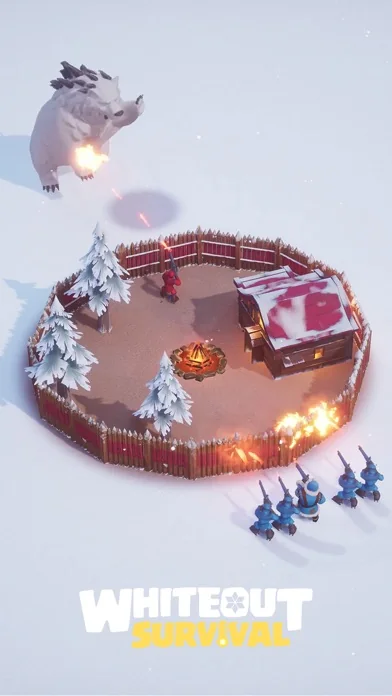
Early combat pits a small squad against wildlife bosses just outside the camp wallsImage: Century Games Pte. Ltd. via the App Store -
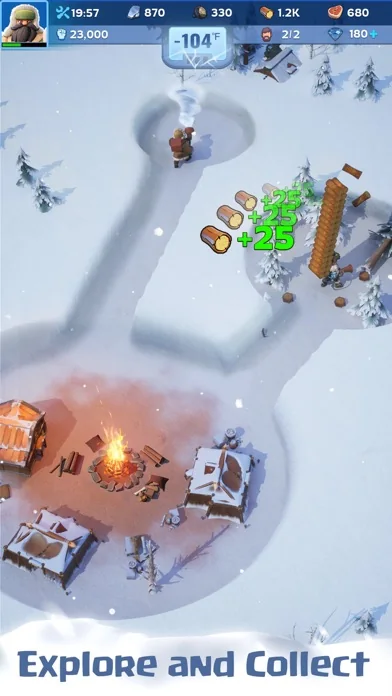
Gathering wood and other resources around the thawed camp, with the sub-zero temperature tracked at the top of the screenImage: Century Games Pte. Ltd. via the App Store -
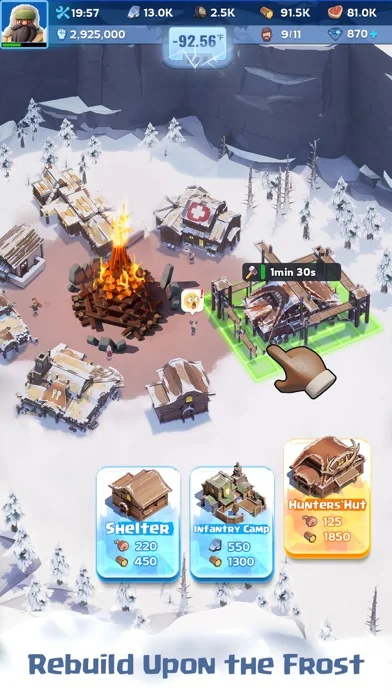
The Furnace sits at the centre of camp and gates how far every other building can goImage: Century Games Pte. Ltd. via the App Store