
Game review
WheelMates Review
6 / 10
- Developer
- Firevolt
- Publisher
- Firevolt
- Released
- 1 September 2026
- Platforms
- ["Windows"]
- Genre
- Adventure
Two Tiny RC Cars, One Missing Professor, and a House-Sized Maze to Explore
WheelMates casts you and a co-op partner as a pair of remote-control cars answering a call for help from a professor who has mysteriously vanished from his cluttered home laboratory. The premise is a shrunken-world riff in the vein of "Honey, I Shrunk the Kids," turning ordinary rooms — a garage, a kitchen, a backyard workshop — into sprawling levels full of oversized furniture, precarious shelves, and hidden shortcuts. Developer Firevolt, a small indie studio, built the game explicitly as a two-player experience with no single-player mode: every level assumes a second driver on the other end, and a Friend's Pass lets that second player join for free off a single $19.99 copy.
Reviewers overwhelmingly frame the game against It Takes Two and Split Fiction, and the comparison is clearly intentional — driving, puzzle-solving, and light platforming are built around constant coordination between two players rather than parallel solo progress. Where WheelMates diverges from its obvious influences is scale: rather than a linear, curated sequence of set pieces, the professor's house is a semi-open, interconnected map that players gradually unlock with new car attachments — a grapple hook, a magnet, a paintball launcher among them — Metroidvania-style, with areas you can see long before you have the tool needed to reach them.
Driving, Grappling, and Solving Puzzles Together — When the Controls Cooperate
The core loop of exploring as a literal toy car gets consistent praise for its novelty and physical comedy. Reviewers describe genuine laugh-out-loud moments from watching a partner fly off a shelf mid-jump, get flung backward by an overtuned grapple, or simply misjudge a gap and go tumbling — and several specifically credit the deliberately janky RC-car handling with contributing to that charm rather than undercutting it. The puzzle structure asks both players to be doing something at once, whether that's one person driving while the other holds a lever, or splitting up to hit two switches simultaneously, and reviewers who found a rhythm with a regular co-op partner describe five-to-eight-hour sessions that flew by on teamwork and constant chatter.
That said, the car handling is the single most contested part of the experience. A meaningful share of reviewers describe the driving as loose, twitchy, and difficult to control with precision — a car that whips around unexpectedly in reverse, jump inputs that produce inconsistent flips or spins, and analog trigger inputs on controller that reviewers say still behave like a binary on/off button rather than true analog throttle. Several reviewers also flag the two-slot ability limit as needlessly restrictive once you've unlocked three or four attachments, forcing frequent menu cycling that interrupts the flow of exploration. Keyboard-and-mouse players in particular report a rougher time than controller users, since ability selection and throttle control both seem tuned primarily around a gamepad.
A Short, Collectible-Heavy Adventure That Ends Abruptly for Some Players
Most reviewers finish WheelMates's main story in five to eight hours, with completionist runs chasing its large pool of collectibles running longer still. Opinions split sharply on whether that's enough game for the price. Plenty of reviewers call the length appropriate for a cozy weekend co-op session and note that the Friend's Pass effectively halves the real cost per player; others feel the $19.99 asking price is steep for a story that several describe as thin or secondary to the mechanics, and a number of critical reviews specifically call out an ending that arrives with little warning or resolution — one reviewer describes finishing what felt like a mid-game puzzle sequence only to cut straight to credits, despite the game teasing a sequel on the way out.
Bugs are the other recurring theme in critical reviews. Multiple reviewers report a fully progression-blocking issue where a required object — a cart, a switch, a puzzle trigger — becomes stuck and unresponsive, forcing a restart or a long wait for a patch; Firevolt appears to have been actively patching post-launch, with reviewers noting fixes arriving within days of a bug being reported, and at least one reviewer confirmed a previously game-breaking issue was resolved in an update. Others mention a display scaling bug that limits some players to windowed mode, a launch crash tied to Intel's NPU driver that required a manual workaround before Firevolt shipped a fix, and cosmetic collectibles that occasionally reset when moving between areas. None of these appear universal, but the volume of independently reported softlocks across the review base is a real risk for anyone chasing full completion at launch.
Genuine Teamwork or Padded Fetch Quests, Depending on Who You Ask
The most divisive question among reviewers is how much of WheelMates actually requires two players rather than merely gesturing at cooperation. Fans describe puzzles that demand real communication and timing — one player driving while relaying directions, both hitting switches within a tight window, working out a shared plan before attempting a tricky jump sequence together. Critics counter that a large share of the puzzle content amounts to "two people press a button at the same time" scenarios that could just as easily be solved solo with a second input device, and that the handful of dedicated minigames — a tag mode and a coin-collecting mode are the only two on offer — don't do much to break up that pattern. Several critical reviewers who came in expecting racing, a battle mode, or more direct use of the RC-car premise say the game undersells its own concept by sticking mostly to fetch-and-place objectives dressed up in shrunken-world scenery.
Firevolt has been visibly responsive during the post-launch window, which a number of reviewers credit even while marking the game down, and multiple positive reviews explicitly say they'd back a sequel or DLC if the studio addresses the handling and pacing complaints. For a first co-op release from a small team, the goodwill on display in the review base is notable even alongside the frustration.
Verdict
WheelMates has a genuinely charming hook — driving toy RC cars through a giant, shrunken-world house with a partner — and when its puzzles click and its physical comedy lands, reviewers describe some of the best co-op sessions they've had in a while. It's held back by handling that a large minority find genuinely frustrating, an ability-switching system that adds friction rather than depth, a story and ending that several reviewers feel arrives too abruptly, and a spread of progression-blocking bugs that Firevolt has been patching steadily but hasn't fully stamped out. Co-op fans hungry for something in the It Takes Two mold and willing to overlook some jank will likely get a fun, laughter-filled few hours out of it, especially split via the Friend's Pass; anyone expecting tight controls or a fully realized RC-racing fantasy should temper expectations.
Pros:
- Genuinely funny, teamwork-driven co-op puzzles that reward real communication
- Shrunken-world house setting is charming and well-realized visually
- Friend's Pass lets a second player join for free off one copy
- Firevolt has patched reported bugs quickly and repeatedly since launch
- Metroidvania-style attachment unlocks give exploration a real sense of progress
Cons:
- Car handling is loose and imprecise for a meaningful share of players
- Two-slot ability limit creates frequent, tedious menu-cycling
- Story and ending feel abrupt and underdeveloped to many reviewers
- Multiple reports of progression-blocking bugs, including stuck puzzle objects
- Many puzzles amount to simultaneous button presses rather than deeper cooperation
Screenshots
-
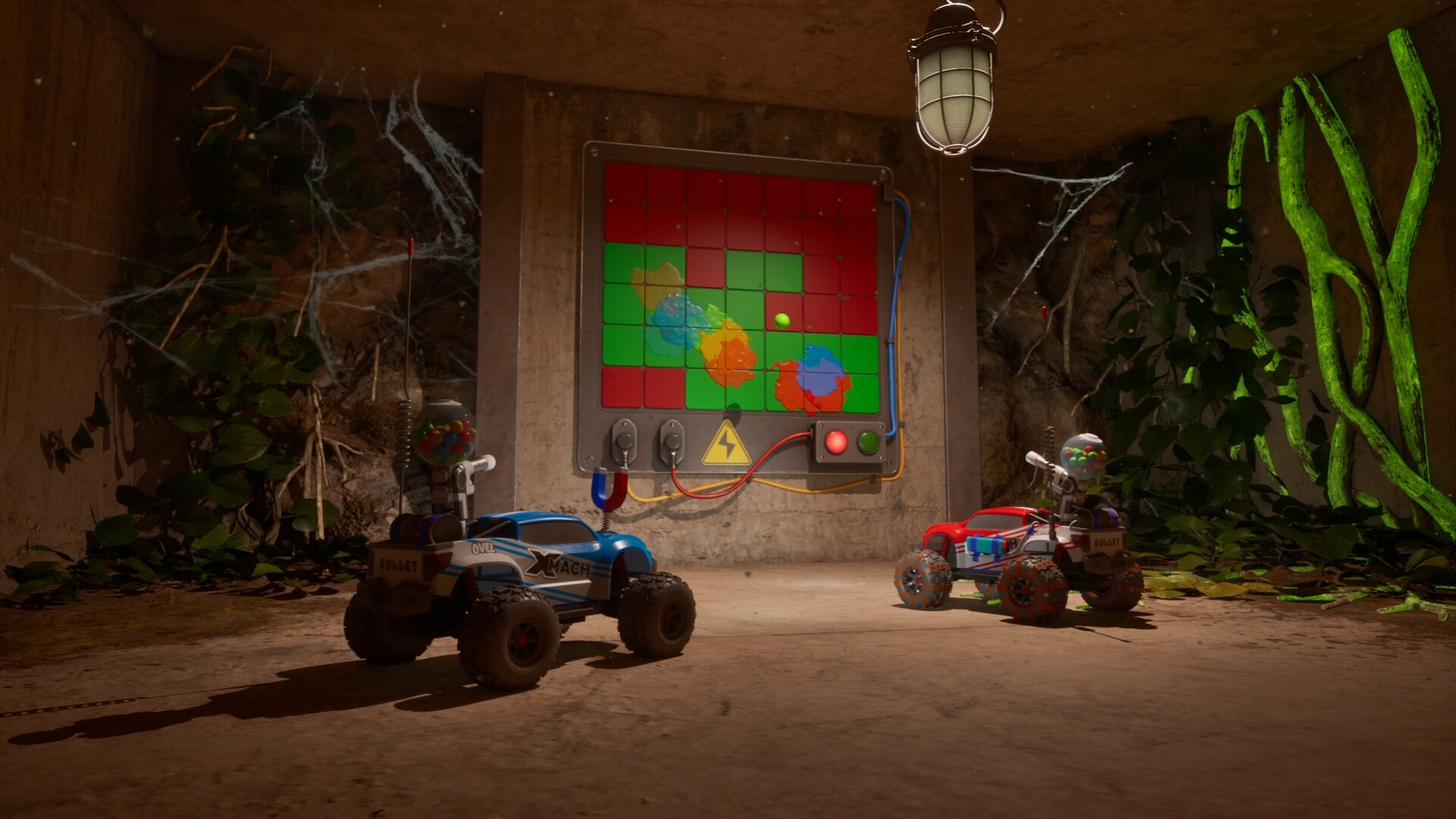
A cooperative puzzle panel deep in the professor's basementImage: Firevolt -
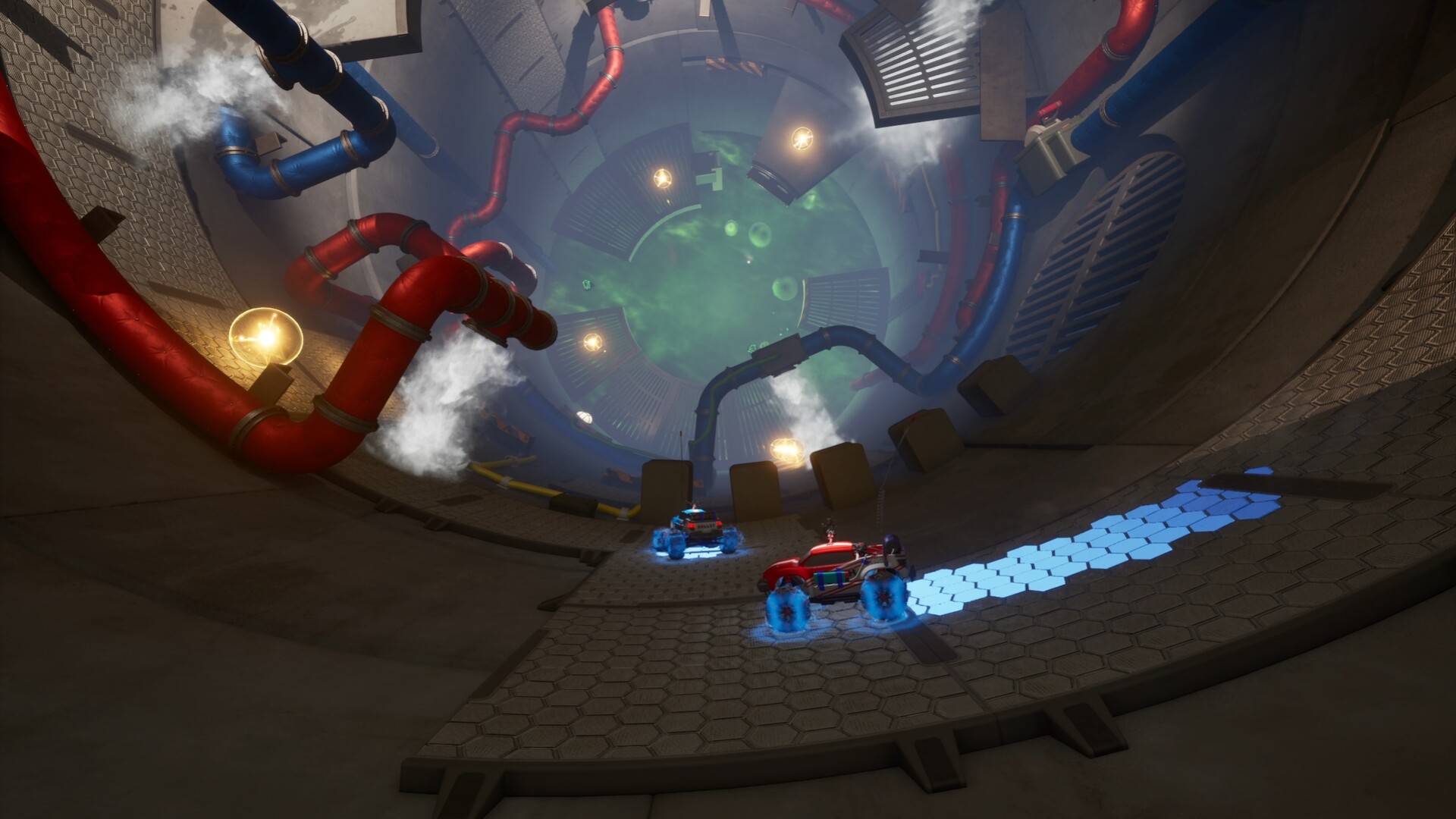
Exploring a pipe-filled tunnel area beneath the houseImage: Firevolt -
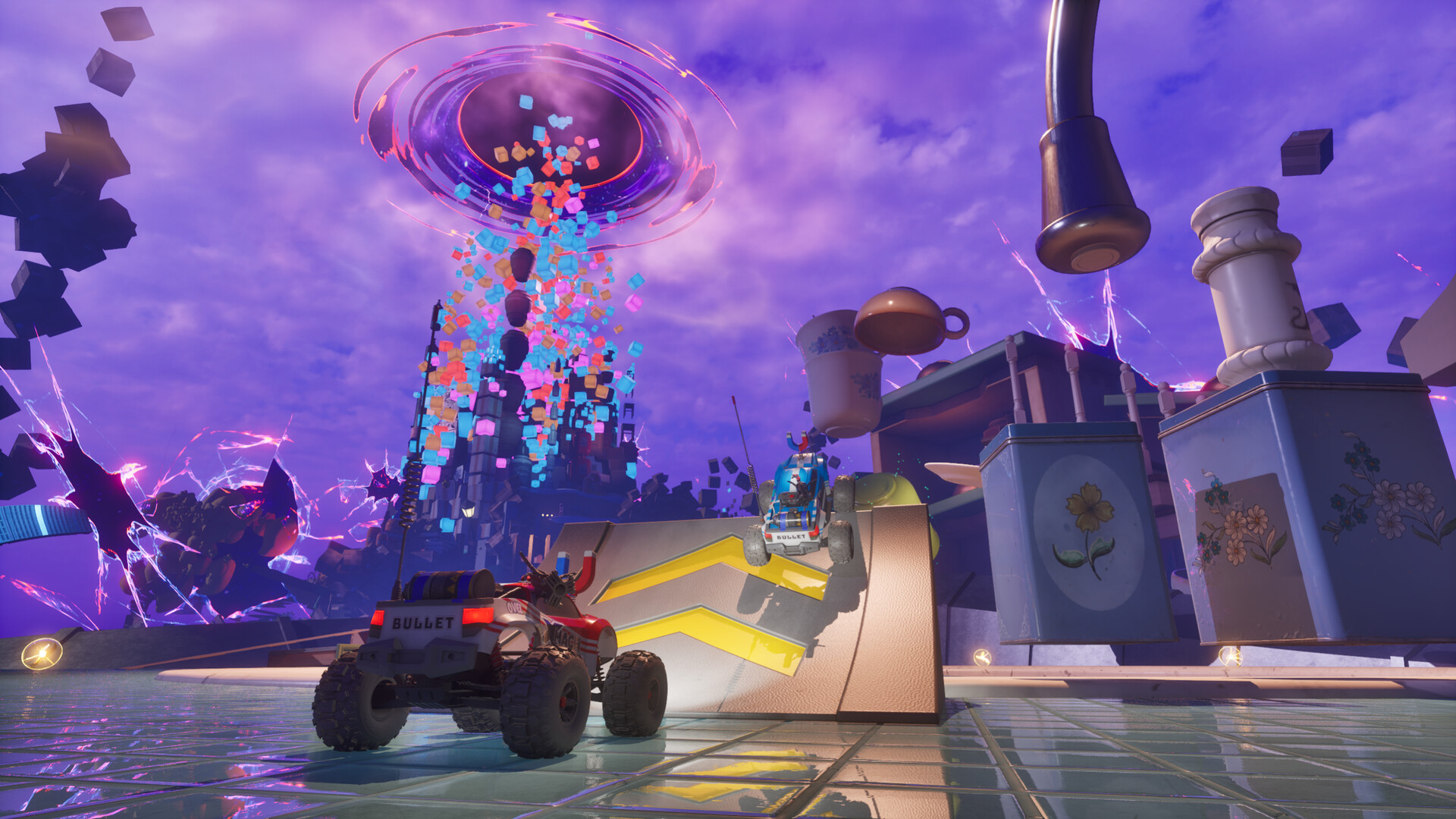
One of the game's more surreal, dreamlike areasImage: Firevolt -
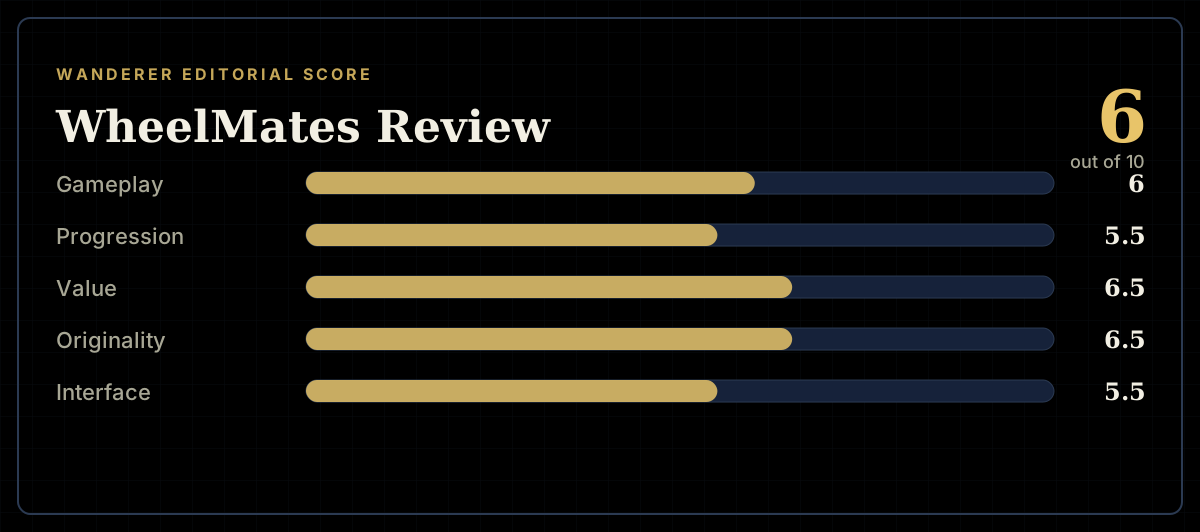
How the review scores each part of the gameWanderer Editorial -
The short versionWanderer Editorial