
Game review
Mad Experiments: Escape Room - Sanctuary Review: A Great Puzzle Box With No Save Button
5.9 / 10
- Developer
- PlayTogether Studio
- Publisher
- PlayTogether Studio, Nejcraft
- Released
- 26 May 2025
- Platforms
- ["PC", "Mac", "Linux"]
- Genre
- Adventure
- Monetisation
- Paid
- Players
- true
The short version
Mad Experiments: Escape Room - Sanctuary drops one to four players into a deserted, cursed convent where they must recover three sacred relics by solving environmental puzzles under a ticking clock, the third entry in developer PlayTogether Studio's escape-room series. Reviewers are consistently won over by the atmosphere, hand-crafted puzzle logic and genuine sense of discovery, several calling it among the better entries in the series and a convincing substitute for a real-world escape room. Set against that praise is a specific, structural complaint raised independently across the sample: unlike a multi-room trilogy, Sanctuary is one dense, sprawling environment with no mid-session save, so a two-to-three-hour full playthrough has to be completed in one sitting or restarted from scratch, a decision several reviewers find genuinely difficult to forgive even when they otherwise enjoyed the puzzles.
Biggest strengths
- Reviewers repeatedly single out the convent's atmosphere, detailed environmental art and evocative music as genuinely immersive and a convincing stand-in for a physical escape room
- The puzzle design is described as fair and rewarding, respecting the player's intelligence rather than resorting to pixel-hunting, with an in-game hint system available for anyone stuck
- Co-op play is consistently praised as a highlight, with reviewers describing satisfying teamwork moments, like a bell-melody trial that rewards coordinated solving between players
Biggest weaknesses
- A specific, repeated complaint: the game is one continuous environment with no mid-session save, so a full playthrough that regularly runs two to three hours has to be finished in one sitting or restarted entirely if interrupted
- A default 90-minute timer sits awkwardly against the actual completion time reported by reviewers, and while a no-timer Relax Mode exists, several reviewers feel the whole timer system adds little and should simply be optional by default
- Several reviewers report minor technical rough edges, including a lack of inventory for carrying more than one item at once, visual glitches requiring a level restart, and a limited resolution-options list in the graphics settings
Who it's for: Escape-room and puzzle-adventure fans, especially existing Mad Experiments players, ideally playing solo or in a group with two to three uninterrupted hours to spare.
Our recommendation: Recommended for puzzle and escape-room fans who can commit to a long, uninterrupted session, with a clear caveat about the lack of a save system.
5.9 / 10
Mad Experiments: Escape Room - Sanctuary sends one to four players into a deserted, cursed convent, tasked with recovering three sacred relics, the Horn of the Fallen One, the Scepter of Radiance, and the Abbot's Ring, by solving a string of environmental, musical and logic puzzles before the exit will open. It's the third entry in developer PlayTogether Studio's Mad Experiments escape-room series, published alongside Nejcraft, and it launched in May 2025 to a 65% positive rating across 47 Steam reviews. The 17-review English-language sample gathered for this piece, spanning both the toprated and most-recent review queues, describes a genuinely well-crafted puzzle experience undercut by one specific and recurring structural decision that clearly frustrates a meaningful slice of its audience.
A Convincing, Well-Loved Escape Room
The dominant thread across the sample is real enthusiasm for the puzzle design and atmosphere. Reviewers describe the convent as "majestic and mysterious, rich in detail," praise the evocative music, and repeatedly compare the experience favourably to a real-world escape room, several noting it delivers that feeling "without cheap tricks." One reviewer calls it "a gloriously tough and smart puzzle adventure with no hand-holding whatsoever," while another highlights the game's chronology board, which forces genuine note-taking, as a sign the puzzles respect the player's intelligence rather than relying on pixel hunts. Co-op play draws specific praise too: reviewers describe playing with friends as "a blast," single out a bell-melody trial that "felt balanced" and rewarded real teamwork, and generally frame the tension between mild creepiness and genuine fun as well-judged, "just enough to keep things tense" without tipping into full horror. One long-time series fan calls it "another fantastic escape room from a developer who genuinely cares about his audience," language echoed in slightly different terms by several other reviewers across the sample.
The Missing Save System Is a Real, Recurring Problem
Set against that goodwill is a specific structural complaint that recurs across the sample independent of otherwise positive framing. Unlike earlier entries in the series, which reviewers describe as spanning multiple discrete rooms, Sanctuary is built as one dense, continuous environment, and it ships with no mid-session save. One detailed review lays out the practical consequence bluntly: the store page's stated 60-90 minute completion time only applies if a player already knows the solutions, while actually exploring and solving each relic's puzzles from scratch takes roughly an hour each, adding up to a two-to-three-hour marathon that must be completed in a single sitting or abandoned and restarted from the beginning. That reviewer's workaround, writing down solved puzzles so a restart goes faster the second time, was echoed by at least one other player, which speaks to how commonly players seem to hit this wall. Not every reviewer treats it as a dealbreaker, most who mention it still recommend the game overall, but at least one Not Recommended review cites the combination of a hard timer and no save option as the specific reason they couldn't get behind it, writing plainly that they "prefer to take my time" and found the pairing a hard pass.
A Default Timer That Reviewers Question the Purpose Of
Layered on top of the save-system complaint is a related gripe about the game's default 90-minute countdown. A "Relax Mode" exists to disable it entirely, but several reviewers who played with the timer active describe it as an awkward fit given how long a genuine first playthrough actually takes, with one calling the whole timer system "pretty meaningless" and suggesting it could simply be removed. The same reviewer flags a couple of smaller interface rough edges alongside this: the graphics settings' resolution list is missing some common options like 2560x1440, and the puzzle involving rotating mirrors feels sluggish to control. None of these individually sound severe, but taken together with the inventory limitation, players can only carry one item at a time, with dropped items easy to lose track of, mentioned by a separate reviewer, they paint a picture of a game whose core puzzle design has had far more polish invested in it than its surrounding systems.
Puzzle Quality Is Not Universally Loved, Either
While the majority of the sample is warmly positive, the two clearest Not Recommended reviews both center on puzzle clarity rather than the save-system issue. One reviewer, who explicitly calls this "the worst of the Mad Experiments games," describes real difficulty with an audio-based puzzle due to a personal hearing impairment, criticises an in-game hint system that they felt simply handed over the solution once triggered, and reports losing significant time hunting for a poorly hidden key. Another reviewer's short but pointed review cites glitches, weak puzzles and persistent on-screen text as reasons they wished they could refund the game. These accounts are a minority in the sample and sit alongside far more numerous accounts of players enjoying the same puzzles without issue, but they're a useful reminder that a design built around close environmental observation and audio cues won't land equally well for everyone.
Value and Final Verdict
At its modest asking price, Sanctuary lands as a genuinely well-regarded entry in an ongoing series, reviewers consistently praise its atmosphere, its co-op-friendly puzzle design, and its willingness to trust players to figure things out for themselves. The lack of a mid-session save system, though, is not a minor nitpick, it's a structural choice that multiple reviewers independently flag as a real barrier to enjoying a two-to-three-hour single environment on their own terms, and it's compounded by a default timer that several players feel adds pressure without adding much value. For puzzle fans who can carve out an uninterrupted evening, or who lean on Relax Mode from the start, this remains a strong recommendation; for anyone who needs to play in short bursts, the sample suggests going in with clear eyes about what that will cost you.
Pros and cons
Pros
- Reviewers repeatedly single out the convent's atmosphere, detailed environmental art and evocative music as genuinely immersive and a convincing stand-in for a physical escape room
- The puzzle design is described as fair and rewarding, respecting the player's intelligence rather than resorting to pixel-hunting, with an in-game hint system available for anyone stuck
- Co-op play is consistently praised as a highlight, with reviewers describing satisfying teamwork moments, like a bell-melody trial that rewards coordinated solving between players
Cons
- A specific, repeated complaint: the game is one continuous environment with no mid-session save, so a full playthrough that regularly runs two to three hours has to be finished in one sitting or restarted entirely if interrupted
- A default 90-minute timer sits awkwardly against the actual completion time reported by reviewers, and while a no-timer Relax Mode exists, several reviewers feel the whole timer system adds little and should simply be optional by default
- Several reviewers report minor technical rough edges, including a lack of inventory for carrying more than one item at once, visual glitches requiring a level restart, and a limited resolution-options list in the graphics settings
Screenshots
-
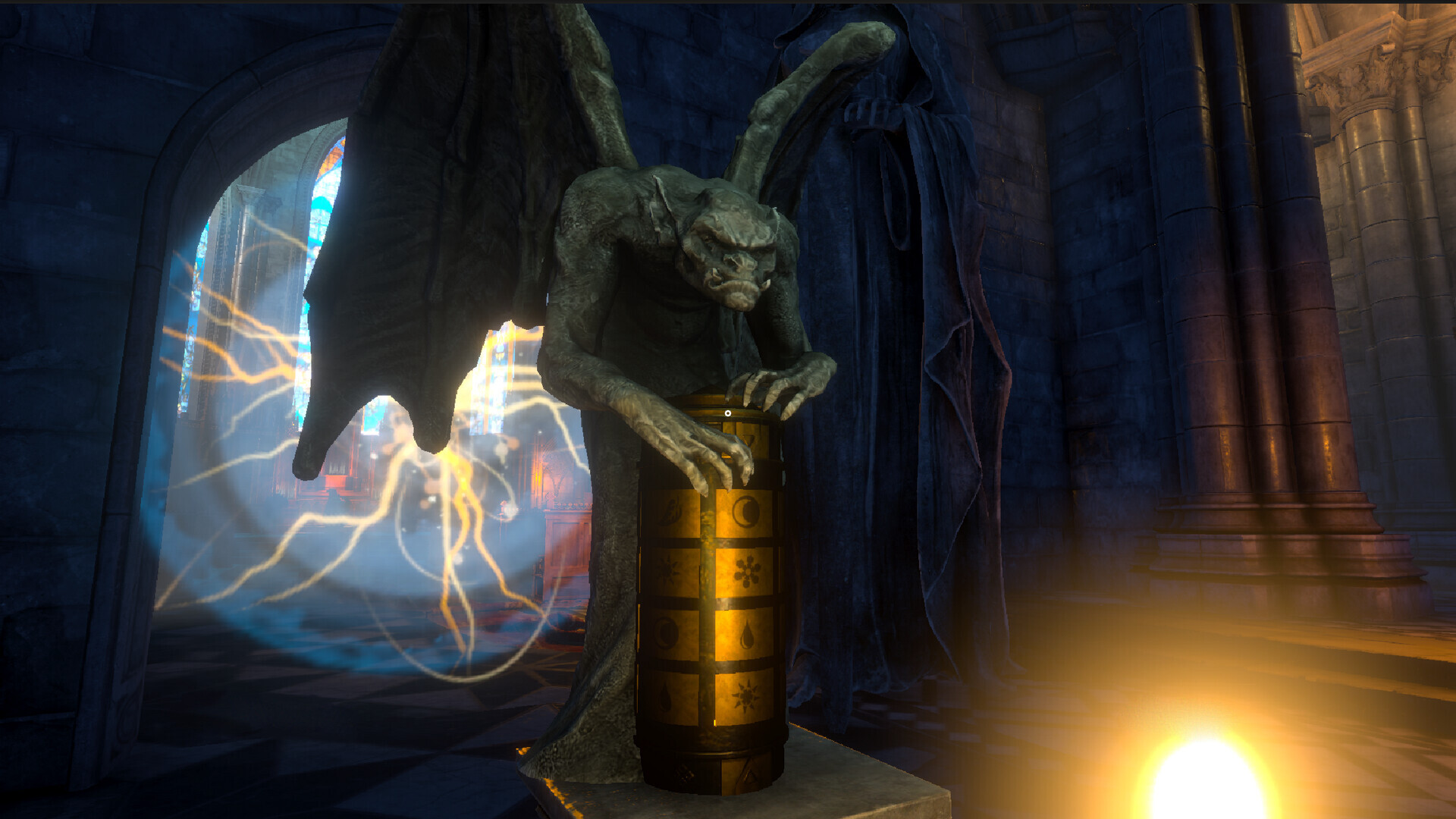
One of the convent's puzzle mechanisms, guarded by an imposing gargoyle statuePlayTogether Studio -
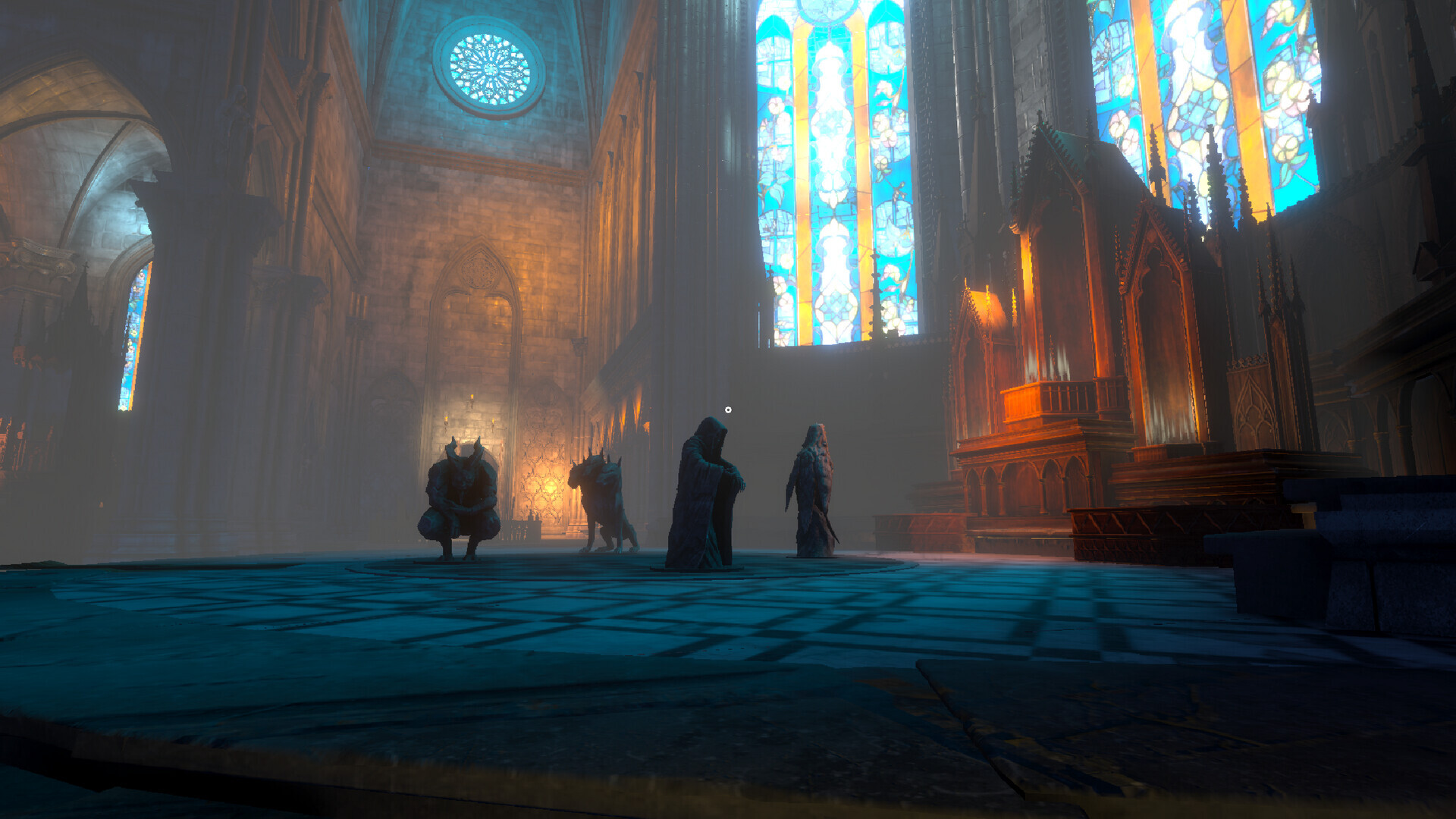
The convent's cathedral hall, lit by stained glass and populated by unsettling hooded figuresPlayTogether Studio -
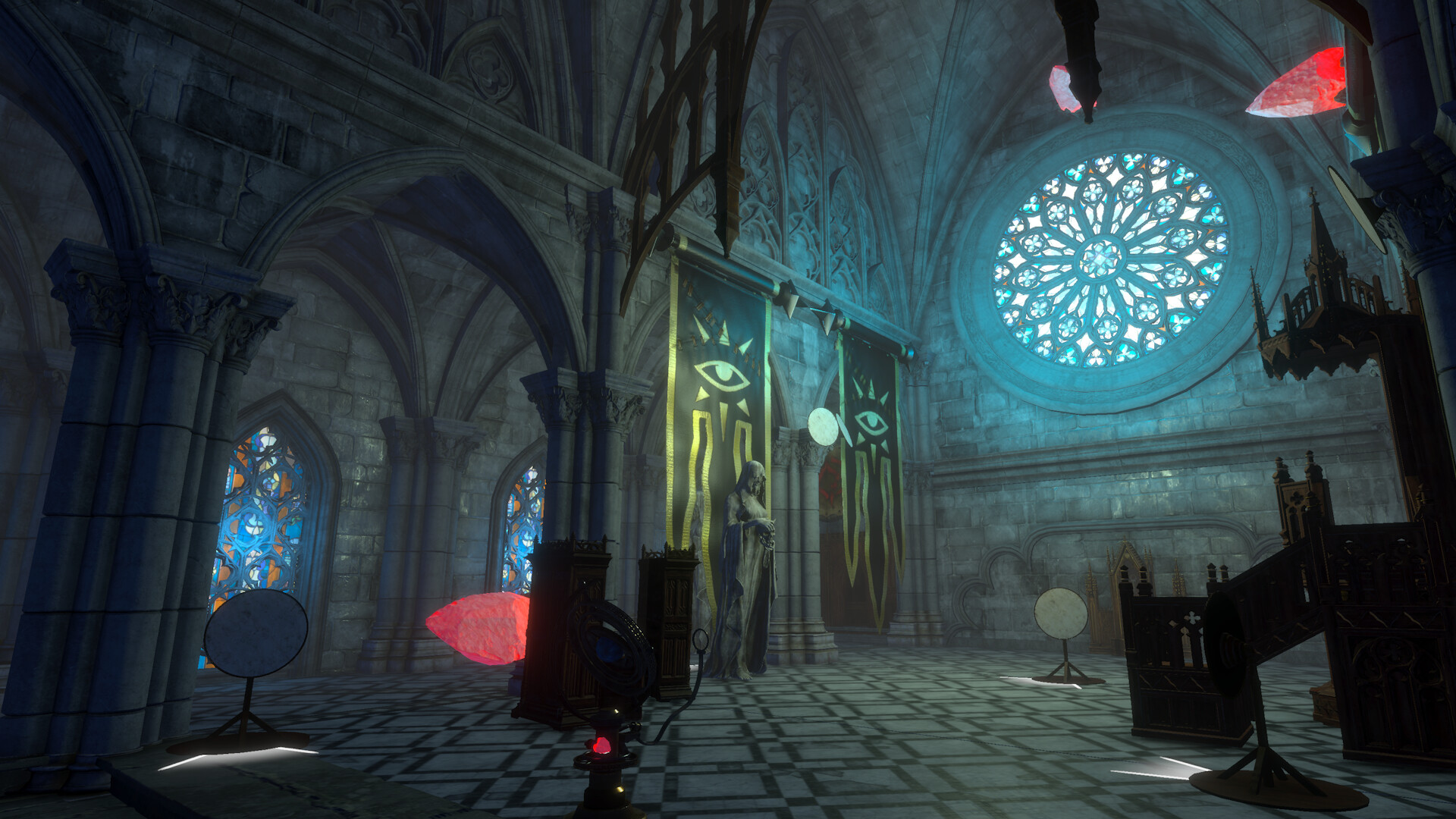
The chapel's mirror-puzzle setup, lit by a large stained-glass rose windowPlayTogether Studio -
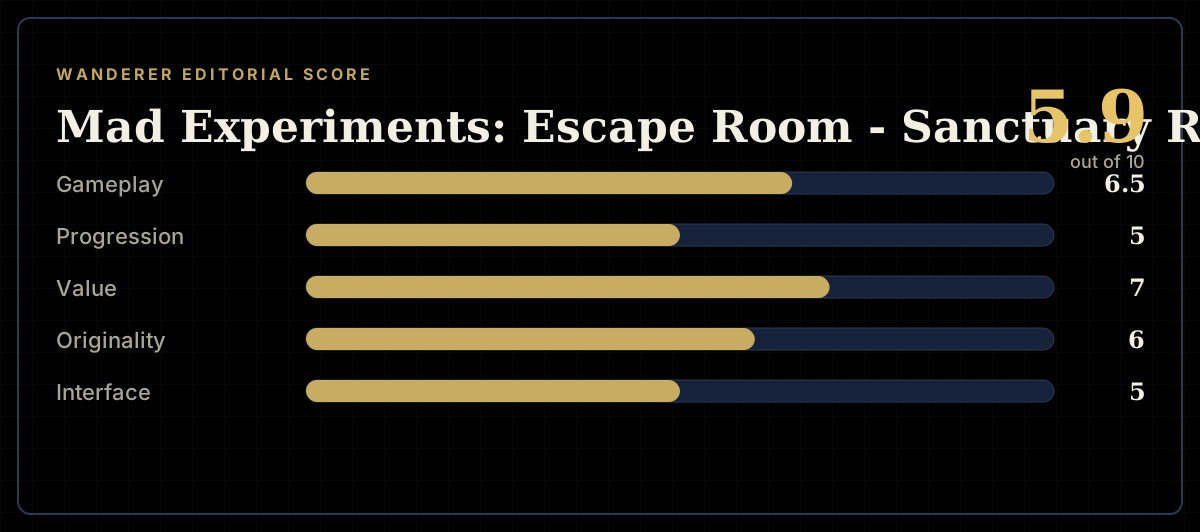
How the review scores each part of the gameWanderer Editorial -
The short versionWanderer Editorial