Game review
Sonic Racing: CrossWorlds Review: A Genuinely Great Kart Racer Undone by Its Own Price Tag
5.1 / 10
- Developer
- Sonic Team
- Publisher
- SEGA
- Released
- 25 September 2025
- Platforms
- ["PC"]
- Genre
- Racing
- Monetisation
- Paid
- Players
- true
The short version
Sonic Racing: CrossWorlds is, by the account of a wide and detailed cross-section of its player base, a genuinely well-built arcade kart racer, and the review that follows takes that consensus seriously rather than dismissing it. Drifting, boosting and chaining corners feel good, the tracks are colourful and often cleverly designed, and the "Crossworlds" gimmick of splicing a lap of one course into another gives races a real sense of surprise the genre hasn't had in years. But that same player base, even among people who ultimately recommend it, returns constantly and specifically to a small set of serious complaints: a launch price that dwarfs comparable kart racers by a wide margin, item balance that several detailed reviews describe as punishing rather than exciting, DLC characters that ship without voice lines, and a single-player mode several reviewers call barebones and repetitive. None of these complaints are vague; they're detailed, specific, and repeated independently across dozens of reviews spanning launch week through nearly a year of post-launch play. The headline positive-review percentage tells only part of the story, this is a game whose core is widely loved and whose packaging and balance decisions have generated an unusually large and consistent volume of frustration for something so well-reviewed overall.
Biggest strengths
- Drifting, boosting and cornering are repeatedly praised as tight, responsive and immediately satisfying, described by several reviewers as a true spiritual successor to Sonic & All-Stars Racing Transformed
- Track design draws consistent praise for variety, colour and clever shortcuts, amplified by the Crossworlds mechanic that splices a lap from a second course into each race for genuine surprise
- A large, characterful crossover roster, spanning Sonic regulars to guests like Hatsune Miku, paired with strong presentation, runs smoothly and is confirmed to perform well even on Steam Deck
Biggest weaknesses
- The launch price, roughly NZ$128 for the base game, is the single most repeated complaint in the sample by a wide margin, with reviewers directly comparing the cost per track against Mario Kart 8 Deluxe and its expansion pass and concluding CrossWorlds delivers far less content per dollar
- Item balance draws sustained, detailed criticism: multiple homing/lock-on item types can chain-stun a leading racer repeatedly, which several reviewers describe as turning races into rubber-banded 'battle racing' rather than skill-based competition
- DLC characters ship without voice lines, a specific and widely repeated complaint, alongside reports of a hard 60fps cap with no unlock option, wall-clipping bugs, netcode desync in online races, and reports of speed-hacking cheaters in ranked multiplayer
Who it's for: Arcade kart racing fans, especially those with a soft spot for Sonic & All-Stars Racing Transformed or the wider Sonic crossover cast, who can stomach a steep asking price and don't mind waiting for a sale.
Our recommendation: Recommended for the core racing and multiplayer experience, but strongly worth waiting for a discount given the near-universal price complaints and real content/balance gaps in the current build.
5.1 / 10
Sonic Racing: CrossWorlds is Sonic Team's latest attempt to recapture the arcade kart-racing crown the series briefly held with Sonic & All-Stars Racing Transformed over a decade ago, built around a large crossover roster, a colourful set of tracks drawn from across Sonic's history and a handful of guest franchises, and a headline gimmick called Crossworlds, where a portion of a second track gets spliced directly into the race you're currently running. Developed by Sonic Team and published by SEGA, it launched on 25 September 2025 and currently sits at 93% positive across 8,538 Steam reviews, an unusually large and unusually consistent sample for a game in this genre. Because that volume makes a small random sample misleading, this review draws on 35 distinct English-language reviews gathered across the top-rated, most-recent, and specifically negative review queues, weighting the negative sample deliberately heavier than usual to make sure the substantial minority of critical voices gets a fair hearing alongside the strongly positive majority.
A Genuine Return to Arcade Kart-Racing Form
The single clearest throughline across the positive portion of the sample is that the actual act of driving feels good. One detailed, nearly 500-hour review calls the driving "very arcade like, so it's easy to pick up and play, but there's still a lot of room to improve and get better," specifically praising how drifting "feels great" and how chaining boosts through corners lets a skilled player "keep an incredible amount of speed." Multiple reviewers independently describe the game as feeling like a true successor to Sonic & All-Stars Racing Transformed rather than a soft reboot trading on nostalgia alone; one long, detailed review goes as far as calling it "a spiritual successor... and NOT its sequel," praising the "fan service" and "deep cut references" while noting the character roster and returning tracks like Bingo Highway and Seaside Hill are reimagined rather than simply recycled. Presentation draws consistent, specific praise too: reviewers repeatedly call the visuals colourful and the sense of speed strong, and one reviewer notes it "runs amazing on Steam Deck" with working crossplay, a meaningful technical claim for a racing game where frame pacing directly affects competitive feel.
Track design is the other major pillar of praise. The same detailed review calls the tracks "varied, colorful, and often full of shortcuts or alternate paths," adding that "some tracks reward learning the layout and optimizing your racing line, which makes replaying them really enjoyable." A separate reviewer specifically credits the Crossworlds mechanic, the game's core new idea, as "genuinely great," even while that same review is otherwise sharply critical of the game elsewhere, a useful sign that the central gimmick is landing even with reviewers who came away disappointed overall. The roster draws similar enthusiasm purely for its breadth and personality: reviewers repeatedly single out crossover inclusions like Hatsune Miku racing alongside "Knuckles the Echidna in the same game," treating the crossover cast as a genuine selling point rather than a gimmick bolted on for marketing.
The Price Tag Dominates the Conversation
If there's one single complaint that appears more often, more specifically, and across more otherwise-positive reviews than any other, it's the price. A striking number of Recommended reviews spend as much time complaining about the cost as they do praising the game itself. One reviewer with over 100 hours logged writes plainly, "I don't blame you if you'd rather wait for a sale as this game is comically overpriced, but trust me it is absolutely worth your time if you like kart racers." Another, addressing SEGA directly, argues "Make the game $40 and more people will buy it. Stop being allergic to money," and goes on to compare the situation directly to how Mario Kart's bundling with Nintendo hardware "effectively made it free for most people," arguing CrossWorlds needs "a lower entry price" to compete. A third reviewer flatly states they "cannot fathom why they think people are going to pay SEVENTY DOLLARS for a kart racing game, REGARDLESS of how good it is." This isn't a fringe complaint from a handful of disgruntled players, it recurs across reviews logging anywhere from five to over five hundred hours, spanning launch week through nearly a year later, which suggests SEGA's own post-launch commentary reportedly expressing surprise at soft sales numbers may be missing a complaint that was, in fact, extremely visible to the people actually buying the game.
The most detailed breakdown of the value complaint comes from a critical review that does the maths explicitly: "70€ for 8 cups with three races each. 70€ for 24 races... Mario Kart 8 released with 32 races for 50€ in 2014 and Mario Kart 8 Deluxe released with 48 races for 60€ in 2018," before noting CrossWorlds' season pass adds "6 races (and 18 karts + 18 voiceless characters) for 30€." Whether or not every reader agrees with a strict cost-per-track calculation as the right way to value a racing game, the specificity and consistency of this complaint across such a wide swathe of the sample, including from reviewers who otherwise clearly love the core driving, makes it the single most load-bearing critique in this review.
Item Balance and the "Battle Racing" Problem
The second major recurring complaint concerns how races actually play out once items enter the mix. One critical reviewer with over 20 hours logged writes that the game "should have been called Sonic Battle Racing with how often and commonly you get stunned out of first," arguing that "over 2/3rds of the roster and customization instantly disappears" once a player realises which handling and acceleration builds are actually viable against the item spam. A separate reviewer, self-described as enjoying "everything from Mario Kart to Gran Turismo to Assetto Corsa," specifically calls out "EIGHT different items that have lock-on/homing/global capabilities" as the one thing capable of souring them on a racing game, comparing the experience to "getting hit by the equivalent of 6 blue shells per race." A third detailed critical review makes a similar point about aggression rather than skill determining outcomes: "all anyone does is shove the next person and spam items," concluding that rank progression happens so quickly that "even if you come in dead last they barely take any points away from you," undermining any sense that skilled play is being meaningfully rewarded.
It's worth noting this complaint isn't universal, several strongly positive reviews describe the chaos as part of the fun, one calling multiplayer races "intense matches with constant lead changes right up to the finish line" as a selling point rather than a flaw. But the volume and specificity of the item-balance complaints, several independently reaching for the same "aggressive," "unbalanced," and "stunned repeatedly" language, suggests this is a real design tension rather than a matter of a few players simply losing badly.
Thin Single-Player Content and a Repetitive Grind
A third consistent thread concerns what there actually is to do outside of head-to-head racing. Even the game's most enthusiastic reviewer, in an otherwise glowing 500-hour review, concedes "the single player mode could also have used a bit more long term variety or extra challenges." A more critical review is considerably blunter, noting that after completing "every prix once," the game then "asks you do do them again in mirror mode," followed by repeating "individual maps another ~48 times in the race park to unlock more karts," at which point "you go to multiplayer" only to find "same maps as the singleplayer." Currency and unlock pacing draws a related complaint: one detailed review notes that during in-game "Festival" events tickets accumulate quickly, but "when there isn't a Festival going on? its a snails pace," while a separate reviewer flags that gadget unlocks require "the long, pretty samey grind" despite there only being six equipment slots to actually use them in. A reviewer directly comparing the game to its own spiritual predecessor makes the sharpest version of this point: "Transformed has an actual career mode for single player, Crossworlds just has the same stuff you can play online but against AI only and thats it." Taken together, the sample suggests the multiplayer experience is where CrossWorlds' design effort clearly went, and that players looking primarily for a substantial solo campaign are likely to come away wanting more.
Technical Rough Edges: Frame Caps, Netcode and Cheaters
A cluster of more concrete technical complaints rounds out the critical portion of the sample. One reviewer reports refunding after discovering the game ships with a hard 60fps cap and no way to unlock higher frame rates, calling it "absurd" for "a modern high speed focused game" and noting frame generation "is not a solution for this." A separate detailed review describes online netcode problems specifically, reporting that hitting an opponent with an item sometimes triggers the hit notification and animation locally without the target actually slowing down, "because this was not communicated to the server," a desync bug they say they reproduced "multiple times with a friend in online mode." Wall-clipping bugs and buggy collision get a specific mention from another reviewer, and a further review raises a more serious concern, describing ranked lobbies frequently populated by opponents at implausibly high trophy counts using "speed hacks," and arguing the wider community is too quick to dismiss the scale of the problem. DLC characters lacking voice lines is, by contrast, a smaller but extremely widely repeated specific complaint, showing up independently across reviews with wildly different overall opinions of the game, suggesting it's simply a real, uncontested gap in the current release rather than a matter of taste.
Value and Final Verdict
Sonic Racing: CrossWorlds is a genuinely difficult game to score cleanly, because the gap between what the actual racing feels like to play and everything surrounding it is unusually wide. The core loop, drifting, boosting, learning tracks, playing with the Crossworlds splice mechanic, draws real, detailed, specific praise from a large cross-section of reviewers, including many who go on to sharply criticise other parts of the package in the same breath. But the price complaint is too large, too specific, and too consistent across too much of the sample, from five-hour reviews to five-hundred-hour reviews, to treat as background noise, and it's compounded by item balance that a meaningful slice of critical reviewers describe in near-identical terms, thin single-player content that even fans acknowledge, and a specific, recurring set of technical gaps around frame rate, netcode and DLC voice acting. For players focused entirely on local or online multiplayer with friends who already own the game, and who can catch it on sale, the underlying racing is good enough to be worth recommending. For anyone considering the full asking price for a primarily single-player experience, the sample here suggests real caution is warranted.
Pros and cons
Pros
- Drifting, boosting and cornering are repeatedly praised as tight, responsive and immediately satisfying, described by several reviewers as a true spiritual successor to Sonic & All-Stars Racing Transformed
- Track design draws consistent praise for variety, colour and clever shortcuts, amplified by the Crossworlds mechanic that splices a lap from a second course into each race for genuine surprise
- A large, characterful crossover roster, spanning Sonic regulars to guests like Hatsune Miku, paired with strong presentation, runs smoothly and is confirmed to perform well even on Steam Deck
Cons
- The launch price, roughly NZ$128 for the base game, is the single most repeated complaint in the sample by a wide margin, with reviewers directly comparing the cost per track against Mario Kart 8 Deluxe and its expansion pass and concluding CrossWorlds delivers far less content per dollar
- Item balance draws sustained, detailed criticism: multiple homing/lock-on item types can chain-stun a leading racer repeatedly, which several reviewers describe as turning races into rubber-banded 'battle racing' rather than skill-based competition
- DLC characters ship without voice lines, a specific and widely repeated complaint, alongside reports of a hard 60fps cap with no unlock option, wall-clipping bugs, netcode desync in online races, and reports of speed-hacking cheaters in ranked multiplayer
Screenshots
-
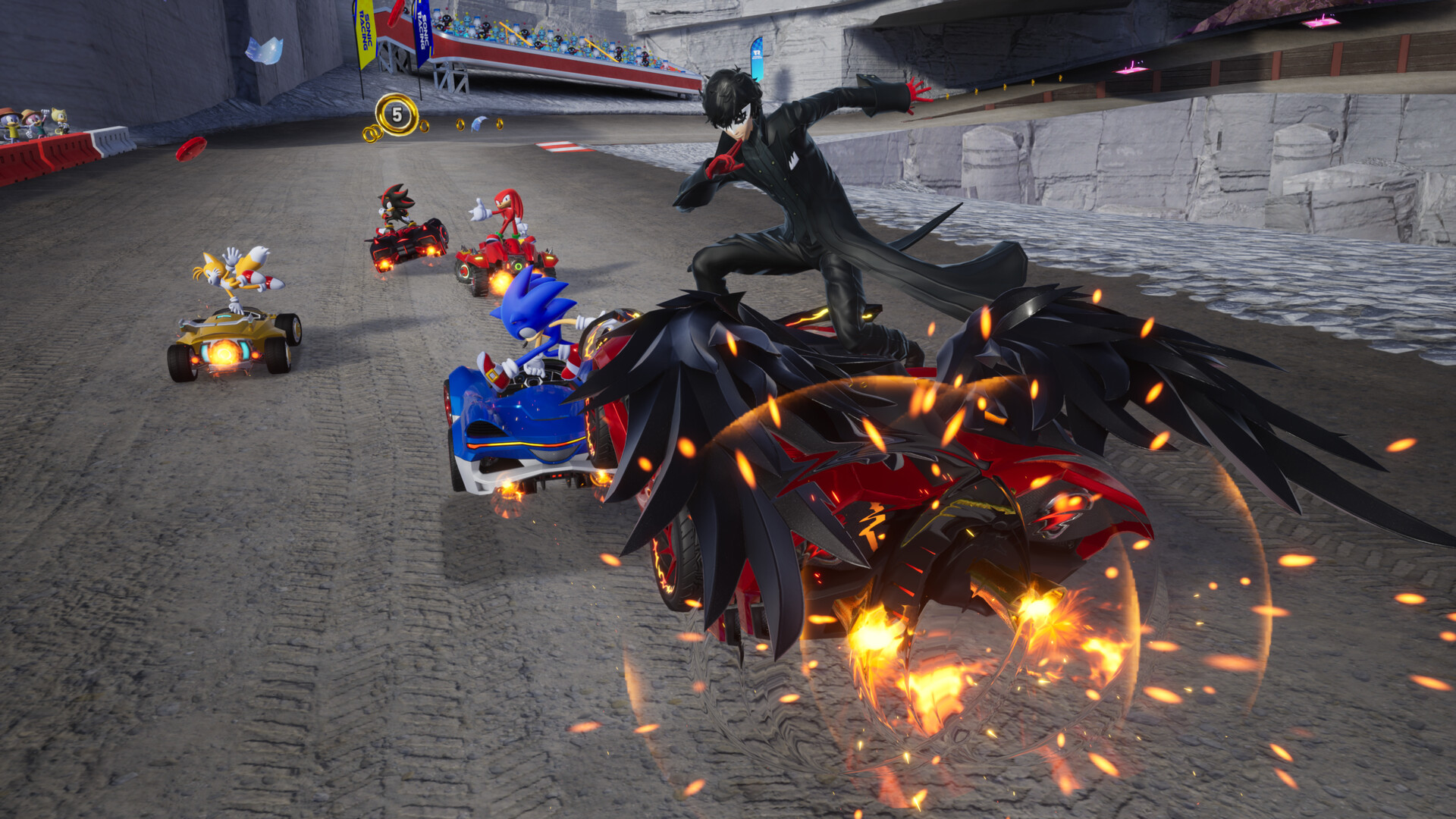
A crossover race featuring Persona 5's Joker alongside the core Sonic rosterSEGA -
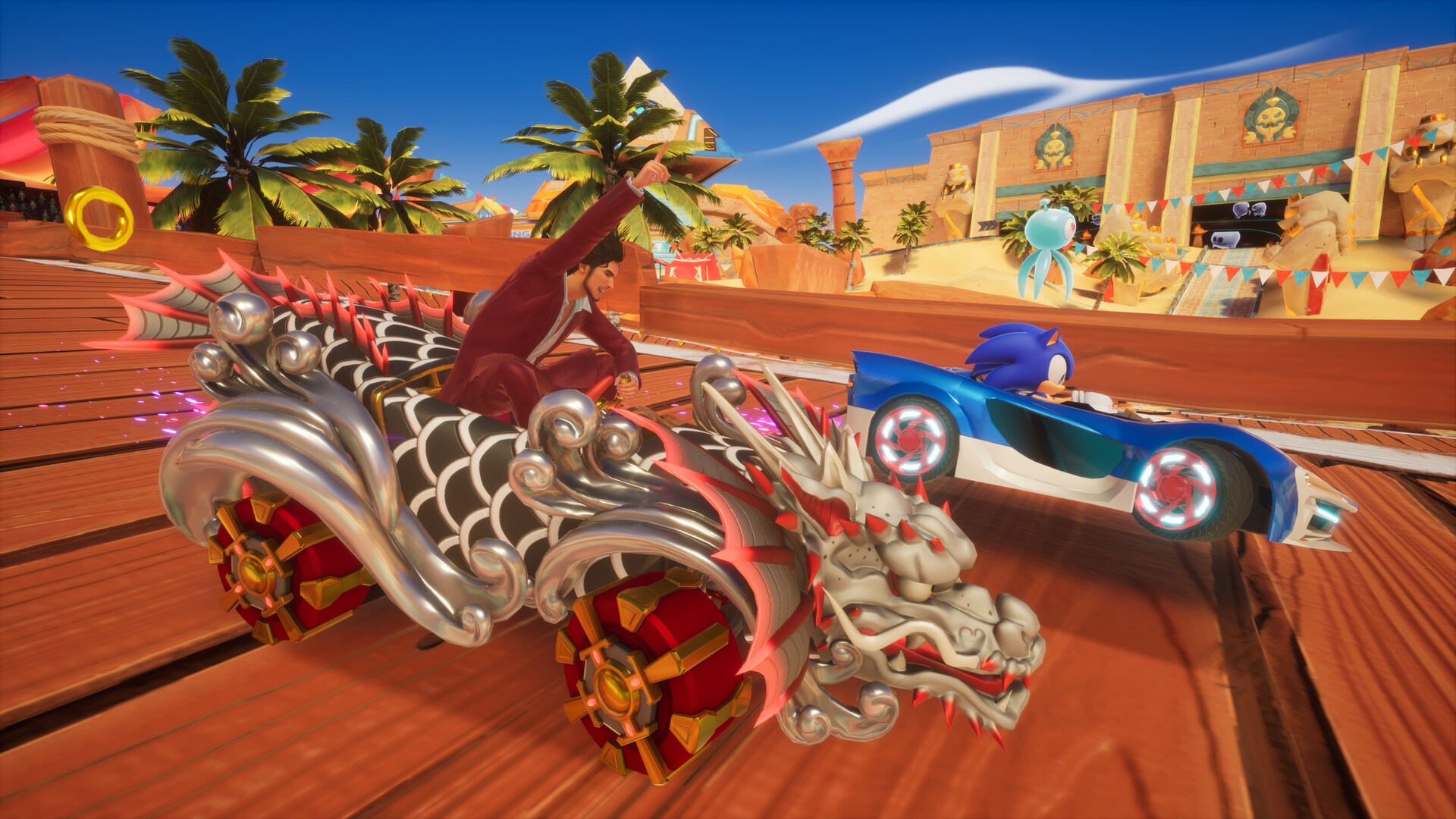
A desert track showcasing one of the game's crossover vehicle designsSEGA -
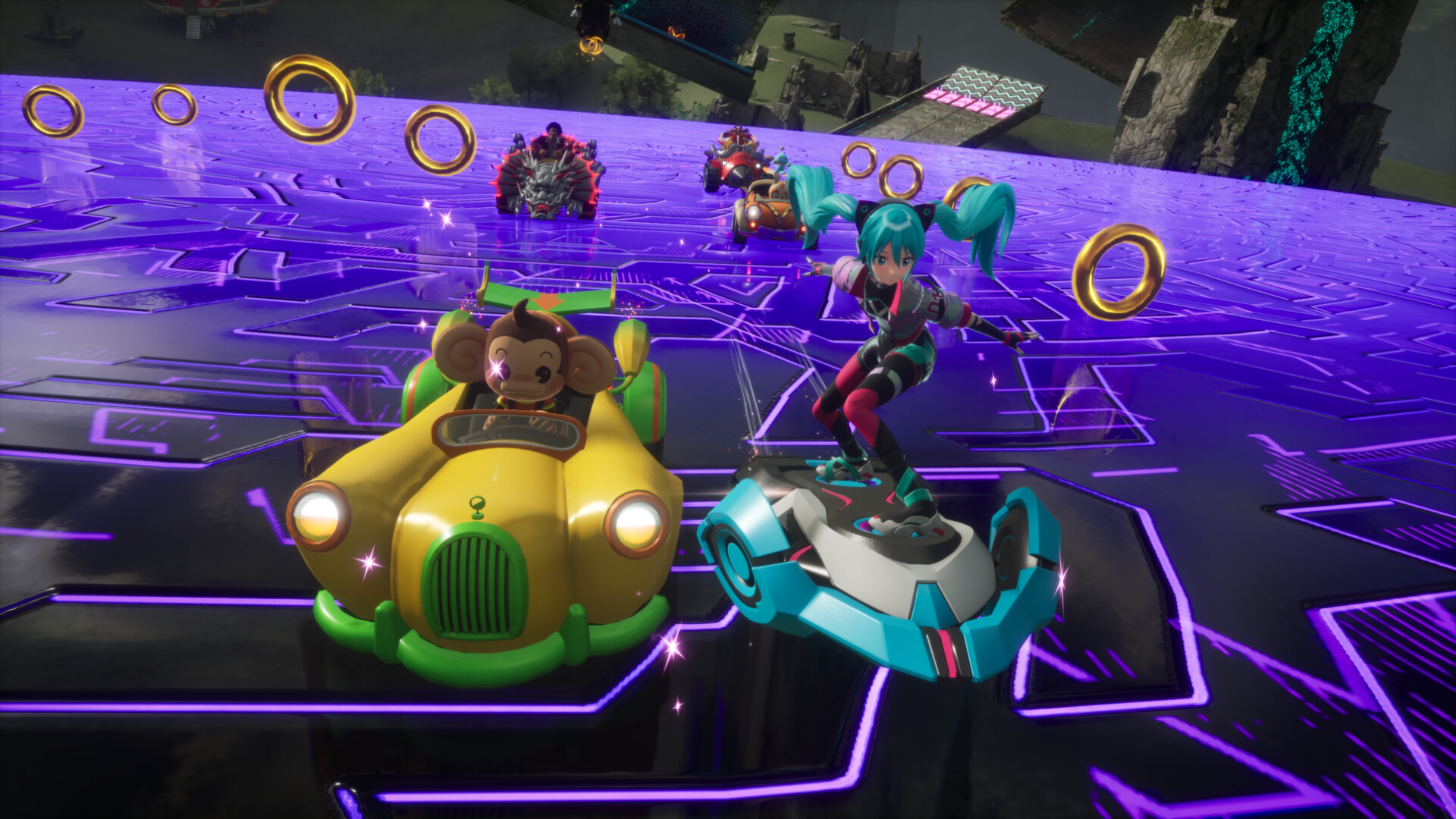
Hatsune Miku racing alongside Amigo on a neon-lit crossover trackSEGA -
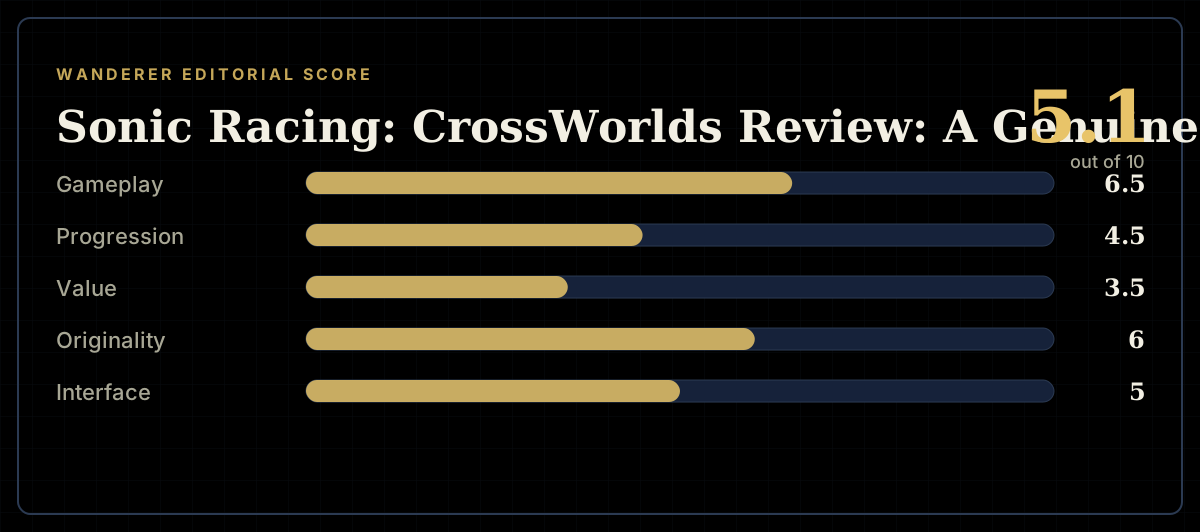
How the review scores each part of the gameWanderer Editorial -
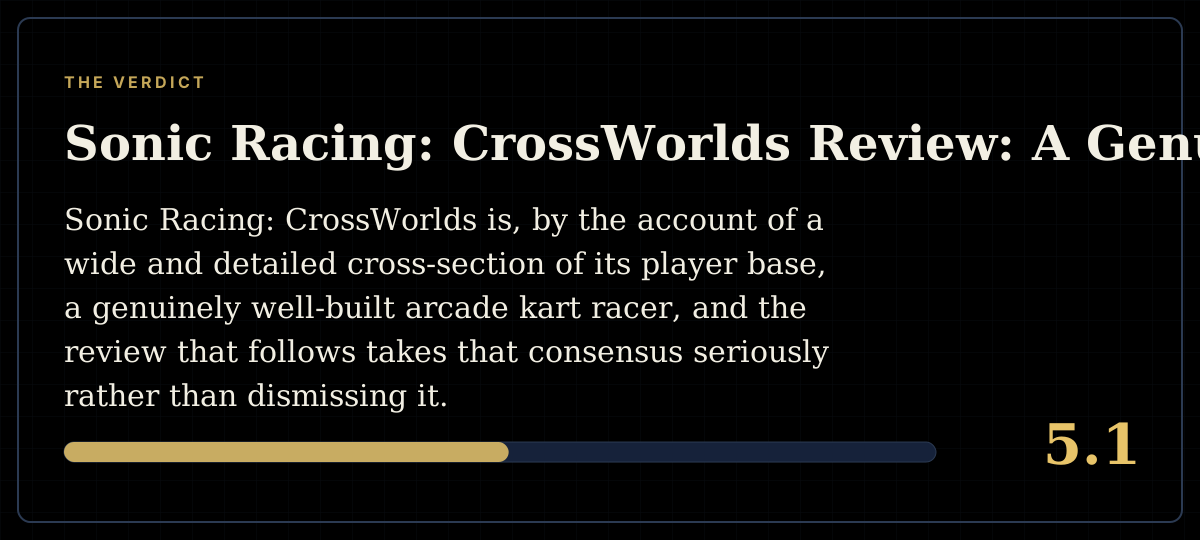
The short versionWanderer Editorial