Game review
DuneCrawl
5.2 / 10
- Developer
- Alientrap
- Publisher
- Alientrap
- Released
- 5 January 2026
- Platforms
- Windows
- Genre
- Action-Adventure / Co-op
- Monetisation
- Premium (one-time purchase)
- Players
- true
The short version
DuneCrawl's central hook — crewing a gigantic, cannon-covered crab across an open sandy sea, splitting duties between steering, gunnery, and away-team exploration with up to three friends — is as inventive and immediately charming as it sounds, and reviewers who play it in a full co-op group consistently describe having real fun with it. What holds the game back is everything built around that hook: a shallow, quickly-exhausted gear and upgrade system, an open world whose points of interest cover a small fraction of its actual size, and a rough technical foundation full of desync, soft-locks, and control-mapping problems that get worse in local co-op. At full price, for a campaign most players finish in ten to twenty-five hours with little reason to return, it's a tougher sell than the premise deserves; on sale, with a full group of friends, it becomes considerably easier to recommend.
Biggest strengths
- A genuinely original premise — commanding a giant crab mount together, splitting cannon, steering, and away-team duties among a crew
- Distinct, pleasant art style and a soundtrack reviewers consistently praise for complementing the atmosphere
- Dungeon and cave puzzle sections earn specific praise for variety and clever, self-contained gimmicks
Biggest weaknesses
- Gear and upgrade pools are small and shallow, with most players seeing everything the game offers within a few hours
- An open world where explorable points of interest cover only a small fraction of the actual map, leading to long stretches of empty travel
- Frequent bugs, including desync, soft-locks, frame drops, and texture pop-in, especially in longer co-op sessions
Who it's for: Co-op groups of two to four looking for a short, novel adventure to play together, especially fans of Lovers in a Dangerous Spacetime or Sea of Thieves who don't mind rough edges; a weaker fit for solo players.
Our recommendation: A strong recommendation for a full co-op group willing to buy in at a discount, and a much more cautious one for solo players or anyone buying at full price expecting deep, long-term progression.
5.2 / 10
What Is DuneCrawl?
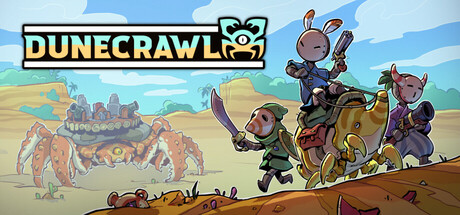
DuneCrawl is an open-world co-op action-adventure from Alientrap in which players take command of a gigantic crustacean "crawler" festooned with black powder cannons, sailing across a sandy open world either solo or with up to three friends in local and online co-op. The game splits its runtime across three distinct modes: piloting the crawler itself across the overworld, with one player steering while others man cannons or launch themselves at enemy crawlers and bases; docking at islands to explore on foot, fight enemies, and complete quests; and descending into dungeons, framed as puzzle-and-combat caves built around individual gimmicks like boomerang mechanics, explosive chain reactions, and hidden levers. A post-launch update added a Battle Royale mode, the game's only addition since release. Released 5 January 2026 at NZ$28.99, it currently sits at 74% positive across 568 reviews — solidly "Mostly Positive," with an unusually detailed and consistent set of both praise and criticism running through the sample.
The pitch is immediately distinctive, and it's the single thing nearly every reviewer — positive or negative — singles out as DuneCrawl's strongest asset. Nothing else on the market quite offers the specific fantasy of a crew splitting duties atop a giant, weaponised crab, and multiple reviewers frame the entire experience through that lens: "the fascination I have with riding a giant crab managed by a team is still present, and it is not something I can find in another game," as one reviewer put it after describing a rough, bug-marred first attempt with the game.
A Genuinely Fun Core Loop, Best Enjoyed With a Full Crew
The reviews that land most positively on DuneCrawl are, almost without exception, from groups who played it with a full or near-full crew rather than solo. One detailed positive review breaks the experience down cleanly into its three core loops — crawler combat, island exploration, and dungeon puzzling — and describes genuine division of labour and specialisation within a two-player group, with one partner favouring guns and melee combat while the other focused on cannon work and ramming enemy crawlers, ultimately concluding "the game works best with co-op with multiple players... I can also see where the game might not be very fun by yourself." Another reviewer who played through the entire campaign with their spouse used almost identical language, comparing the experience favourably to Zelda and Dune in the same breath, while a separate review specifically compares the feel of crew coordination to Lovers in a Dangerous Spacetime and Final Fantasy Crystal Chronicles — a useful reference point for players deciding whether the format appeals to them.
The dungeon and cave sections draw some of the most focused praise in the sample. One reviewer calls out "a healthy amount" of puzzles, "quite rewarding" and "each centered around their own unique gimmicks," listing specific mechanics like boomerang-based puzzles, dangerous traps, and breakable walls as evidence of real design variety within those spaces, even while criticising the broader open world around them as comparatively empty. The art direction and music receive consistent, if modest, praise across the sample as well — one more critical review that ultimately recommends the game "begrudgingly" still credits its "distinct and pleasant" art style and describes the overall atmosphere as "comfy and immersive" despite listing a long string of mechanical complaints in the same review.
Solo play, by contrast, draws near-uniformly negative reactions from the reviewers who tried it. One reviewer who bought the game specifically to try it alone describes it as "unplayably bad solo," citing "completely terrible controls" and enemy encounters and escort missions that feel entirely unbalanced for a single player, while another reviewer who tested the single-player mode briefly before switching to co-op simply says they "quickly nope'd out" of it, concluding the game "is absolutely built for multiplayer." This is a genre-appropriate design choice rather than an oversight — the crawler's whole premise depends on splitting roles among a crew — but it does mean the game is a significantly weaker purchase for anyone without a group of friends to bring along.
Thin Progression and an Open World That Doesn't Reward Exploring It
The most consistent and detailed criticism in the sample concerns how little the game's systems grow or change over a full playthrough. One reviewer memorably describes DuneCrawl as feeling "like a massive ocean that is 3 inches deep," pointing out that despite an apparently large map, the actual points of interest "boil down to 10% of the map," with roughly half of one playthrough spent "slowly walking my crab across the map" between content. The same review notes that gear upgrades are functionally static across the entire runtime — "you see the same 8 items across the entire game" — and that crawler upgrades amount to little beyond swapping weapons, with no meaningful changes to how combat or exploration feels as the game progresses.
A separate, similarly detailed critical review lays out the economy in specific terms: players earn gold and "sparkflies" (experience), but gold quickly becomes worthless once the small available gear pool is exhausted, while sparkflies unlock only four accessory slots and nothing else — no crawler upgrades, no new traversal options, no expanded stash. That reviewer explicitly frames this as a missed opportunity rather than an inherent flaw of the concept, writing that "if gear was more interesting and offered more choices, and sparkflies offered more upgrades... this could be a very tight, very engaging 10-20 hours," and scoring the game "a 6.5/10" despite not recommending it at full price. A third reviewer makes essentially the same point about the game's specialised mounts: bug mounts introduced with real narrative fanfare, they note, are "barely" usable "outside of their designated quests," a case of an interesting mechanic being built but never meaningfully deployed. Quest design draws similar complaints — multiple reviewers describe most quests as fetch-quest busywork disconnected from the main story, functioning, in the words of one reviewer, mainly "to be a time gate to keep you playing" rather than to add meaningful content.
Playtime figures across the sample are notably consistent regardless of overall verdict, with most groups reporting somewhere between ten and twenty-five hours to fully complete the campaign and its side content, and several explicitly noting there's little reason to return once finished. One reviewer who paid a discounted price directly ties their positive verdict to that discount: "it is SHORT, even if we got the game for ~$13 AUD (55% off), just because of the lack of replayability" — a framing echoed by several other reviewers who separately suggest the asking price feels steep relative to the amount of content on offer, even when they otherwise enjoyed their time with it.
A Rough Technical Foundation
Beyond the progression complaints, a large share of the review sample — including from reviewers who ultimately recommend the game — describes a genuinely unpolished technical state. Reports include frequent desync between players, soft-locks requiring manual "unstuck" commands or full restarts, progressive frame-rate degradation over multi-hour sessions serious enough that one reviewer recommends restarting the application roughly every three hours to avoid memory leaks, and texture pop-in during crawler travel. One detailed refund review documents local co-op specifically: beetle mounts that die quickly and can't climb small obstacles, fruit-carrying mechanics that leave players defenceless and prone to being accidentally trampled by their own crawler, and control-mapping problems including dodge-roll and sprint sharing a single default button and reassigned inputs that only apply to the first local player, breaking menu functionality for the second. The same reviewer notes that the developers "promptly fixed" an early blocking bug after it was reported, and says they are considering giving the game another chance — a pattern that recurs elsewhere in the sample, with several reviewers describing the developer as responsive to bug reports even where the underlying issues remain frustrating in the moment. More recent reviews from several months after launch still describe "constant frame drops," desync, and "severe" bugs in later areas, suggesting these problems have not been fully resolved as of writing, even as most of those same reviewers still lean toward recommending the game overall for its co-op experience.
An Overlooked Battle Royale Mode
Alientrap's sole post-launch content addition, a Battle Royale mode supporting up to sixteen players, is barely mentioned across the review sample compared with the campaign — and the reviews that do mention it aren't encouraging. One detailed reviewer, writing several months after the mode's release, reports never having tried it despite otherwise fully completing the campaign twice with a friend, explaining plainly that a game this size simply doesn't have the population to fill a sixteen-player lobby without resorting to bots: "unless we had a 16 large friend group and an equal amount of licenses for the game we'd never have a complete lobby." No reviewer in the sample offers a substantive account of actually playing a full human Battle Royale match, which on its own says something about how little traction the mode appears to have found. For a co-op-first game whose entire identity rests on the campaign's crawler-and-crew fantasy, the mode reads as a feature added to broaden the pitch rather than one central to what makes DuneCrawl worth playing.
Where DuneCrawl Sits Against Its Co-op Peers
Several reviewers explicitly frame DuneCrawl against other recent co-op titles rather than judging it in isolation, and the comparisons are instructive. One reviewer who came to the game straight from It Takes Two, Split Fiction, and Ship of Fools calls DuneCrawl "a blessing" by comparison for the sheer number of multiplayer configurations it supports out of the box — couch co-op, local split-screen, and online play for up to four — while still flagging persistent texture pop-in and players getting stuck in terrain during longer sessions. Others invoke Sea of Thieves as a natural comparison point given the open-water crawler traversal, though one critical reviewer specifically argues the comparison exposes a weakness rather than a strength, noting the game "isn't designed around PvP so [it's not clear] why its so stingy and samey" relative to titles that build their entire economy around repeat exploration. This tension — a game whose moment-to-moment structure borrows from larger, more systemically deep multiplayer titles without matching their long-term content loops — runs through much of the sample's criticism, and helps explain why so many otherwise positive reviews still qualify their recommendation with some version of "good, but don't expect it to last."
Final Verdict
DuneCrawl earns real credit for a premise nothing else on the market quite matches, and for the specific, well-realised moments — cave puzzles, crew co-ordination during crawler battles, the sheer novelty of steering a giant weaponised crab with friends — that reviewers across the sample consistently single out as highlights. But it's held back by a progression system several detailed reviews independently describe as flat and quickly exhausted, an open world whose scale isn't matched by its content density, and a technical foundation rough enough that bugs and desync show up repeatedly even in glowing reviews. Playing solo is not recommended by nearly anyone who's tried it. For a full group of friends buying in at a discount and treating it as a single ten-to-twenty-hour co-op weekend rather than a long-term investment, DuneCrawl delivers a genuinely memorable, if flawed, experience; at full price, expecting a deep or lengthy adventure, it's much harder to recommend.
Pros and cons
Pros
- A genuinely original premise — commanding a giant crab mount together, splitting cannon, steering, and away-team duties among a crew
- Distinct, pleasant art style and a soundtrack reviewers consistently praise for complementing the atmosphere
- Dungeon and cave puzzle sections earn specific praise for variety and clever, self-contained gimmicks
- Full range of co-op options, including couch, local split-screen, and online play for up to four players
Cons
- Gear and upgrade pools are small and shallow, with most players seeing everything the game offers within a few hours
- An open world where explorable points of interest cover only a small fraction of the actual map, leading to long stretches of empty travel
- Frequent bugs, including desync, soft-locks, frame drops, and texture pop-in, especially in longer co-op sessions
- Local co-op control mapping issues, including shared button assignments that can't be changed per-player and conflicting inputs like dodge-roll and sprint sharing a button
Screenshots
-
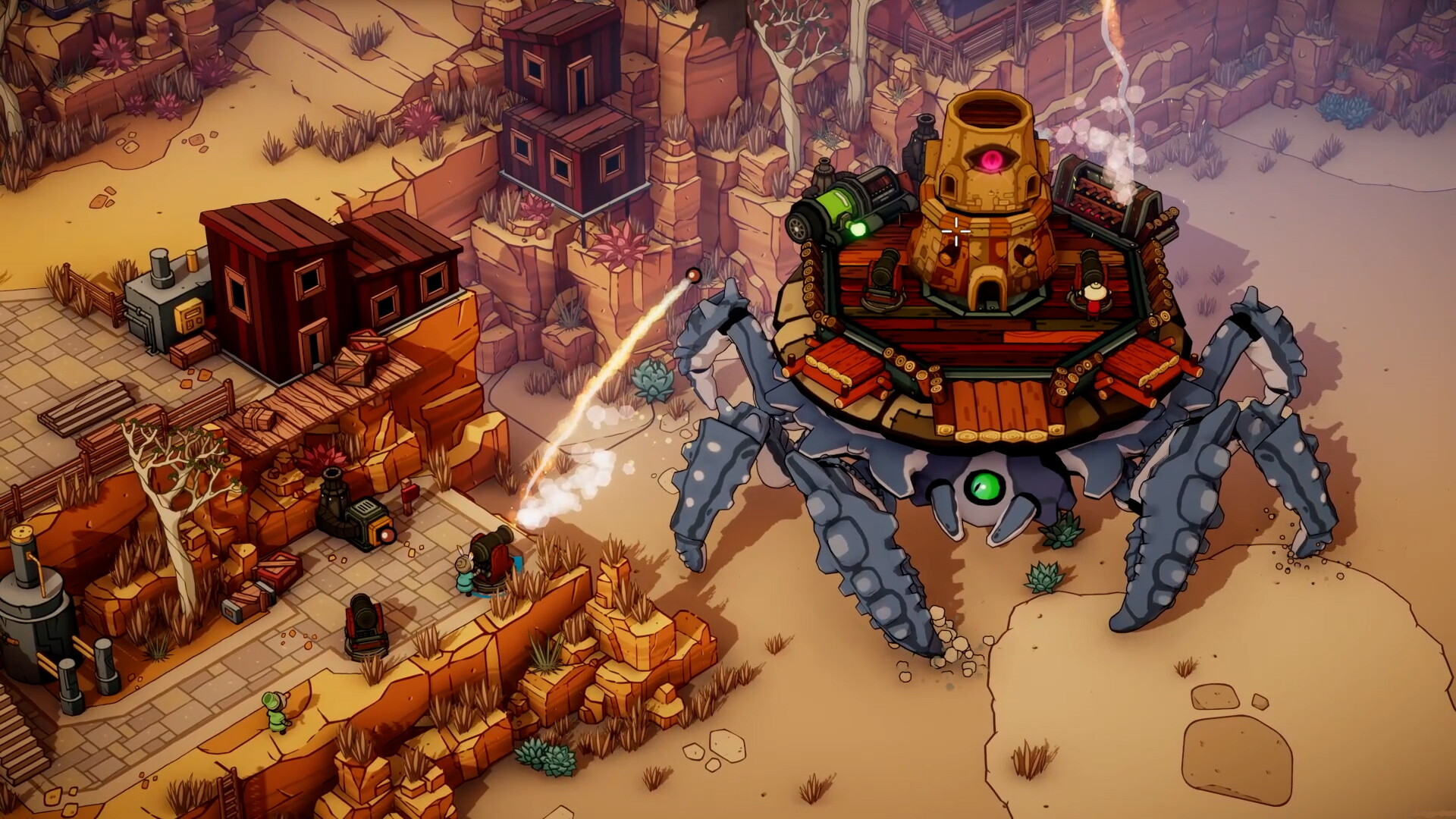
Crawler battles split the crew between steering, gunnery, and ramming enemy bases and crawlersAlientrap -
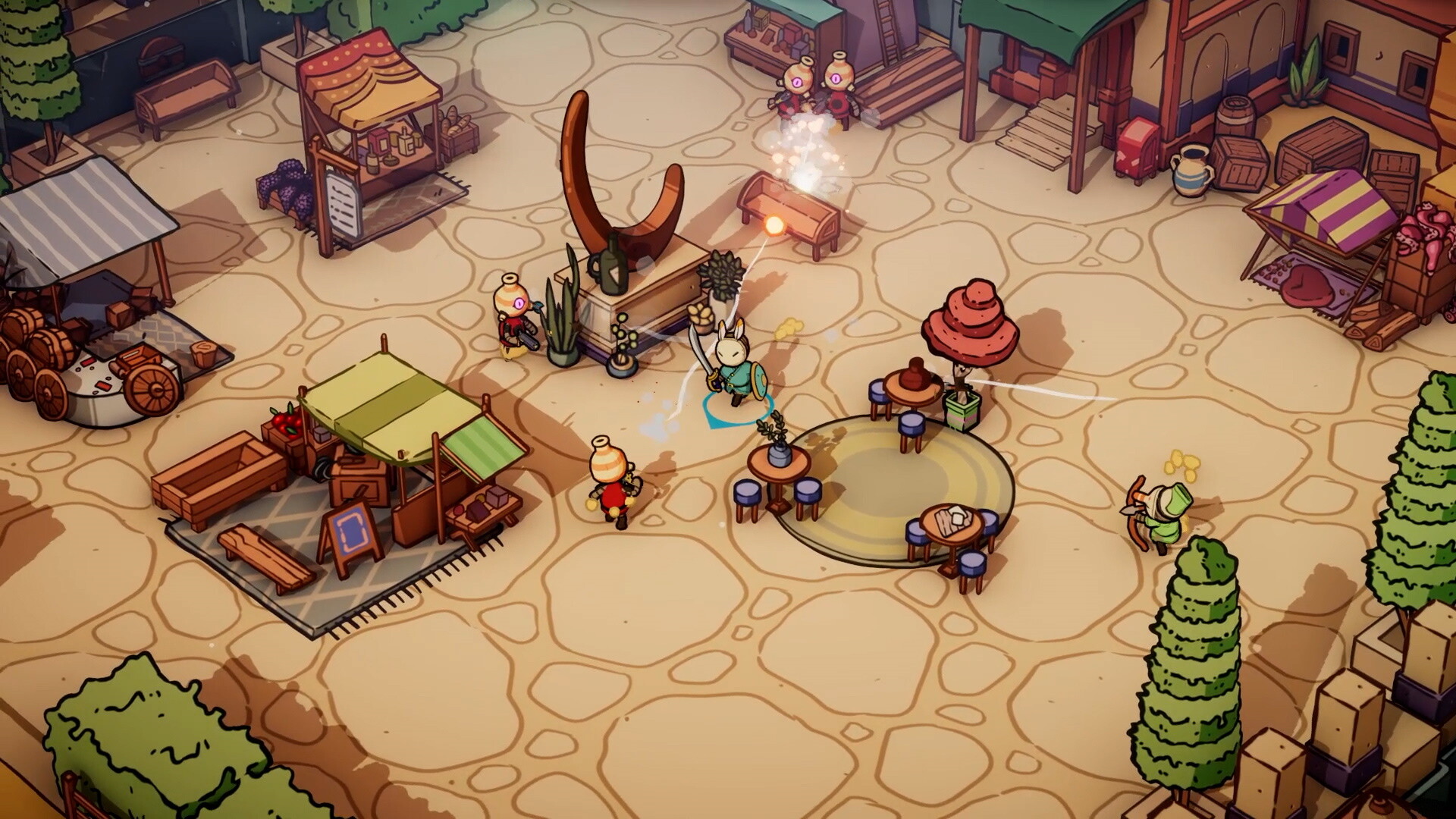
Docking at islands shifts play to on-foot combat and quests among the game's villages and marketsAlientrap -
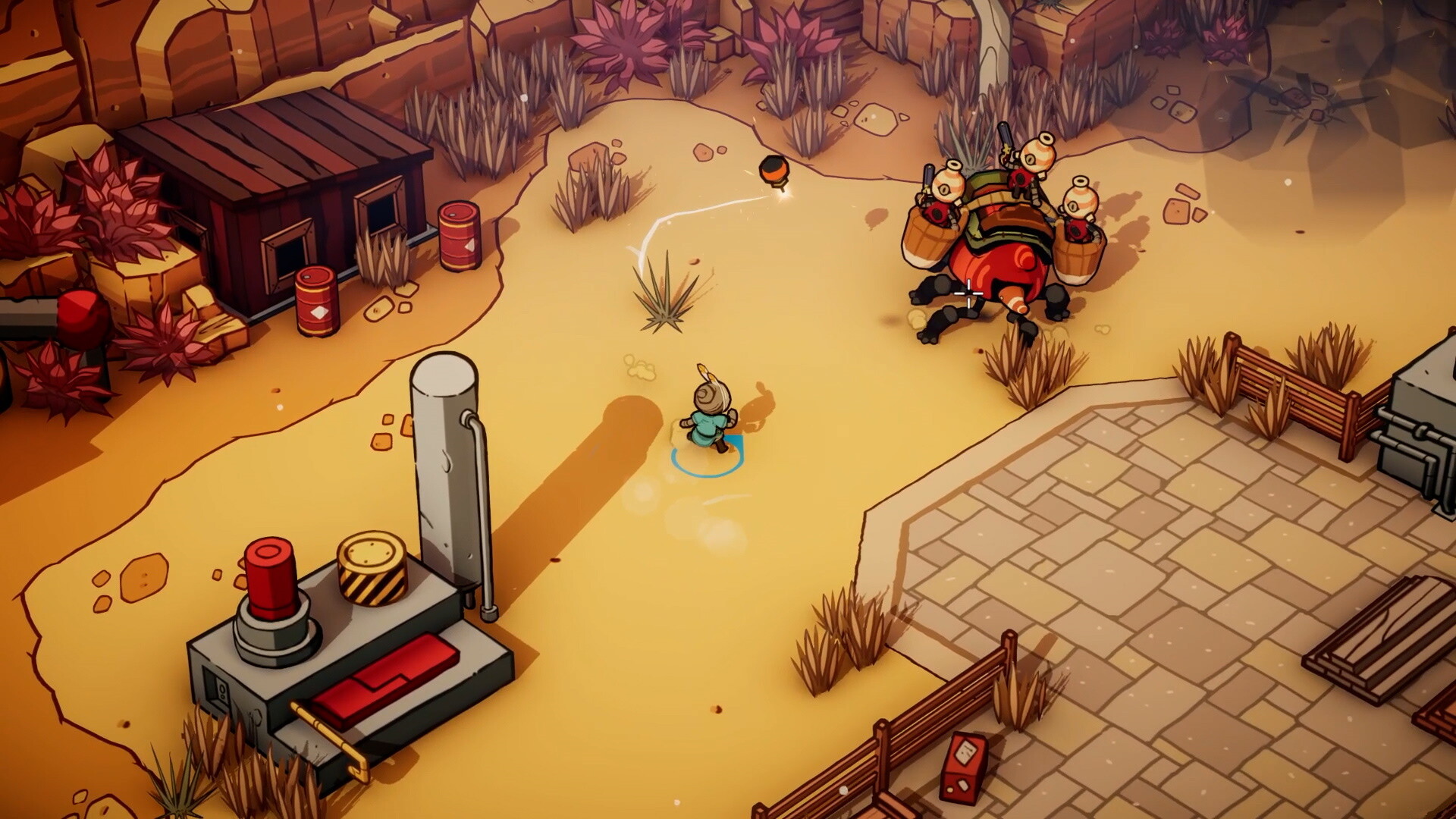
Solo play draws some of the sample's sharpest criticism, with several reviewers calling it unbalanced without a crewAlientrap -
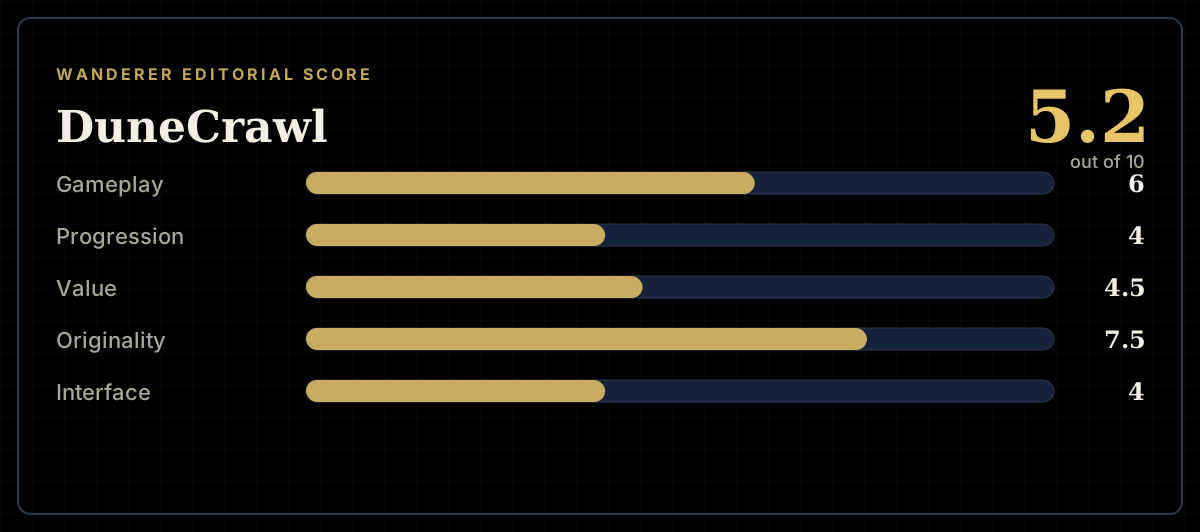
How the review scores each part of the gameWanderer Editorial -
The short versionWanderer Editorial