
Game review
Wheel World
6.5 / 10
- Developer
- Messhof
- Publisher
- Annapurna Interactive
- Released
- 23 July 2025
- Platforms
- Windows, macOS, Linux
- Genre
- Racing, Adventure, Sports
- Monetisation
- One-time purchase, optional soundtrack DLC
- Players
- Single-player
The short version
Wheel World casts you as Kat, a cyclist chosen by ancient spirits to perform the "Great Shift" ritual and save a collapsing universe, racing elite teams and customizing an ever-growing collection of bike parts across a semi-open world from Messhof, the small studio behind the acclaimed Nidhogg, published by Annapurna Interactive. Reviewers consistently praise its cel-shaded art, soft synth-pop soundtrack, and an unusually sincere, detail-observant take on cycling subculture that more than one reviewer credits with genuinely reigniting their interest in real-world biking. That goodwill runs headlong into a widely corroborated structural problem: a second in-game "world," arriving roughly 80% through the campaign, that a large share of reviewers say introduces a sudden difficulty spike built on unpredictable collision physics with rival racers, turning races that were previously about skill and course knowledge into frustrating, restart-heavy contests of luck.
Biggest strengths
- The cel-shaded art style and soft synth-pop soundtrack draw consistent, specific praise, with multiple reviewers comparing the overall mood favourably to A Short Hike, Sable and Breath of the Wild
- Reviewers repeatedly single out the game's sincere, detail-observant treatment of cycling subculture, with quirky NPCs several describe as recognisably similar to real people met at bike meetups or repair shops
- At least two reviewers report the game rekindled or reinforced a genuine real-world interest in cycling, with one describing buying and restoring an old road bike specifically because of how the game made them feel about riding
Biggest weaknesses
- A large, specific share of the review corpus describes a second in-game "world," arriving around 80% through the campaign, as introducing a sudden and disproportionate difficulty spike relative to the rest of the game
- Multiple reviewers independently describe unpredictable collision physics with rival racers as the core problem in that back half, reporting that contact with an NPC can send the player's bike flying off course while the reverse contact does nothing, turning races into contests of luck rather than skill
- Steam's own global achievement data corroborates this account: early achievements sit around 90%+ completion while the game's late achievements fall to roughly 2-4%, a steep cliff consistent with widespread reviewer reports of abandoning the game partway through the second world
Who it's for: Fans of laid-back, vibe-driven open-world exploration games in the vein of A Short Hike or Sable who also have some affection for cycling culture, and who can tolerate a rocky, less-polished back stretch after an excellent first half. Less of a fit for players who specifically want tight, fair, skill-based racing mechanics all the way through.
Our recommendation: Worth playing for the first world alone if the art style and cycling-culture sincerity appeal to you, but go in aware that a large share of reviewers report the back half's collision physics and difficulty spike as a genuine drop in quality, not just a difficulty curve working as intended.
6.5 / 10
Chosen by cycling spirits
Wheel World puts you in the saddle as Kat, a young cyclist chosen by ancient forces to perform the "Great Shift" ritual and save a collapsing universe — a premise that leans gleefully into the absurdity of treating competitive biking as a matter of cosmic importance. It's the latest from Messhof, the small studio best known for the sharp, minimalist fencing game Nidhogg, published by Annapurna Interactive, and the tonal shift from that earlier work is significant: this is a semi-open-world racing-adventure hybrid, closer in spirit to a laid-back exploration game than a competitive racer, built around discovering points of interest, racing rival cycling gangs, and steadily upgrading your bike with parts earned or bought along the way.
A sincere love letter to bike culture
What separates Wheel World from a generic "collect parts, win races" loop is how specifically and affectionately it treats actual cycling subculture. Reviewers repeatedly note that the NPCs populating the world feel recognisably like real people you'd meet at bike meetups or repair shops, suggesting genuine enthusiast knowledge on the development team rather than a surface-level theme applied to a generic racing template. That sincerity apparently reaches beyond the screen for some players: at least one reviewer specifically credits the game with reigniting a dormant interest in real-world cycling strongly enough that they went out and bought an old road bike to fix up. Layered on top of the cel-shaded art style and a soft synth-pop soundtrack that multiple reviewers compare favourably to the moods of A Short Hike, Sable and Breath of the Wild, the game's first impression is consistently and specifically strong across the review corpus.
When the second world hits
The dominant complaint running through this review's corpus concerns a sharp, structural turn roughly 80% through the campaign, when the game moves into its second "world." Multiple reviewers describe this transition almost identically: a sudden, disproportionate difficulty spike that isn't really about the races getting harder in a fair, skill-testing way, but about the collision physics between the player and rival racers becoming unpredictable and punishing. Several reviewers specifically describe rival NPCs barging into the player and sending them flying off course, while contact initiated the other way around does nothing to the rival — an asymmetry that, if accurately described across this many independent accounts, undermines the sense that losing a race reflects a mistake the player can learn from and correct. One especially detailed account frames the emotional arc bluntly: repeated race restarts trigger progressive in-game frame-rate loss and looping music that eventually falls silent, until the reviewer alt-F4s out of frustration mid-race.
What the achievement data confirms
Steam's own global achievement percentages offer an independently-checkable window into how widespread this drop-off actually is across the full ownership base, rather than relying solely on the self-selected population of people who write reviews. The pattern is stark: early, first-world achievements sit at roughly 67-94% completion, while the game's latest, most demanding achievements fall to just 2.4-4.1%. That's a steep cliff, and it lines up precisely with the qualitative account running through the negative and mixed reviews — a large share of the ownership base appears to reach, and then stall out at, the second world, corroborating the reviewer consensus that something changes meaningfully in difficulty and consistency partway through rather than the game simply ramping up smoothly throughout.
Performance, mostly fixed but not entirely
A separate, narrower thread concerns technical performance. At least one reviewer specifically credits the developers with fixing performance bugs that had been present during the game's beta period, reporting the launch build running "buttery smooth" by comparison. Set against that, other reviewers report ongoing framerate issues, particularly on Steam Deck, where one describes struggling to hold 60 FPS even at lowered settings and resolution. Taken together, these accounts suggest performance improved meaningfully between beta and launch without fully resolving on every configuration — a reasonable, if imperfect, trajectory rather than an outright broken launch.
Bike parts that don't quite matter
A quieter, secondary complaint concerns the depth of the customization system that's meant to be the game's core progression hook. Several reviewers who otherwise enjoyed themselves note that once you've gotten the hang of the controls, most bike parts feel functionally interchangeable rather than offering meaningfully distinct playstyles, undercutting the sense of build variety the game's part-collecting loop seems designed to encourage. One reviewer summarizes the arc plainly: bike parts are "too similar to make upgrading fun," and the story built around collecting ghosts and unlocking new areas is "just checkboxes to get to the end" rather than a substantial narrative in its own right. That's a fair criticism to weigh alongside the difficulty-spike complaints above, since it suggests the second world's frustration isn't just about unfair physics — it also arrives at a point where the underlying progression system has less new material to offer than the strength of the first world's presentation might lead a player to expect.
Messhof's tonal range
It's worth noting how different Wheel World is from Messhof's best-known prior release. Nidhogg was a sparse, competitive, almost abstract fencing duel game built around split-second reads and local multiplayer tension; Wheel World is a single-player, exploration-driven, tonally warm open world about subculture and self-discovery. Reviewers don't spend much time drawing that comparison directly, which is itself notable — the game stands convincingly on its own terms rather than reading as a scaled-up version of the studio's earlier, narrower design language. That range suggests a studio willing to take real creative risks between projects rather than iterating narrowly on a single proven formula, even if this particular risk didn't fully stick the landing all the way to the credits.
The verdict
Wheel World earns real, specific praise for its art direction, soundtrack and unusually sincere take on cycling culture, enough that its first world alone justifies trying it for players drawn to laid-back, vibe-forward open-world games. Where it falls down for a large and specific share of its own audience is structural: a second world that introduces frustrating, physics-driven unpredictability rather than fair difficulty, corroborated independently by a steep achievement-completion cliff that suggests this isn't just a vocal minority's complaint. If Messhof addresses the collision-physics issues in a future patch, this could be a genuinely excellent game from front to back; as it stands at review time, expect a wonderful first half and a rockier, more frustrating back stretch.
Pros and cons
Pros
- The cel-shaded art style and soft synth-pop soundtrack draw consistent, specific praise, with multiple reviewers comparing the overall mood favourably to A Short Hike, Sable and Breath of the Wild
- Reviewers repeatedly single out the game's sincere, detail-observant treatment of cycling subculture, with quirky NPCs several describe as recognisably similar to real people met at bike meetups or repair shops
- At least two reviewers report the game rekindled or reinforced a genuine real-world interest in cycling, with one describing buying and restoring an old road bike specifically because of how the game made them feel about riding
- The core loop of racing rival gangs, earning reputation, and unlocking new bike parts to customize your ride is described by multiple reviewers as satisfying and well-paced through the game's first world
- At least one reviewer specifically reports that performance issues present during the game's beta were fixed by launch, running "buttery smooth" — a positive, checkable signal about the developer addressing feedback before release
Cons
- A large, specific share of the review corpus describes a second in-game "world," arriving around 80% through the campaign, as introducing a sudden and disproportionate difficulty spike relative to the rest of the game
- Multiple reviewers independently describe unpredictable collision physics with rival racers as the core problem in that back half, reporting that contact with an NPC can send the player's bike flying off course while the reverse contact does nothing, turning races into contests of luck rather than skill
- Steam's own global achievement data corroborates this account: early achievements sit around 90%+ completion while the game's late achievements fall to roughly 2-4%, a steep cliff consistent with widespread reviewer reports of abandoning the game partway through the second world
- Several reviewers report unresolved performance problems at launch, including framerate drops on Steam Deck and progressive frame-rate degradation after repeated race restarts, despite at least one other reviewer's account that beta-era performance bugs had been fixed
- More than one reviewer describes the story and bike-part progression as fairly shallow once the initial charm wears off, with upgrades that "don't really do anything" and a narrative reduced to checkbox-style ghost encounters rather than a substantial plot
Screenshots
-

Wheel WorldImage: Annapurna Interactive via Steam -

Wheel WorldImage: Annapurna Interactive via Steam -

Wheel WorldImage: Annapurna Interactive via Steam -
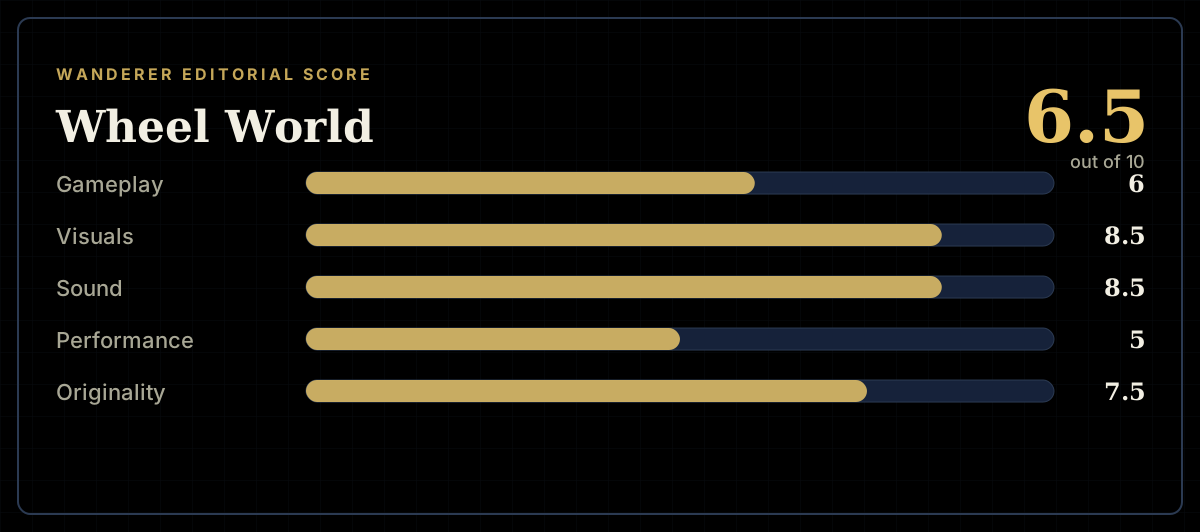
How the review scores each part of the gameWanderer Editorial -
The short versionWanderer Editorial