
Game review
The Village Above the Well Review
5.5 / 10
- Developer
- STREAM ON
- Publisher
- STREAM ON
- Released
- 11 September 2026
- Platforms
- ["Windows"]
- Genre
- Simulation
A Grandfather's Keepsake, A Village to Rebuild
The Village Above the Well opens on a small, sincere premise: a grandfather lost the only keepsake he had left of the woman he loved, a blue stone medallion, somewhere in the abandoned mining galleries beneath the village well. Too old to climb down himself, he asks the player not to risk their life over an object, and the player, naturally, does exactly that anyway. It's a modest framing device, but it earns real sentiment by tying the entire village-building loop to a personal act of retrieval rather than an abstract resource race, and that emotional throughline is the game's clearest strength on paper.
Two Loops Stitched Together
Structurally, this is a village-builder married to an idle dungeon-crawler, and the stitching between the two halves is the most interesting design idea here. Above ground, players gather wood, stone, iron, and crystal across three quality tiers, raising a sawmill, quarry, warehouse, forge, and arcane workshop wherever they choose to place them, then hire woodcutters, stoneworkers, miners, and lapidaries who keep producing resources on timed expeditions, from ten minutes to twelve hours, even while the game is closed. Below ground, the well leads to seven dungeons of ten floors each, where combat resolves automatically while the village is being tended, and crucially, how deep the hero's expedition can push is gated entirely by what's been built and equipped up top. That's a clean, legible incentive loop: better forges produce better gear, better gear survives deeper floors, deeper floors yield the 42 relics and Founder's Seal pieces that unlock the well's true depths.
An Automation Game That Respects the Player's Time
The expedition system, letting hired workers and the dungeon-diving hero keep producing and progressing while the game sits closed, is a smart concession to a genre that too often demands players babysit a screen. Skill trees for mining and combat, three tiers of tools, and ten upgrade levels per equipment piece give the automation layer real long-term texture rather than a single flat progress bar, and the promise of "a small story about memory, loss and the way back home" told through the act of rebuilding is a genuinely appealing pitch for anyone who likes their idle games to have something resembling a soul.
A Serious Accusation From the Only Detailed Review
The review base here is thin, just three reviews total, and one of the two English-language reviews is far more than a simple thumbs-down. The reviewer, who logged only seven minutes of playtime, opens by identifying the developer as the team behind a prior free release called Bomb Farm, states plainly that Bomb Farm "was a free game that was fully made with AI," and then extends the same accusation to this release: "something fully made with AI, but now you gotta PAY for it." The same review reports hitting "a game breaking bug in the tutorial" that made continued play impossible, closing with "if you want to play a game that doesn't respect your money or your time... The modern digital homicide." That is a specific, serious set of claims, both an accusation of undisclosed AI-generated production and a concrete report of a tutorial-blocking bug, made by someone who paid for the game, and it has to be weighed heavily against a release asking $7.99 for what is otherwise pitched as a hand-crafted, story-driven village sim.
The Other Side of a Split Verdict
Set against that, the game's other two reviews describe something considerably warmer. A Brazilian Portuguese review, translated here, reads: "You can tell The Village Above the Well was made with a lot of care and attention to detail. It's great to see an indie game put so much personality into every part of the experience, from the atmosphere to the systems and buildings. The art is one of the biggest highlights! The visual style is beautiful, full of detail, and fits the game's concept perfectly... It's the kind of game where you can tell it was made by people who genuinely like what they're creating." That reviewer logged 405 minutes, more than six and a half hours, which is a meaningfully longer sample than the bug-report review's seven minutes. A second, shorter English review simply calls it "awesome game, well worth the money" after 870 minutes played, over fourteen hours, the deepest engagement of any reviewer on record. Three reviews split two-positive, one-negative is too small a sample to treat as statistically decisive in either direction, but the fact that the two positive reviewers both logged dramatically more time than the one leveling the AI-authorship and bug accusation is worth noting as a data point, not a rebuttal.
Verdict
The Village Above the Well is a game caught between two believable accounts of itself: a lovingly detailed village-and-dungeon hybrid with a real emotional hook, backed by two reviewers who each played for hours and came away moved by its atmosphere and systems, and a game that at least one paying customer experienced as an unplayable, possibly AI-generated mess that broke in its own tutorial. Both things being true simultaneously, a promising core loop and a serious unresolved accusation about its production and stability, is exactly why this lands as a cautious middle score rather than a confident recommendation. The automation-plus-dungeon structure is sound enough to be worth a look for genre fans patient enough to verify the tutorial holds up for them, but at $7.99 with a review base this small and this divided, going in with tempered expectations is the responsible move.
Screenshots
-

The hero's skill tree spans three pages of branching upgrade nodes across combat and survival trees.Image: STREAM ON via Steam -

The relics screen tracks all 42 collectibles across the well's seven dungeons.Image: STREAM ON via Steam -
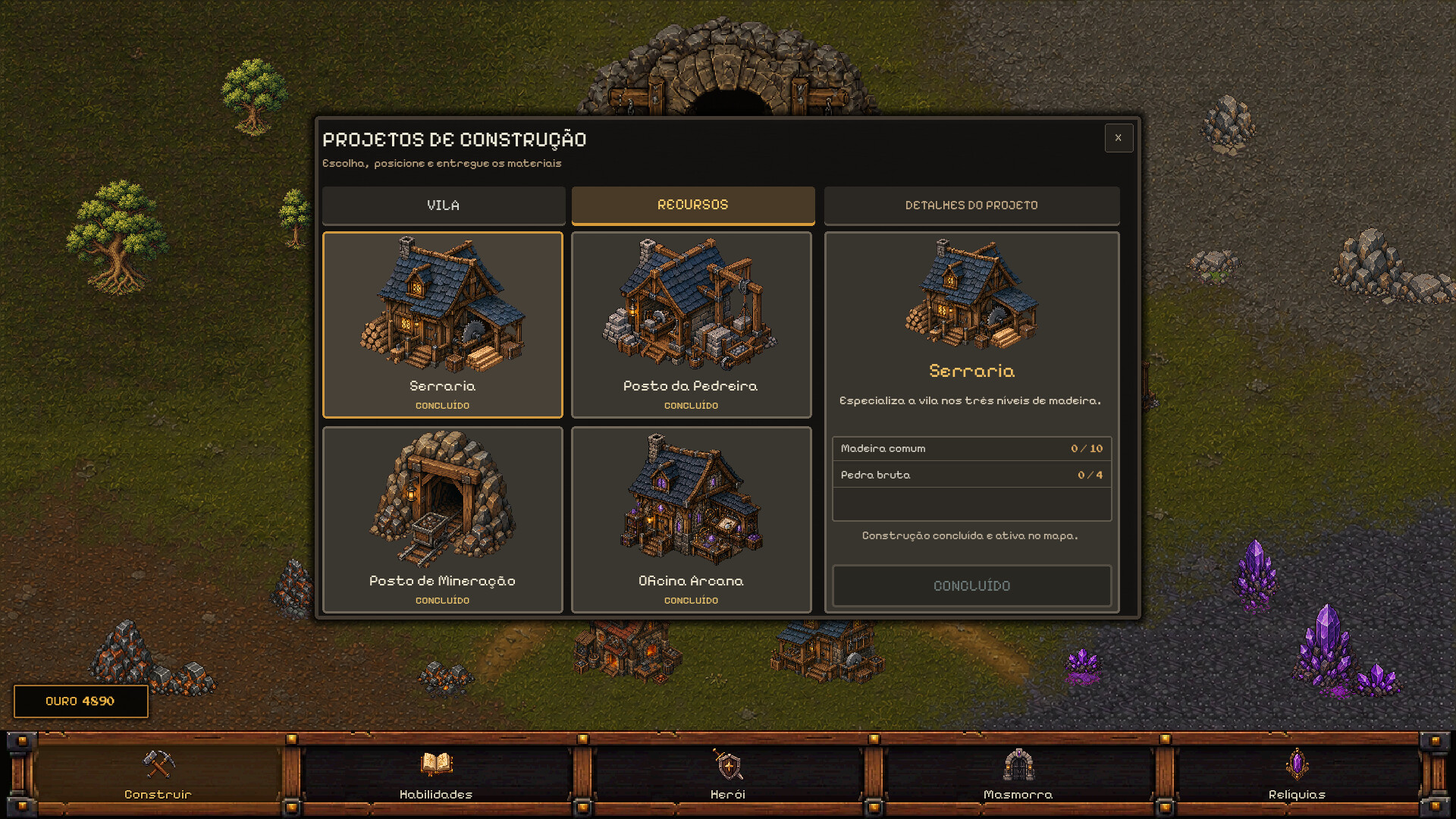
The build menu lets players place and complete the village's core production buildings.Image: STREAM ON via Steam