
Game review
Vile
5.5 / 10
- Developer
- Ardentsquid
- Publisher
- Ardentsquid
- Released
- 16 October 2019
- Platforms
- Windows
- Genre
- Action
- Monetisation
- Paid, no in-app purchases found
- Players
- true
The short version
Vile leans on familiar rogue-lite bones — procedurally generated rooms, souls-based meta-progression, unlockable characters — and dresses them up with a genuinely likeable cast of classic horror archetypes fighting demons and monsters across increasingly intense boss encounters. Fans of the genre's faster, messier end (Nuclear Throne, Enter the Gungeon) find real value here, but a chorus of reviewers report the core loop turning repetitive fast, progression feeling like a grind rather than a reward, and at least one specific boss fight crossing from difficult into what several separately call unfair.
Biggest strengths
- A genuinely likeable roster of classic horror-trope characters (a vampire hunter, a werewolf, Frankenstein's monster, Death himself) each with distinct abilities, unlocked progressively through play
- Solid, fluid controls and well-regarded boss design and art style, according to multiple reviewers
- Local split-screen co-op and PvP plus Steam Remote Play Together support for playing with a friend online through a locally-hosted session
Biggest weaknesses
- Level generation is repeatedly described as simplistic and repetitive, with one reviewer arguing a single well-designed hand-built level would be more engaging than the procedural generation on offer
- Character progression relies on a souls-based stat and talent system multiple reviewers call slow and grindy, with one specifically burning out on repeated first-area farming before quitting in frustration
- A specific, detailed complaint about the game's second boss describes it as disproportionately "spongy," capable of one-hit kills at close range despite short-range weapons forcing players to get close, while healing and spawning reinforcements throughout the fight
Who it's for: Rogue-lite shooter fans who want something in the Nuclear Throne/Dungeon Souls space with a horror-monster theme, played in short sessions rather than one long sitting.
Our recommendation: A reasonable pick-up-and-play option for genre fans at the right price, with the specific expectation that its later content gets grindy and at least one boss fight will test your patience more than your skill.
5.5 / 10
What it is
Vile sends players through procedurally generated dungeons to fight demonic creatures, "grim looking mushrooms," and swarms of worms, collecting souls, weapons and artifacts along the way before facing down escalating boss encounters. Its closest reference points, according to reviewers who name them directly, are Nuclear Throne, Enter the Gungeon, Dungeon Souls and Deathstate — fast, messy, top-down rogue-lite shooters built around quick runs and steady meta-progression rather than slow, methodical dungeon crawling. Where Vile carves out its own identity is in its cast: rather than generic adventurer archetypes, playable characters are drawn from classic horror tropes — a vampire hunter, a werewolf, Frankenstein's monster, and Death himself among them — each starting with distinct abilities like a dodge roll or a unique special attack, unlocked progressively as players clear zones.
It released on 16 October 2019 at NZD 16.49 from small developer Ardentsquid, with full controller support, local split-screen co-op and PvP, and Steam's Remote Play Together feature for sharing a locally-hosted session with a friend online. Its review corpus is modest — 20 English-language reviews — but detailed enough on both sides to draw real conclusions from, sitting at a solid Mostly Positive overall.
What works
Reviewers who enjoy the genre's faster, looser end are consistently positive about Vile's fundamentals. One early review, describing itself as "somekind of a first review" for the newly released game, recommends it directly to fans of Nuclear Throne, Dungeon Souls and Deathstate, noting the enemy variety extends beyond generic demons to include distinctly designed threats like fast-moving worms and hostile mushrooms. A more detailed review praises the character roster specifically: "each character is a classic horror trope... but each one" brings distinct mechanical identity rather than being a reskin, and calls out solid controls and fleshed-out mechanics as the game's real strengths beyond its art style. Boss design draws particular praise from multiple reviewers, with one describing fights escalating in creativity as the game progresses — battling across "the corpse of a boss you just killed," down a fast-moving river, or atop a moving stage — rather than simply scaling up numbers.
At least one reviewer specifically credits the developer's responsiveness: after reporting a bug where weapons failed to carry between levels, they later noted in an edit that they could no longer reproduce it, adding that "the developer has been very responsive and open to ideas and questions" — a good sign for a small studio's ongoing support, even in a corpus this size.
Where it wears thin
The most detailed critical review argues that everything outside the art assets is "extremely simplistic and repetitive," singling out map generation and objectives as lacking meaningful variety and combat outside of boss fights as "very basic." A separate reviewer who put several hours into the game's progression system reaches a similar conclusion from a different angle: repeated soul-farming in the first area to raise stats became so tedious that they stopped playing altogether, specifically recommending more detail and uniqueness in level design as the fix. That's a meaningful structural complaint for a rogue-lite specifically, since repeat-run variety is close to the entire point of the genre.
The single most specific and pointed complaint in the corpus concerns the game's second boss, which one reviewer describes in detail as disproportionately unfair relative to everything before it: "super spongy," capable of a one-hit kill at close range while the game's weapons have "terrible range" forcing that closeness anyway, and further complicated by a healing mechanic and constant reinforcement spawns. That reviewer reports spending almost their entire playtime stuck on this one encounter — a specific, credible account of a real difficulty spike rather than a general complaint about the game being hard. The achievement data offers some corroboration: only 6.1% of players have defeated the final boss, a meaningfully low completion rate that's consistent with a genuine difficulty wall somewhere in the game's progression, even if the achievement data alone can't confirm exactly where.
The multiplayer confusion, sorted out
One review in the corpus is worth addressing directly because it's written as an all-caps warning: that the game claims "online multiplayer local coop" but delivers only local play. Checking the game's own current Steam category listing clarifies what's actually on offer: Single-player, Multi-player, PvP and Co-op are all listed alongside "Shared/Split Screen PvP," "Shared/Split Screen Co-op," and "Remote Play Together." That combination describes local, same-screen multiplayer that can additionally be shared with a remote friend through Steam's Remote Play Together technology — which lets one player host a locally-designed multiplayer session while a friend joins in over the internet, controlling a second local-style player slot remotely. That's a genuinely useful feature, but it is meaningfully different from dedicated online matchmaking or netcode built for two separate players each running their own game client — the distinction the frustrated reviewer seems to have expected and not found. It's worth flagging plainly for a prospective buyer specifically looking for traditional online co-op: Vile's multiplayer is built around local-style sessions extended over Steam's remote-play tooling, not a standalone online mode.
Weighing the value proposition
At NZD 16.49, Vile sits at a moderate price for the genre — not the impulse-buy territory of a $5 rogue-lite, but well below the premium end either. One reviewer's blunt assessment, awarding a 6/10 while separately calling "the asking price... a joke," suggests at least some buyers feel the content on offer doesn't fully justify the cost, though that same reviewer's numeric score still lands on the positive side of neutral. Weighed against the genuinely well-received character roster and boss design, and against the specific structural complaints about repetitive generation and grindy progression, this reads as a game whose ceiling is "solidly decent for the right audience" rather than a hidden gem — worth its price primarily for players who specifically want more of the Nuclear Throne/Gungeon design space and can tolerate some repetition getting there.
Verdict
Vile delivers a competent, occasionally inspired take on the fast rogue-lite shooter formula, with a genuinely fun horror-themed cast and boss encounters that reviewers consistently praise for their escalating creativity. But repetitive level generation, grindy meta-progression, and a specific, credibly-documented difficulty spike keep it from clearing the bar its own inspirations set. A reasonable pick for genre fans looking for a horror-flavoured session-based rogue-lite, best enjoyed in short bursts rather than one long push toward the ending.
Pros and cons
Pros
- A genuinely likeable roster of classic horror-trope characters (a vampire hunter, a werewolf, Frankenstein's monster, Death himself) each with distinct abilities, unlocked progressively through play
- Solid, fluid controls and well-regarded boss design and art style, according to multiple reviewers
- Local split-screen co-op and PvP plus Steam Remote Play Together support for playing with a friend online through a locally-hosted session
- Boss encounters get meaningfully more intense and varied as the game progresses, with later fights taking place across shifting, hazard-filled arenas
Cons
- Level generation is repeatedly described as simplistic and repetitive, with one reviewer arguing a single well-designed hand-built level would be more engaging than the procedural generation on offer
- Character progression relies on a souls-based stat and talent system multiple reviewers call slow and grindy, with one specifically burning out on repeated first-area farming before quitting in frustration
- A specific, detailed complaint about the game's second boss describes it as disproportionately "spongy," capable of one-hit kills at close range despite short-range weapons forcing players to get close, while healing and spawning reinforcements throughout the fight
- The game is not a true online-matchmaking multiplayer title despite reviewer confusion on this point — its multiplayer categories are local split-screen and Steam's Remote Play Together, not dedicated online co-op or PvP
- A relatively low achievement-completion ceiling (just 6.1% of players have defeated the final boss) suggests a meaningful fraction of the playerbase stops well short of finishing
Screenshots
-

VileImage: Ardentsquid via Steam -

VileImage: Ardentsquid via Steam -

VileImage: Ardentsquid via Steam -
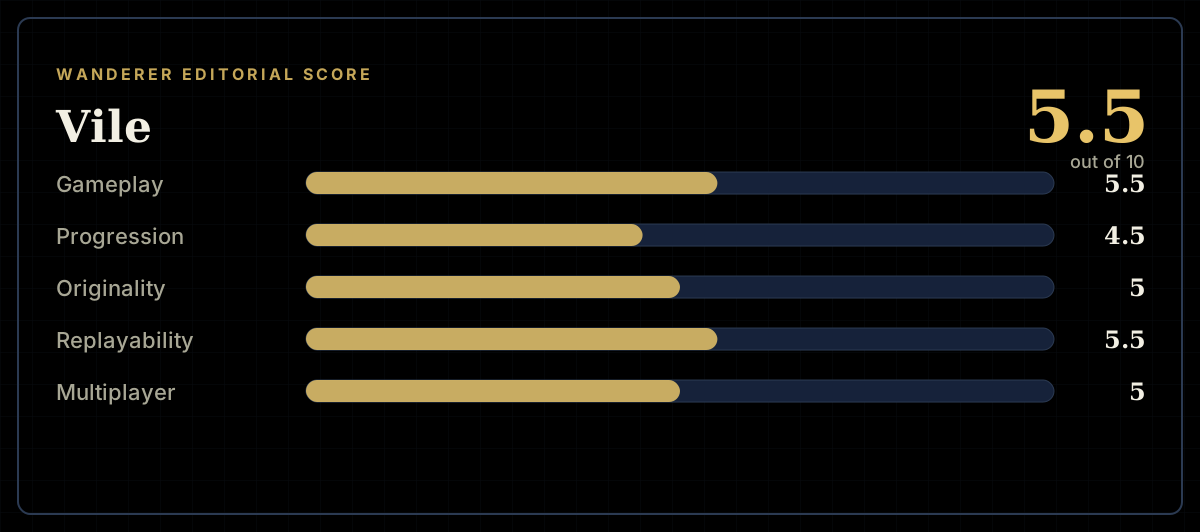
How the review scores each part of the gameWanderer Editorial -
The short versionWanderer Editorial