Game review
Turn Based Boxing: Tactics - Legends Edition
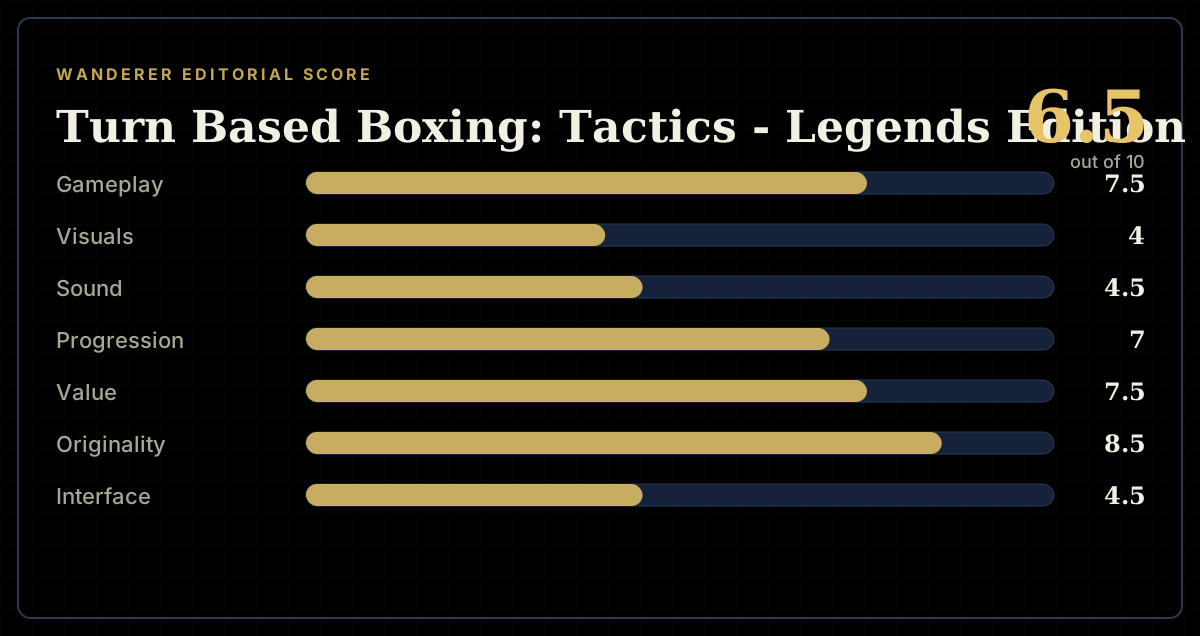
6.5 / 10
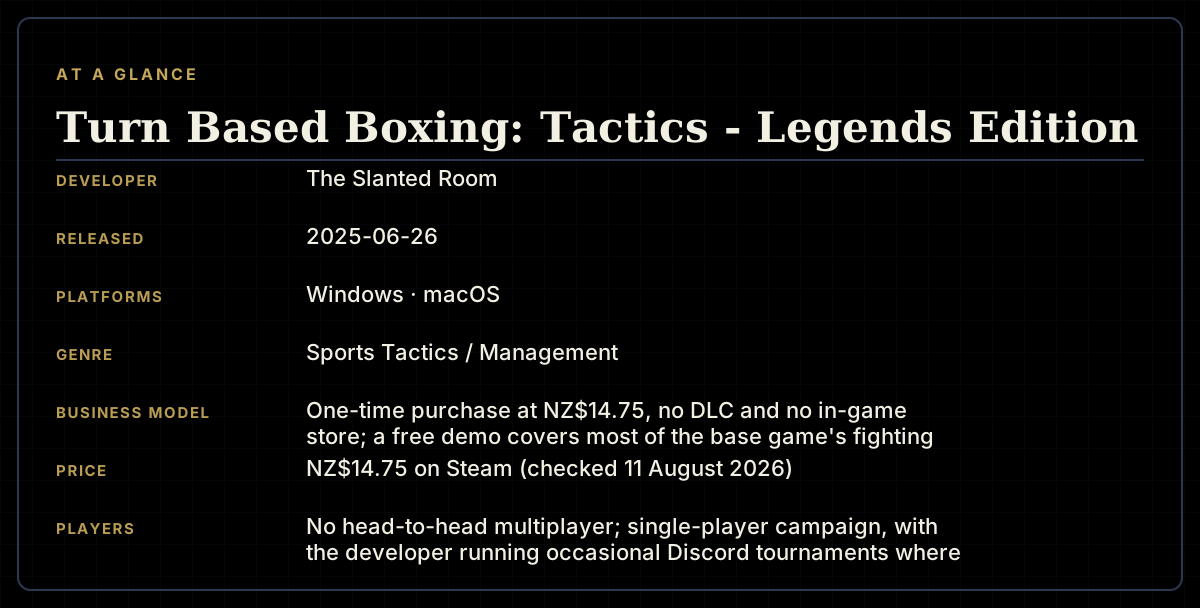
- Developer
- The Slanted Room
- Publisher
- The Slanted Room
- Released
- 26 June 2025
- Platforms
- Windows, macOS
- Genre
- Sports Tactics / Management
- Monetisation
- One-time purchase at NZ$14.75, no DLC and no in-game store; a free demo covers most of the base game's fighting
- Players
- No head-to-head multiplayer; single-player campaign, with the developer running occasional Discord tournaments where players submit a fighter for an AI-controlled bracket
The short version
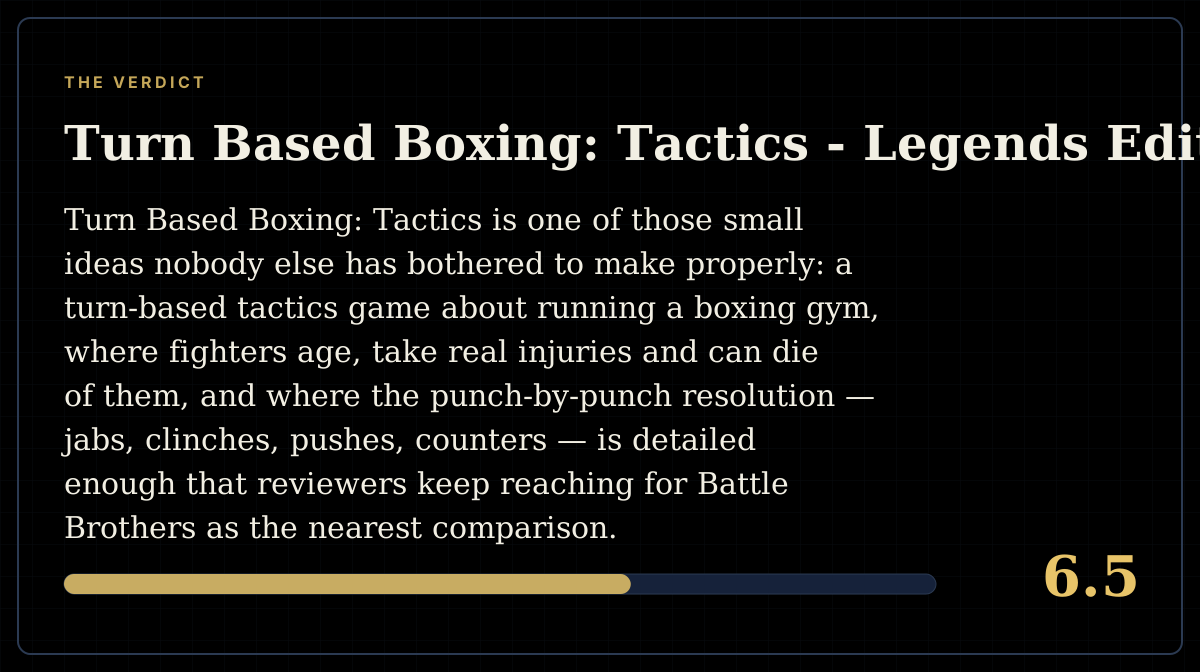
Turn Based Boxing: Tactics is one of those small ideas nobody else has bothered to make properly: a turn-based tactics game about running a boxing gym, where fighters age, take real injuries and can die of them, and where the punch-by-punch resolution — jabs, clinches, pushes, counters — is detailed enough that reviewers keep reaching for Battle Brothers as the nearest comparison. That combat layer earns its praise. Everything wrapping around it is rougher: a cluttered, unexplained interface, a single music track that restarts jarringly every time you change menus, and a management layer — training, finances, recruitment — that even its fans describe as thin next to the fighting itself.
This is a genuinely tiny release. Its English-language Steam review sample sits at eleven reviews, thirteen months after launch, so this review reads every one of them rather than a sample of them. Ten recommend it. The one that doesn't makes almost exactly the same complaints as the ten that do — they just weigh them differently.
Biggest strengths
- The punch-by-punch resolution — jabs, clinches, pushes, counters, stamina — is detailed and satisfying enough that multiple reviewers independently compare its perk system to Battle Brothers
- Permadeath with real stakes: boxers age, injuries compound, and fighters can die in the ring or of old age, which reviewers say gives fights weight that most sports sims don't bother with
- A free demo that, per its own players, covers most of the base game's actual fighting, so there's a genuine way to try before paying
Biggest weaknesses
- The management menus are widely called confusing and cluttered, with information like an opponent's stats hidden behind extra clicks instead of shown by default
- A single music track restarts every time you switch menus, which more than one reviewer flags as a basic, jarring oversight
- Visual presentation is plain to the point that even positive reviews call it unattractive
Who it's for: Boxing fans and tactics-game players who don't mind rough presentation in exchange for a mechanically dense combat system they can't get anywhere else, and who have the patience to fight through an interface the developer hasn't finished explaining.
Our recommendation: Play the free demo first — several reviewers note it covers essentially the whole base game's fighting on its own — and buy only if the punch-by-punch tactics hook you before the menus have a chance to put you off. At NZ$14.75 the full purchase is a low-risk add-on once the demo has done that job.
6.5 / 10
Most sports games avoid death entirely, and most tactics games avoid boxing entirely. Turn Based Boxing: Tactics - Legends Edition sits in the small overlap between the two: a turn-based tactical combat system, resolved punch by punch, wrapped around a gym-management loop where the fighters you've trained for months can be seriously hurt or killed by the sport they're in. It's made by one studio, The Slanted Room, describing itself on its own store page as "made for boxers and boxing fans by a boxer and a boxing fan" — and that origin shows in both directions, in a combat system with real specificity and a wrapper around it that reads like a first pass nobody circled back to finish.
A gym full of people who can actually die
The premise is straightforward on paper: recruit boxers, train their stats, assign perks, send them into the ring, and try to build a stable that climbs the rankings toward the Lineal Championship. What sets it apart is that none of that is safe. Boxers age over the course of a career; at 60 they become vulnerable to dying from ring injuries, and by 100 death is certain. Every fight carries a real chance of ending a career — or a life — permanently, and the game's own store description doesn't soften that: "This is a hard game. Some boxers will die." Reviewers who've spent real time with it describe building attachments to specific fighters the same way tactics-game players describe their mercenary companies in Battle Brothers, which is the comparison that comes up again and again, unprompted, across the review sample: the perk system, the gradual stat growth, the sense that a talented recruit is worth protecting rather than spending recklessly.
Difficulty here is a dial rather than a fixed setting. Player-adjustable modifiers let you turn the whole thing into a bloodbath — one reviewer describes cranking punch damage and injury severity so their gym became a conveyor belt of career-ending violence — or soften it into a much gentler management sim. That flexibility is one of the more consistently praised things about the game, because it means the permadeath premise doesn't have to be all-or-nothing for every player who tries it.
The fighting itself, and why Battle Brothers keeps coming up
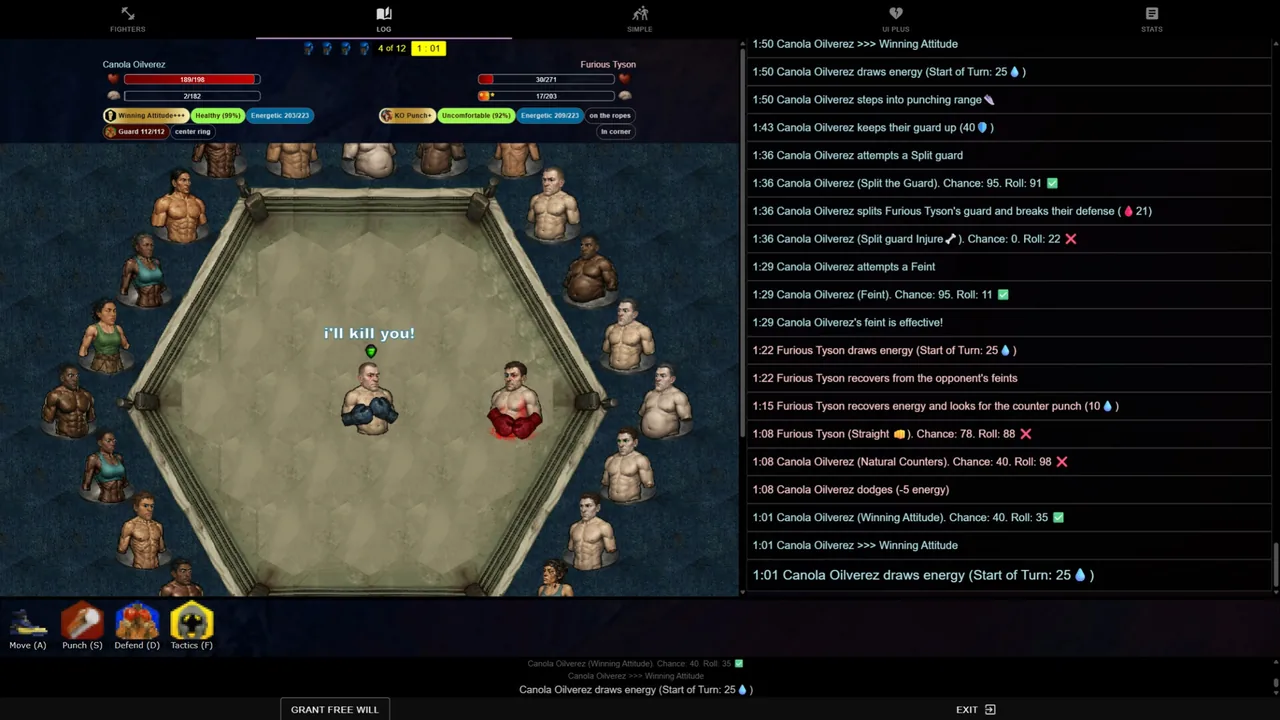
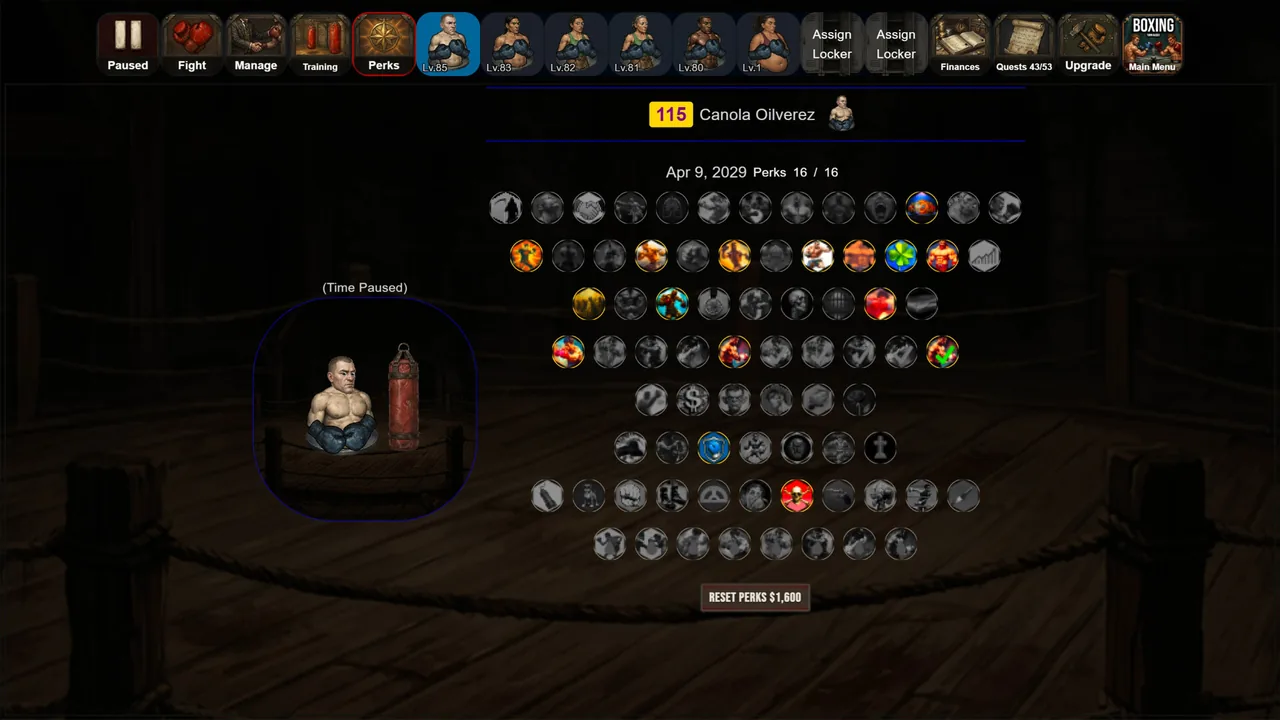
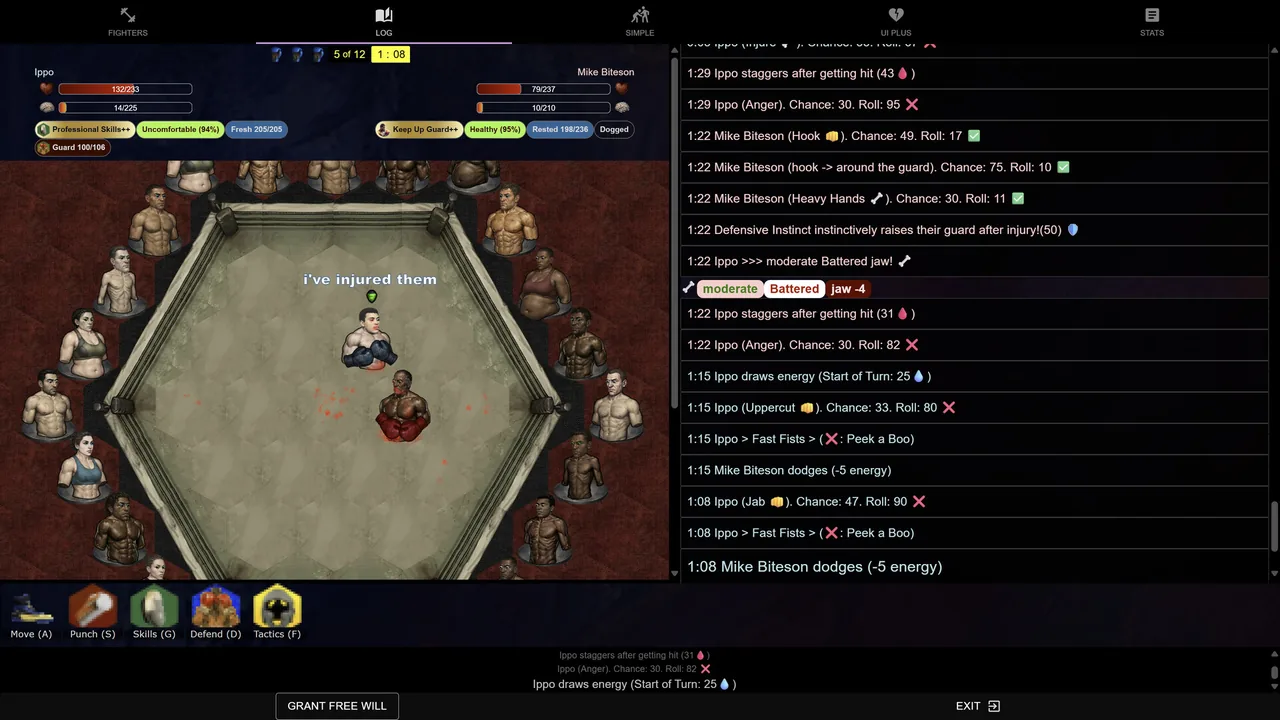
The actual resolution of a bout is where the game earns its strongest reviews. It isn't an abstracted stat check; reviewers describe jabs, clinches, pushes and counters as distinct, readable actions with their own tactical logic, closer in feel — as one puts it — to the combat in NEO Scavenger or Dwarf Fortress than to any other boxing game on the market. Perks are the build system layered on top: special abilities tied to a boxer's stats, fighting style and weaknesses, with enough combinations that reviewers describe genuinely distinct fighter archetypes — the aggressive killer, the defensive counter-puncher, the feinting southpaw — built from the same underlying toolkit. Progress toward new strategies is gated behind quests, which double as an unusually researched flavour layer: rare event cards drop real boxing history, trivia and slang between fights rather than generic filler text, consistent with a developer who says the whole project grew out of a genuine interest in the sport. There are also easter egg fighters drawn from real boxing history, obituaries and fiction alike for players who go looking.
The free demo is worth calling out on its own, because several reviewers specifically recommend it as the best way to evaluate the game: it reportedly lets you experience most of the base game's actual fighting for nothing, which is a rare and player-friendly way for a tiny studio to let its strongest system speak for itself before asking for money.
Where the seams show
The same review sample that praises the combat is unusually blunt about everything around it. The game's one negative review — from a player with roughly 3.7 hours on record who says they started with a "reluctant thumbs up" before reversing it — reads less like an outlier and more like a harsher version of what the positive reviews already say more gently: menus with too many buttons, information about an opponent that should be visible on screen instead sitting behind extra clicks, a tutorial split confusingly between popup windows and separate in-interface tips, inconsistent text formatting and grammar, and a single music track that restarts every time you switch between menus — a small bug that several reviewers single out specifically for how jarring it is. None of that is disputed by the positive reviews; a five-star write-up that otherwise calls the game "the best 'written by one guy indie style game'" the reviewer has played in years still opens by warning that "everything about the way it is presented sucks."
The gap between the two halves of the game is stated most clearly by a reviewer who liked it enough to recommend it anyway: "Everything outside the boxing is underbaked. Training your boxers is extremely boring and the finances fall short of a satisfying management game." Even one of the more enthusiastic reviews, at sixteen hours in, reports the loop going stale and specifically asks for more things to spend money and time on — a yearly awards system, an equipment store, meaningful weight classes, more game modifiers — the kind of requests that read as evidence of real engagement rather than complaint for its own sake.
A small, real audience rather than a loud one
Judging traction here has to be honest about scale. Thirteen months after release, the game's English-language Steam review count sits at eleven — not a filtered sample, all of them, which is why this review discusses every single one by name rather than characterising a slice of a larger pool. Ten of the eleven recommend the game; Steam's own systems don't display a percentage rating tier until a listing clears ten reviews, so this one only just qualifies for one at all.
The Steam achievement data tells a more encouraging story about the players who do pick it up. 79% of players who've touched achievements at all have recruited a boxer and 71% have fought at least once — a normal tutorial drop-off. From there the curve is gentler than most niche indie releases manage: 49% have won five fights, 46% have won ten, and 32% have stuck around long enough to win fifty. Nearly a tenth of the tracked player base has climbed all the way to the game's number-one ranked boxer, which is a real achievement-completion result for a genre this narrow, and it lines up with reviewers who report hundreds or low thousands of minutes played rather than a quick bounce.
Value and where this leaves it
At NZ$14.75, with no DLC, no in-game store and a free demo that does real work letting players judge the fighting before paying, the commercial side of this is about as low-pressure as an indie release gets. Cross-save with the Android version — including importing individual boxers between platforms — adds real convenience for anyone who wants to check in on a gym from a phone. One reviewer even reports the developer personally gifting them the mobile version after a Steam purchase, which fits a small studio that also runs its own Discord and hosts fighter-submission tournaments there — the kind of direct community presence bigger studios rarely bother with.
Final verdict
Turn Based Boxing: Tactics is a game with a genuinely good idea at its centre, executed by someone who clearly understands both boxing and tactical combat design, sitting inside a presentation layer that hasn't caught up to the strength of what it's protecting. The fighting system is specific, tactical and dense enough to earn its Battle Brothers comparisons on merit, not just on shared DNA. The interface, audio and management layers around it are the work of a solo developer who hasn't had the time, or maybe the help, to give them the same attention. Ten of eleven reviewers recommend it anyway, and the achievement data suggests the players who get past the rough edges tend to stick around.
This isn't a game to buy on a whim. It's one to try for free first, let the punch-by-punch tactics make their case, and decide from there whether the menus around them are a price worth paying for a system that, as far as this review can tell, nobody else on Steam has quite built.
Pros and cons
Pros
- The punch-by-punch resolution — jabs, clinches, pushes, counters, stamina — is detailed and satisfying enough that multiple reviewers independently compare its perk system to Battle Brothers
- Permadeath with real stakes: boxers age, injuries compound, and fighters can die in the ring or of old age, which reviewers say gives fights weight that most sports sims don't bother with
- A free demo that, per its own players, covers most of the base game's actual fighting, so there's a genuine way to try before paying
- Rare setting done with real care — event cards drop boxing history, trivia and slang between fights, written by developers who describe themselves as boxers and boxing fans first
- Cross-save with the Android version, including importing individual boxers, so a roster started on PC keeps working on a phone
- Deep customisation of difficulty and injury/death frequency, letting players dial the game from a punishing permadeath simulation down to a much gentler one
Cons
- The management menus are widely called confusing and cluttered, with information like an opponent's stats hidden behind extra clicks instead of shown by default
- A single music track restarts every time you switch menus, which more than one reviewer flags as a basic, jarring oversight
- Visual presentation is plain to the point that even positive reviews call it unattractive
- The core fight loop grows repetitive well before the content does — one enthusiastic 16-hour reviewer says it was "already getting very stale" and asks for more systems to spend money and time on
- The layer outside the ring — training, finances, recruitment — is described by more than one reviewer as underbaked next to the combat it surrounds
- Text throughout the game has inconsistent formatting and grammar errors, a rough edge typical of a one-person production
Screenshots
-
Turn Based Boxing: Tactics - Legends EditionImage: The Slanted Room via Steam -
Turn Based Boxing: Tactics - Legends EditionImage: The Slanted Room via Steam -
Turn Based Boxing: Tactics - Legends EditionImage: The Slanted Room via Steam -
How the review scores each part of the gameWanderer Editorial -
The game at a glanceWanderer Editorial -
The short versionWanderer Editorial