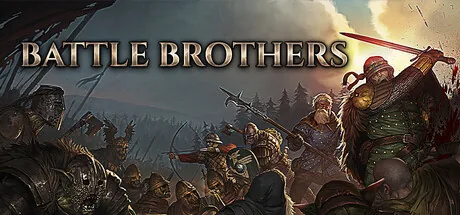
Game review
Battle Brothers
8 / 10
- Developer
- Overhype Studios
- Publisher
- Hooded Horse
- Released
- 24 March 2017
- Platforms
- Windows
- Genre
- Tactical RPG / Company Management
- Monetisation
- One-time purchase at NZ$39.99, with nine expansions. Pricing seven of them on 4 August 2026 gives NZ$100.93 for the add-ons — these are substantial content expansions rather than cosmetic packs. No microtransactions.
- Players
- Single-player only
The short version
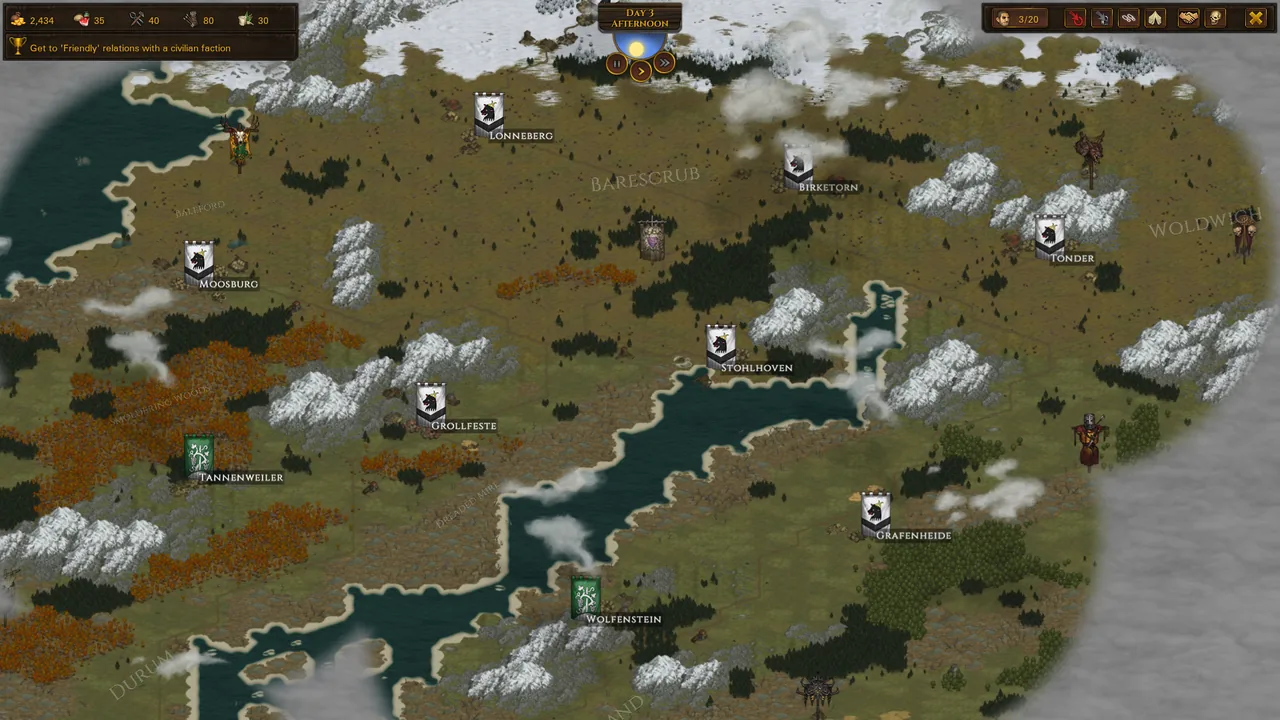
A procedurally generated medieval world, a wagon, and twelve men you can barely afford. Battle Brothers understands something most tactical games don't — that the interesting resource isn't hit points but *people*, each with a name, a background, hidden stat ceilings you'll never fully know, and a family somewhere. Losing one hurts, and it should. The tactical layer is excellent and the campaign layer is better. What holds it back is a mid-game difficulty wall that arrives abruptly, a build system offering far more options than are actually viable, and a hit-chance model that has been generating the same argument for nine years.
Biggest strengths
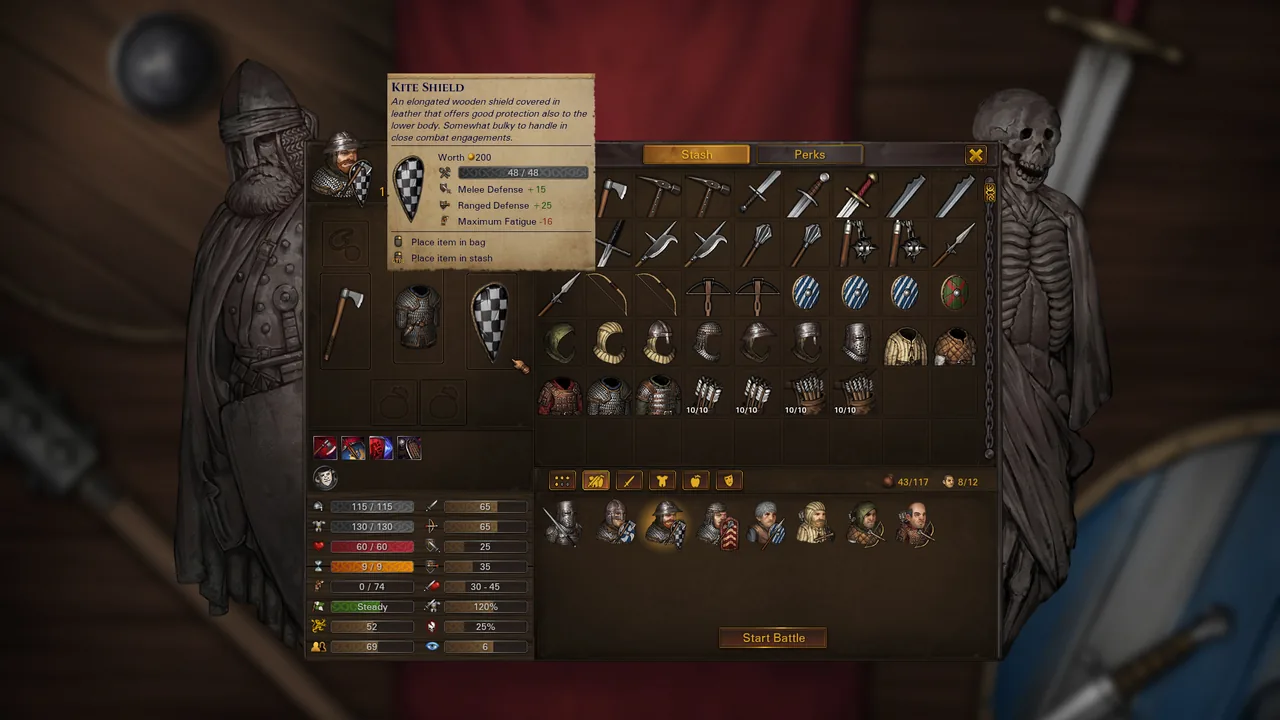
- The company layer is the real game — hiring, paying, feeding, equipping and burying named mercenaries makes every tactical decision carry economic weight
- Backgrounds give each recruit hidden stat ceilings and personality, so a promising farmhand may quietly be better than an expensive sellsword
- Tactical combat is genuinely deep, with terrain, morale, fatigue, formation and weapon-specific special attacks all mattering
Biggest weaknesses
- The mid-game difficulty spike is abrupt — reviewers with hundreds of hours describe early combat as hard-but-fair and the middle as a different game entirely
- Many character builds are non-viable, and community guides simply skip whole skills as worthless, which makes the breadth of choice partly illusory
- The hit-chance system produces streaks that feel impossible, and nine years of argument about whether that's perception or design has never resolved
Who it's for: Players who want a hard, systems-driven tactical RPG where losing is part of the story, and who enjoy managing an economy as much as a battle line. Not for anyone who needs a fair fight, and not for players who want their build choices to all be valid.
Our recommendation: Buy the base game first — it's complete on its own and NZ$39.99 is fair for a campaign most players spend 85 hours in. Start on the lowest difficulty regardless of your tactics-game experience; the community consensus, from people who like XCOM, is that this game's "beginner" setting is harder than it sounds. Read a build primer before you commit character perks, because several of the available choices are traps and the game will not tell you. Expansions are worth adding later, not up front.
8 / 10
Most tactical games give you units. Battle Brothers gives you a payroll.
You start with a wagon, a few coins and a handful of men who had nothing better to do. Each one has a name and a background — a farmhand, a poacher, a disgraced knight, a lumberjack — and that background sets hidden ceilings on how good he can ever become. You won't know for certain. You'll find out over twenty levels, or you'll find out when a goblin puts an arrow through him in the fourth week and you have to hire whoever's in the tavern.
That's the game. Everything tactical serves the ledger, and the ledger is what makes the tactics matter.
Why the company layer works
The insight here is that a tactical RPG becomes far more interesting when the units are expensive and irreplaceable. Wages come due whether you fought that week or not. Food runs down as you travel. Armour takes damage that costs real money to repair, so winning a fight badly can leave you poorer than losing one quickly. A brother with good stats is an investment you've been paying into for thirty hours.
So you find yourself making decisions no scripted campaign would produce. Retreating from a contract you accepted because the enemy composition turned out wrong, and eating the reputation hit. Deliberately spending a cheap recruit's life to hold a chokepoint. Taking a caravan escort you don't want because payday is Thursday.
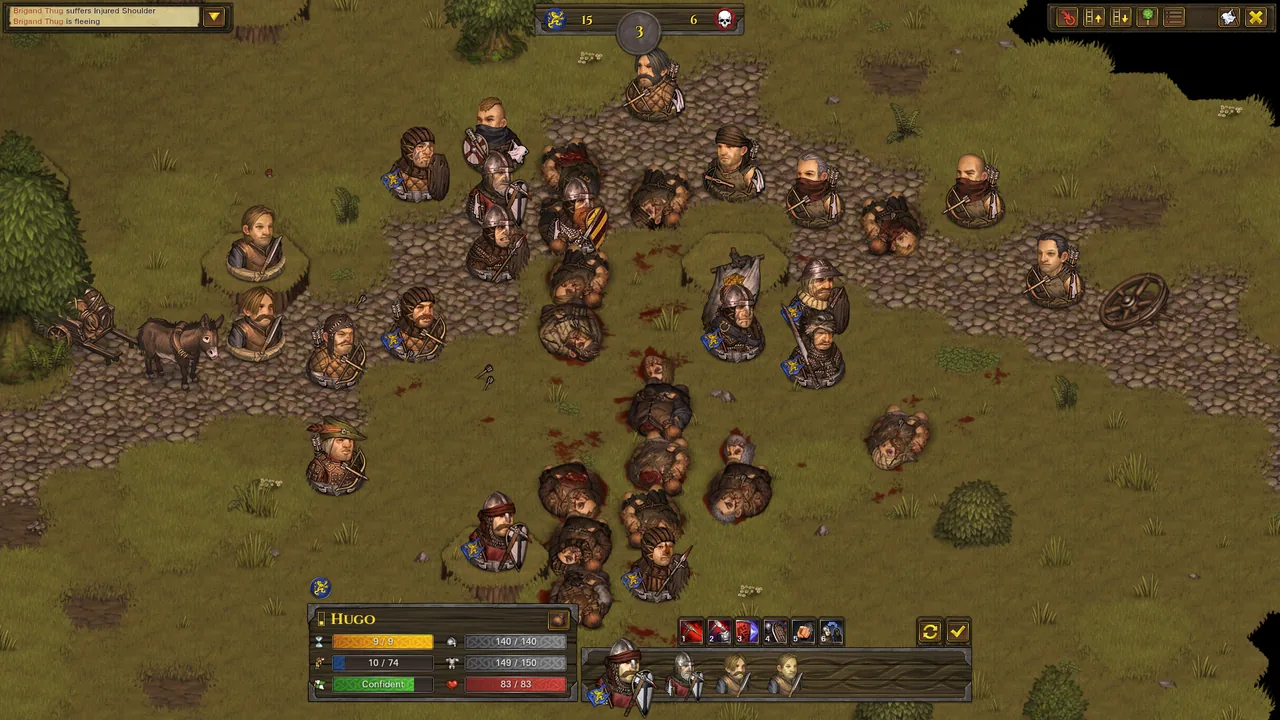
The combat underneath supports all of it. Terrain and elevation matter, fatigue limits what you can do per turn, morale can collapse an entire line, and weapons have specific special attacks that make a billhook a different proposition from a warhammer. It rewards preparation more than reflex, which is exactly right for a game where your assets are people you can't replace quickly.
Recent reviewers have a median of 85 hours logged. This is a game people finish and then start again, helped by procedural worlds and several distinct starting scenarios.
The three complaints, in order of seriousness
The mid-game wall. This is the most credible criticism and it comes from people who love the game. A reviewer with 381 hours describes early combat as comparable to XCOM — hard but fair, where playing well means a bad fight costs you a couple of men — and then an abrupt mid-campaign spike where the difficulty stops scaling with you and starts scaling past you. Another, who explicitly enjoys the genre, says even the easiest setting is brutal with save-scumming. Whatever the intent, the curve has a step in it rather than a slope.
The build traps. A reviewer with 44 hours makes a point I think is the sharpest structural criticism available: the game offers many ways to build a warrior, but only a few of them work, and every community guide simply skips certain skills as worthless. Breadth of choice that resolves into one correct answer isn't depth — it's a quiz. For a game this long, discovering at hour forty that you've invested twenty levels into a dead end is a real cost.
The hit chances. And here's the nine-year argument. A thoughtful 2026 review with 141 hours puts it better than I can: a lot of the negative reviews come from the RNG, many players call it broken and unfair, many others insist it's balanced and tested to death — and both groups are right about their own experience. A 75% chance missing four times in a row is unremarkable statistically and infuriating practically, and Battle Brothers surfaces those moments at exactly the points where a campaign can die.
I don't think the system is broken. I do think a game that asks you to invest thirty hours in a character owes you more insulation from variance than this one provides, and the players ripping their hair out aren't confused about probability — they're objecting to the stakes attached to it.
A historical note worth correcting
If you dig into the negative reviews you'll find a well-upvoted one from 2017 arguing that the studio's announcement of no further additions and no mod support was damaging its reputation and sales, and that the review score had fallen as a result.
That complaint has been comprehensively overtaken by events. Overhype went on to release nine expansions over the following years — beasts, deserts, northern raiders and more — all of them substantial content rather than cosmetic packs. It's a good reminder that the loudest reviews on an old game's page can be describing a situation that no longer exists.
The current cost picture: NZ$39.99 for the base game, and NZ$100.93 for seven of the expansions I was able to price. That's a lot in total, but the base game is complete and self-contained, and buying it alone is a perfectly good decision.
8.0 out of 10. Rated 8.0 out of 10.
Battle Brothers is one of the best things in its genre and, nine years on, still has no real imitator — Wartales comes closest and is gentler, Darkest Dungeon shares the attrition philosophy with far less tactical depth. If the idea of running a mercenary company as a business appeals even slightly, this is the game.
It stops short of the top because two of its problems are structural rather than tonal: a difficulty curve with a step in it, and a character system whose apparent breadth narrows to a handful of correct paths. Neither ruins it. Both mean I'd hand a new player a build primer along with the recommendation, which is not something a nine-out-of-ten needs.
Pros and cons
Pros
- The company layer is the real game — hiring, paying, feeding, equipping and burying named mercenaries makes every tactical decision carry economic weight
- Backgrounds give each recruit hidden stat ceilings and personality, so a promising farmhand may quietly be better than an expensive sellsword
- Tactical combat is genuinely deep, with terrain, morale, fatigue, formation and weapon-specific special attacks all mattering
- Procedurally generated worlds and multiple starting scenarios give it enormous replay value, reflected in an 85-hour median among recent reviewers
- Nine substantial expansions added over the years, all of them content rather than cosmetics
- Permadeath that produces stories instead of frustration, because the campaign is built to absorb losses
Cons
- The mid-game difficulty spike is abrupt — reviewers with hundreds of hours describe early combat as hard-but-fair and the middle as a different game entirely
- Many character builds are non-viable, and community guides simply skip whole skills as worthless, which makes the breadth of choice partly illusory
- The hit-chance system produces streaks that feel impossible, and nine years of argument about whether that's perception or design has never resolved
- Presentation is bare — functional art, minimal fanfare, and an interface that expects you to already know what matters
- The contract loop can feel thin: take job, travel, fight, return, sell, repeat
- The full set of expansions costs more than twice the base game
Screenshots
-
Battle BrothersImage: Hooded Horse via Steam -
Battle BrothersImage: Hooded Horse via Steam -
Battle BrothersImage: Hooded Horse via Steam -
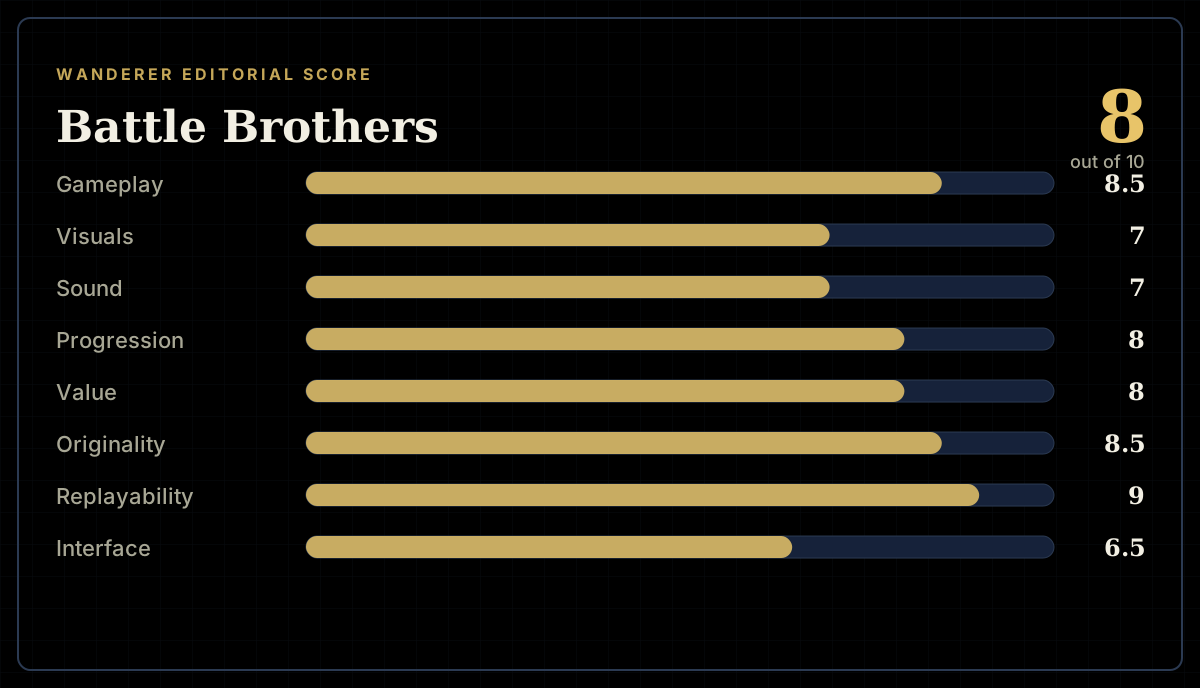
How the review scores each part of the gameWanderer Editorial -
The short versionWanderer Editorial