
Game review
Truberbrook
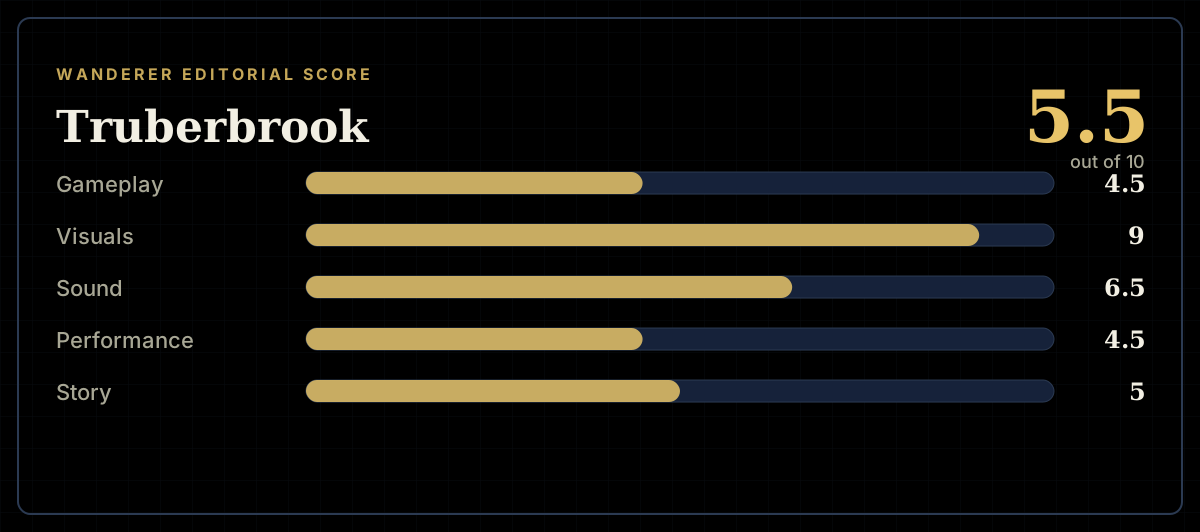
5.5 / 10
- Developer
- btf
- Publisher
- Headup
- Released
- 12 March 2019
- Platforms
- Windows, Mac, Linux
- Genre
- Adventure
- Monetisation
- Paid, no in-app purchases found
- Players
- false
The short version
Truberbrook drops a young American physicist into a strange 1960s German village pulled into an interdimensional science-fiction mystery, presented through genuinely hand-built physical dioramas scanned and rendered into the game world. Its visual craft draws close to unanimous, often emotional praise. But a large, detailed share of its own review corpus argues the puzzles beneath that presentation follow unfair, undocumented 90s adventure-game logic, the story is disjointed and unsatisfying, and real, specific bugs — including a save system reviewers call non-intuitive and at least one game-breaking issue reported and left unfixed for years — undercut a genuinely striking piece of craftsmanship.
Biggest strengths
- A genuinely extraordinary, one-of-a-kind visual style built from real, physically hand-crafted dioramas rather than purely digital art, drawing close to universal praise even from the corpus's harshest critics
- Strong voice acting and a distinctive, quirky cast of village characters that multiple reviewers specifically enjoy independent of the plot's coherence
- A relaxing, low-pressure pace that a portion of reviewers explicitly appreciate as well-suited to casual, unhurried play
Biggest weaknesses
- A large, repeated critical thread describes real, specific technical bugs: a game-ending bug that stripped a saved game of all interactive hotspots, an unclear and non-intuitive save system, and no confirmation prompt before quitting, causing reviewers to lose progress accidentally
- Widely and specifically criticised puzzle logic, with multiple independent reviewers reporting they needed a walkthrough to progress due to undocumented, illogical solutions — one reviewer notes a specific progression-blocking bug was reported to the developers and remained unfixed five years after launch
- A story a substantial share of reviewers call disjointed, cliche-driven, and ultimately unsatisfying, with characters described as one-dimensional caricatures despite the visual craft surrounding them
Who it's for: Point-and-click adventure fans who prioritize visual artistry and atmosphere and can tolerate old-school, sometimes illogical puzzle design without leaning on a walkthrough.
Our recommendation: Worth experiencing for the presentation alone on a steep discount — go in with a walkthrough on hand, save obsessively given the reported bugs, and temper expectations for the story and puzzle fairness.
5.5 / 10
What it is
Truberbrook follows a young American physicist on what should be a simple vacation to a remote German village, only to be drawn into an interdimensional science-fiction mystery involving a portal, a stranded traveler, and a villain with designs on using it herself. Developed by btf and published by Headup, its defining feature is presentation: rather than purely digital art, the game's sets were physically hand-built as detailed miniature dioramas and then scanned and rendered into the 3D game world, giving every location a tactile, handcrafted quality distinct from almost anything else in the genre. It released on 12 March 2019 at NZD 43.59.
Its review corpus, 529 in English, sits at a genuine Mostly Positive 73% (386 to 143), and reading through it in depth reveals a familiar shape for a visually extraordinary adventure game: presentation draws consistent, often emotional praise, while the mechanics and narrative built on top of it draw real, detailed, repeated criticism.
Visual craft that earns nearly universal admiration
Almost without exception, this corpus agrees on Truberbrook's core visual achievement. "It is beautiful, no doubt," writes one detailed reviewer who otherwise catalogs a long list of technical complaints. Another, delivering an overall negative review, still credits the artistry directly: "gorgeous looking, detailed and realistic hand built 3D graphics" and "an interesting sci fi story" open their review before the criticism begins. A separate reviewer frames the achievement in genre terms: the hand-crafted diorama visuals create "a charming, atmospheric world that feels genuinely distinctive" within a genre where most competitors rely on conventional digital art. This isn't faint praise scattered across a few reviews — it's close to the single most consistent point of agreement in the entire corpus, regardless of overall recommendation.
A large, specific case that the puzzles are unfair
Set against that visual praise, a substantial and detailed critical thread argues the actual puzzle design fails the genre's basic fairness standards. "'90s Adventure game logic' abounds," writes one reviewer, arguing that as a traditional adventure game "it is bad," though they find more value treating it as a story-driven walking simulator instead. A separate, more pointed review calls the design "not based on logic but on 'doing everything' including interacting with things/people multiple times without any direction to do so," adding that automatic inventory-item matching removes any real deduction from the player even as the underlying puzzles remain obscure. A particularly damning, specific account describes a progression-blocking bug reported "FIVE YEARS AGO" in the developer's own Steam bug-report thread that was never fixed, forcing that reviewer to abandon the game entirely despite trying "everything I can think of to get around it."
Real, repeated technical complaints
Beyond puzzle design, a detailed, highly-upvoted review catalogs a specific list of technical rough edges: "the mouse is super-slow and sluggish, making aiming an act of luck; the game-save is non- intuitive (so, when exactly does it save?); I lost progress numerous times by accidentally hitting 'quit' (which has no safety-net...); video sequences cannot be skipped, forcing repeats on reloads." A separate reviewer independently corroborates the save-system concern, describing a "game-ending bug" where a saved game loaded with all interactive hotspots stripped out, only circumvented by discovering an unintended chapter-skip exploit. That's a specific, repeated pattern across independent reviews rather than an isolated technical hiccup — the save and quit systems in particular draw consistent, detailed complaints.
A specific, memorable example of the puzzle-fairness problem
One recurring reviewer complaint deserves naming directly, since it captures the "unfair logic" issue more concretely than a general description can. "The main character is able to light cigarettes throughout the game, yet when it comes to need to ignite some gas his matches or way of lighting his cigarettes suddenly doesn't work here," one reviewer writes, concluding the game had "thrown in a [nonsensical] puzzle just to delay you." That's exactly the kind of internally inconsistent object logic that classic adventure games have long been criticized for, and its presence here — in a genre entry otherwise praised for thoughtful craftsmanship — is a specific, checkable example of why so many reviewers reach for a walkthrough rather than persevering through trial and error.
A story that undercuts its own promising premise
Beyond mechanics, a real share of this corpus argues the mystery at Truberbrook's center doesn't pay off its setup. "The story ended up being a patchwork of inconsistencies — one dimensional characters, caricatures really," writes one reviewer, while a separate detailed account states the story "isn't quirky or surreal... it's just a string of nonsense things happening one after another, with no feeling of progress towards a resolution." Even a broadly positive reviewer concedes real limits: "lovely animation and creative scenery... so much room for further story telling and character development" that the actual game never quite delivers on.
What the achievement data suggests about engagement
Truberbrook's achievement curve shows a smooth, unremarkable decline through its chapter-completion milestones — 58.2% for the first, descending steadily through the mid-game (45.9%, 38.7%, 30.8%) to 19.5% and 18.2% for the two final-chapter splits. That's consistent with a linear, story-driven adventure where a meaningful share of buyers make real progress but a substantial portion don't see the ending — plausibly connected to the specific puzzle-logic and bug complaints documented above rather than simple lack of interest, given how many detailed reviews describe getting stuck on specific, illogical puzzle steps well before the credits.
Verdict
Truberbrook's hand-crafted diorama visual style is a genuine, rare achievement that this review corpus recognizes almost unanimously, and it remains worth experiencing for that presentation alone. But the adventure-game fundamentals built on top of it — puzzle fairness, narrative coherence, and basic technical stability around saving and quitting — draw real, detailed, repeated criticism that a prospective buyer should weigh seriously rather than treating as isolated complaints. Best approached patiently, with a walkthrough close at hand, and ideally at a discount rather than full price.
Pros and cons
Pros
- A genuinely extraordinary, one-of-a-kind visual style built from real, physically hand-crafted dioramas rather than purely digital art, drawing close to universal praise even from the corpus's harshest critics
- Strong voice acting and a distinctive, quirky cast of village characters that multiple reviewers specifically enjoy independent of the plot's coherence
- A relaxing, low-pressure pace that a portion of reviewers explicitly appreciate as well-suited to casual, unhurried play
- Genuine ambition in blending a science-fiction mystery with a small-town 1960s setting, praised by several reviewers as a promising and distinctive premise even by those disappointed in its execution
Cons
- A large, repeated critical thread describes real, specific technical bugs: a game-ending bug that stripped a saved game of all interactive hotspots, an unclear and non-intuitive save system, and no confirmation prompt before quitting, causing reviewers to lose progress accidentally
- Widely and specifically criticised puzzle logic, with multiple independent reviewers reporting they needed a walkthrough to progress due to undocumented, illogical solutions — one reviewer notes a specific progression-blocking bug was reported to the developers and remained unfixed five years after launch
- A story a substantial share of reviewers call disjointed, cliche-driven, and ultimately unsatisfying, with characters described as one-dimensional caricatures despite the visual craft surrounding them
- Real pacing complaints: slow, frequently unskippable dialogue and video sequences that force players to sit through repeated content on reload after a bug or death
- A short campaign (roughly 6-7 hours per multiple reviewers) that a portion of the corpus feels is priced well above what its actual content and replay value justify at full price
Screenshots
-

Truberbrook / TrüberbrookImage: Headup via Steam -

Truberbrook / TrüberbrookImage: Headup via Steam -

Truberbrook / TrüberbrookImage: Headup via Steam -
How the review scores each part of the gameWanderer Editorial -
The short versionWanderer Editorial